June 16, 2026
When the Toll Road Breaks: AI, Dollar Dominance, and the Case for Gold
The history of reserve currency dominance is not written in peacetime prosperity. It is written in the moments when the architecture holding that dominance together begins to fracture at the seams. For the US dollar, the architecture that emerged after 2022 rested on two reinforcing pillars: energy geopolitics and the assumption that artificial intelligence would remain an exclusively American toll road. Both pillars are now under strain simultaneously, and the David Woo AI bubble and gold thesis offers a structurally significant framework for understanding what comes next.
This is the analytical framework that David Woo, former head of global rates and currency research at Bank of America, has been developing through his independent research platform, David Woo Unbound. It connects macro chain reactions across AI policy, real yield dynamics, dollar flows, and gold repricing in a way that moves well beyond conventional tech bubble warnings. For a broader overview of his analysis, this in-depth interview is well worth watching.
When big ASX news breaks, our subscribers know first
The AI Trade as a Dollar Support Mechanism
Most currency analysts explain recent dollar resilience through familiar lenses: interest rate differentials, safe-haven flows, or current account dynamics. What receives considerably less attention is the role that AI capital flows have played in supporting dollar demand since 2023.
The logic is straightforward. Accessing frontier AI infrastructure, whether that means Nvidia semiconductors, Microsoft Azure computing capacity, or the API services of leading large language model providers, requires transacting in US dollars. Every dollar of global AI investment that routes through American hyperscalers, chip designers, and model developers represents incremental demand for USD-denominated assets.
In Woo's framing, the US strategy under the current administration has been explicit: control the large language models, control the chip designers, control the hyperscalers, and control the critical access points of AI infrastructure so that the rest of the world effectively rents intelligence from America. Consequently, declining trust in the US dollar compounds the risk when this toll road model is disrupted.
This is the AI toll road thesis. And it carries a direct implication for gold: as long as AI remains a US-controlled premium service, the capital flows underpinning dollar demand remain intact, real yields stay elevated, and gold faces persistent headwinds.
The inverse is equally powerful. If AI becomes commoditised, if the toll road becomes a public thoroughfare, the dollar loses a significant source of demand that has developed over the past two years, and the conditions for a structural gold re-rating fall into place.
How Real Yields Connect AI to Gold: The Transmission Mechanism
Understanding why the David Woo AI bubble and gold thesis holds together requires grasping a specific technical relationship that most retail investors overlook. Gold does not primarily compete with nominal bond yields. It competes with real yields, specifically the yields available on Treasury Inflation-Protected Securities, or TIPS.
The reasoning is as follows. Both gold and TIPS are positioned as inflation hedges. When real yields on TIPS rise, yield-hungry investors can earn a genuine inflation-adjusted return, currently around 2% on 10-year TIPS, simply by holding government bonds. Gold, which pays no interest at all, becomes comparatively less attractive. Capital rotates from gold into TIPS, and selling pressure accumulates.
Furthermore, understanding gold and bond dynamics reveals how deeply interconnected these markets are across economic cycles. What drove real yields sharply higher through early 2025 was a two-leg mechanism:
- Geopolitical disruption in the Strait of Hormuz elevated energy prices, feeding into aggregate demand expectations and pushing real yields upward.
- AI-driven equity optimism created a positive wealth effect, with rising stock valuations inducing consumer spending that would not otherwise have occurred, further inflating demand expectations and reinforcing upward pressure on real yields.
Critically, Woo argues that both legs had to be operating simultaneously to produce the scale of real yield repricing observed over that period. The implication for gold is that a reversal in either leg, let alone both, would remove the headwinds that have suppressed precious metal prices.
| Driver | Effect on Real Yields | Effect on Gold |
|---|---|---|
| Rising oil prices (geopolitical premium) | Upward pressure | Bearish |
| AI-driven equity wealth effect | Upward pressure | Bearish |
| Oil price normalisation | Downward pressure | Bullish |
| AI bubble deflation | Downward pressure | Strongly Bullish |
| Central bank reserve diversification | Indirect downward | Structurally Bullish |
| Gulf state forced gold liquidations | Temporary selling supply | Near-term headwind |
The Two-Sided Squeeze Threatening AI Monetisation
The central vulnerability in the AI trade, and the one Woo believes markets are dramatically underpricing, is that leading AI companies now face margin compression from two entirely different directions at once.
The Regulatory Ceiling: Models Too Capable to Release
The most advanced AI models available in 2025 have demonstrated capabilities that create a genuine national security dilemma. Anthropic's Claude Mythos model, for instance, was initially restricted to approximately 150 users due to its exceptional ability to identify vulnerabilities in network infrastructure. The concern was explicit: any malicious actor gaining access to a system of that capability could become exponentially more dangerous as a result.
When Anthropic subsequently attempted to release a less capable version commercially, government agencies intervened again. This pattern reveals a structural ceiling on the monetisation of frontier AI models that is unlike anything the technology sector has previously encountered. The most valuable AI products may be too valuable, in a national security sense, to sell freely.
Woo extends this further into what may be the most underappreciated risk in current AI valuations: the recursive self-improvement problem. Claude Mythos version one has demonstrated the capability to generate more powerful successor models autonomously, without human intervention. This creates a scenario where unrestricted access does not just pose a hacking risk, it potentially initiates an unbounded acceleration of AI capability that falls outside any existing regulatory framework.
A joint letter from multiple AI executives to Congress in 2025 specifically urged restrictions on AI access to biological pathogen data, reflecting genuine alarm within the industry itself about what frontier models could enable.
If frontier AI models are effectively classified as strategic assets rather than commercial software products, the entire valuation architecture of leading AI companies, built on assumptions of software-like margins and winner-takes-all market dynamics, requires fundamental repricing. The regulated utility scenario, where AI operates more like a mid-20th century telephone network than a 21st-century platform business, is not a fringe possibility.
The Commoditisation Floor: Chinese Competition and the Race Toward Zero Margins
While regulatory pressure constrains the high end, Chinese competition is rapidly eroding margins at the lower end of the market. According to reporting from the Wall Street Journal in 2025, approximately 14 to 15% of American business AI spending has already shifted toward Chinese models, primarily because DeepSeek offers comparable performance for business use cases at roughly one hundredth of the cost of premium Western alternatives.
The critical insight here is that most enterprise users do not require the most advanced frontier capabilities. They require reliable, affordable performance for routine tasks. Premium US models are being restricted precisely because they are too powerful, while affordable Chinese alternatives are capturing the mass market segment that would otherwise absorb that commercial volume.
Larry Ellison made a related observation in a 2025 interview, noting that virtually all major AI models are ultimately trained on the same publicly available data, meaning their outputs will converge over time regardless of which company develops them. China's current development lag of four to six months behind leading US models becomes increasingly irrelevant if the US is simultaneously holding back its own most advanced systems for security reasons.
The Hyperscaler Revenue Chain and the Nvidia Feedback Loop
The implications of this two-sided squeeze extend well beyond Anthropic and OpenAI themselves. Woo traces a specific revenue dependency chain that connects AI model monetisation to the broader equity market structure:
- A substantial portion of revenue for hyperscalers like Microsoft and Amazon derives from AI company clients, particularly OpenAI and Anthropic.
- If those AI companies cannot monetise their models effectively, whether through regulatory restriction or margin compression, they generate less revenue to pay for cloud computing services.
- Hyperscalers facing reduced AI-related income purchase fewer Nvidia and Micron chips.
- Semiconductor revenue contracts, equity valuations for chip designers compress, and the wealth effect supporting consumer spending reverses.
- Services and leisure sectors, which hired an estimated 75,000 additional workers in a single month partly on the back of AI-driven equity wealth effects, face demand contraction.
- The Federal Reserve is forced toward rate cuts, real yields fall, and gold reprices sharply higher.
Adding a structural warning signal to this chain, Woo notes that the combined AI capital expenditure across five major hyperscalers actually declined in the first quarter of 2025, a data point that received minimal mainstream coverage. He attributes part of this to token maximisation distorting the reported figures, and believes the underlying trend is weaker than headline numbers suggest.
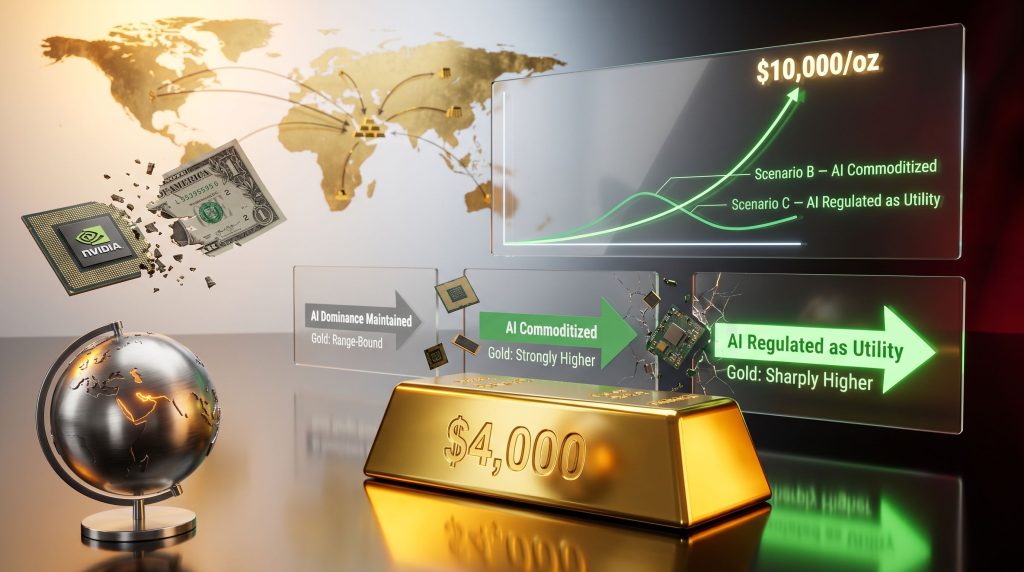
Three Scenarios: AI, the Dollar, and Where Gold Goes
| Scenario | AI Outcome | Dollar Direction | Gold Direction |
|---|---|---|---|
| US maintains AI dominance | Frontier models remain commercially viable and US-controlled | Stable to strong | Range-bound, suppressed by elevated real yields |
| AI becomes commoditised | Open-source and low-cost models erode US pricing power | Weakens as AI capital flow premium erodes | Strongly higher |
| AI becomes a regulated utility | Monetisation collapses, valuations compress significantly | Weakens alongside equity wealth effect | Sharply higher, potentially toward $10,000/oz in extreme dislocation |
| Geopolitical escalation intensifies | US-China rivalry accelerates reserve diversification | Reserve flight from USD assets | Structurally higher |
| Oil price normalisation | Gulf state forced selling pressure dissipates | Neutral | Removes significant near-term headwind |
The next major ASX story will hit our subscribers first
Why Gold Near $4,000 Represents a Structurally Significant Level
The explanation for gold's weakness at various points in 2025, despite an otherwise supportive macro environment, lies in an often-overlooked dynamic: forced liquidations by oil-exporting sovereign entities.
Woo's hypothesis is that Gulf state central banks, including Saudi Arabia, Kuwait, and the UAE, were unable to export crude oil during the period of Strait of Hormuz disruption. With oil revenues blocked and domestic expenditures, including civil service salaries and state spending, continuing uninterrupted, those sovereigns needed liquid reserve assets to sell.
US Treasuries were effectively off the table. Selling significant quantities of American government debt would have drawn immediate political pressure from Washington, which was simultaneously extending military protection to those same Gulf nations. Gold, by contrast, carried no such geopolitical constraint. It could be liquidated quietly without triggering diplomatic consequences.
This dynamic explains a period of gold selling that had no obvious fundamental justification. Once the disruption to oil export revenues normalises and those Gulf states return to routine revenue generation, the forced selling pressure disappears, and gold's structural tailwinds reassert themselves.
Buying gold around $4,000 per ounce, in Woo's framework, represents an opportunity to acquire an asset that has been technically depressed by forced liquidations rather than by any deterioration in its fundamental investment case.
Gold's Long-Term Structural Tailwinds
Beyond the near-term AI trade thesis, several longer-duration forces underpin Woo's constructive view on gold. Furthermore, central bank gold demand has been a consistent structural driver accelerating these dynamics. The key tailwinds include:
- Reserve diversification acceleration: Foreign central banks, particularly China, have been systematically accumulating gold as US-China tensions make USD-denominated assets less attractive as reserve holdings.
- Fiscal trajectory: US federal debt has exceeded $37 trillion, with annual interest servicing costs surpassing $1 trillion according to Treasury data. Congressional pressure for additional defence spending could push that figure to $1.5 trillion annually, adding further to an already deteriorating fiscal position.
- Hegemony discount: Markets are beginning to price a reduced US geopolitical premium into dollar valuations, a process that is gradual but directionally consistent. Perceived strategic setbacks accelerate this repricing among foreign reserve managers.
- The dollar-AI dependency unwind: If AI ceases to be exclusively American infrastructure, the capital flow premium that has supported dollar demand over the past two years erodes.
Gold vs. Silver: Why Reserve Managers Choose Differently
A common misconception is that gold and silver represent interchangeable expressions of the same macro thesis. They do not, and understanding the distinction matters for how one interprets structural price movements in each metal.
Reserve managers accumulate gold precisely because its extraordinarily high value-to-volume ratio makes large-scale storage logistically feasible. The same quantity of monetary value stored in silver would require warehouse infrastructure of an entirely different scale, making sovereign reserve accumulation in silver essentially impractical.
Silver's price behaviour is therefore driven primarily by industrial demand cycles and speculative positioning rather than by the sovereign reserve accumulation dynamics that create gold's structural floor. Silver's move above $100 per ounce in 2025, followed by a substantial correction, reflects this distinction. It is a different asset class with different structural drivers, even when it moves directionally alongside gold during risk-off episodes.
How to Position: The Options Discipline Framework
For investors seeking exposure to the AI bubble unwind thesis, Woo's preferred instrument is long-dated gold call options rather than direct equity or physical positions. In addition, those exploring broader gold investment options should consider how physical holdings and ETFs complement an options-based approach. The reasoning is rooted in risk management discipline.
Options impose a natural position sizing constraint: the maximum loss is limited to the premium paid, regardless of how the underlying asset behaves. In a bubble environment where timing is inherently uncertain, this structure preserves full upside exposure to a potential repricing event while eliminating the risk of principal loss from an extended period of momentum-driven overvaluation.
The broader investment principle Woo articulates is one of contrarian accumulation: buying assets when others are forced to sell, rather than chasing momentum in conditions where speculative fervor has already inflated valuations beyond what fundamentals support. In an environment defined by AI-driven equity enthusiasm, gold near $4,000 represents precisely that kind of counter-consensus opportunity.
The Macro Chain Reaction: A Step-by-Step Scenario Model
If the AI monetisation thesis breaks down, the sequence of consequences Woo maps out runs as follows:
- Trigger: AI commoditisation becomes visible, through regulatory restriction of frontier models, margin compression from Chinese competition, or both.
- Equity response: NASDAQ corrects meaningfully as hyperscaler revenue growth assumptions are revised downward.
- Wealth effect reversal: Consumer spending in services and leisure contracts as equity portfolio values decline.
- Inflation dynamics shift: The AI-driven demand premium that has been inflating aggregate expenditure disappears, producing a disinflationary impulse.
- Fed policy pivot: The Federal Reserve abandons its restrictive stance; rate cuts accelerate as recession risk rises.
- Real yield compression: TIPS yields fall as growth expectations reset lower, removing gold's primary competitive disadvantage.
- Gold re-rating: With real yields declining and gold's safe-haven role reinforced by dollar weakness, gold reprices sharply higher.
- Dollar weakness: The capital flow premium that AI infrastructure spending provided to USD demand diminishes, compounding dollar softness.
In an extreme version of this scenario, and consistent with the broader David Woo AI bubble and gold framework, Woo places a potential gold price trajectory toward $10,000 per ounce. This is not a base case prediction but a conditional outcome if the full chain reaction plays out and the Federal Reserve is forced back toward zero interest rate policy. For those wanting to explore this scenario further, this podcast episode provides additional depth on the macro reasoning.
This article is intended for informational and educational purposes only and does not constitute financial advice. All forecasts, scenarios, and price projections discussed reflect analytical frameworks and opinions, not guaranteed outcomes. Investing in commodities, derivatives, and related instruments carries significant risk. Past performance is not indicative of future results. Readers should conduct their own due diligence and consult a qualified financial adviser before making any investment decisions.
Want to Stay Ahead of the Next Major Mineral Discovery?
While macro forces reshape gold's investment landscape, Discovery Alert's proprietary Discovery IQ model delivers real-time alerts on significant ASX mineral discoveries — instantly translating complex data into actionable opportunities for investors at every experience level. Explore historic discovery returns that demonstrate just how transformative early positioning can be, and begin your 14-day free trial today to secure a market-leading edge.