
June 15, 2026
When Digital Capital Meets Physical Gold: The New Royalty Finance Paradigm
Investor psychology in the natural resources sector has rarely been tested by a more unusual convergence than the one now unfolding at the intersection of stablecoin treasury management and hard asset royalty finance. For decades, the royalty model was the domain of specialist mining finance firms and patient institutional capital. Today, that architecture is attracting a fundamentally different class of capital allocator: digital asset treasury managers sitting on billions in fiat-linked reserves, increasingly motivated to rotate portions of those reserves into commodity-linked cash flows.
The Elemental Royalty Tether backing represents one of the clearest expressions of this structural shift. Understanding why a stablecoin issuer would anchor a $100 million USD position in a gold and copper royalty company reveals as much about the evolving logic of institutional treasury management as it does about the royalty sector itself.
When big ASX news breaks, our subscribers know first
Why Stablecoin Capital Is Rotating Into Mining Royalties
The core revenue engine of a stablecoin issuer is straightforward: hold U.S. dollar reserves, collect interest income on Treasury bills and money market instruments, retain the spread. Tether, the world's largest stablecoin issuer by market capitalisation, generated approximately $13 billion in profit in 2024 according to its published attestations, making it one of the most profitable financial entities per employee globally.
However, this model carries inherent structural exposures. Dollar-denominated yield is directly tied to U.S. Federal Reserve policy cycles. As interest rates normalise from their post-2022 highs, the spread available from Treasury-bill income compresses. More significantly, the regulatory environment surrounding stablecoin issuers is evolving rapidly in the United States, creating compliance uncertainty around the long-term architecture of dollar-backed digital assets.
Why Mining Royalties Offer a Structurally Distinct Alternative
Mining royalties offer a fundamentally different proposition, and commodity diversification strategies across multiple asset classes are becoming increasingly relevant for treasuries of this scale. Consider the following structural advantages:
- Royalty income is classified as top-line commodity revenue, not financial yield, placing it outside the definitional scope of most U.S. securities and financial instrument regulations
- Gold and base metal royalty streams are denominated in commodity prices, not interest rate cycles, providing genuine diversification against monetary policy risk
- Physical commodity exposure serves as a natural hedge against the fiat currency debasement that long-term stablecoin holders themselves are seeking to hedge against
The Elemental Royalty Tether backing is not speculative positioning in a single mining company. It reflects a deliberate, strategic repositioning of digital treasury capital into hard, inflation-resistant cash flows that behave differently from any instrument on a traditional bank balance sheet.
The $100 Million Cornerstone: Structure, Mechanics, and Capital Deployment
The Elemental Royalty Tether backing was structured as a cornerstone equity investment to facilitate the merger of Elemental Altus Royalties and EMX Royalty Corp, creating a single consolidated entity now trading on the NASDAQ under the ticker ELE on the TSX.
| Feature | Detail |
|---|---|
| Investment Commitment | USD $100 million |
| Approximate Share Price | CAD $184 per share |
| Approximate Share Volume | ~75 million shares |
| Post-Merger Ownership Stake | ~32% |
| Pre-Merger Stake in Elemental Altus | ~38% with warrant pathway to 51%+ |
| Primary Capital Uses | Credit facility repayment, royalty acquisitions, post-merger liquidity |
The capital deployment served three distinct purposes. First, outstanding credit obligations inherited from the EMX Royalty balance sheet were retired, immediately reducing the combined entity's leverage ratio and lowering its blended cost of capital. Second, two royalty acquisitions completed in the period surrounding the merger were funded without requiring any dilutive public equity raise.
Third, a meaningful post-merger treasury buffer was established, positioning the company to compete aggressively for large-scale royalty packages in a market where deal sizes have been growing substantially. Furthermore, the pre-merger to post-merger ownership transition is worth understanding carefully.
Prior to consolidation, Tether held approximately 38% of Elemental Altus with a contractual warrant structure that could have extended control beyond 51%. The merger diluted this to approximately 27–32% of the enlarged combined entity, reflecting the share issuance required to absorb EMX shareholders. Despite the percentage reduction, the absolute asset base and revenue-generating capacity of Tether's position increased materially. For a deeper analysis of how this fits into broader LBMA gold markets, it is worth considering the physical gold standards underpinning these royalty structures.
The Royalty Model's Structural Advantages: Why Investors Pay a Premium
The royalty business model is frequently misunderstood by investors accustomed to evaluating direct mining equities. The distinction is not merely about risk reduction; it is about constructing a fundamentally asymmetric return profile.
No Capex, No Opex, All Revenue Upside
A royalty holder's position in the economic waterfall of a mining operation sits above virtually every operating cost category:
- Capital expenditure liability: Mine construction, processing plant commissioning, tailings infrastructure, and ongoing sustaining capital are entirely the operator's responsibility. Royalty holders contribute nothing and owe nothing when budgets overrun.
- Operating cost exposure: Labour inflation, energy price spikes, reagent cost increases, and mine maintenance expenses are absorbed entirely by the operating entity.
- Jurisdictional operating risk: Environmental compliance obligations, permitting renewals, community consultation requirements, and social licence maintenance fall exclusively on the mine operator.
What the royalty holder retains is a contractual percentage of top-line production revenue. As commodity prices rise, royalty income scales proportionally. When commodity prices fall, the operator absorbs the margin compression. This asymmetry is the fundamental reason royalty companies have historically traded at significant premiums to their net asset values relative to direct mining operators.
The Pyramid Portfolio Architecture Explained
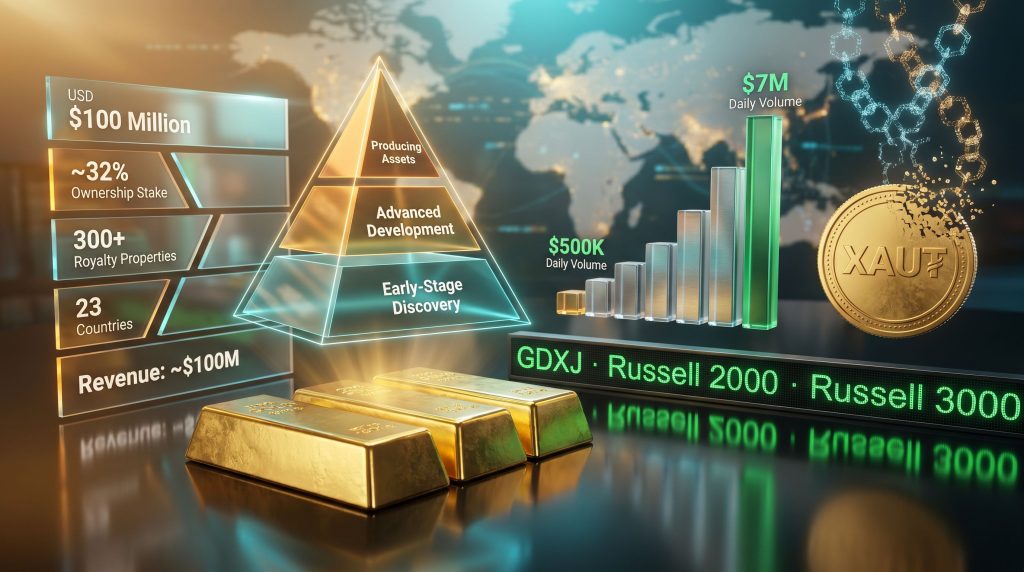
Elemental Royalty structures its 300+ mineral property positions across 23 countries into a tiered value framework that investors should understand when evaluating NAV growth potential:
- Apex: Producing Assets generating immediate, recurring royalty cash flows from active mining operations
- Middle Tier: Advanced Development Projects where operators are committing substantial capital toward construction and production decisions, creating near-term revenue inflection points
- Base Layer: Early-Stage Discovery Options providing zero-cost exposure to future resource discoveries across a geographically diverse operator network
This architecture delivers a dual-return mechanism unavailable in direct mining equity: current income from the apex while simultaneously gaining optionality on NAV appreciation as middle and base-tier assets advance through the development pipeline.
Risk Comparison: Royalty vs. Direct Mining Equity
| Risk Category | Direct Mining Equity | Royalty Company |
|---|---|---|
| Capital Cost Overruns | Full exposure | Zero exposure |
| Operating Cost Inflation | Full exposure | Zero exposure |
| Exploration Upside | Limited to own projects | Across 300+ operator projects |
| Revenue Leverage to Commodity Prices | High | High |
| Balance Sheet Leverage Risk | Significant | Typically low |
| Index Inclusion Eligibility | Variable | Structured for qualification |
Revenue Architecture: Approaching the $100 Million Milestone
The consolidated Elemental Royalty entity is tracking toward approximately $100 million in full-year top-line revenue, a threshold that repositions it from mid-tier to large-scale royalty operator status. This milestone matters beyond the headline number: it crosses liquidity and revenue thresholds that expand the universe of institutional funds permitted to hold the stock under their mandate guidelines. The gold price impact on royalty revenue at this scale becomes particularly significant for investors evaluating near-term cash flow potential.
Revenue Composition by Commodity
| Commodity Segment | Revenue Contribution |
|---|---|
| Gold and Silver | ~60% |
| Copper | ~30% |
| Lead, Zinc, and Molybdenum | ~10% |
The deliberate maintenance of gold and silver above 50% of total revenue is not accidental portfolio construction. It is a structural eligibility requirement for inclusion in precious metals-focused equity indexes, including the VanEck Junior Gold Miners ETF (GDXJ). Dropping below this threshold would disqualify the company from a category of institutional buying that management has explicitly targeted.
Copper's 30% weighting provides meaningful leverage to global electrification demand. In addition, copper supply trends suggest consumption will grow substantially through the 2030s as electric vehicle penetration accelerates and grid infrastructure investment intensifies across developed and emerging markets alike.
Management has articulated NAV per share growth as the primary performance metric, prioritising it above short-term earnings metrics. This framing reflects the royalty sector's fundamental value driver: each resource discovery or development advancement across the operator portfolio adds to NAV without requiring Elemental to deploy a dollar of additional capital.
Index Inclusion: The Non-Discretionary Demand Event
Perhaps the most immediate catalyst for Elemental Royalty's institutional investor base expansion is not commodity prices or operator drilling results. It is index inclusion.
The company has been confirmed as a candidate for both the Russell 2000 and Russell 3000 indexes, with GDXJ inclusion anticipated later in 2026. To contextualise the significance of this transition, consider the liquidity transformation already underway. Before the merger, the combined predecessor entities averaged approximately $500,000 in daily trading volume across all public exchanges, a level that effectively excluded the stock from institutional portfolio mandates with minimum liquidity requirements.
Following the NASDAQ listing, average daily trading liquidity has expanded to approximately $7 million, with options trading now available on the stock. This represents a fourteen-fold improvement in daily liquidity, crossing thresholds that are hard-coded into many institutional fund manager mandates.
| Index | Status | Investor Impact |
|---|---|---|
| Russell 2000 | Confirmed candidate | Mandatory buying from small-cap passive funds |
| Russell 3000 | Confirmed candidate | Broader institutional passive fund exposure |
| VanEck GDXJ | Anticipated in 2026 | Specialist precious metals ETF buying |
Index inclusion triggers non-discretionary buying from passive fund managers who are contractually obligated to hold all index constituents. These managers do not evaluate fundamentals. They buy because they must. This creates a structural demand floor that informed active investors can position ahead of.
GDXJ inclusion carries particular significance because it channels capital from investors specifically seeking junior gold miner exposure. This is a highly targeted institutional audience with concentrated commodity conviction, and their mandated buying operates entirely independently of individual views on Elemental's management quality or specific asset performance.
The next major ASX story will hit our subscribers first
Key Asset Catalysts Driving the Revenue Growth Trajectory
The Timok Lower Zone: A Decade-Scale Copper Revenue Engine
The single most consequential long-duration royalty asset in Elemental's portfolio is the Timok lower zone project in Serbia, operated by Zijin Mining. The scale of this deposit deserves careful attention from investors evaluating long-term NAV potential.
- Deposit Scale: Over 2.5 billion tonnes of mineralisation at approximately 1% copper content
- Initial Processing Rate: 45,000 tonnes per day, scaling to over 100,000 tonnes per day at full production capacity
- Projected Annual Royalty Revenue: In excess of $20 million per year upon reaching full capacity
To place this in perspective: a single asset has the potential to increase Elemental's total annual revenue by more than 20% relative to current levels, funded entirely by Zijin Mining's development capital. Elemental contributes nothing to the billions required to develop this operation and retains its royalty position regardless of construction cost outcomes.
A 1% copper grade across a 2.5 billion tonne resource base places Timok among the largest undeveloped copper deposits globally by contained metal content, a fact that receives insufficient attention in most discussions of Elemental's portfolio.
Additional Near-Term Revenue Catalysts
Vizsla Silver-Gold Royalty (Mexico): The pending acquisition of the Vizsla Royalties package in Mexico's Sinaloa silver belt targets one of the highest-grade silver development corridors currently active globally, providing direct leverage to silver price appreciation as the asset advances toward production.
Karlawinda Gold Mine (Western Australia): Output growth at this deposit is contributing incremental royalty cash flows as the operator executes a production expansion programme. Western Australia's established mining infrastructure and stable regulatory environment reduce execution risk materially compared to frontier jurisdictions.
Leeville Royalty, Nevada Gold Mines (United States): This royalty generates consistent cash flows from high-grade underground ore extraction across the Turf complex and Four Corners deposit. Nevada's Carlin Trend, one of the most prolific gold-producing geological corridors on earth, provides structural durability for this royalty position over decades.
Caserones Copper Mine, Lundin Mining (Chile): Lundin's active exploration programme at Caserones, including work on the adjacent Angelica project, creates potential for royalty coverage expansion as new resources are defined within and adjacent to the existing operation.
Viscaria Copper-Iron Project (Sweden): Development is progressing toward production at this Scandinavian asset, adding base metals diversification across a stable European jurisdiction.
Tether's Broader Royalty Platform Strategy
The Elemental Royalty Tether backing does not exist in isolation. Tether holds significant equity positions in Versamet Royalties and Metalla Royalty and Streaming, creating a coordinated hard asset accumulation strategy across multiple royalty platforms simultaneously. According to reporting on Tether's gold royalty strategy, this repositioning signals a broader shift in how digital asset treasuries are approaching inflation-resistant hard assets.
Collectively, these three royalty platforms manage over 200 royalty and streaming contracts across four continents. This coordinated positioning represents a capital structure with no direct historical precedent in mining finance: a digital asset issuer building a diversified royalty conglomerate anchored by blockchain-native treasury capital.
| Metric | Combined Platform Estimate |
|---|---|
| Total Royalty and Streaming Contracts | 200+ |
| Geographic Reach | 4 continents |
| Elemental's Role | Flagship, highest-revenue entity |
| Credit Facility Target | Up to $200 million |
Within this network, Elemental functions as the flagship entity. The combined capital infrastructure provides deal flow access, co-investment opportunities, and balance sheet support that standalone royalty companies of similar size cannot replicate independently. Management has outlined a target of scaling the company's undrawn credit facility toward $200 million, providing substantial acquisition capacity without requiring public equity market access.
The Tokenized Gold Dividend: A Financial Market First
In March 2026, Elemental Royalty declared its inaugural dividend of $0.03 per share, with qualifying shareholders offered the option to receive payment in Tether Gold (XAU₮) tokens. XAU₮ is a blockchain-based token backed on a 1:1 basis by one fine troy ounce of physical gold meeting London Bullion Market Association (LBMA) Good Delivery standards. This marks the first documented instance of a publicly listed gold royalty company distributing dividends in tokenized physical gold, a genuinely novel financial instrument. As CoinDesk has reported, this mechanism is drawing considerable attention from both digital asset and commodity investors.
The XAU₮ dividend mechanism works as follows:
- Shareholders declare their election to receive dividends in XAU₮ rather than fiat currency
- The dividend value is converted into a fractional claim on LBMA-grade physical gold held in reserve
- The XAU₮ token is delivered to the shareholder's designated digital wallet
- The token can be held as a digital gold position, traded on compatible exchanges, or redeemed under applicable physical delivery terms
Beyond the novelty factor, this mechanism eliminates the fiat conversion step that erodes real purchasing power in inflationary environments. Furthermore, it creates a direct link between gold royalty income and gold-denominated wealth preservation. Investors seeking tokenized gold exposure will find the XAU₮ dividend option a compelling differentiator versus conventional royalty company structures. It also demonstrates that Tether's involvement in Elemental is actively enabling financial product innovation, not merely representing passive equity ownership.
Investment Thesis Summary and Key Risk Considerations
Five Structural Reasons Institutional Investors Are Taking Notice
1. Inflation-Insulated Revenue Architecture: Rising commodity prices flow directly to royalty revenue. Rising costs flow directly to operators. This asymmetry becomes more valuable as input cost pressures across the mining sector intensify.
2. Imminent Index-Driven Demand Catalysts: Russell 2000, Russell 3000, and anticipated GDXJ inclusion create structural demand events independent of commodity price movements or individual investor sentiment.
3. Non-Dilutive Capital Access: The 32% cornerstone equity position held by one of the world's most profitable private companies provides acquisition financing capacity that competitors of similar size cannot replicate.
4. Embedded Zero-Cost Exploration Optionality: Operators across 300+ properties are deploying over $100 million in annual drilling programmes at no cost to Elemental. Each discovery or resource expansion adds directly to NAV per share.
5. Tokenized Financial Innovation: The XAU₮ dividend option positions Elemental at the convergence of hard asset finance and digital asset infrastructure, attracting a category of investor previously unreachable by traditional royalty company marketing.
Key Risks Investors Should Evaluate
- Commodity Price Sensitivity: Despite operational cost insulation, royalty revenues are directly linked to gold, silver, and copper prices. A sustained commodity downturn would reduce cash flows proportionally.
- Operator Execution Risk: Revenue depends on third-party operators successfully executing development and production plans. Delays at Timok or other major assets would defer anticipated revenue inflection points.
- Concentration in Cornerstone Investor: A 32% ownership stake held by a single entity creates governance concentration risk and potential share overhang if that position were ever to be reduced in the market.
- Regulatory Evolution for Digital Asset Holders: Changes to the regulatory treatment of stablecoin issuers could indirectly affect the strategic rationale or financial capacity of the cornerstone investor over time.
This article is for informational purposes only and does not constitute financial advice. Investors should conduct their own due diligence and consult a qualified financial adviser before making investment decisions. Forward-looking statements, projections, and revenue estimates referenced herein involve risks and uncertainties, and actual outcomes may differ materially from those anticipated.
Want to Stay Ahead of the Next Major Mineral Discovery on the ASX?
Discovery Alert's proprietary Discovery IQ model delivers real-time alerts on significant ASX mineral discoveries, transforming complex geological and commodities data into actionable investment insights for both short-term traders and long-term investors — explore historic discoveries and their exceptional returns to understand the potential, then begin your 14-day free trial at Discovery Alert to position yourself ahead of the broader market.