May 13, 2026

The Geopolitics of Dependency: How Critical Minerals Became the New Oil
For most of the twentieth century, the phrase "resource security" conjured images of oil tankers, OPEC summits, and petrodollar diplomacy. Today, a different category of materials is generating equivalent levels of strategic anxiety inside the world's most powerful economies. The minerals that make electric motors spin, wind turbines generate power, and guided weapons systems function with precision have quietly moved from the industrial supply chain into the heart of national security planning. Understanding why the G7 critical minerals supply chain talks in Paris on May 6, 2026 generated both consensus and fracture requires understanding how this transformation happened, and what it means for the architecture of global trade.
When big ASX news breaks, our subscribers know first
Why Processing Dominance Creates a Fundamentally Different Kind of Risk
Most resource competition in history has centred on who controls the ground where deposits sit. The rare earth and critical mineral challenge operates on a different logic. The strategic leverage in this sector derives not primarily from geology but from processing capacity, which is the industrial infrastructure required to convert extracted ore into refined elements suitable for high-tech manufacturing.
China has invested decades in building that infrastructure. Today, it controls an estimated 85 to 90 percent of global rare earth processing and refining capacity, with dominant positions across dysprosium, terbium, and other heavy rare earth oxides central to EV motor magnets, wind turbine generators, and defence electronics. For graphite, a critical battery material, China's processing share is estimated at above 70 percent. These figures are not contested in the industry and are routinely cited by agencies including the International Energy Agency and the U.S. Geological Survey.
The consequence of this concentration is subtle but profound. Even nations that mine raw mineral ore domestically often lack the domestic capacity to refine it, creating a structural dependency that persists even where geological endowment is strong. A country may sit atop significant reserves while still functioning as a raw material exporter dependent on Chinese refining for finished products.
What makes this particularly difficult to reverse is the capital intensity and time horizon required to build processing infrastructure. Refining facilities typically require multi-year construction timelines, specialised technical expertise, and consistent demand commitments before private capital will commit. The Caremag facility under development in southern France — one of the most advanced allied-nation refining projects underway — is targeted for late 2026 operations despite work having commenced substantially earlier. Furthermore, the European critical raw materials facility model being developed across allied nations underscores just how capital-intensive and time-sensitive this challenge truly is.
French Finance Minister Roland framed the structural threat precisely: China's dominant market share across EVs, wind energy, electronics, and defence applications gives it the capacity to price competitors out of the market before alternative supply chains can be established. This is not simply a trade imbalance. It is an industrial strategy designed to foreclose the viability of competing refining industries before they mature.
How China's Export Controls Amplify the Risk
China's rare earth export restrictions have demonstrated Beijing's willingness to use mineral access as a lever in broader trade disputes. Controls on gallium and germanium, implemented in prior periods, offered a clear preview of how processing dominance can be converted into geopolitical leverage at short notice.
What the G7 Paris Meeting Actually Produced
When trade ministers from G7 nations gathered in Paris on May 6, 2026, the meeting agenda reflected both the urgency and the complexity of the supply chain challenge. France, holding the G7 presidency, positioned critical mineral supply chains as a central priority. French Foreign Trade Minister Nicolas Forissier characterised the discussions as an opportunity to make concrete progress on rare earths and critical minerals, with securing supply chains and avoiding strategic vulnerability to dominant suppliers as the explicit objective.
The ministerial produced a joint statement committing G7 nations to ensuring that attempts or threats to weaponise economic dependencies will fail. This language is significant for what it signals about the collective perception of risk. It frames China's processing dominance not merely as a trade policy concern but as a potential instrument of economic coercion between rival economic blocs. Consequently, metals and mining geopolitics have become inseparable from broader national security frameworks.
According to Reuters reporting on the G7 trade ministers' discussions, the Paris meeting was notable for the directness with which ministers addressed Chinese overcapacity as a systemic challenge rather than a bilateral trade irritant.
Key areas of consensus included:
- Shared acknowledgment that Chinese industrial overcapacity in mineral processing represents a systemic challenge requiring a coordinated response
- Broad agreement on the need to reduce Chinese supply dependency across critical mineral categories
- Support in principle for WTO reform to address the mechanisms through which state-backed production distorts global mineral markets
- Endorsement of the February 4, 2026 Critical Minerals Ministerial framework, which brought together 55 nations to establish preferential trade zone architecture incorporating price support mechanisms, shared technical standards, coordinated subsidy structures, and guaranteed offtake agreements
Where G7 unity fractured:
- The US approach favours aggressive tariff structures, bilateral friend-shoring agreements, and preferential trade zones restricted to aligned nations
- The European approach prioritises WTO reform pathways, multilateral frameworks, and negotiated market access within established international trade rules
- Implementation timelines, enforcement mechanisms, and the allocation of subsidy burdens among member nations remain sources of ongoing disagreement
How the Auto Tariff Dispute Undermines Mineral Supply Chain Cooperation
The most disruptive element of the Paris gathering was not the substance of the mineral discussions but the parallel tariff conflict between the United States and the European Union over automobile imports. President Donald Trump announced plans to raise tariffs on EU-manufactured vehicles from 15 percent to 25 percent, citing European non-compliance with the trade deal reached in Turnberry, Scotland, in 2025.
The Turnberry agreement had established a framework for trade normalisation between the US and EU. As of May 6, 2026, EU implementation legislation remained unfinished, with parliamentary negotiations ongoing and divisions over safeguard provisions slowing progress toward a common text. EU Trade Commissioner Maros Sefcovic, who met with US Trade Representative Jamieson Greer on May 5, characterised the situation as requiring compliance from both parties.
French Foreign Trade Minister Forissier attempted to reframe Trump's tariff escalation as an incentive to accelerate implementation rather than a punitive measure. Germany's Economy Minister Katherina Reiche confirmed she was in intensive bilateral talks with US officials.
The auto tariff dispute matters for the minerals agenda for structural reasons that extend beyond diplomatic optics:
| Pressure Source | Impact on Germany | Connection to Critical Minerals |
|---|---|---|
| Weakening Chinese automotive demand | Reduced export revenue | Less capital available for supply chain investment |
| Higher EV input costs | Margin compression | Mineral dependency amplified by EV transition |
| Rising labour expenses | Competitiveness challenge | Weakens case for allied-nation manufacturing |
| US tariff escalation | Direct export revenue threat | Undermines shared messaging on bloc cooperation |
Germany's situation illustrates the structural bind facing European industrial economies. The EV transition requires access to processed critical minerals at competitive prices. However, a tariff conflict with the United States simultaneously reduces the revenue available for that investment while fracturing the coordinated messaging that gives the G7 framework its political credibility.
The Bilateral Agreements Building the Alternative Architecture
Beyond the ministerial discussions, several concrete agreements are constructing the operational foundations of a non-Chinese critical mineral supply chain. These bilateral and multilateral arrangements represent the practical infrastructure behind the strategic rhetoric.
Japan and France: The Caremag Model
The partnership between Japan and France centred on the Caremag rare earth refining facility represents one of the most operationally advanced attempts to build allied-nation heavy rare earth processing capacity. The facility, located in southern France, is scheduled to begin operations in late 2026, backed by Japan's state-owned Japan Organisation for Metals and Energy Security and gas infrastructure firm Iwatani.
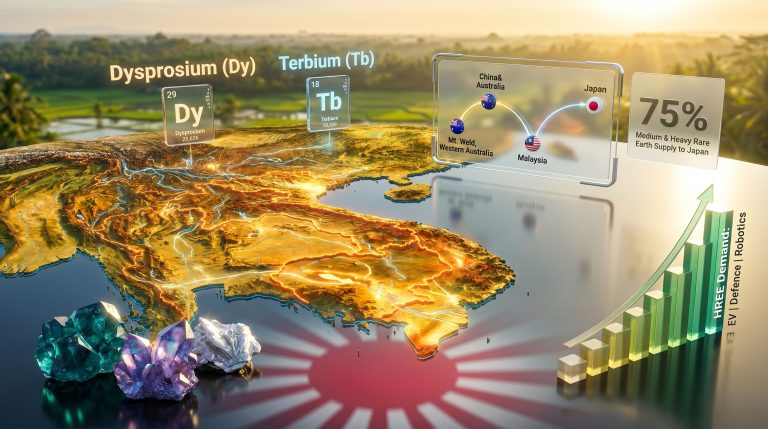
Japan's strategic objective is explicit: source approximately 20 percent of its future dysprosium and terbium demand from this single facility. These two heavy rare earth oxides are essential inputs for the permanent magnets used in EV motors, offshore wind turbine generators, and high-performance electronics. Dysprosium, in particular, is a critical component because it allows neodymium-iron-boron magnets to maintain their magnetic strength at the elevated temperatures generated inside operating motors.
The significance of the Caremag approach extends beyond Japan's supply security. If the facility demonstrates commercial viability, it establishes a replicable model for allied-nation refining investment, directly challenging the assumption that Chinese processing infrastructure is economically irreplaceable. In addition, understanding rare earth supply chains more broadly helps contextualise why this single facility is receiving such concentrated geopolitical attention.
Brazil and India: Unlocking Southern Hemisphere Reserves
Brazil holds the world's second-largest rare earth reserves, estimated at 21 million tonnes, representing a substantial geological asset that has been largely underutilised in the context of global supply chain restructuring. The bilateral cooperation agreement signed between Brazil and India, combined with nearly US$500 million in financing from the US International Development Finance Corporation committed to Serra Verde (Brazil's only currently active rare earth producer), reflects a coordinated effort to activate this reserve base.
Indian Prime Minister Narendra Modi characterised the India-Brazil cooperation pact as a major step toward building resilient supply chains, underscoring the geopolitical framing that now surrounds mineral investment decisions that would previously have been treated as purely commercial matters.
The 55-Nation Preferential Trade Zone
The February 4, 2026 Inaugural Critical Minerals Ministerial, hosted by the United States and drawing participation from 55 nations, represents the broadest attempt yet to institutionalise an alternative to Chinese market dominance. The framework's four core mechanisms target the structural barriers that have prevented allied-nation producers from scaling:
- Price support mechanisms designed to prevent Chinese predatory pricing from destroying project economics before facilities reach commercial production
- Shared technical and processing standards to enable interoperability and traceability across national supply chains
- Coordinated subsidy structures to prevent internal competition among member nations from undercutting the collective objective
- Guaranteed offtake agreements to reduce the demand-side risk that deters long-term capital commitment from private investors
Mexico's Strategic Position Within the Realignment
Mexico enters the G7-driven supply chain restructuring with a combination of geological endowment, existing bilateral frameworks, and significant structural challenges that make its trajectory within the realignment consequential for North American industrial policy.
Mexico ranks among the world's top producers of 23 minerals, of which nine are classified as critical for North American supply chains. These include copper, silver, graphite, and fluorite, each of which occupies a different position within the emerging preferential trade framework. Economy Minister Marcelo Ebrard has indicated that Mexico is seeking access to 13 additional minerals it either lacks or produces in insufficient quantities.
The Mexico-US Action Plan on Critical Minerals establishes a bilateral cooperation structure intended to integrate Mexican mineral production into regional supply chains for electromobility, advanced manufacturing, and digitisation. US Trade Representative Jamieson Greer confirmed that plans and strategies will be developed to strengthen regional resilience in critical and rare minerals, framing the bilateral framework as an active instrument rather than an aspirational statement.
The USMCA Review as a Repositioning Vehicle
Rafael Rebollar, CEO of Peñoles, one of Mexico's largest mining companies, identified the USMCA review process as the primary mechanism through which Mexico can structurally reposition itself in regional supply chains. His argument draws on the China model directly: China's current processing dominance was built through sustained investment in technological development and refining infrastructure over decades. Mexico has the geological assets. What it lacks is the downstream processing capacity.
Rebollar articulated the risk of remaining purely an extraction economy with unusual clarity. The worst possible outcome, in his framing, involves Mexico exporting unprocessed minerals to China for refining, only to receive finished goods embedded in manufactured products — including automobiles — in return. He placed this within the specific context of Mexico's automotive manufacturing base, built over five to six decades, which faces existential competitive pressure from Chinese vehicle imports.
The refining capacity gap is Mexico's most critical strategic challenge. Extraction without processing places a nation at the lowest point in the mineral value chain, generating raw material export revenue while surrendering the manufacturing employment, technological capability, and industrial base that processed minerals enable.
The next major ASX story will hit our subscribers first
Broader Implications: Friend-Shoring, WTO Norms, and What June Must Deliver
The G7 critical minerals supply chain talks are producing a structural tension between the preferential trade zone architecture being constructed among allied nations and the non-discrimination principles that underpin the World Trade Organization's framework. Preferential mineral trade zones, guaranteed offtake agreements among blocs, and coordinated subsidy programmes all represent departures from Most Favoured Nation treatment — the foundational WTO principle requiring members to offer all trading partners the same terms offered to the most favoured one.
This tension is not incidental. It reflects a deliberate strategic choice by G7 nations to prioritise supply security over trade law compliance, at least in the critical mineral domain. Furthermore, critical minerals and energy security are now so intertwined that the outcomes of these trade architecture debates will shape the pace and structure of the global energy transition itself.
Analysis from Mining.com covering the G7 trade talks highlights that the US-EU tariff rift is straining the very unity that the minerals agenda depends upon, making diplomatic resolution of the auto tariff dispute a precondition for substantive progress on supply chain cooperation.
Indicators that the June 2026 leaders' summit has produced meaningful progress include:
- Formal ratification of a preferential trade zone framework with binding mineral commitments and defined enforcement mechanisms
- Coordinated subsidy standards preventing internal G7 competition from undermining allied-nation producers
- Concrete announced investment in processing and refining infrastructure outside China
- Resolution or structured deferral of the US-EU auto tariff dispute to preserve bloc unity on the minerals agenda
- A clear timeline for WTO reform proposals that address the industrial overcapacity and state-subsidy mechanisms identified by Paris ministers
Summary of G7 Critical Minerals Talks Core Tensions
| Dimension | Consensus Position | Point of Divergence |
|---|---|---|
| China dependency | Reduction is a shared priority | Speed and method of reduction differ significantly |
| Industrial overcapacity | China identified as primary source | Enforcement mechanisms remain undefined |
| Trade architecture | Preferential zones under construction | US tariffs vs. EU multilateralism in conflict |
| WTO reform | Broadly supported in principle | Implementation timeline and scope contested |
| Regional integration | Mexico-US framework confirmed active | Refining capacity investment still pending |
| June summit outcomes | Formal framework widely expected | Binding nature and scope remain uncertain |
The Paris meeting made one thing structurally clear: the era in which critical minerals were treated as commercial commodities governed by market pricing alone is over. These materials are now being managed as strategic assets, with nation-states directly intervening in investment decisions, pricing structures, and trade access. The G7 critical minerals supply chain talks represent the institutionalisation of that shift. Whether the institutional architecture being built proves durable enough to actually displace Chinese processing dominance is a question the next several years of investment, legislation, and diplomacy will answer.
This article contains forward-looking statements, projections, and analysis based on information available as of the date of publication. Supply chain dynamics, trade negotiations, tariff structures, and bilateral agreements are subject to change. Nothing in this article constitutes investment advice. Readers should consult primary sources and professional advisors before making investment or business decisions based on the information presented here.
Want To Position Yourself Ahead of the Next Major Mineral Discovery?
As geopolitical competition over critical minerals intensifies and allied nations race to secure alternative supply chains, Discovery Alert's proprietary Discovery IQ model delivers real-time ASX mineral discovery alerts — instantly translating complex data across 30+ commodities into actionable investment insights. Explore how historic mineral discoveries have generated substantial returns and begin your 14-day free trial today to ensure you're never the last to know when a significant discovery hits the ASX.