August 5, 2026
The Hidden Geography of Rare Earth Power: Why Southeast Asia Is the Next Frontier
Geopolitical leverage rarely announces itself through military action. More often, it is exercised through control of supply chains that appear mundane until the moment they become unavailable. Sojitz rare earth supply Southeast Asia represents precisely this kind of strategic realignment — one that sits at the intersection of industrial dependency and geopolitical exposure. The nations that control extraction, processing, and refining hold meaningful influence over the countries that depend on them for advanced manufacturing.
Japan understands this vulnerability better than most. As one of the world's most sophisticated manufacturers of electric vehicles, precision electronics, robotics, and defence systems, Japan consumes enormous quantities of rare earth elements while producing almost none domestically. For decades, the majority of that supply originated from a single country with both the geological reserves and the processing infrastructure to dominate the market: China.
That structural dependency is now driving one of the more consequential quiet pivots in global resource strategy. Japanese trading house Sojitz Corporation, working in concert with Tokyo-backed energy and metals agency JOGMEC, is actively expanding its rare earth supply architecture beyond Australia to encompass Southeast Asia and potentially India. Understanding why this is happening, and what it means for rare earth supply chains globally, requires looking beyond headlines to the underlying geology, economics, and industrial logic at play.
When big ASX news breaks, our subscribers know first
Japan's Rare Earth Exposure: A Structural Problem Decades in the Making
The Anatomy of Supply Concentration Risk
China's rare earth strategy is not merely a function of geological fortune. It reflects decades of deliberate industrial policy, state-directed investment in processing infrastructure, and a willingness to operate mines at margins that discouraged competing supply from developing elsewhere. The result is that China controls not only a significant share of global rare earth mining but, critically, the overwhelming majority of global separation and refining capacity.
This matters because mining ore is only the beginning of the value chain. Raw rare earth ore must be separated, refined, and alloyed before it can be incorporated into the magnets and components that drive EV motors, wind turbines, missile guidance systems, and smartphone vibration units. A country that controls refining controls the supply chain even if other nations possess the underlying ore.
For Japan, this creates what resource economists describe as single-origin supply chain exposure: a situation where disruption at one node — whether through export controls, quota adjustments, diplomatic friction, or logistics bottlenecks — can cascade across multiple downstream industries simultaneously.
Furthermore, rare earth export restrictions have historically functioned as both an industrial policy tool and a diplomatic instrument, with tightening or relaxation corresponding to the state of bilateral relationships rather than purely commercial logic.
From Corporate Procurement to National Industrial Policy
Japan's response has evolved from corporate-level supply chain management into something closer to a national resource security doctrine. The sogo shosha model — the diversified Japanese trading house structure exemplified by Sojitz — has become a vehicle for this policy ambition. These trading houses, with their deep regional relationships, long investment horizons, and capacity to absorb multi-decade development timelines, are uniquely suited to the patient capital requirements of resource diplomacy.
The broader diplomatic context reinforces this urgency. Japan's government agreed to commit $550 billion in US investments in exchange for a reduction in tariffs on Japanese products to 15 percent, according to Bloomberg News reporting from May 2026. This macro-level trade negotiation framework operates in parallel with Japan's push to secure non-Chinese rare earth supply, illustrating how resource security and trade diplomacy have become inseparable strategic imperatives.
Rare Earth Elements: What Makes Them Strategic and Why Southeast Asia Is Geologically Compelling
Light Versus Heavy: The Distinction That Drives Premium Value
The 17 elements classified as rare earth elements are divided into two broad categories with meaningfully different strategic profiles:
-
Light rare earth elements (LREEs) include Lanthanum, Cerium, Praseodymium, Neodymium, and Samarium. They are more abundant globally and are found in a wider range of deposit types, including the carbonatite formations that characterise Australia's Mt. Weld deposit.
-
Heavy rare earth elements (HREEs) include Dysprosium, Terbium, Yttrium, Gadolinium, Erbium, and Lutetium. They are significantly scarcer, command higher price premiums, and are subject to far more acute supply concentration risk.
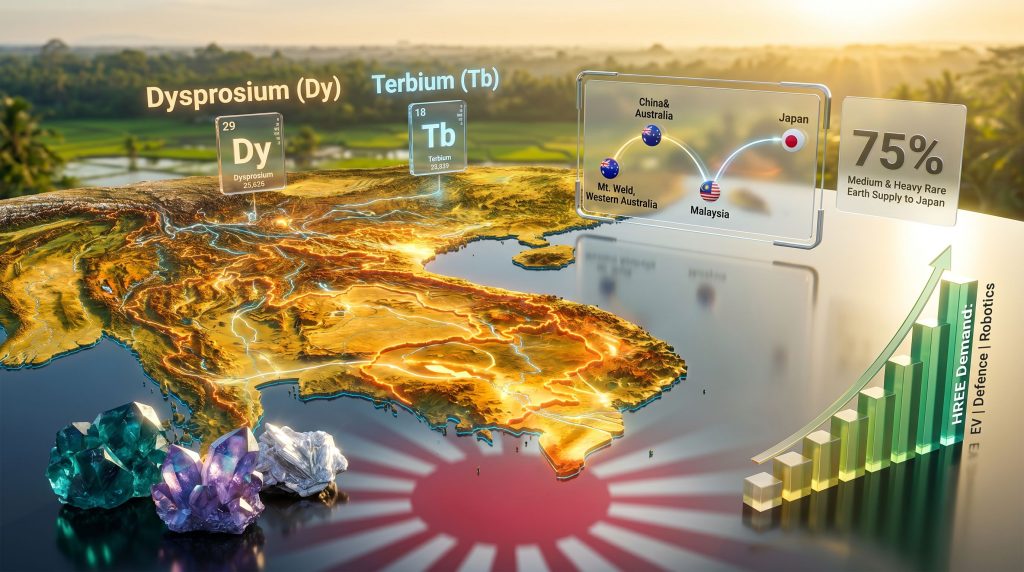
The industrial significance of HREEs is disproportionate to their abundance. Dysprosium and Terbium, in particular, are critical additives in neodymium-iron-boron (NdFeB) permanent magnets. These magnets are used in EV traction motors, wind turbine generators, and precision guidance systems. Without adequate Dysprosium content, NdFeB magnets demagnetise at elevated operating temperatures, making them unsuitable for high-performance applications. There is currently no commercially viable substitute.
The Ionic Clay Deposit Type: Southeast Asia's Geological Advantage
The geological case for Southeast Asia as a future rare earth supply source rests substantially on the nature and distribution of ionic clay deposits. Unlike hard rock carbonatite deposits, ionic clay rare earth mineralisation forms through long-term tropical weathering of granitic bedrock. The weathering process leaches rare earth ions from primary minerals and re-deposits them as exchangeable ions on clay particles.
This deposit type has two commercially critical properties: the extraction process is relatively low-cost, and the resulting rare earth profile tends to be enriched in heavy rare earths, making ionic clay deposits among the most strategically valuable in the world. The rare earth processing challenges associated with hard rock deposits are consequently far less pronounced in ionic clay operations, which is a meaningful advantage for prospective Southeast Asian producers.
The geological formations of southern China's Jiangxi and Yunnan provinces that host the world's most productive ionic clay deposits do not stop at national borders. The same granitic basement geology and subtropical weathering conditions extend across northern and central Indochina, encompassing regions of Laos, Cambodia, and Vietnam. This is the geological foundation for Sojitz CFO Makoto Shibuya's identification of these countries as priority exploration targets, as reported by Bloomberg News in May 2026.
The comparative landscape across the region's key jurisdictions looks broadly as follows:
| Country | Primary Deposit Type | REE Profile Emphasis | Current Development Stage |
|---|---|---|---|
| Vietnam | Ionic clay and hard rock | Mixed LREE and HREE | Active mining and export sector |
| Laos | Ionic clay (prospective) | HREE-enriched (potential) | Early-stage exploration |
| Cambodia | Ionic clay (prospective) | HREE-enriched (potential) | Pre-exploration frontier |
| India | Monazite beach sands | LREE-dominant | State-controlled development |
| Australia (Mt. Weld) | Carbonatite hard rock | LREE-dominant | Mature, operating production |
The contrast between Australia's carbonatite LREE profile and Southeast Asia's potential ionic clay HREE enrichment is not incidental. It explains precisely why Sojitz's Southeast Asia ambitions are additive to, rather than competitive with, its existing Lynas partnership.
How the Sojitz-Lynas-JOGMEC Partnership Became Japan's Supply Chain Anchor
A Decade-Long Joint Venture and Its Architecture
The foundation of Japan's non-Chinese rare earth supply strategy is the joint venture between Sojitz Corporation, JOGMEC, and Australia-based Lynas Rare Earths Ltd. This partnership, which has been operational for more than a decade, represents one of the most significant long-term rare earth procurement arrangements outside of Chinese-controlled supply chains.
The arrangement is known as the Japan Australia Rare Earth (JARE) joint venture. Its commercial architecture centres on long-term offtake commitments that give Japan structured access to Lynas's production from Mt. Weld, one of the world's highest-grade rare earth deposits located in Western Australia. Sojitz's Australian rare earth imports have been a cornerstone of this arrangement since its inception.
Malaysia as the Processing Bridge
A less-discussed but strategically vital element of this supply architecture is the role of Malaysia as a processing and separation hub. Raw ore extracted at Mt. Weld is not shipped directly to Japan in unprocessed form. Instead, it travels to Lynas's separation and refining facility in Malaysia, where it is processed into separated rare earth oxides and compounds before onward shipment to Japanese industrial customers.
This processing corridor is strategically significant because it establishes a rare earth refining pathway entirely independent of Chinese processing infrastructure. For the first time at commercial scale, Japan has access to refined rare earth materials that have passed through no Chinese-controlled processing node from extraction to delivery.
Expanding the Product Portfolio: Heavy Rare Earths Enter the Picture
The partnership's evolution reflects growing downstream demand from Japanese manufacturers. Sojitz has progressively expanded the range of rare earth elements it imports through the Lynas supply channel, moving from an initial focus on light rare earths toward an increasingly comprehensive portfolio.
This expansion to include elements such as Dysprosium and Terbium alongside Samarium, Yttrium, Lutetium, and Gadolinium marks a strategic maturation of Japan's supply chain thinking. The addition of HREEs signals that Japan's industrial customers are now demanding supply security across the full spectrum of rare earth inputs, including the most constrained and strategically sensitive elements.
Sojitz's Southeast Asia Ambition: Target Markets and Strategic Logic
The March 2026 Mandate and What It Signals
In mid-March 2026, Sojitz and Lynas formalised an agreement to establish a joint steering committee with an explicit mandate to explore rare earth resources, including possible new mines located both within and outside Australia. This is the first formal institutional signal that the Sojitz rare earth supply Southeast Asia strategy extends the partnership's geographic ambitions beyond the existing Mt. Weld operation into new jurisdictions.
Sojitz has been explicit that its primary objective is to reduce concentration risk at the single Mt. Weld site. This is not a reflection of dissatisfaction with the Lynas partnership but rather a recognition that single-site dependency, even at a world-class deposit, introduces vulnerability incompatible with Japan's supply security objectives.
Vietnam, Laos, Cambodia, and India: A Differentiated Assessment
Sojitz CFO Makoto Shibuya confirmed to Bloomberg News in May 2026 that the company is evaluating regions connected to southern China, specifically naming Laos, Cambodia, and Vietnam as potential exploration targets, with India also under consideration.
Each jurisdiction presents a distinct risk-reward profile:
Vietnam stands as the most mature rare earth jurisdiction in Southeast Asia, with an existing mining and export sector. Japan's deep existing trade and investment relationships with Vietnam provide a diplomatic and corporate foundation for resource sector engagement.
Laos presents a compelling geological argument given its proximity to Yunnan Province, the heartland of China's ionic clay HREE production. Its landlocked geography creates logistics complexity but also reduces exposure to maritime supply chain disruption risks.
Cambodia represents a genuine frontier jurisdiction. Development activity in rare earths is minimal, and the geological prospectivity, while plausible by analogy with adjacent regions, remains largely unvalidated by systematic exploration.
India operates on an entirely different model. Its rare earth endowment is dominated by monazite-bearing coastal placer deposits, which are LREE-dominant. The growing strategic alignment between India and Japan within the Quad framework, however, creates a favourable diplomatic backdrop for exploring this engagement.
Why the Sojitz Approach Is Structurally Different from Western Strategies
Japan's model for rare earth supply security is substantively different from approaches pursued by the United States and European Union. Understanding these differences illuminates why the Sojitz-JOGMEC model has been more durable:
| Strategic Dimension | Japan (Sojitz and JOGMEC Model) | Western Approach (US and EU) |
|---|---|---|
| Primary investment instrument | Trading house combined with state agency joint venture | Government grants paired with private mining companies |
| Geographic focus | Australia, Southeast Asia, and India | Australia, Canada, and Africa |
| Processing strategy | Malaysia-based regional refining hub | Domestic processing ambitions |
| Investment time horizon | Multi-decade partnership model | Policy-cycle driven (typically 3 to 5 years) |
| Offtake structure | Long-term volume commitments | Spot market and short-term contracts |
| Capital patience | High (trading house balance sheet depth) | Variable (dependent on political cycles) |
The China Variable: Export Controls and the Acceleration of Diversification
China's export licensing and quota mechanisms for rare earths function as a geopolitical instrument as much as a trade policy tool. Recent tightening of these controls has increased the urgency of diversification for Japanese industrial consumers.
Critically, Japan's strategy of establishing processing infrastructure outside China — particularly through the Malaysian separation facility — may be as strategically significant as the mining diversification itself. A supply chain that depends on Chinese refining remains vulnerable regardless of where ore is extracted.
The establishment of a processing corridor independent of Chinese infrastructure is consequently not merely a logistical convenience. It is the structural prerequisite for genuine supply chain independence.
The next major ASX story will hit our subscribers first
Sojitz's Capital Allocation Logic: Rare Earths In, Energy Out
The Deliberate Portfolio Rebalancing
Sojitz's commitment to rare earth supply expansion is thrown into sharper relief by its simultaneous retrenchment from energy. According to Bloomberg News, energy represents only approximately 10 percent of Sojitz's total investment portfolio over the past decade, and the company has been actively reducing even that exposure.
The company's position on the proposed Alaska LNG project is instructive. Despite US backing and Japan's broader government commitment to US investment, Sojitz CFO Makoto Shibuya confirmed the company has no appetite for either a stake in the Alaska LNG project or offtake volumes from it, citing cost levels that do not meet internal investment thresholds.
The portfolio logic is coherent. LNG and fossil fuel infrastructure face long-term demand uncertainty, high capital intensity, and increasing political complexity. Critical minerals, and rare earths in particular, face structural demand growth driven by the energy transition itself. From Sojitz's perspective, the energy transition is not a headwind for its Sojitz rare earth supply Southeast Asia ambitions — it is their primary demand driver.
What This Means for Investors and the Broader Market
For investors tracking rare earth supply chain developments, several implications deserve attention:
-
Development timelines are long. Rare earth mine development from initial exploration to commercial production typically requires 10 to 15 years under favourable conditions. Any Southeast Asian deposits Sojitz identifies through near-term exploration would not reach commercial production before the mid-to-late 2030s at the earliest.
-
Processing infrastructure is the bottleneck. The geological identification of a prospective rare earth deposit is necessary but not sufficient for commercial development. Processing and separation infrastructure represents a significant capital and timeline hurdle.
-
Heavy rare earth supply constraints are acute. The expansion of Sojitz's import portfolio to include Dysprosium and Terbium reflects real and growing downstream demand pressure from Japanese EV and defence manufacturers.
-
The Japanese model may be replicable. South Korea, Germany, and the United States all face comparable rare earth supply concentration risks to Japan. If Sojitz rare earth supply Southeast Asia strategy succeeds, it could establish a template that other rare earth-dependent economies seek to replicate.
Frequently Asked Questions: Sojitz Rare Earth Supply and Southeast Asia Strategy
What rare earth elements is Sojitz currently importing through the Lynas partnership?
Sojitz imports a range of rare earth elements through its JARE joint venture with Lynas and JOGMEC. The portfolio has expanded over time to include both light rare earths such as Neodymium and Praseodymium, and heavy rare earths including Dysprosium, Terbium, Samarium, Yttrium, Lutetium, and Gadolinium. These are sourced from Lynas's Mt. Weld operation in Western Australia and processed in Malaysia before shipment to Japan.
Why is Malaysia important to Japan's rare earth supply chain?
Malaysia hosts the Lynas separation and refining facility that processes ore from Mt. Weld before onward shipment to Japan. This processing node is strategically critical because it enables Japan to access refined rare earth materials without passing through any Chinese-controlled processing infrastructure, which is the core objective of Japan's rare earth supply security strategy.
Which Southeast Asian countries are being evaluated for rare earth exploration?
Sojitz CFO Makoto Shibuya confirmed to Bloomberg News in May 2026 that Laos, Cambodia, and Vietnam are priority regions under evaluation given their geological proximity to southern China's ionic clay rare earth formations. India is also under consideration as a separate strategic opportunity.
What is the JARE joint venture?
The Japan Australia Rare Earth (JARE) joint venture is a partnership between Sojitz Corporation and JOGMEC, Japan's government-affiliated energy and metals agency, with Lynas Rare Earths. Established more than a decade ago, it underpins Japan's primary structured rare earth procurement arrangement outside of Chinese-controlled supply chains.
How long would it take for Southeast Asian rare earth projects to reach production?
Rare earth mine development from initial exploration to commercial production typically requires between 10 and 15 years under favourable conditions. Southeast Asian projects that Sojitz identifies through near-term exploration would most likely not reach commercial production until the mid-to-late 2030s at the earliest.
Why is Sojitz reducing its energy portfolio while expanding into rare earths?
According to Bloomberg News, Sojitz's management has been actively reducing its energy exposure, which represents only approximately 10 percent of the company's investment portfolio over the past decade. The company's capital allocation reflects a view that critical minerals, including rare earths, offer stronger long-term growth prospects aligned with the energy transition than capital-intensive fossil fuel infrastructure projects.
Want to Track the Next Major Rare Earth Discovery Before the Broader Market Does?
Discovery Alert's proprietary Discovery IQ model delivers real-time alerts on significant ASX mineral discoveries — instantly translating complex geological data into actionable investment insights for both short-term traders and long-term investors. Explore why major mineral discoveries have historically generated extraordinary returns on Discovery Alert's dedicated discoveries page, and begin your 14-day free trial today to position yourself ahead of the market.