May 12, 2026
The Processing Gap That Mining Alone Cannot Close
Industrial supply chains are rarely broken at their most visible point. For rare earth elements, the conversation has centred overwhelmingly on mines, deposits, and extraction capacity. Yet the most consequential vulnerability sits several stages downstream from the ground, in the specialised industrial processes that convert mined oxides into the precision metals and alloys that defence contractors, magnet manufacturers, and advanced electronics producers actually need.
This distinction matters enormously. A nation can identify, permit, and operate rare earth mines while remaining entirely dependent on foreign processors for usable output. Without the capability to transform separated oxides into defence-grade metals, the raw material is strategically inert. Understanding this gap is the starting point for understanding why the REalloys rare earth processing facility in Euclid, Ohio occupies a position in North American industrial infrastructure that no other facility currently fills.
When big ASX news breaks, our subscribers know first
Why Four Decades of Industrial Attrition Cannot Be Reversed Overnight
The Economic Logic That Hollowed Out Western Processing
The story of how the West lost rare earth processing capability is not one of technological defeat. It is a story of rational short-term economics producing catastrophic long-term strategic outcomes.
Beginning in the 1980s, China deployed state resources to build an integrated rare earth industrial base. Labour costs were low, environmental compliance requirements were minimal, and state subsidies absorbed operational losses that would have shuttered any privately financed competitor. Western processors, operating under market conditions and without equivalent government support, found themselves unable to compete on price.
Facilities closed progressively through the 1990s, and the last major U.S. rare earth mining anchor, the Mountain Pass operation in California, ceased production in 2002. Furthermore, as explored in broader analyses of rare earth supply chains, what followed was not simply a loss of physical infrastructure.
The institutional knowledge embedded in those facilities — the process engineers, metallurgists, and production specialists who understood how to separate 17 individual rare earth elements, reduce purified oxides at extreme temperatures, and alloy the resulting metals to exact compositional tolerances — dispersed, retired, or relocated. The accumulated expertise of decades of industrial operation effectively ceased to exist in any concentrated, accessible form within the Western industrial base.
The Center for Strategic and International Studies has assessed rare earth metallisation and alloying as the least developed and most difficult industrial capability to reconstruct outside China, noting that this type of expertise is built through long operational histories and cannot be replicated on an accelerated schedule regardless of financial investment. (CSIS, Developing Rare Earth Processing Hubs: An Analytical Approach)
By the time Western governments recognised the depth of their dependency, China controlled an estimated 90 to 95 percent of global rare earth processing capacity, according to industry figures cited across NBC News and specialist energy publications, and an even larger share of finished magnet production.
The Timeline of Industrial Capability Loss
| Decade | Key Development | Strategic Consequence |
|---|---|---|
| 1980s | China begins state-subsidised rare earth investment | Western producers face uncompetitive cost structures |
| 1990s | North American and European processing operations close progressively | Institutional knowledge begins to disperse |
| 2002 | Mountain Pass mine in California ceases operations | Last major U.S. rare earth mining anchor lost |
| 2000s–2010s | Processing expertise retires or relocates; equipment decommissioned | Accumulated process knowledge effectively disappears from Western industry |
| 2020 | China restricts export of rare earth processing technology | Western rebuilding efforts forced to develop systems independently |
What Rare Earth Metallisation Actually Involves
Most commentary on rare earth supply chain security treats the processing stage as a generic manufacturing problem. It is not. Rare earth metallisation encompasses a series of interdependent industrial processes, each of which requires specialised knowledge that accumulates through operational experience rather than classroom instruction. In addition, the processing challenges in 2025 have made these complexities even more apparent:
- Multi-stage solvent extraction to isolate individual elements from mixed rare earth concentrates, a process requiring precise chemical control across dozens of sequential stages
- High-temperature oxide reduction conducted at temperatures exceeding 1,200 degrees Celsius under precisely controlled atmospheric conditions to prevent reoxidation
- Precision alloying to exact compositional tolerances, often within fractions of a percentage point, across thousands of individual micro-process steps
- Quality qualification against defence and industrial specifications that require demonstrated production history, not theoretical process design
Each of these stages produces knowledge through failure as much as success. Process engineers learn from production runs that go wrong, from batches that fall outside specification, from equipment behaviour under real operating conditions. This is knowledge that cannot be transferred through documentation or installed through capital expenditure. It must be earned through time.
What Makes the REalloys Rare Earth Processing Facility in Euclid, Ohio Structurally Irreplaceable
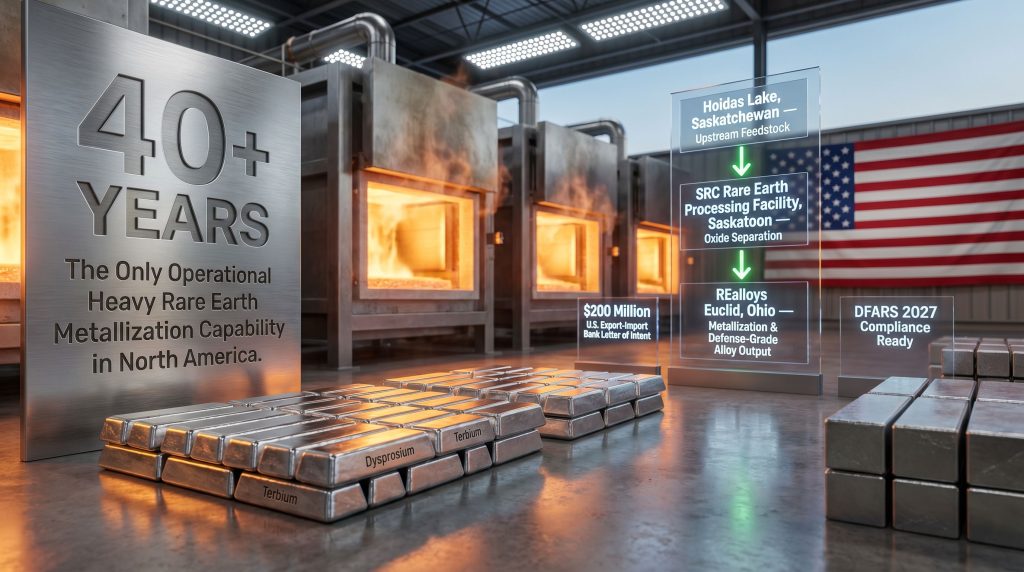
The Only Operational Heavy Rare Earth Metallisation Capability in North America
While numerous companies across North America are advancing rare earth mining projects and early-stage oxide separation capabilities, the critical conversion step — transforming separated heavy rare earth oxides into finished metals qualified for defence and industrial use — remains an almost entirely absent capability outside China. The REalloys rare earth processing facility in Euclid, Ohio is currently the only site in North America with a demonstrated, operational capability to perform this conversion at commercial scale with an existing government contract track record.
This is not a facility under development or a capability being assembled. It is an operating facility with:
- Active contracts with the U.S. Department of Defense
- Supply relationships with the Defence Logistics Agency for strategic stockpile requirements
- Contracts with the Department of Energy and NASA
- Qualified commercial relationships with rare earth magnet manufacturers
The significance of existing qualification status cannot be overstated. Defence procurement does not simply evaluate a technology or a production process in isolation. It qualifies the specific facility, its documented process history, its workforce, and its demonstrated reliability under real operating conditions. Qualification timelines typically extend across multiple years, and once a supplier relationship is established, defence procurement officers face significant technical and regulatory barriers to switching.
Four Decades of Embedded Process Knowledge
The Euclid facility's strategic value is not primarily a function of its physical equipment or floor space. It resides in the operational knowledge embedded within it, built over more than 40 years of specialty metals processing including approximately eight years of focused collaboration with U.S. national laboratories and the Defence Logistics Agency on rare earth metallisation specifically.
This collaboration produced thousands of production runs, iterative process redesigns, and real-world qualification work conducted in an operating industrial environment. The resulting process dataset and institutional expertise represents a form of industrial capital that is genuinely non-replicable through financial investment alone.
REalloys acquired this asset through its purchase of PMT Critical Metals, taking ownership of both the physical facility and the accumulated process knowledge, government relationships, and qualification history it contains. According to a GlobeNewswire release from April 2025 covering the transaction, the acquisition gave REalloys direct ownership of an operating rare earth metals platform with a documented defence production history.
Proprietary Process Innovations Developed at Euclid
Beyond its operational history, the Euclid facility has developed several proprietary process innovations that represent meaningful technical differentiators:
-
Hydrofluoric acid-free oxide-to-fluoride conversion: Conventional rare earth metallisation uses hydrofluoric acid, one of the most hazardous industrial chemicals in metals processing, during the oxide-to-fluoride conversion stage. The Euclid facility has developed a proprietary process that achieves the same conversion without hydrofluoric acid, reducing industrial safety risk, simplifying environmental compliance, and improving the facility's regulatory positioning for expansion.
-
Narrow-tolerance alloy chemistry control: Output is pre-alloyed to the precise compositional specifications required by downstream magnet manufacturers, reducing secondary processing requirements for customers and enabling tighter integration into their production workflows.
-
Demonstrated heavy rare earth metallisation: The facility has proven operational capability for dysprosium and terbium metallisation, the heavy rare earth elements most critical to high-performance permanent magnets and the most technically difficult to process outside China.
The hydrofluoric acid-free process is a particularly significant innovation from a commercial viability standpoint. Industrial facilities handling hydrofluoric acid face stringent regulatory requirements, worker safety protocols, and community relations challenges that create meaningful friction in permitting and expansion processes. Eliminating this chemical from the process flow removes a significant operational liability.
The Integrated North American Supply Chain Anchored at Euclid
Supply Chain Architecture: From Feedstock to Defence-Grade Alloy
The Euclid facility operates as the downstream anchor of a vertically integrated supply chain that REalloys has assembled to move rare earth material from extraction through to finished metals and alloys entirely within North America, without dependence on Chinese technology, equipment, or consumables at any stage. Consequently, this positions the operation at the heart of efforts to address the critical minerals demand surge currently reshaping global industrial policy.
| Stage | Asset or Partner | Location | Function |
|---|---|---|---|
| Upstream | Hoidas Lake rare earth project | Saskatchewan, Canada | Primary domestic feedstock source |
| Upstream supplemental | Feedstock agreements | Kazakhstan, Brazil, Greenland | Supply diversification and redundancy |
| Midstream | Saskatchewan Research Council Rare Earth Processing Facility | Saskatoon, Canada | Oxide separation; NdPr metal, dysprosium and terbium oxide production |
| Downstream | REalloys Euclid Facility | Euclid, Ohio, USA | Metallisation, precision alloying, defence-grade output |
The Saskatchewan Research Council Partnership: Solving the Midstream Challenge
The midstream component of this supply chain represents one of the most technically sophisticated elements of the entire programme. The Saskatchewan Research Council's Rare Earth Processing Facility in Saskatoon holds an unusual position in North American rare earth infrastructure: it is one of the few operating separation and early metallisation facilities on the continent with a genuine production track record.
REalloys holds an exclusive 80 percent offtake on SRC's annual production under a cost-plus pricing structure, a commercial arrangement that provides volume certainty to REalloys while ensuring cost transparency rather than exposure to spot market price volatility.
The development of the SRC facility illustrates the scale of challenge facing any new entrant attempting to build midstream rare earth capability from scratch. When China restricted the export of processing technology in 2020, SRC was compelled to design and construct its own separation systems independently. The effort required a multidisciplinary team spanning mineral processing specialists, metallurgists, and AI systems engineers, working over multiple years.
The AI-assisted separation system was trained through a methodology of deliberate process failure, running the system to breakdown conditions repeatedly until its error response library was effectively exhausted. The efficiency outcome of this approach is striking. The SRC facility produces higher-purity outputs using approximately six operators, compared to the estimated 80 workers a comparable conventional Chinese operation would require.
This productivity differential — roughly a 93 percent reduction in labour requirements through AI-assisted process control — demonstrates that Western operators investing in genuine process innovation rather than conventional facility replication can achieve meaningful competitive advantages.
Phase 1 and Phase 2 Production Targets
Phase 1, expected operational late 2026 to early 2027:
| Material | Annual Production Target |
|---|---|
| Neodymium-Praseodymium (NdPr) Metal | ~525 tonnes |
| Dysprosium Oxide | ~30 tonnes |
| Terbium Oxide | ~10 tonnes |
At Phase 1 scale, the SRC facility is positioned to become the largest producer of heavy rare earth oxides outside China located within the North American industrial base.
Phase 2, planned for later this decade:
| Material | Annual Production Target |
|---|---|
| Dysprosium Metal | ~200 tonnes |
| Terbium Metal | ~45 tonnes |
| Heavy Rare Earth Permanent Magnets | Up to 20,000 tonnes |
The Heavy Rare Earth Metallisation Facility Expansion
A $40 Million Investment Targeting the Hardest-to-Produce Materials
REalloys is constructing an additional Heavy Rare Earth Metallisation Facility at the Euclid site at an estimated capital cost of $40 million. The facility is designed to produce approximately 30 tonnes of dysprosium metal and approximately 15 tonnes of terbium metal annually, with operational timing targeted for early to mid-2027.
This expansion extends the Euclid facility's capability from processing oxide-stage inputs through to finished heavy rare earth metals, the specific output form required for high-performance permanent magnet manufacturing. Furthermore, the integration of this expanded capability with the existing Euclid operations creates a continuous processing platform from separated oxide through to defence-qualified finished metal.
Why Dysprosium and Terbium Define the Permanent Magnet Performance Ceiling
Heavy rare earths occupy a technically critical role in high-performance permanent magnet manufacturing that is not widely understood outside the specialty materials industry. Neodymium-iron-boron (NdFeB) magnets represent the highest-performance commercially available permanent magnets and are essential components in electric motors, defence systems, wind turbine generators, and advanced electronics. Their performance at elevated operating temperatures, however, degrades significantly without additions of dysprosium and terbium.
These elements increase the coercivity of NdFeB magnets, meaning their resistance to demagnetisation under thermal or external magnetic field stress. For defence applications where operating environments are demanding, and for electric vehicle motors where thermal management is a continuous engineering challenge, dysprosium and terbium additions are not optional enhancements but functional requirements.
China's dominance of heavy rare earth processing, particularly for dysprosium and terbium which are predominantly sourced from ionic clay deposits in southern China, represents a structural vulnerability for any Western defence or clean energy industrial base. The Euclid expansion directly targets this specific gap. Indeed, the strategic importance of rare earths in 2025 has made this kind of targeted investment increasingly urgent.
The 2027 Regulatory Inflection Point
DFARS Compliance: Government-Mandated Demand Creation
On January 1, 2027, updated U.S. defence procurement regulations under the Defence Federal Acquisition Regulation Supplement — specifically provisions under 10 U.S.C. Section 4872 and DFARS 252.225-7052 — take effect for qualifying weapons systems procurement. These rules restrict the use of rare earth materials originating from China, Russia, Iran, and North Korea in covered defence applications.
The practical consequence is the regulatory creation of mandatory demand for domestically processed, defence-compliant rare earth metals and alloys. According to reporting by the New York Times in December 2025, these procurement rules are already driving defence contractors to evaluate and accelerate domestic supply qualification processes ahead of the compliance deadline.
The procurement timeline pressure here is asymmetric and works strongly in favour of already-qualified suppliers. Defence contractors supplying qualifying weapons systems must have compliant rare earth material supply secured before the 2027 effective date. Given that facility qualification can take multiple years, the relevant procurement decisions are not decisions that will be made in 2027. They are being made now.
What Genuine DFARS Compliance Requires
Compliance with the 2027 regulations is not simply a matter of purchasing from a non-Chinese supplier. It imposes specific chain-of-custody and verification requirements:
- Documented origin traceability from extraction through every processing stage
- Facility qualification under defence procurement standards at each stage in the supply chain
- Process verification confirming no stage of processing passed through a restricted-nation facility
- Ongoing compliance documentation throughout the supply relationship lifetime
The Euclid facility's existing government contract history and documented process qualification position it as one of the very few facilities capable of meeting these requirements at the time the rules take effect. This is particularly relevant given the broader context of semiconductors and critical minerals policy, where qualification timelines remain a persistent bottleneck for new entrants.
The next major ASX story will hit our subscribers first
Institutional Credibility and Governance Architecture
The U.S. Export-Import Bank Letter of Intent
The U.S. Export-Import Bank has issued a $200 million letter of intent to support REalloys' supply chain development, according to Reuters reporting from October 2025. Export-Import Bank engagement at this scale reflects an institutional-level assessment of a programme's viability, strategic rationale, and operational credibility. Letters of intent of this magnitude are not extended to programmes at early concept or speculative development stages.
Note: A letter of intent represents a non-binding expression of interest and does not constitute confirmed financing. Investors should consult the company's formal SEC filings for details on the current status of any financing arrangements.
Board Composition as a Strategic Signal
The governance structure assembled around REalloys reflects the specific intersection of defence procurement expertise, government relations capability, and cross-border industrial policy experience that a programme of this nature requires:
- Stephen S. DuMont, Chairman and President of GM Defence, bringing direct defence industrial procurement experience
- General Jack Keane (Ret.), four-star general and Presidential Medal of Freedom recipient, providing defence policy and national security perspective
- Brad Wall, former Premier of Saskatchewan, offering direct relevance to the Canadian supply chain components
- David MacNaughton, former Canadian Ambassador to the United States, contributing cross-border government relations expertise
The Competitive Moat: What Replication Would Actually Require
The Rebuild Timeline Problem Facing New Entrants
Industry analysis consistently places the realistic timeline for a credible new entrant in rare earth metallisation at three to seven years under optimal conditions. That estimate assumes no significant technical setbacks, no workforce development delays, no regulatory complications, and an ability to attract and retain specialised personnel who currently exist in extremely limited numbers globally.
The specific structural barriers a new entrant faces are worth enumerating precisely:
- No operational process history to draw on for customer qualification
- No accumulated production dataset to inform AI-assisted process optimisation
- No trained specialist workforce with hands-on metallisation experience for the specific elements required
- No existing government contract relationships to anchor early revenue and demonstrate reliability
- Full qualification timelines required before any defence customer can make a supply commitment
Comparative Position Against Emerging Western Competitors
| Capability Dimension | REalloys (Euclid) | Typical New Entrant |
|---|---|---|
| Operational history | 40+ years specialty metals; 8+ years rare earth focus | Zero |
| Government contracts | Active (DoD, DLA, DoE, NASA) | None |
| DFARS compliance readiness | Positioned for 2027 | Qualification timeline: 3–7 years |
| Heavy rare earth metallisation | Operational | Under development or planned |
| AI-assisted process optimisation (SRC) | Operational | Not applicable |
| HF-free conversion process | Proprietary, operational | Not developed |
| Integrated supply chain | Upstream through downstream | Typically single-stage |
Other companies across the Western rare earth sector, including NioCorp Developments advancing the Elk Creek project in Nebraska and Critical Metals Corp developing critical mineral assets tied to Western supply chain security, are addressing important pieces of the broader supply challenge. However, these efforts are predominantly focused on upstream mining and extraction rather than the downstream metallisation and alloying capability that the Euclid facility provides.
Frequently Asked Questions
What does the REalloys rare earth processing facility in Euclid, Ohio actually produce?
The Euclid facility specialises in rare earth metallisation and precision alloying, converting separated rare earth oxides into high-purity metals and defence-grade alloys. Current production serves U.S. Department of Defence programmes, the Defence Logistics Agency, and commercial magnet manufacturers. The expanded facility under construction will add dedicated heavy rare earth metallisation capability producing dysprosium and terbium metals for high-performance permanent magnet applications.
Why is dysprosium and terbium metallisation more strategically significant than neodymium processing?
While neodymium-praseodymium processing receives more commercial attention due to higher production volumes, dysprosium and terbium metallisation represents a more acute strategic vulnerability. These elements are required to maintain magnet coercivity at elevated operating temperatures, making them functionally necessary for defence system and electric motor applications. China's near-total control of heavy rare earth processing, particularly from southern Chinese ionic clay deposits, means this specific capability gap carries disproportionate strategic risk relative to its market volume.
What is the significance of the hydrofluoric acid-free process?
Conventional rare earth oxide-to-fluoride conversion uses hydrofluoric acid, a highly hazardous industrial chemical that creates significant worker safety requirements, environmental compliance obligations, and community relations challenges. The Euclid facility's proprietary HF-free process achieves the same conversion without this chemical, reducing regulatory burden, improving expansion permitting prospects, and lowering operational risk. This is a meaningful competitive differentiator that new entrants attempting to build conventional processing facilities will not possess.
How does the 2027 DFARS deadline create immediate commercial pressure?
Defence contractors supplying qualifying weapons systems must secure compliant rare earth supply before January 1, 2027. Because facility qualification for defence procurement typically takes multiple years, procurement decisions cannot be deferred until the compliance deadline. Contractors who have not secured qualified supply chains ahead of the effective date face the prospect of supply disruption or contract non-compliance. This timeline pressure makes the current period, not 2027, the critical window for supply relationship formation.
What distinguishes REalloys' supply chain from other Western rare earth initiatives?
The primary distinction is vertical integration without Chinese dependency at any processing stage. Most Western rare earth initiatives address a single stage, typically mining or early separation. REalloys has assembled a supply chain spanning upstream feedstock through midstream oxide separation at the SRC facility to downstream metallisation and alloying at Euclid, with each stage designed to operate using non-Chinese technology, equipment, and consumables. The exclusive 80 percent offtake on SRC production under cost-plus pricing adds a layer of cost predictability and volume certainty that purely market-exposed procurement cannot provide.
This article contains forward-looking statements and projections regarding production timelines, facility capabilities, and regulatory outcomes. These statements involve risks and uncertainties that could cause actual results to differ materially from those described. The U.S. Export-Import Bank letter of intent referenced herein is a non-binding expression of interest and does not constitute confirmed financing. Readers should conduct independent due diligence and consult a qualified financial adviser before making any investment decisions. This article does not constitute financial or investment advice.
Want To Stay Ahead of the Next Major Critical Minerals Discovery?
Discovery Alert's proprietary Discovery IQ model delivers real-time alerts on significant ASX mineral discoveries — instantly cutting through complex data to surface actionable opportunities in critical minerals, rare earths, and beyond. Explore why historic mineral discoveries have generated extraordinary returns for early investors, and begin your 14-day free trial at Discovery Alert to position yourself ahead of the broader market.