May 12, 2026
America's Minerals Problem Isn't Underground — It's in the Processing Plant
For decades, policymakers and industry analysts debated whether the United States had enough mineral wealth beneath its soil to support a self-sufficient industrial economy. The answer, it turns out, was never really the question. America holds substantial deposits of rare earth elements, lithium, gallium, germanium, and dozens of other strategically critical materials. The more consequential problem has always been what happens after those minerals leave the ground.
Processing and refining — the steps that transform raw ore into the high-purity feedstocks required by semiconductor fabs, battery manufacturers, and defence contractors — represent the true bottleneck in U.S. supply chain resilience. Without domestic capacity to perform these steps, even the richest mineral deposit in the country remains commercially irrelevant to advanced manufacturing.
This processing deficit is precisely what the DOE critical minerals funding review and the agency's recently launched Critical Minerals and Materials (CMM) Accelerator are now designed to address.
When big ASX news breaks, our subscribers know first
The Processing Gap at the Heart of U.S. Supply Chain Vulnerability
Why Ore in the Ground Is Not Enough
The distinction between mineral extraction and mineral processing sounds technical, but its implications are profound. A nation can mine significant quantities of rare earth ore while still depending entirely on foreign countries to perform the chemical separation, reduction, and refining steps that produce usable materials. This is precisely the structural reality the United States currently faces, and it sits at the heart of ongoing rare earth processing challenges that policymakers are urgently working to resolve.
China has built dominant global capacity in rare earth processing over several decades, controlling well over 80% of global rare earth element refining throughput. For gallium, a semiconductor-critical material essential to gallium nitride (GaN) chips used in 5G infrastructure and advanced defence electronics, China similarly controls an estimated 80% of global supply. When Beijing introduced export restrictions on gallium and germanium in late 2023, the downstream effects rippled immediately through Western semiconductor supply chains, underscoring just how exposed advanced manufacturing had become.
The consequences extend well beyond rare earths. Battery supply chains for electric vehicles depend on processed lithium carbonate and lithium hydroxide, not just raw lithium brine. Defence systems rely on refined germanium for infrared optics and fibre optic components. Semiconductor fabrication requires silicon carbide and gallium nitride at purity levels exceeding six nines — 99.9999% or higher — with dopant concentrations controlled to parts-per-billion precision.
Building domestic capacity for each of these refining steps requires capital, infrastructure, and specialised expertise that takes years to develop. Federal programmes are now explicitly oriented toward compressing that timeline.
The Federal Architecture Responding to This Challenge
The policy response has been constructed across multiple layers. Executive-level directives have called for accelerated domestic mineral production, and the Bipartisan Infrastructure Law (BIL) allocated more than $8 billion across the critical minerals supply chain, providing the fiscal foundation for a coordinated multi-agency strategy. The Department of Energy, Department of Defence, U.S. Geological Survey, and National Science Foundation are now operating with greater alignment on minerals strategy than at any prior point in recent history.
Critically, the strategic framing has shifted. Earlier federal minerals initiatives focused heavily on expanding extraction. The current generation of programmes explicitly targets the full domestic value chain — from ore beneficiation through refining, alloying, and manufacturing-ready material production. Furthermore, the CMM Accelerator represents the most direct embodiment of this evolved approach.
The United States possesses significant in-ground mineral wealth yet remains structurally dependent on foreign nations for the refining and processing steps that convert raw ore into manufacturing-ready feedstocks. Federal funding programmes are now explicitly designed to close this gap at the technology development stage.
Inside the $69 Million Critical Minerals and Materials Accelerator
Programme Design and Strategic Intent
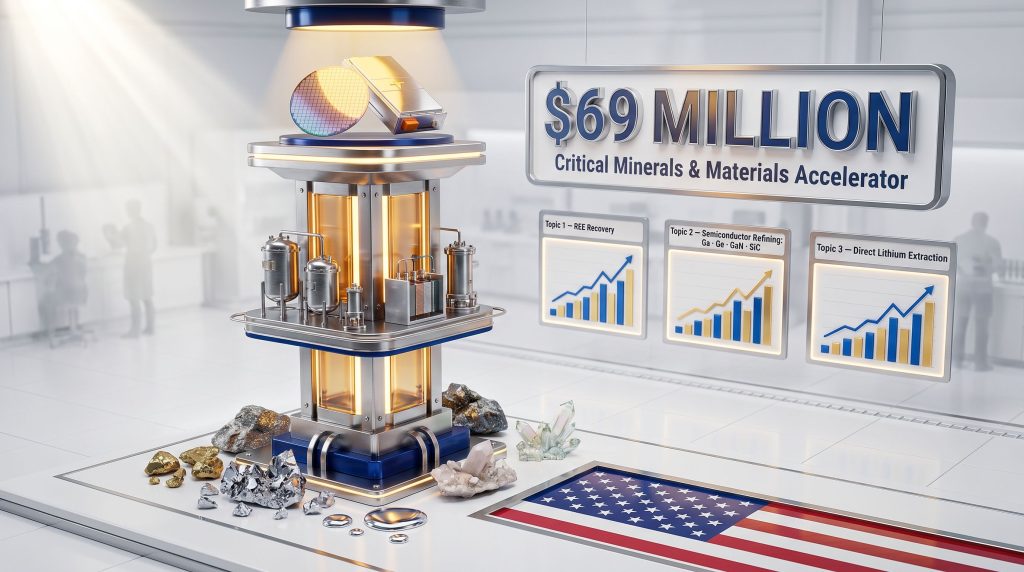
Launched by the DOE in early April 2026, the Critical Minerals and Materials Accelerator offers up to $69 million in federal funding for American, industry-led partnerships working to advance domestic processing technologies. The programme was issued jointly through the DOE's Office of Critical Minerals and Energy Innovation and its Hydrocarbons and Geothermal Energy Office, reflecting the interdisciplinary nature of the challenge. The DOE's critical minerals and materials programme provides further detail on the overarching strategic framework guiding these investments.
The programme's philosophical core is bridging what technology development specialists refer to as the "valley of death" — the funding gap between laboratory-scale innovation and prototype or pilot-scale demonstration where private capital is reluctant to commit and federal basic research programmes typically disengage. The CMM Accelerator occupies this precise intermediate stage, requiring private sector entities to lead project teams whilst permitting academic institutions and national laboratories to participate as partners.
Phase 1 awards are estimated at $2 to $3 million per project, with Topic Area 1 alone anticipated to generate between 10 and 14 funded projects. The project performance period runs from late 2026 through 2029.
How the $69 Million Is Allocated Across Three Topic Areas
The accelerator divides its funding across three distinct technological domains, each targeting a different segment of the critical minerals processing challenge:
| Topic Area | Focus Domain | Estimated Funding | Application Deadline |
|---|---|---|---|
| Topic 1 | REE and critical material recovery from scrap, e-waste, and mine tailings | ~$24 million | May 29, 2026 |
| Topic 2 | Semiconductor material refining and alloying (Ga, Ge, GaN, SiC) | Not yet specified | June 25, 2026 |
| Topic 3 | Direct lithium extraction from brines and geothermal systems | ~$17 million (split) | July 23, 2026 |
Beyond direct funding, successful projects gain access to two significant federal infrastructure assets: the Critical Materials Innovation (CMI) Hub, which coordinates applied research across DOE national laboratories, and the Minerals to Materials Supply Chain Research Facility, which provides pilot-scale testing infrastructure for technology validation at larger scales.
This access to federal lab infrastructure represents a non-monetary programme benefit that materially de-risks the path from pilot to commercial demonstration — a step that has historically stalled domestic processing development.
Three Technology Pillars: What the Accelerator Is Actually Trying to Build
Topic Area 1 — Recovering Critical Materials from Secondary Feedstocks
The first and largest topic area targets the recovery of rare earth elements and other critical materials from secondary and waste feedstocks rather than primary ore. This approach reflects a strategic insight that recycling and secondary sourcing can create supply chain resilience that primary mining alone cannot deliver. In addition, strengthening the rare earth supply chain through secondary recovery reduces dependence on geopolitically sensitive primary sources.
Target feedstock categories include:
- Post-industrial manufacturing scrap, including waste from permanent magnet production
- Post-consumer scrap such as electronic waste (e-waste) and end-of-life EV drivetrain components
- Blended feedstocks combining mine tailings, industrial scrap, and consumer waste streams
The technical approaches under evaluation span a broad spectrum of processing methods:
- Hydrometallurgical processes: aqueous leaching and solvent extraction for REE separation, requiring careful management of multi-stage chemical processing and waste streams
- Pyrometallurgical processes: high-temperature smelting and reduction techniques offering high throughput but significant energy and emissions challenges
- Electrochemical methods: electrodeposition and electrolytic refining providing precise separation control but requiring substantial electrical infrastructure
- Mechanical separation: physical beneficiation and sorting technologies with lower capital requirements but potential purity limitations
- Bio-based processes: bioleaching and microbial-assisted extraction representing an emerging frontier with limited commercial demonstration to date
The strategic logic of secondary sourcing is compelling. Recovering rare earth elements from end-of-life electronics and manufacturing waste reduces dependence on primary mining supply chains, shortens material transit distances, and creates a circular domestic feedstock loop. For materials like neodymium and dysprosium used in permanent magnets, e-waste and drivetrain recovery pathways could eventually supplement or partially offset the need for imported primary ore.
Topic Area 2 — Semiconductor Material Refining and Alloying
The second topic area addresses one of the most acute and underappreciated supply vulnerabilities in the U.S. industrial base: near-zero domestic refining capacity for semiconductor-critical materials. Consequently, the accelerator's focus on critical minerals for semiconductors aligns directly with broader allied efforts to diversify away from single-source dependencies.
| Material | Key Applications | Strategic Concern |
|---|---|---|
| Gallium (Ga) | GaN chips, LEDs, RF electronics | China controls ~80% of global supply |
| Gallium Nitride (GaN) | Power electronics, 5G, defence RF systems | Critical for next-generation telecom and weapons systems |
| Germanium (Ge) | Fibre optics, infrared optics, solar cells | Subject to Chinese export restrictions since 2023 |
| Silicon Carbide (SiC) | EV power inverters, industrial electronics | Rapidly scaling demand with EV sector growth |
Achieving semiconductor-grade purity for these materials is technically demanding and capital-intensive. Refining processes must typically achieve purity levels of 99.9999% or greater, eliminating trace quantities of dozens of potential contaminants to levels measurable in parts per trillion. Alloying requires controlling dopant concentrations at parts-per-billion precision, necessitating specialised analytical instrumentation and tightly controlled manufacturing environments.
The practical implication is that building even a pilot-scale domestic gallium or germanium refinery is a multi-year, multi-hundred-million-dollar undertaking. The CMM Accelerator's role is not to fund a commercial refinery but to de-risk the technology development steps that precede one, giving private capital a validated technical foundation on which to build.
Topic Area 3 — Direct Lithium Extraction, Separation, and Processing
Conventional lithium recovery from brine deposits relies on solar evaporation ponds that require 12 to 18 months of processing time, deliver relatively low recovery rates, and consume significant quantities of water in typically arid environments. This approach has proven commercially viable in South American lithium triangle operations but is poorly suited to the faster timelines and environmental constraints of domestic U.S. production. However, direct lithium extraction technologies promise to fundamentally alter this equation.
The CMM Accelerator targets several DLE approaches:
- Pre-treatment technologies for brine conditioning and impurity removal prior to extraction
- Core extraction methods including ion exchange resins, solvent extraction systems, and membrane-based separation processes
- Post-treatment and brine disposal management, addressing the environmental handling of spent brine streams
- Geothermal exploration and characterisation, assessing volcanic-hosted geothermal systems as co-production sources for both lithium and rare earth elements
The inclusion of geothermal-hosted mineral deposits within Topic Area 3 is particularly notable. Volcanic-origin geothermal brines in certain U.S. regions carry dissolved lithium concentrations that, combined with the existing heat energy extraction infrastructure, could enable economically co-productive systems. This represents an unconventional sourcing pathway that remains largely uncharacterised at commercial scale domestically.
Where the $69M Fits in the Broader Federal Funding Ladder
Mapping the Full DOE Critical Minerals Investment Ecosystem
The CMM Accelerator does not operate in isolation. It occupies a specific and deliberate position within a tiered federal technology commercialisation architecture, designed to move technologies progressively from early-stage development toward commercial deployment.
| Programme | Announced | Total Value | Development Stage |
|---|---|---|---|
| CMM Accelerator | April 2026 | $69 million | Bench to prototype/pilot |
| Manufacturing Deployment Office NOFO | March 2026 | $500 million | Pilot to commercial demonstration |
| Mines and Metals Capacity Expansion | August 2025 | ~$1 billion package | Industrial site byproduct recovery |
| FEED Studies from Coal Resources | BIL-funded | $17 million (3 projects) | Feasibility to design |
| BIL Battery Supply Chain Grants | 2023-2026 | $2.8 billion+ | Full chain (mining to recycling) |
| LPO Loan Portfolio (e.g., Ioneer) | Ongoing | $996 million (Ioneer alone) | Commercial scale |
The architecture is designed so that projects succeeding at the CMM Accelerator stage have a defined pathway toward the larger $500 million Manufacturing Deployment Office programme, and ultimately toward commercial-scale private investment or Loan Programmes Office support. Ioneer's Rhyolite Ridge lithium-boron project in Nevada, which secured a reported $996 million DOE loan commitment, illustrates how federal support at successive stages can catalyse commercial-scale deployment.
The CMM Accelerator occupies the earliest commercialisation stage of a deliberately tiered federal funding ladder. Projects that succeed here are designed to graduate toward the $500 million Manufacturing Deployment Office programme and ultimately attract private capital for full commercial deployment.
The Private Investment Multiplier Dynamic
A recurring pattern in federal technology commercialisation programmes is that early-stage public investment functions as a credibility signal for private capital. When the DOE validates a technology team and approach through a competitive award process, institutional investors and strategic industry partners gain a degree of technical due diligence they did not previously have.
Historically, successful DOE pilot-stage awards have been followed by private co-investment at three to five times the federal grant value in subsequent financing rounds. For the CMM Accelerator's estimated 10 to 14 Topic 1 projects alone, this multiplier effect could translate to substantial private capital entering the domestic critical minerals processing sector during the 2027 to 2029 window.
The Expert Review Process and Why Technical Rigour Matters
How the DOE Selects Which Projects Get Funded
On May 11, 2026, the DOE issued a formal call for qualified subject matter experts to evaluate project proposals submitted under the CMM Accelerator. The reviewer application deadline is 5:00 p.m. ET on May 22, 2026, with interested experts instructed to submit a resume or curriculum vitae to the DOE's designated review inbox. This DOE critical minerals funding review process provides a technical firewall between political considerations and funding decisions.
Independent peer review is central to the DOE's project selection process, with reviewers assessing proposals on dimensions including technical merit, commercial viability, team capability, and supply chain relevance.
Expertise Profiles Being Sought
The DOE is specifically seeking reviewers with demonstrated expertise across the accelerator's target domains:
Technical processing expertise:
- Hydrometallurgical, pyrometallurgical, electrochemical, mechanical, and bio-based recovery processes
- Semiconductor-grade refining of gallium, germanium, GaN, and SiC
- Direct lithium extraction engineering and geothermal systems characterisation
Broader analytical expertise:
- Supply chain economics and domestic manufacturing feasibility assessment
- Critical minerals market dynamics and feedstock valuation
Eligible reviewers may include academic researchers with active publication records in critical materials processing, industry engineers with pilot or commercial-scale experience, national laboratory scientists, and consultants with demonstrated supply chain advisory work. Reviewer selection is competitive and based on verified domain expertise.
The next major ASX story will hit our subscribers first
Full Programme Timeline at a Glance
| Programme Milestone | Timing |
|---|---|
| Expert reviewer applications close | May 22, 2026 (5:00 p.m. ET) |
| Topic Area 1 full applications due | May 29, 2026 |
| Topic Area 2 full applications due | June 25, 2026 |
| Topic Area 3 full applications due | July 23, 2026 |
| DOE selection notifications | July to August 2026 |
| Award execution | September to December 2026 |
| Project performance period | Late 2026 through 2029 |
Broader Implications for U.S. Industrial and Geopolitical Competitiveness
Semiconductor Independence and Defence Procurement
The semiconductor dimension of the CMM Accelerator's scope extends well beyond commercial electronics manufacturing. U.S. defence systems rely on domestically refined gallium and germanium for radar components, infrared optics, directed energy systems, and satellite communications hardware. When China introduced export controls on these materials in 2023, the exposure of defence procurement supply chains became impossible to ignore at the policy level.
Building domestic gallium and germanium refining capacity is therefore not merely an economic competitiveness question — it is a defence industrial base requirement. The CMM Accelerator's explicit focus on semiconductor material refining reflects this dual-use strategic reality.
Allied-Nation Supply Chain Complementarity
The CMM Accelerator's technology outputs are also relevant to a broader allied-nation minerals strategy. America's rare earth supply chain ambitions are further reinforced by the fact that Australia, Canada, and European Union member states are simultaneously investing in their own critical minerals processing capacity, creating the possibility of complementary supply chain architectures where allied-nation primary production feeds into distributed refining capacity across trusted partners.
Domestic processing technology developed through the CMM Accelerator could eventually support licensing arrangements, joint venture structures, or technology transfer agreements that strengthen the collective processing capacity of mineral-aligned democracies. This allied dimension represents a longer-term strategic benefit that extends beyond the programme's immediate domestic objectives.
The Geothermal Wildcard
One of the more speculative but genuinely intriguing aspects of the CMM Accelerator is its inclusion of volcanic-hosted geothermal systems as potential co-production sources for lithium and rare earth elements within Topic Area 3. Certain geothermal brine systems in the western United States carry dissolved lithium concentrations that could be economically significant if extraction technologies prove technically feasible at scale.
This is not yet a proven commercial pathway. The characterisation work required to define resource quality, extraction economics, and brine management requirements remains largely incomplete. However, if even a fraction of the geothermal-hosted lithium resource base proves commercially viable, it would represent a structurally domestic supply source with minimal competition for land or water from conventional mining operations. The level of interest that Topic Area 3 attracts from industry applicants will serve as a leading indicator of how seriously the sector views this unconventional source pathway.
Frequently Asked Questions: DOE Critical Minerals Funding Review
What is the total funding available through the CMM Accelerator?
The programme offers up to $69 million distributed across three topic areas covering rare earth element recovery, semiconductor material refining, and direct lithium extraction technologies.
Who is eligible to apply for programme funding?
The programme targets American, industry-led partnerships. Private sector entities must serve as project leads, though academic institutions and national laboratory partners may participate in project teams.
How do the three topic areas differ from each other?
Topic Area 1 focuses on recovering critical materials from scrap, e-waste, and mine tailings. Topic Area 2 addresses high-purity refining of semiconductor materials including gallium, germanium, GaN, and SiC. Topic Area 3 covers direct lithium extraction from brine and geothermal sources.
How can qualified experts participate in the review process?
Experts should submit a resume or CV to the DOE's designated review inbox by 5:00 p.m. ET on May 22, 2026. Demonstrated domain expertise in critical materials processing or related fields is required. The selection process is competitive.
When will DOE announce which projects receive awards?
Selection notifications are anticipated between July and August 2026, with formal award execution expected between September and December 2026.
How does the CMM Accelerator connect to larger DOE programmes?
The accelerator functions as an early-stage commercialisation bridge. Successful projects can access federal laboratory infrastructure for larger-scale testing and may subsequently qualify for the $500 million Manufacturing Deployment Office programme or other downstream federal support mechanisms.
The Structural Shift This Funding Review Signals
From Isolated Grants to Industrial Policy Architecture
Viewed individually, a $69 million funding announcement occupies a modest position in the broader federal budget landscape. Viewed within its proper context — as one deliberate layer of a tiered, multi-agency, multi-billion-dollar technology commercialisation pipeline — its significance is considerably greater.
The DOE critical minerals funding review reflects a maturation in how the United States approaches critical minerals development. Rather than treating processing technology as a basic research problem, federal policy now explicitly recognises the commercialisation pathway as a public good requiring structured investment at each development stage. The combination of executive-level mandates, BIL-funded infrastructure, competitive technology accelerators, and escalating commercial demonstration programmes represents the most coordinated U.S. critical minerals industrial policy in modern memory.
What Industry Observers Should Watch
As the programme advances through its application and review cycles, several indicators will reveal whether the initiative is achieving its intended catalytic effect:
- Application volume by topic area: high submission numbers under Topic Area 2 (semiconductor materials) would signal that private sector technology developers view domestic refining as commercially viable, not merely a policy aspiration
- Geothermal lithium interest: meaningful participation in the geothermal-hosted mineral characterisation subtopic within Topic Area 3 would suggest the sector is beginning to treat unconventional sources as investment-grade opportunities
- Private co-investment announcements: the months following DOE selection notifications in mid-to-late 2026 will reveal whether federal validation is successfully unlocking private capital at the scale needed to advance projects toward commercial demonstration
The DOE critical minerals funding review process underway now is, in essence, the gating mechanism for a pipeline that could reshape domestic manufacturing capacity over the next decade. Which technologies are selected, which teams are funded, and which approaches prove scalable through the 2026 to 2029 performance window will have consequences that extend well beyond the programme's direct dollar value. For broader context on the global critical minerals landscape, the IEA's critical minerals analysis provides a comprehensive overview of supply dynamics and strategic dependencies shaping international policy.
Readers seeking additional context on U.S. critical minerals policy and domestic supply chain development can explore related reporting and analysis through Metal Tech News, which covers the evolving landscape of technology metals, federal funding programmes, and domestic processing innovation.
This article contains forward-looking statements and projections based on publicly available programme documentation and policy analysis. Federal funding programmes are subject to change, and award outcomes cannot be predicted with certainty. This article does not constitute financial or investment advice.
Want to Spot the Next Major Mineral Discovery Before the Broader Market Does?
While federal programmes reshape the critical minerals processing landscape, Discovery Alert's proprietary Discovery IQ model delivers real-time alerts on significant ASX mineral discoveries — instantly translating complex geological and commodity data into actionable investment insights for both short-term traders and long-term investors. Explore Discovery Alert's dedicated discoveries page to see how historic ASX discoveries have generated substantial returns, and begin your 14-day free trial today to secure a market-leading edge as the critical minerals sector accelerates.