July 20, 2026
The Five Structural Tests That Separate Mineral Wealth from Industrial Reality
The history of resource-rich nations is littered with cautionary examples of geological abundance failing to translate into economic development. From the copper belts of central Africa to the lithium triangles of South America, the pattern repeats itself: extraordinary mineral endowments exist beneath the surface while the institutional, regulatory, and social frameworks above ground remain too fragmented to unlock them at scale. Understanding why this gap persists is one of the most consequential questions in modern industrial policy, and nowhere is this tension more visible today than in the discussion around critical minerals in Mexico.
The global energy transition has fundamentally changed the calculus. Minerals that were once priced and traded purely as industrial commodities now occupy a different category in the strategic thinking of governments, manufacturers, and militaries. Furthermore, critical minerals demand has reshaped how copper, silver, fluorite, and antimony are valued across defence, clean energy, and advanced manufacturing systems. When these inputs are concentrated in a small number of jurisdictions, their strategic value rises in proportion to the fragility of existing supply chains.
Mexico sits at the centre of this shift. The country's mineral endowment is not in question. What is being tested, increasingly and in full view of international capital markets, is whether Mexico can build the institutional architecture to convert that endowment into projects that are explored, financed, permitted, constructed, and operated under rules that are clear enough to attract long-term investment.
When big ASX news breaks, our subscribers know first
What Critical Minerals Does Mexico Actually Produce?
Mexico's Position in the Global Critical Minerals Hierarchy
Few countries can match the breadth of Mexico's critical mineral production profile. According to the U.S. Geological Survey, Mexico produces eight of the 60 minerals classified as critical to the United States economy and national security, spanning both high-volume industrial inputs and niche strategic materials that very few jurisdictions can supply at comparable scale.
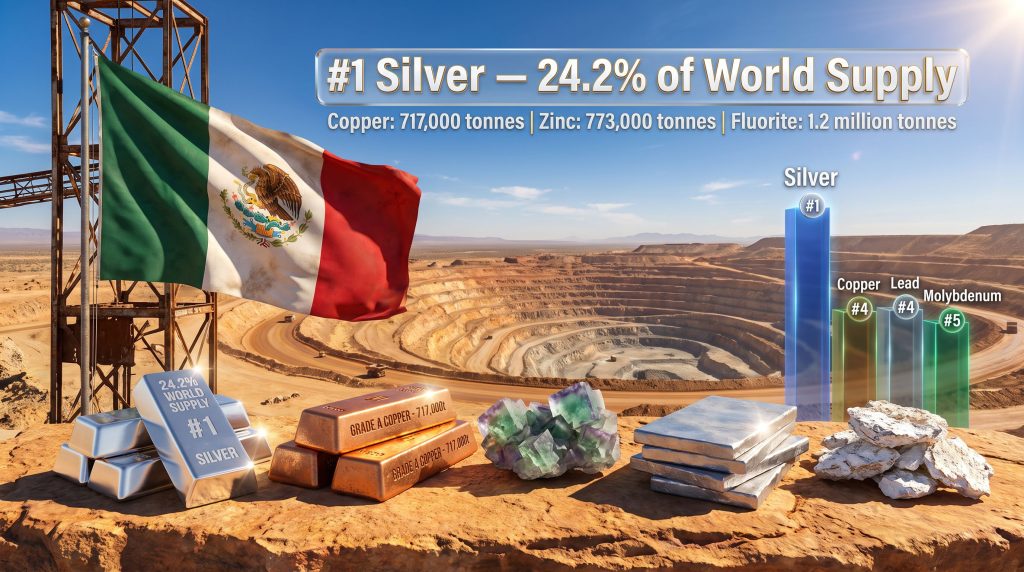
Mexico's Critical Mineral Production Snapshot (2025)
| Mineral | Global Ranking | Annual Output | Primary Producing States |
|---|---|---|---|
| Silver | #1 globally (24.2% of world supply) | Leading producer | Nationwide |
| Copper | #4 globally | 717,000 tonnes | Sonora (70%), Zacatecas, Chihuahua |
| Zinc | Top-tier producer (5.95% of world supply) | 773,000 tonnes | Zacatecas, Chihuahua, Sonora |
| Fluorite | #2 globally | 1.2 million tonnes | San Luis Potosí, Coahuila, Durango |
| Lead | #4 globally | 180,000 tonnes | Zacatecas, Durango, Chihuahua |
| Molybdenum | #5 globally (6.13% of world supply) | Significant output | Sonora |
| Antimony | Leading producer | 600 tonnes | Sonora, Baja California Sur |
| Graphite | Significant resources | 900 tonnes | Sonora |
| Barite | Leading producer | 330 tonnes | Multiple regions |
Mexico's mineral production portfolio spans both high-volume industrial minerals and niche strategic inputs, a combination few jurisdictions can match at comparable scale.
Emerging and Untapped Strategic Resources
Beyond current production, Mexico holds a significant pipeline of undeveloped strategic mineral resources that have drawn increasing international attention:
- Lithium: Substantial untapped reserves concentrated in Sonora, declared a strategic national resource, though full-scale commercial extraction requires processing technology not yet fully deployed within Mexico.
- Rare Earth Elements (REEs): Mexico is not a current producer, but identified deposits of cerium, lanthanum, neodymium, praseodymium, dysprosium, gadolinium, and yttrium exist primarily in Coahuila.
- Heavy rare earths and titanium: Confirmed deposits have been identified in Oaxaca and Chiapas, though these remain at early exploration stages.
- Tellurium: Active mine identification is underway, with tellurium carrying significant strategic value for solar photovoltaic applications.
- Mexico has identified prospects for approximately 14 minerals carrying supply risk for other nations, extending well beyond its current production base.
A detail that is rarely discussed outside specialist circles is fluorite's specific strategic role. Mexico's position as the world's second-largest fluorite producer is particularly significant because high-grade acid-spar fluorite is an essential input in the manufacture of lithium hexafluorophosphate, the dominant electrolyte salt used in lithium-ion batteries. This means Mexico's fluorite sector has an upstream connection to the very battery supply chains that the energy transition depends upon, yet this linkage is almost entirely absent from mainstream coverage of the country's mineral profile.
How Does Mexico's USMCA Position Shape Its Critical Minerals Opportunity?
Geographic and Trade Architecture as a Competitive Advantage
No other mineral-producing country in Latin America, and very few anywhere globally, holds the geographic and trade-architecture advantages that Mexico possesses relative to the United States. Proximity is not simply a logistical convenience; within the framework of the United States-Mexico-Canada Agreement, it functions as a structural preference that competing jurisdictions in Asia, Africa, and South America cannot replicate through commercial terms alone.
The U.S. strategic imperative to reduce dependence on single-source mineral supply chains has elevated Mexico's relevance considerably. Discussions around critical minerals trade increasingly highlight North American upstream capacity as a foundational requirement for allied industrial resilience, particularly across clean energy and advanced electronics sectors.
The North American Resilience Equation
North American supply chain security in clean energy, electric vehicles, advanced electronics, and defence cannot be achieved without a functioning Mexican upstream mining sector. The logic is straightforward but often underappreciated: downstream manufacturing ambitions in the United States require a reliable upstream feed, and Mexico is geographically positioned to provide it faster, more cost-effectively, and within an allied trade framework than virtually any alternative.
However, Mexico currently lacks domestic processing capacity for at least 13 additional critical minerals, including cobalt, nickel, and advanced lithium compounds. This processing gap represents both a vulnerability and an investment opportunity. Moving beyond raw material export toward refining and value-added manufacturing would fundamentally alter Mexico's position within the North American industrial ecosystem, though closing this gap requires capital, technology transfer, and the kind of regulatory predictability that currently remains elusive.
Mexico's geographic location and USMCA membership create a structural advantage that no other Latin American jurisdiction can replicate. The question is whether institutional conditions can match the geological and logistical opportunity.
What Are the Five Structural Pillars Determining Mexico's Critical Minerals Competitiveness?
Pillar 1: Exploration Pipeline Development
Exploration represents the foundational upstream requirement for any mining jurisdiction. Without continuous investment in discovering and delineating new reserves, future production capacity inevitably contracts. This is not a speculative concern; it is a geological and mathematical certainty. Mexico must treat responsible exploration as a strategic national activity rather than a speculative private enterprise that sits at the periphery of mining policy.
The economics of exploration are unforgiving. The process is capital-intensive, technically demanding, and produces commercially viable results in only a small fraction of cases. Most exploration projects never reach feasibility study stage, let alone production. Yet without a healthy exploration pipeline feeding new projects into the development system, a jurisdiction's existing production base ages without replacement.
Responsible exploration does not mean unconstrained access. Environmental compliance, genuine engagement with landowners and local communities, and rigorous technical oversight are non-negotiable conditions. However, Mexico's ability to participate seriously in the global critical minerals race depends on its capacity to generate fresh geological information and sustain an active exploration pipeline that gives investors confidence in future project flow.
Pillar 2: Regulatory Architecture and Legal Certainty
The 2023 Mexican Mining Law reform represented a structural inflection point for the sector. It confirmed that Mexico is moving into a materially stricter regulatory environment, and operators should proceed on the basis that the pre-reform model will not simply return. The more productive discussion is not whether regulation will tighten further, but how the existing framework will be operationalised through secondary rules.
This distinction matters enormously in practice. The 2023 law established the direction of regulatory intent, but secondary regulations that translate legislative intent into operational procedures remain underdeveloped. Project teams, legal advisors, and financiers need clarity across a specific set of procedural questions:
- Concession application and approval procedures
- Concession renewal and transfer mechanisms
- Social impact assessment methodologies and thresholds
- Environmental obligation frameworks and compliance timelines
- Mine closure standards and financial assurance requirements
- Water use frameworks and inter-agency coordination protocols
The critical gap is not the existence of strict regulation; it is the absence of secondary regulations that translate the 2023 Mining Law into operational procedures. This is where investor confidence is most acutely eroded.
Regulatory uncertainty is not only generated by demanding laws. It is equally produced by administrative silence, inconsistent application of criteria across different project applications, and undefined timelines that leave project teams unable to communicate realistic development schedules to their boards, shareholders, and lenders. From a financing perspective, undefined permitting pathways are treated as equivalent to negative decisions, because the cost of carrying unresolved regulatory exposure through a capital raise is prohibitive.
Pillar 3: Water Strategy as a Project-Design Imperative
Water has undergone a fundamental repositioning in mining project development. A generation ago, water access was addressed as a late-stage permitting matter, something to be resolved after the orebody was defined and the project economics were established. That approach is no longer viable in Mexico, and treating it as such is one of the more common and costly miscalculations that project teams make.
Modern mining projects in Mexico must address six distinct dimensions of water management from the earliest design stages:
- Availability: Quantified assessment of regional water budgets and seasonal variability
- Usage rights: Legal title to water extraction volumes and inter-agency coordination
- Monitoring: Real-time instrumentation and reporting frameworks
- Reuse systems: Closed-loop recirculation infrastructure that reduces net water consumption
- Discharge compliance: Treated effluent standards and watercourse protection
- Community communication: Transparent, ongoing dialogue about water impacts and mitigation measures
The geographic concentration of Mexico's copper production in Sonora, which accounts for approximately 70% of national output, illustrates the intersection of mineral value and water conflict risk. Sonora is among Mexico's most water-stressed states, and the political sensitivity around water use is high. Technologies including treated water systems, advanced recirculation infrastructure, and real-time monitoring platforms are increasingly viewed not as optional enhancements but as baseline requirements for project viability in these regions.
Pillar 4: Social License and Security Integration
The phrase social license has become so widely used in the mining industry that it risks losing its operational meaning. In the context of critical minerals in Mexico, it describes something specific and consequential: the capacity of a project to operate with the active or passive acceptance of the communities in whose territories it functions. This is not a legal construct. No government agency issues a social license, and its absence cannot be remedied by a permit or a court order.
A credible social license framework in the Mexican context requires:
- Formal and accessible grievance mechanisms that community members can use without fear of reprisal
- Transparent demonstration of local economic benefit through employment, procurement, and infrastructure investment
- Long-term community partnership structures that outlast individual project stages
- Consistent and honest communication, including communication about risks and uncertainties
Security planning carries equal weight and must be integrated into project strategy from the earliest stages, not treated as a reactive operational matter. Remote mining regions in Mexico frequently feature limited institutional presence, complex social dynamics, and logistical vulnerabilities. Personnel movement, contractor activity, supply chain access, and site security require systematic assessment and planning that begins at the project design phase, not after construction commences.
Pillar 5: Regional Value Chain Integration
The most strategically valuable contribution Mexico can make to North American industrial resilience is not simply exporting unprocessed mineral concentrates. It is functioning as an integrated contributor to the full value chain that stretches from geological discovery through to manufactured components. Achieving this requires mining policy to be explicitly connected to industrial policy in a way that it currently is not.
Minerals are the first link in a value chain that extends through refining, materials processing, component manufacturing, and ultimately into electric vehicles, renewable energy infrastructure, advanced electronics, and defence systems. In addition, semiconductor supply chains are increasingly dependent on upstream mineral inputs that Mexico is well-positioned to supply, conditional on the upstream mining sector functioning with the reliability that downstream investors require.
How Does Mexico's Regulatory Environment Compare to Competing Jurisdictions?
The Global Competition for Critical Minerals Capital
Capital allocation decisions in the mining sector are inherently comparative. Investors do not evaluate Mexico against its own historical baseline; they evaluate it against a portfolio of alternative jurisdictions that are simultaneously competing for the same exploration budgets, development capital, and strategic partnership agreements. Consequently, energy security minerals policy has become a central factor in how governments and investors assess jurisdiction risk globally.
| Competitiveness Factor | Mexico's Current Position | Key Competing Jurisdictions |
|---|---|---|
| Geological endowment | Strong — 8 of 60 USGS critical minerals | Australia, Chile, DRC, Canada |
| Regulatory clarity | Evolving — post-2023 reform uncertainty | Canada, Australia (clearer frameworks) |
| Permitting speed | Below benchmark — administrative gaps | Chile, Peru (faster processes) |
| USMCA trade access | Unique structural advantage | No direct competitor |
| Social license frameworks | Developing — inconsistent application | Canada (stronger indigenous frameworks) |
| Water governance | High-risk variable | Chile (advanced water rights systems) |
Mexico's climb to 36th position in the Fraser Institute's Global Mining Investment Attractiveness ranking reflects incremental progress in geological recognition and operational conditions. However, the policy perception component of that index continues to act as a significant drag on the overall score. The gap between Mexico's geological ranking and its policy ranking within the Fraser methodology is itself a diagnostic tool: it quantifies precisely how much institutional improvement would be required to bring Mexico's overall competitiveness into alignment with the quality of its mineral endowment. For further context, Mexico's nearshoring potential offers additional analysis on how trade positioning intersects with investment attractiveness.
What Does Mexico's Sovereignty Position Mean for Foreign Investment?
The Sheinbaum Administration's Strategic Minerals Stance
President Claudia Sheinbaum has stated clearly that Mexico's mineral reserves are protected national assets and are not subject to negotiation within the context of trade agreement revisions. This position establishes a firm boundary for international discussions about supply chain access. The lithium nationalisation framework, which asserts government authority over lithium resources and limits private sector participation in their exploitation, has created particular uncertainty for companies evaluating lithium project development in Sonora.
Navigating the tension between resource sovereignty and the private investment required to move reserves from geological classification to commercial production is one of the defining policy challenges of the current administration. The resolution of this tension will materially influence how much exploration and development capital Mexico attracts over the next decade.
Balancing State Rights, Community Rights, and Investor Obligations
The functional system that Mexico needs to build rests on three simultaneous requirements operating in balance. The state has the authority and obligation to regulate mining activity in the national interest. Communities hold the right to meaningful prior consultation and must be able to demonstrate concrete benefit from activities within their territories. Companies have the obligation to operate responsibly, transparently, and in full compliance with their social and environmental commitments.
The risk that currently concerns experienced practitioners in the sector is that policy declarations are substituting for operational frameworks. Announcing that certain minerals are strategic national assets and asserting sovereignty over their development is legally and politically coherent, but it does not constitute a development pathway. Without secondary regulations, administrative procedures, and inter-agency coordination mechanisms, the gap between stated policy and investable project conditions simply widens.
The next major ASX story will hit our subscribers first
What Investment and Financing Challenges Do Critical Mineral Projects in Mexico Face?
The Capital Formation Problem
Regulatory ambiguity translates directly into financing barriers through a set of mechanisms that are well understood by lenders and project finance specialists. When permitting pathways are undefined, lenders cannot model project timeline risk with sufficient confidence to approve credit facilities. When social license frameworks are absent or inconsistent, ESG screening processes flag the jurisdiction as elevated risk. When water availability is uncertain, environmental and social impact assessments cannot close, blocking the bankability determinations that underpin project financing.
Development finance institutions and multilateral lenders have a structural role to play in bridging early-stage project development in this environment. However, their participation is itself conditional on minimum standards of regulatory predictability and governance transparency that not all Mexican projects currently meet.
Risk Categories That Determine Project Bankability
Five distinct risk categories require systematic assessment and credible mitigation strategies before a Mexican critical mineral project can attract international financing. For instance, antimony supply risks illustrate how strategic mineral vulnerabilities compound when regulatory and operational barriers prevent viable production from proceeding:
- Permitting risk: Undefined timelines and inconsistent administrative criteria as primary deterrents to capital commitment
- Water risk: Availability uncertainty and organised community opposition as conditions that lenders explicitly price into financing terms
- Social risk: Absence of formal grievance mechanisms and benefit-sharing frameworks as red flags in ESG due diligence
- Security risk: Operational exposure in remote regions with limited institutional presence, affecting contractor availability and insurance terms
- Regulatory risk: Post-2023 reform ambiguity and secondary regulation gaps that prevent reliable project timeline modelling
Frequently Asked Questions: Critical Minerals in Mexico
What Are the Most Important Critical Minerals Produced in Mexico?
Mexico is the world's largest silver producer, accounting for 24.2% of global supply, and ranks among the top four global producers of copper, zinc, lead, and fluorite. It also produces antimony, graphite, barite, and molybdenum at globally significant volumes.
Does Mexico Have Lithium Reserves?
Yes. Mexico holds substantial untapped lithium reserves concentrated primarily in Sonora. The government has declared lithium a strategic national resource, though full-scale extraction requires processing technology not yet fully deployed domestically.
Does Mexico Produce Rare Earth Elements?
Mexico is not currently a rare earth producer, but has identified deposits of cerium, lanthanum, neodymium, praseodymium, dysprosium, gadolinium, and yttrium in Coahuila, as well as heavy rare earths and titanium in Oaxaca and Chiapas.
How Does the 2023 Mining Law Reform Affect Critical Mineral Investment?
The 2023 reform introduced a stricter regulatory environment for mining concessions, environmental obligations, and social impact requirements. While the direction of regulation is clear, secondary rules translating the law into operational procedures remain incomplete, creating significant uncertainty for project development and financing.
What Is Mexico's Ranking in Global Mining Investment Attractiveness?
Mexico ranked 36th in the Fraser Institute's Global Mining Investment Attractiveness Index, reflecting improved geological recognition but persistent concerns around policy predictability and permitting clarity.
Why Is Water a Critical Issue for Mexican Mining Projects?
Several of Mexico's highest-value mineral regions, particularly Sonora, face significant water scarcity and community sensitivity around water use. Modern projects must integrate water availability, reuse, and community communication strategies from the earliest design stages to remain viable.
The Path Forward: Converting Geological Endowment into Long-Term Industrial Value
What Mexico Must Build Beyond Its Mineral Deposits
The five structural pillars outlined above — exploration pipeline development, regulatory clarity, water governance, social license, and regional value chain integration — do not operate independently. They function as an interconnected system in which weakness in any single pillar compromises the integrity of the whole. A project with a compelling orebody, a clear water strategy, and strong community relations will still fail to achieve financing if its permitting pathway is undefined.
The competitive window is real and time-limited. Other jurisdictions, including Canada, Australia, and several emerging African producers, are actively competing for the same exploration capital, the same technical talent, and the same strategic partnership opportunities that Mexico's mineral endowment could attract. These jurisdictions are investing in geological promotion programmes, streamlining permitting processes, and establishing dedicated critical minerals agencies precisely because they understand the scale of the opportunity. For additional context on Mexico's evolving strategy, Mexico's approach to building critical mineral supply chains provides useful industry-level perspective.
Key Takeaways for Investors, Policymakers, and Industry Stakeholders
- For investors: Geological potential is necessary but insufficient. The primary risk variables to assess are regulatory trajectory, water governance frameworks, social license conditions, and security planning capacity. Projects that demonstrate maturity across all five pillars represent the genuinely investable frontier.
- For policymakers: The highest-leverage interventions available to unlock critical mineral investment are the completion of secondary regulations under the 2023 Mining Law, the establishment of clear administrative timelines, and improved inter-agency coordination. These institutional improvements cost far less than the investment foregone through continued ambiguity.
- For industry: Projects that integrate legal, environmental, social, and security planning from inception are no longer exceptional — they are becoming the baseline requirement for viable operations in Mexico. Companies that treat these elements as late-stage compliance activities rather than front-end design constraints will find themselves unable to access capital or community acceptance.
Mexico has the mineral profile, the trade architecture, the industrial history, and the geographic position to become a central contributor to North American critical mineral supply chain resilience. The next chapter of that story will be written not by what lies underground, but by the quality of the institutions, regulations, and relationships built above it.
Disclaimer: This article contains forward-looking analysis, projections, and sector assessments based on publicly available information. It does not constitute financial or investment advice. Readers should conduct independent due diligence before making any investment decisions related to the mining sector or any specific jurisdiction.
Further Exploration: Readers seeking additional perspectives on Mexico's mining regulatory environment and critical mineral policy landscape can explore related expert commentary published by Mexico Business News, including analysis from legal and operational specialists active in the Mexican mining sector. Visit mexicobusiness.news/mining for ongoing coverage of regulatory developments, investment trends, and industry perspectives.
Want to Track the Next Major Critical Minerals Discovery Before the Market Does?
Discovery Alert's proprietary Discovery IQ model scans ASX announcements in real time, instantly identifying significant mineral discoveries across copper, silver, antimony, and more than 30 other commodities — turning complex geological data into actionable investment insights the moment they are announced. Explore how historic discoveries have generated substantial returns on Discovery Alert's dedicated discoveries page, and begin a 14-day free trial to position yourself ahead of the broader market.