May 12, 2026
Why Geological Diplomacy Is Becoming the Quiet Engine of the Critical Minerals Race
The global race for critical minerals is no longer fought solely through commodity prices, mine permits, or trade agreements. Increasingly, it is being shaped by something far less visible: the relationships between national geological services, the institutions responsible for mapping, classifying, and certifying the mineral wealth beneath a nation's surface. The cooperación técnica entre Sernageomin y Polonia sobre minerales críticos exemplifies precisely this shift. When two geological institutes meet to align methodologies and exchange technical knowledge, the implications extend well beyond academic cooperation. They touch investment certainty, supply chain resilience, and the foundational data infrastructure that underpins every mining decision made in a given country.
Against this backdrop, the recently reported technical cooperation between Chile's Servicio Nacional de Geología y Minería (Sernageomin) and Poland's State Geological Institute represents one of the more strategically significant bilateral meetings of 2026, even if its institutional understated tone belies its geopolitical weight.
When big ASX news breaks, our subscribers know first
Chile's Geological Institution in a New Strategic Role
Sernageomin's core mandate has historically been regulatory and scientific: generating geological and geophysical information, overseeing mine safety standards, and providing the technical backbone for Chile's mining concession processes. What has changed in recent years is the strategic elevation of those functions. Geological data is no longer just a public good or a regulatory prerequisite. It is now understood as a form of sovereign intellectual capital with direct implications for investment flows and international partnership formation.
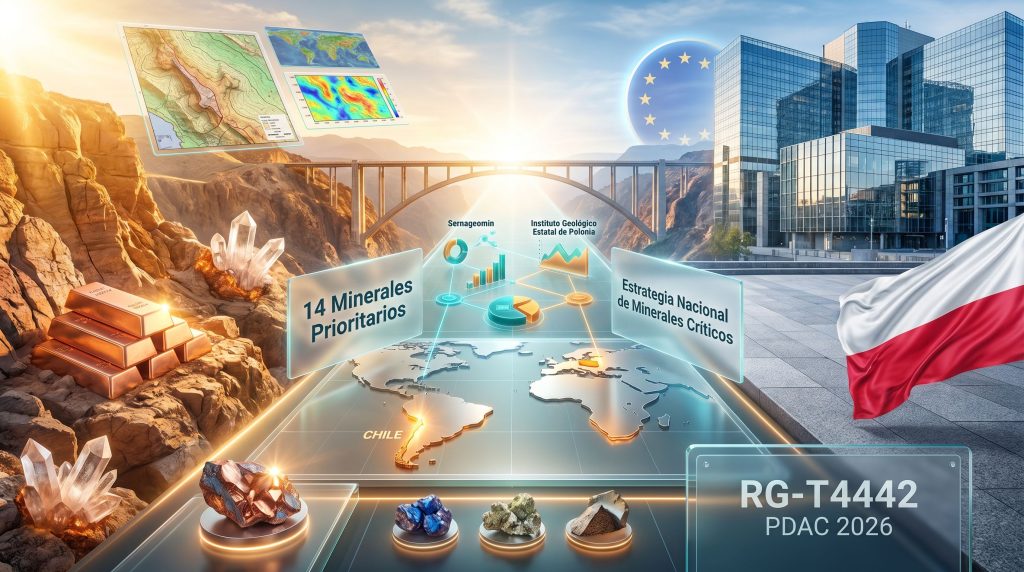
Chile launched its Estrategia Nacional de Minerales Críticos (EMC) in January 2026, identifying 14 priority minerals as central axes of national development policy. These include copper, lithium, cobalt, and rare earth elements — minerals now recognised globally as essential inputs for batteries, renewable energy infrastructure, and decarbonisation technologies. Furthermore, critical minerals demand growth is reshaping how governments prioritise geological services and institutional capacity. Sernageomin contributed geological analysis throughout 2024 and 2025 as technical input for the EMC, working alongside the Comisión Chilena del Cobre (Cochilco) and teams coordinated through Inter-American Development Bank (BID) financing.
This institutional positioning means that when Sernageomin director Mauricio Lorca met with Polish delegation leader Krzysztof Galos in May 2026, it was not simply a technical courtesy visit. It was an expression of Chile's broader strategy of embedding its geological services within an expanding network of international alliances.
The ability of a national geological service to provide verifiable, standardised, and internationally credible technical certainty within its mining concession processes functions as a risk-reduction mechanism for international capital, compressing the information asymmetry that typically inflates investor risk premiums in emerging market mining jurisdictions.
Poland's Underappreciated Role in the Global Critical Minerals Architecture
Poland is rarely the first country that comes to mind when critical minerals discussions arise. Its significance is institutional rather than extractive. The country's State Geological Institute has developed substantial expertise in designing mineral resource governance policies that comply with European Union regulatory standards, including environmental impact frameworks, mineral data classification systems, and technical standards for operational licensing.
Within the EU's broader effort to reduce strategic dependence on China for rare earths and other critical inputs, Poland operates as a policy design and regulatory bridge, converting European-level principles into actionable national frameworks. In addition, the European critical raw materials strategy has intensified demand for partners capable of aligning with EU-standard governance. This makes Poland's geological institute a genuinely valuable partner for countries like Chile that are building or modernising their own critical minerals governance systems.
The institutional value Poland offers is best understood through a knowledge-gap framework rather than a resource-volume framework. Chile has the minerals in the ground. Poland has developed the policy architecture for managing those kinds of resources within one of the world's most demanding regulatory environments. The bilateral value exchange is therefore complementary rather than competitive.
| Institutional Dimension | Sernageomin (Chile) | Polish State Geological Institute |
|---|---|---|
| Core technical strength | Geological and geophysical data generation | Mineral resource policy within EU frameworks |
| Current modernisation priority | Cartographic technology and mapping precision | Supply chain diversification partnerships |
| Bilateral opportunity | Access to European regulatory methodologies | Field geology and critical minerals data |
| Regulatory orientation | Chilean mining concession technical standards | EU environmental and technical compliance standards |
The Three Technical Pillars of the Cooperation Agenda
The meeting produced a structured cooperation agenda built around three operational axes. Understanding each axis reveals the depth of what is being exchanged and why it matters beyond the headline level.
Methodological Exchange in Geological Research
The first pillar involves the transfer of geological research approaches between the two national services. This goes beyond sharing documents or publications. Methodological exchange means aligning the processes by which each institution interprets geophysical data, classifies mineral systems, and integrates field observations with remote sensing outputs.
When two geological services align their methodologies, they create the conditions for mutual data comparability. This is technically significant because it allows Chile to benchmark its mineral characterisation approaches against EU-standard equivalents, potentially raising the credibility of Chilean geological data in European investment and policy contexts. For further context on how rare earth supply chains are influencing these institutional alignments, the strategic rationale becomes even clearer.
Cartographic Modernisation and Precision Mapping
The second pillar targets one of the most consequential technology frontiers in modern resource exploration: the generation of high-precision geological maps using advanced remote sensing, AI-assisted geophysical data interpretation, and three-dimensional subsurface modelling.
Modern geological mapping has undergone a fundamental transformation in the past decade. The integration of satellite-derived hyperspectral data, airborne electromagnetic surveys, and machine learning classification algorithms has enabled geological services to identify subsurface mineral concentrations with a level of resolution previously inaccessible without extensive and costly drilling programmes. Poland's experience applying these methodologies within EU-funded exploration programmes represents a directly transferable technical asset for Sernageomin, which manages some of the geologically most complex and mineral-rich terrain on Earth.
Chile's Andean territory, spanning a vast range of geological environments from porphyry copper systems to lithium-bearing salt flats and polymetallic volcanic arcs, constitutes a natural laboratory of exceptional diversity. Applying European advances in precision cartography to this terrain could accelerate the identification of previously unmapped critical mineral concentrations, particularly in areas with lower existing cartographic coverage.
Binational Research for Natural Resource Systems
The third pillar involves the joint development of research projects oriented toward studying natural resource systems. This is the most open-ended of the three axes, but also potentially the most durable in terms of long-term institutional relationship building. Joint research creates co-authorship, shared datasets, institutional trust, and academic networks that can outlast any individual bilateral agreement.
The emphasis on systems rather than individual deposits is technically significant. A systems-level approach to mineral resource research examines the geological processes that generate mineralisation, the structural and geochemical conditions that control deposit formation, and the landscape-scale distribution of mineralisation potential. This produces knowledge that is generative rather than merely descriptive, enabling better predictive models for new deposit identification.
Mining Tailings and the Circular Economy Dimension
One of the more forward-looking elements of the bilateral agenda involves the potential of mining tailings as secondary critical mineral sources. This connects directly to circular economy principles already embedded in EU regulatory frameworks and that Poland applies within its national mining governance system. According to Sernageomin's official announcement, the cooperation explicitly identifies tailings reprocessing as a key axis of the joint agenda.
Mining tailings are the solid residues generated during ore processing. Historically treated as waste requiring containment and environmental management, they are increasingly recognised as repositories of residual critical mineral concentrations that could not be economically recovered using earlier processing technologies.
Several factors make this dimension particularly relevant for Chile:
- Chile has accumulated decades of tailings deposits from large-scale copper and other metal production, many of which contain concentrations of cobalt, molybdenum, rhenium, and other critical minerals
- Advances in hydrometallurgical processing, bioleaching, and selective flotation technologies have improved the economic viability of secondary recovery from low-grade tailings materials
- Processing existing tailings reduces the environmental footprint of meeting growing critical minerals demand by deriving value from passive waste rather than opening new extraction fronts
- EU circular economy frameworks provide tested policy and technical models for regulating and incentivising tailings reprocessing programmes
The knowledge Poland can transfer in this domain is not primarily geological but regulatory and commercial: how to design policy frameworks that make tailings reprocessing economically viable within an environmental compliance structure acceptable to sophisticated capital markets.
The BID-EU Regional Architecture and Where This Cooperation Fits
The bilateral Sernageomin-Poland engagement does not exist in isolation. It connects to a broader regional institutional architecture anchored by BID project RG-T4442, approved in September 2024 with European Union financing. This project provides technical assistance to five Latin American countries — Chile, Argentina, Bolivia, Brazil, and Ecuador — focused specifically on critical minerals governance.
This framework creates the institutional connective tissue that allows bilateral technical partnerships, like the cooperación técnica entre Sernageomin y Polonia sobre minerales críticos, to scale into broader multilateral frameworks. The potential for this specific bilateral relationship to serve as a pilot case within the larger BID-EU architecture is real, given that Chile is a direct beneficiary of the regional programme and Poland represents EU interests in critical minerals supply diversification.
Furthermore, Europe's critical minerals supply chain strategy is actively seeking southern hemisphere partners with credible institutional frameworks, making Chile's engagement with Poland particularly well-timed. The April 2026 PDAC conference in Toronto, where Chile's delegation was led by Mining Minister Aurora Williams with active Sernageomin participation, demonstrated that Chile is not operating passively in this landscape.
The next major ASX story will hit our subscribers first
Technical Certainty as an Investable Asset
A thread running through the entire bilateral discussion is the concept of certeza técnica — technical certainty — as both a regulatory product and an investment enabler. This concept deserves careful examination because it represents a relatively sophisticated articulation of how institutional quality translates into capital market outcomes.
In mining investment, technical certainty refers to the reliability and verifiability of the geological, legal, and regulatory information underpinning a concession or exploration licence. When a geological service can demonstrate that its data generation methodologies are rigorous, that its concession processes are legally robust, and that its regulatory standards are internationally comparable, it reduces the information discount that investors apply when evaluating projects in jurisdictions with weaker institutional frameworks.
For international investors evaluating projects in Chile, Sernageomin's capacity to provide this certainty is a quantifiable risk-reduction factor. Aligning Chilean methodologies with EU-equivalent standards — the implicit goal of the Poland cooperation — would further strengthen that positioning in European capital markets specifically. This is also why critical minerals and energy security are now inseparable from institutional quality debates at the highest levels of policy.
Scenarios for Deepening the Partnership
The May 2026 meeting represents a starting point rather than an endpoint. Both delegations characterised the cooperation as a proposed agenda still in the definition and formalisation phase. Several concrete pathways could advance or limit the depth of what emerges.
| Development Scenario | Required Conditions | Potential Impact |
|---|---|---|
| Formal MOU between Sernageomin and Polish Geological Institute | Political will and institutional alignment | Systematic methodology and data exchange |
| Jointly funded binational research project | BID-EU co-financing or bilateral funding mechanism | Scientific publications and new geological maps |
| Circular economy pilot for tailings reprocessing | Technology transfer and regulatory alignment | Critical mineral recovery from existing passive waste |
| Integration into EU-Latin America geological network | Coordination with broader BID-EU RG-T4442 framework | Chile positioned as regional geocientific hub |
Key indicators to watch include the formalisation of a memorandum of understanding between the two institutions, the announcement of jointly funded research projects with defined outputs and timelines, the integration of European cartographic methodologies into Sernageomin's standard mapping programmes, and any formal policy dialogue on tailings reprocessing frameworks informed by EU circular economy experience.
What This Model of Geological Diplomacy Signals for the Decade Ahead
The broader significance of bilateral geological service cooperation — the kind demonstrated by the cooperación técnica entre Sernageomin y Polonia sobre minerales críticos — is that it represents a form of diplomacy operating below the threshold of commodity trade agreements and investment treaties, but with potentially greater durability. Analysts examining Latin America's critical minerals positioning have noted that institutional technical relationships built on shared methodologies and aligned regulatory frameworks tend to be more resilient to political cycles than commercial agreements tied to individual projects or commodity price environments.
As the energy transition advances and demand for the 14 minerals identified in Chile's EMC continues to intensify, the countries that will capture the greatest value from their natural endowments will not simply be those with the largest reserves. They will be those with the most credible, technically sophisticated, and internationally integrated geological institutions. Consequently, for Chile, building that institutional network — through partnerships like the one initiated with Poland, through PDAC participation, and through the regional BID-EU governance framework — is how geological sovereignty translates into long-term economic leverage in the critical minerals era.
Disclaimer: This article is intended for informational purposes only and does not constitute investment advice. References to strategic cooperation frameworks, policy initiatives, and research programmes reflect information available at the time of reporting. The bilateral cooperation between Sernageomin and Poland remains in an early formalisation phase, and future outcomes are subject to institutional, political, and funding variables that cannot be predicted with certainty.
Want To Identify The Next Major Critical Minerals Discovery Before The Broader Market?
Discovery Alert's proprietary Discovery IQ model delivers real-time alerts on significant ASX mineral discoveries — instantly translating complex geological and commodity data across 30+ sectors into actionable investment insights, giving subscribers a decisive edge as the global critical minerals race intensifies. Explore historic discoveries and their extraordinary returns on Discovery Alert's dedicated discoveries page, or start your 14-day free trial today and position yourself ahead of the next transformative find.