May 12, 2026
The Geological Bet That Could Reshape Arctic Critical Mineral Supply
Few corners of the mineral exploration world generate as much anticipation as a first drill hole into a genuinely untested magmatic system. The mechanics are straightforward in theory: a body of mafic or ultramafic magma cools slowly beneath the surface, sulfide liquids separate and sink, and base metals concentrate into sulfide pools far richer than anything achievable through sedimentary or hydrothermal processes. In practice, finding one of these systems intact, accessible, and in a jurisdiction where it can be developed is extraordinarily rare.
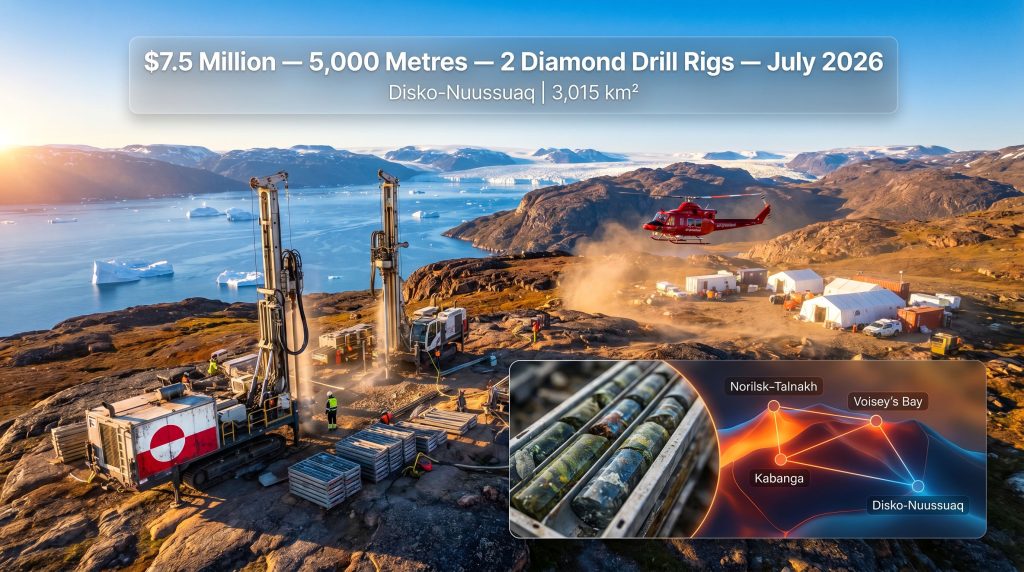
That rarity is precisely what makes the 80 Mile Greenland summer drilling campaign at Disko-Nuussuaq so closely watched. With two diamond drill rigs scheduled to turn in the first week of July 2026 and a fully funded programme behind them, this West Greenland project is entering the phase that separates geological promise from mineral discovery.
When big ASX news breaks, our subscribers know first
What Kind of Deposit Is Actually Being Targeted?
Understanding why this campaign matters requires a brief detour into deposit geology. Magmatic nickel deposits are fundamentally different from the volcanogenic massive sulfide (VMS) systems that dominate many exploration textbooks. While VMS deposits form on the seafloor through hydrothermal venting, magmatic massive sulfide (MMS) deposits originate deep within cooling igneous intrusions, where immiscible sulfide melts physically separate from silicate magma and accumulate in structural traps.
The consequences of this process are significant:
- Metal grades in MMS systems tend to be exceptionally high, because sulfide liquids are highly efficient at scavenging nickel, copper, cobalt, and platinum group elements (PGEs) from surrounding magma
- The four metals targeted at Disko-Nuussuaq (Ni, Cu, Co, and PGEs) frequently co-occur in a single system because they are all chalcophile elements with similar geochemical affinities for sulfide melts
- Deposit footprints can be very large, since sulfide accumulation is controlled by structural geometry rather than surface hydrothermal activity
The geological analogy drawn by 80 Mile between Disko-Nuussuaq and Russia's Norilsk-Talnakh district is a statement about deposit style, not confirmed scale. Norilsk-Talnakh is a Permian-age intrusive system in Siberia that produces roughly 180,000 tonnes of nickel and over 400,000 tonnes of copper annually through Nornickel's operations, making it the world's single most important source of both metals. Describing Disko-Nuussuaq's setting as geologically analogous is a meaningful claim in exploration terms, but investors should treat it as a thesis rather than a forecast. Drilling will determine whether the comparison holds at the grade and tonnage level.
A 3,015 km² Licence in One of the World's Most Underexplored Geological Terranes
The Disko-Nuussuaq exploration licence covers 3,015 km² of West Greenland's coastline, an area roughly comparable to Luxembourg. Greenland's geological basement spans multiple Archaean and Proterozoic terranes that have been largely shielded from the kind of intensive modern exploration that has systematically catalogued mineral endowments in Canada, Australia, and Scandinavia. Ice cover, logistical remoteness, and the narrow seasonal access window have historically limited exploration density across the island.
This creates an unusual situation in contemporary mineral exploration: large tracts of geologically prospective crust that have never been drill-tested. For the specific deposit type being targeted at Disko-Nuussuaq, the absence of historic drilling is not necessarily a negative signal. MMS systems rarely produce the kind of surface expression that draws immediate exploration attention. Geophysical anomalies, rather than outcropping mineralisation, typically guide targeting in this deposit style.
The four primary metal targets at Disko-Nuussuaq sit at the centre of the energy transition supply debate, where critical minerals demand continues to intensify:
| Metal | Primary End Use | Supply Concentration Risk |
|---|---|---|
| Nickel | EV battery cathodes, stainless steel | Indonesia (46% of mine supply) |
| Copper | Wiring, motors, renewables infrastructure | Chile and Peru (~40% combined) |
| Cobalt | Battery chemistry, superalloys | DRC (~70% of mine supply) |
| PGEs | Fuel cells, catalytic converters, electronics | South Africa and Russia (~90% combined) |
Both the United States Geological Survey (USGS) and the European Union's Critical Raw Materials framework formally classify cobalt and PGEs as critical minerals, citing supply concentration and substitution difficulty. Nickel and copper face no formal critical designation in most frameworks but are nonetheless considered strategically important given projected demand growth from electric vehicle manufacturing and grid-scale energy storage.
From Joint Venture Exit to Full Operational Control
The history of the Disko-Nuussuaq project adds important context to the current drilling campaign. In 2022, 80 Mile entered a joint venture agreement with KoBold Metals, a technology-oriented mineral exploration company that applies machine learning and geophysical data integration to target generation. KoBold deployed approximately $13.4 million across the project during its period of involvement, conducting surveys and generating substantial exploration data.
However, the earn-in structure required KoBold to advance the project to drilling within a defined timeframe. When that milestone was not achieved, the contractual reversion mechanism operated as designed: KoBold's 49% interest returned to 80 Mile. The exit was structured with a 2% net smelter return (NSR) royalty retained by KoBold on any future production.
Several aspects of this outcome are worth examining carefully:
- A 2% NSR royalty is a standard, relatively low-burden royalty in exploration-stage mining. It does not impair development economics at early stage and only becomes financially material upon commencement of commercial production.
- KoBold left behind approximately £750,000 worth of field equipment, which transferred to 80 Mile. In remote Arctic environments, established field infrastructure carries outsized operational value relative to its monetary worth, given the cost and complexity of mobilisation.
- The $13.4 million in prior expenditure, while not resulting in a discovery, generated a geological dataset that informs current target selection. In MMS exploration, geophysical data quality is the primary determinant of drill target quality. Prior investment in airborne and ground geophysics is therefore not wasted capital; it is the intellectual foundation for the current programme.
The reversion of KoBold's interest did not reflect a negative geological assessment of the project. It reflected a failure to meet contractual drilling milestones, a distinction that is critically important when evaluating the project's current standing.
Following the JV dissolution, 80 Mile confirmed that exploration licences remained valid with Greenlandic authorities, that expenditure commitments recognised during KoBold's tenure preserved permit standing, and that full drilling permits were subsequently secured to enable the 2026 campaign.
USFM Corporation: The Funding Architecture Behind the Summer Campaign
The financial structure underpinning the 80 Mile Greenland summer drilling campaign at Disko-Nuussuaq was established through an earn-in agreement with USFM Corporation (United States Fuel and Mining). The scale of this arrangement is notable for an exploration-stage project:
| Parameter | Detail |
|---|---|
| Total Earn-In Commitment | Up to $30 million |
| Equity Earned at Full Completion | 51% interest in the project |
| Initial Programme Budget | $7.5 million (fully funded by USFM) |
| Drill Programme Scope | 5,000 metres across 2 diamond drill rigs |
| Programme Start | First week of July 2026 |
The earn-in structure has important implications for 80 Mile's existing shareholders. Because USFM is funding the initial $7.5 million programme directly as part of its earn-in obligations, 80 Mile does not need to raise capital to fund drilling. This preserves existing shareholder equity positions during the initial exploration phase and removes near-term dilution risk, which is one of the most common sources of investor concern in small-cap exploration companies.
The broader $30 million commitment represents a meaningful signal of conviction. Earn-in agreements of this magnitude at the pre-resource stage are typically reserved for projects where target quality, geological data, and jurisdictional conditions are sufficiently compelling to justify large sequential capital deployment. Furthermore, the structure effectively means USFM has committed to spending up to $30 million before acquiring majority control, with each tranche of funding tied to continued work programme delivery.
Earn-in joint ventures place exploration execution risk on the funding partner rather than the asset holder. For 80 Mile shareholders, this means the project advances without dilutive equity raises, while USFM bears the financial risk of the initial programme.
The Operational Team and Logistical Framework
Executing a diamond drilling campaign in the Arctic requires a specific combination of technical expertise and logistical capability that differs substantially from drilling in more accessible environments. The service provider selection for this campaign reflects those demands.
Forage Fusion Drilling has been contracted for rig operations. Diamond core drilling in an Arctic geological setting requires rigs capable of handling variable overburden conditions, permafrost interfaces, and the core recovery challenges associated with highly competent crystalline basement rocks typical of Greenlandic geology.
SRK Exploration is engaged as geological manager, responsible for target prioritisation, real-time core logging, and technical oversight of the programme. SRK is one of the mining industry's most established independent technical consultancies, with extensive experience in geological programme management across multiple jurisdictions. Their involvement adds institutional credibility to the technical execution and provides the kind of independent oversight that supports future resource estimation processes.
Air Greenland provides logistical and aviation support for crew and equipment mobilisation. In a remote Arctic environment with no road access to drill sites, helicopter and fixed-wing support from a locally based carrier is an operational necessity rather than a logistical convenience. Air Greenland's knowledge of Greenlandic operating conditions, weather patterns, and airspace management is directly relevant to programme execution reliability.
Why the July Start Date Matters
Greenland's accessible drilling season is genuinely short. The practical ground-based exploration window runs from approximately late June through early September, constrained by ice conditions, frozen terrain, and weather deterioration in autumn. A July start date is strategically positioned to capture the maximum portion of this window with two rigs operating simultaneously. The 5,000-metre programme is designed to be completed within a single summer campaign, meaning results could be available for market disclosure in the October-to-December timeframe, depending on laboratory turnaround times for assays.
The next major ASX story will hit our subscribers first
Benchmarking Against Global Magmatic Sulfide Systems
Placing Disko-Nuussuaq in comparative context requires examining the track record of MMS exploration globally. The deposit type has produced some of the most economically significant mineral discoveries of the past century. Understanding the mineral deposit tiers involved helps contextualise just how significant a world-class MMS system can be:
| System | Location | Primary Metals | Development Status | Key Characteristics |
|---|---|---|---|---|
| Norilsk-Talnakh | Russia | Ni, Cu, PGE | Producing (Nornickel) | World's largest MMS system; Permian age |
| Voisey's Bay | Canada | Ni, Cu, Co | Producing (Vale) | Discovered 1993; ~88Mt initial resource at 1.5% Ni |
| Sudbury Basin | Canada | Ni, Cu, PGE | Producing (multiple operators) | Impact-origin; oldest major MMS producer |
| Kabanga | Tanzania | Ni, Cu, Co | Development stage | ~62Mt indicated resource grading ~1.2% Ni |
| Disko-Nuussuaq | Greenland | Ni, Cu, Co, PGE | Exploration (pre-drill) | Geological analogue; first drilling July 2026 |
Voisey's Bay is the most instructive modern analogue from an exploration pathway perspective. Its 1993 discovery transformed understanding of MMS potential in the North American Arctic and ultimately delivered a world-class resource that anchored Vale's nickel strategy for decades. The discovery was made through surface prospecting followed by targeted drilling of geophysical anomalies, a sequence not dissimilar to the approach being applied at Disko-Nuussuaq.
The critical difference is that Voisey's Bay has an independently verified resource with declared grades and tonnages. Disko-Nuussuaq does not yet have a single drill hole result. The comparison is aspirational and geological, not confirmatory.
Greenland's Position in the Western Critical Minerals Supply Chain
Greenland occupies a peculiar position in the global critical minerals debate. Its geology is genuinely exceptional, hosting documented occurrences of rare earth elements, base metals, and PGEs across multiple geological terranes. The Geological Survey of Denmark and Greenland (GEUS) has catalogued hundreds of mineral occurrences across the island, many of which remain undrilled. Greenland's critical minerals profile has, consequently, attracted considerable Western government attention in recent years.
Western governments, particularly the United States and European Union members, have actively sought to accelerate development of non-Chinese, non-Russian mineral supply chains as a structural policy response to the supply concentration risks described earlier. China controls approximately 60% of global cobalt refining capacity and a significant proportion of PGE processing, while Russia's Nornickel alone accounts for roughly 40% of global palladium supply. These concentrations represent genuine systemic vulnerabilities for industries dependent on these materials.
The Greenland mining geopolitics surrounding the territory have progressively shaped its regulatory environment. Greenland's autonomous government, Naalakkersuisut, has progressively opened the territory to foreign exploration investment, though all projects must navigate environmental assessments and community consultation requirements. The licensing framework requires operators to maintain active expenditure commitments and adhere to environmental standards comparable to those applied in Nordic jurisdictions.
It is important to be precise about what this means for Disko-Nuussuaq specifically: the broader geopolitical context creates favourable conditions for Western-aligned exploration projects in Greenland, but this should not be interpreted as project-specific government support, accelerated permitting, or any form of official endorsement. 80 Mile is operating within Greenland's standard licensing framework, not under any special designation.
The Nine-Stage Pathway From Permits to Results
For readers unfamiliar with how a remote Arctic drilling campaign actually unfolds, the process from regulatory clearance to market disclosure follows a defined sequence:
- Permit finalisation – Confirmation that all exploration and environmental permits are current and valid for the planned programme scope
- Target ranking – SRK Exploration's geological management role begins here, integrating KoBold's historical data and prior survey results to prioritise drill collar positions
- Equipment and crew mobilisation – Forage Fusion rigs, core handling equipment, and camp infrastructure are transported via Air Greenland to the drill site locations
- Site establishment – Water supply, core handling facilities, and safety infrastructure are set up before drilling commences
- Drilling execution – Diamond core drilling proceeds to planned target depths, with continuous core recovery from surface to target horizon
- Real-time geological logging – SRK geologists examine and log core as it is recovered, identifying mineralised intervals, alteration zones, and structural features
- Sample selection and dispatch – Intervals of geological interest are cut, bagged, and shipped to accredited laboratories for multi-element geochemical analysis
- Assay integration – Laboratory results are returned and integrated with the geological model to assess mineralisation grade, width, and continuity
- Market disclosure and follow-up planning – Results are reported to shareholders, and programme outcomes inform the design of any subsequent drilling phases
Laboratory turnaround times for Arctic exploration campaigns typically run four to eight weeks from sample receipt, meaning first assay results from a July start could begin reaching the market by October or November 2026, subject to sample volumes and laboratory scheduling.
Risk Framework: What Can Go Wrong and Why It Matters
No honest assessment of an exploration-stage drilling campaign is complete without a frank treatment of the risk landscape. The following risks are material and specific to this programme:
- Geological risk is the dominant concern. Geophysical anomalies that prompted target selection may not correspond to economic sulfide mineralisation. The presence of a magmatic intrusion does not guarantee that sulfide liquid segregation occurred, or that any accumulated sulfides reached economic grade and tonnage thresholds.
- Logistical and weather risk is elevated in Arctic environments. Equipment failures, weather delays, ice conditions, and supply chain disruptions can curtail drilling windows with limited ability to recover lost time within a single season.
- Assay risk exists even when mineralised intervals are intersected. Visual or logging estimates of grade can differ substantially from laboratory assay results. High-grade visual estimates have historically disappointed on assay in poorly-mineralised systems.
- Regulatory continuity risk reflects the fact that Greenlandic mining policy continues to evolve. Environmental requirements, community consultation obligations, and political priorities can change between exploration and development phases.
- Funding sequencing risk applies to phases beyond the initial $7.5 million programme. USFM's continued investment is tied to programme milestones and results. Disappointing initial drilling could affect the pace or scale of subsequent earn-in contributions.
This is characteristic binary risk territory for early-stage mineral exploration. The July 2026 drilling campaign will either validate the geological thesis and catalyse further investment, or require substantial reassessment of target quality and programme design. There is no middle outcome at this stage.
This article is informational only and does not constitute financial advice. Mineral exploration involves significant uncertainty, and past analogies or geological comparisons do not guarantee discovery outcomes. Readers considering investment in exploration-stage companies should seek independent financial advice and review all available company disclosures.
Key Milestones to Monitor Through Late 2026
For investors and industry observers tracking the 80 Mile Greenland summer drilling campaign at Disko-Nuussuaq, the following near-term and medium-term catalysts define the value pathway.
Near-Term Catalysts (July to December 2026)
- Confirmation of drilling commencement and first rig operational updates
- Geological progress reports from SRK on core logging and visual mineralisation observations
- First batch of assay results from priority drill holes, expected approximately six to twelve weeks after core submission
Medium-Term Pathway (2027 and Beyond)
- If initial results are positive, continued USFM earn-in funding supports expanded drilling towards the full $30 million commitment
- Positive intersections could attract additional strategic partnership interest or institutional investor attention from larger mining companies evaluating the deposit's scale potential
- A maiden mineral resource estimate, which requires sufficient drill data to support a JORC or NI 43-101 compliant calculation, would represent a transformational milestone that fundamentally re-rates the project's perceived value
Broader Portfolio Leverage
Disko-Nuussuaq is 80 Mile's flagship asset, but the company also holds interests in other Greenlandic projects including Jameson Land and Dundas Ilmenite. Success at Disko-Nuussuaq would materially re-rate the company's entire Greenlandic portfolio, given the geological credibility and institutional interest that a positive discovery generates across proximal exploration ground. Indeed, Mining Magazine's coverage of the campaign highlights the broader industry attention this programme has attracted.
The Arctic mineral frontier has produced world-class discoveries before. Whether Disko-Nuussuaq joins that list will be answered in the rock core recovered from West Greenland's brief summer window, beginning in July 2026.
For ongoing coverage of global drilling operations and Arctic mineral exploration campaigns, GeoDrilling International publishes daily industry news at geodrillinginternational.com.
Want to Track the Next Major Arctic Mineral Discovery in Real Time?
Discovery Alert's proprietary Discovery IQ model instantly scans ASX announcements to identify significant mineral discoveries — the kind of magmatic nickel, copper, cobalt, and PGE systems that have historically generated extraordinary investor returns, as showcased on Discovery Alert's dedicated discoveries page. Begin your 14-day free trial at Discovery Alert and position yourself ahead of the market when the next world-class discovery is announced.