May 12, 2026
When Geology Speaks Louder Than Headlines: Decoding Chile's Next Big Porphyry Discovery
The most consequential moments in junior mining exploration rarely announce themselves loudly. They arrive quietly, buried in drill core data, expressed through subtle shifts in alteration mineralogy and sulphide density at depth. For investors and geologists who understand what they are looking at, these signals carry more weight than any press release. The San Lorenzo Gold Arco de Oro Chile discovery is generating serious attention not because of marketing narratives, but because the geology itself is behaving in ways that suggest something considerably larger than initially anticipated.
When big ASX news breaks, our subscribers know first
Understanding the Geological Setting Behind the Arco de Oro System
Chile's Atacama Region is not a coincidental address for a copper-gold exploration project. The country hosts the world's most concentrated cluster of large-scale porphyry copper-gold-molybdenum deposits, a geological reality shaped by hundreds of millions of years of subduction tectonics along the South American continental margin. Furthermore, the Chile copper outlook confirms that the mega-porphyry belt stretching through northern Chile has produced a disproportionate share of the world's copper supply and continues to yield new discoveries as exploration technology and geological understanding deepen.
San Lorenzo Gold Corp., a Canadian junior explorer listed on the TSX Venture Exchange under the ticker SLG, controls the Salvadora property within this geological corridor. The property spans 9,062 hectares in the Atacama Region and sits approximately 15 kilometres from Codelco's El Salvador mine, one of Chile's historically significant copper-gold operations. That proximity is not simply a marketing talking point.
In porphyry geology, large magmatic-hydrothermal systems frequently cluster within the same structural corridors, sharing plumbing connections to deeper intrusive sources. El Salvador's existence in the regional neighbourhood raises the geological probability that comparable or related systems exist within striking distance.
The presence of a world-class producing porphyry mine within 15 km of an early-stage exploration property does not guarantee discovery, but it does confirm the regional geological architecture is capable of generating large-scale mineralisation. That context shapes how exploration results from Salvadora should be interpreted.
What Makes a Porphyry System Different From an Ordinary Gold Discovery?
For readers less familiar with the technical distinction, porphyry copper-gold systems differ fundamentally from narrower high-grade epithermal vein deposits. Porphyry systems are characterised by:
- Large tonnage potential, often containing hundreds of millions to billions of tonnes of mineralised material
- Lower average grades distributed across broad, geometrically continuous zones
- A characteristic alteration zonation pattern, with potassic alteration at the core transitioning outward and upward to phyllic and propylitic assemblages
- Copper and gold hosted in disseminated sulphides and sulphide veinlets rather than discrete veins
- Economic viability based on bulk mining at scale rather than selective high-grade extraction
The presence of epithermal gold mineralisation near the surface above a deepening potassic alteration core is a classic transitional signature. It indicates the drill program is approaching a system from the top, with the economically critical porphyry core remaining at depth. Understanding ore deposit formation helps contextualise why these structural indicators carry such significance for project scale potential.
Five Targets, One Flagship: The Salvadora Property Framework
Salvadora is not a single-target property. The 9,062-hectare land package hosts five distinct high-priority exploration zones, each representing a different expression of the broader hydrothermal system:
| Target Zone | Mineralisation Style | Exploration Stage |
|---|---|---|
| Arco de Oro | Epithermal/Porphyry Cu-Au | Active drilling — flagship priority |
| Cerro Blanco | Porphyry | Advanced investigation |
| Tres Amigos | Porphyry | Under evaluation |
| Caballo Muerto | Epithermal | Early-stage |
| Caballo South | Epithermal | Early-stage |
The multi-target architecture is significant for two reasons. First, it provides geological redundancy. If one target underperforms, others can sustain exploration momentum. Second, the distribution of porphyry and epithermal targets across a single land package suggests a district-scale hydrothermal system rather than an isolated occurrence.
The Arco de Oro target currently commands the greatest attention. What began as an epithermal gold vein system is revealing deeper characteristics consistent with a transitional porphyry environment. Recent drilling has expanded the known footprint of the mineralised corridor from an initial 1.3 km to a potential strike length approaching 5 km, with all lateral and depth extensions remaining geologically open.
The San Juan Sector: Why a 3.9 km Step-Out Changes Everything
The most strategically significant recent development at Salvadora is the identification of the San Juan sector, located approximately 3.9 kilometres northwest of prior drilling. In exploration terms, a step-out of this scale is not routine. It represents a fundamental reassessment of system dimensions.
When meaningful mineralisation is confirmed at a 3.9 km offset from known drilling, it forces geologists to reconsider whether they are looking at:
- A single continuous large-scale system extending across the full distance
- Multiple separate but related mineralised centres within the same structural corridor
- A district-scale hydrothermal system with several mineralised loci connected at depth
Any of these interpretations carries major implications for scale potential. The San Juan sector now represents the critical next exploration vector, with follow-up drilling targeting confirmation of mineralisation continuity at this extended step-out distance.
Dissecting the Drill Results: What the Numbers Actually Mean
The most recent drilling campaign at Arco de Oro has produced a body of intercept data that allows for preliminary interpretation of system scale, grade distribution, and architectural complexity. Importantly, every drill hole completed at the Arco de Oro target to date has returned meaningful gold mineralisation — a consistency rate that is statistically uncommon in early-stage exploration.
Consequently, interpreting drill results at this stage requires understanding not just individual intercepts but the broader geological pattern they collectively define.
SAL 10-25: The Flagship Intercept and Its Deeper Significance
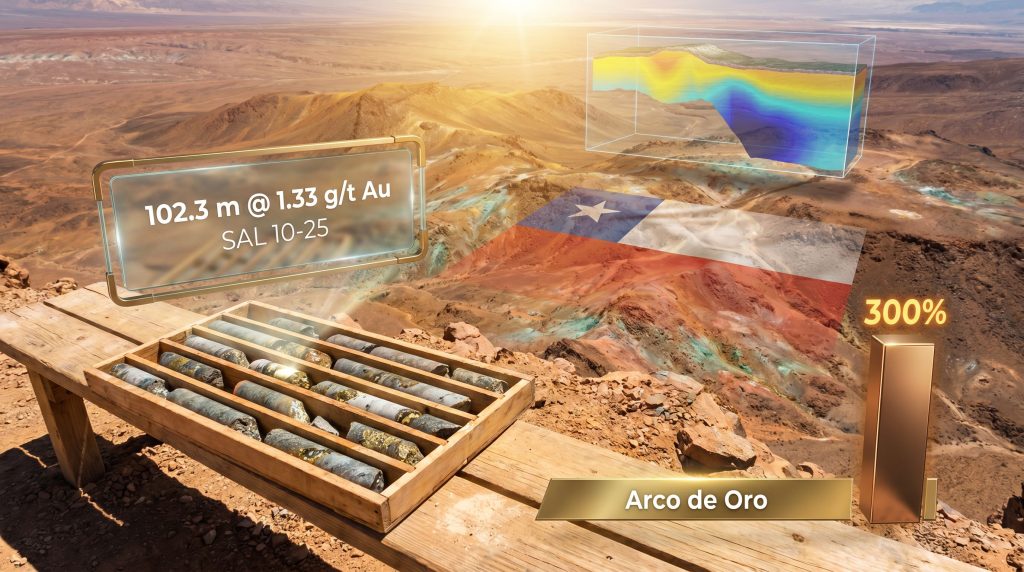
Hole SAL 10-25 delivered the project's most compelling single intercept to date:
- 102.3 metres at 1.33 g/t gold from 153 m depth (headline interval)
- 13.3 metres at 2.21 g/t Au included within the broader zone (higher-grade core)
- 33.7 metres at 1.48 g/t Au as a secondary enriched interval
- 37.6 metres at 2.01 g/t Au from 310 m depth (deep high-grade continuation)
The CEO of San Lorenzo Gold, Al Kroontje, confirmed that the company released partial results from this hole specifically because of its geological relevance, noting that assay results from deeper sections were still pending. The significance of this partial release is itself informative: management's assessment is that the deeper portions of SAL 10-25 may ultimately prove more important than the already-notable upper intervals.
In porphyry exploration, the strengthening of potassic alteration with depth, accompanied by increasing sulphide veinlet density, is one of the most reliable indicators of proximity to the magmatic-hydrothermal core. The fact that these indicators are intensifying in the lower portions of SAL 10-25 suggests the most economically critical parts of the system may remain untested.
SAL 09-25: Stacked Zones and Structural Complexity
Hole SAL 09-25 demonstrated a multi-zone mineralisation architecture that adds a different dimension to the geological picture:
- 58.5 metres at 1.07 g/t Au from 238 m depth, including 11.1 metres at 3.78 g/t Au and a high-grade core of 1.6 metres at 8.53 g/t Au
- 60.3 metres at 1.01 g/t Au representing a parallel zone confirming lateral continuity
- 42 metres at 0.76 g/t Au as a volumetrically significant lower-grade interval
The presence of three distinct mineralised intervals within a single drill hole is geologically meaningful. It indicates a stacked, multi-zone system rather than a simple single-vein occurrence. This architecture is consistent with multi-stage hydrothermal activity, where successive pulses of mineralising fluids have exploited different structural pathways within the same broader system.
For investors, drill results for investors at this level of structural complexity typically signal bulk-tonnage potential rather than selective high-grade mining scenarios.
Complete Intercept Summary
| Hole ID | From (m) | Width (m) | Au Grade (g/t) | Key Feature |
|---|---|---|---|---|
| SAL 02-25 | 99.0 | 4.5 | 6.52 | High-grade epithermal; incl. 1.2 m @ 9.54 g/t |
| SAL 09-25 | 238 | 58.5 | 1.07 | Multi-zone; incl. 11.1 m @ 3.78 g/t and 1.6 m @ 8.53 g/t |
| SAL 09-25 | — | 60.3 | 1.01 | Parallel zone confirming lateral extent |
| SAL 09-25 | — | 42.0 | 0.76 | Lower-grade bulk tonnage potential |
| SAL 10-25 | 153 | 102.3 | 1.33 | Flagship intercept; incl. 13.3 m @ 2.21 g/t |
| SAL 10-25 | 310 | 37.6 | 2.01 | Deep high-grade continuation |
The Alteration Signature: Reading the Rock as a Geological Map
For investors and analysts who are not geologists, the repeated references to potassic alteration in the Arco de Oro drill reports deserve unpacking. Alteration mineralogy is not decorative information. In porphyry systems, it functions as a spatial map of where the system's core lies relative to where drilling is currently occurring.
The classic porphyry alteration zonation model works as follows:
- Potassic core: Characterised by secondary biotite and K-feldspar, coincident with the highest copper-gold grades and the densest sulphide veinlet populations. This is the most economically valuable portion of the system.
- Phyllic overprint: Secondary sericite and quartz, often overprinting potassic assemblages, associated with moderate grades and elevated gold relative to copper.
- Propylitic halo: Chlorite, epidote, and carbonate alteration in the outermost zones, generally lower grade but defining the outer boundary of the hydrothermal system.
- Argillic cap: Clay-dominant alteration near the surface, sometimes associated with high-grade epithermal gold above the porphyry system.
The deepening and strengthening of potassic alteration in SAL 10-25 indicates that drilling is moving toward the system core rather than away from it. Terence Walker, VP of Exploration, described this as evidence that the company appears to be penetrating the upper portions of a large gold-rich copper-gold porphyry system, with the intrusive complex hosting the mineralisation warranting immediate follow-up drilling to better characterise its geometry and extent.
How Does Arco de Oro Compare Geologically to the El Salvador Model?
| Characteristic | El Salvador (Codelco) | Arco de Oro (Exploration Stage) |
|---|---|---|
| Distance Relationship | 15 km from Arco de Oro | Reference point |
| System Classification | Cu-Au-Mo Porphyry | Cu-Au Porphyry (emerging) |
| Development Stage | Mature producing operation | Pre-resource; active drilling |
| Alteration Fingerprint | Potassic core, phyllic overprint | Potassic strengthening at depth confirmed |
| Infrastructure | Fully established | Road access and power access confirmed |
Market Response and Capital Positioning
The market's reaction to San Lorenzo Gold's exploration progress has been emphatic. The company's share price reached an all-time high of C$4.43, contributing to a market capitalisation of approximately C$455 million at peak, alongside a 300% year-to-date return and a single-session gain of 45% following key result announcements. Coverage from Mining.com highlighted these record-breaking milestones as the project gained broader industry recognition.
These movements reflect a particular dynamic in junior exploration markets that experienced investors recognise: the point at which a project transitions from speculative concept to geologically credible discovery. That transition is not merely psychological. It shifts the investor base from retail-driven momentum participants to institutional capital with longer time horizons and higher conviction thresholds.
A C$20 million financing round completed alongside a 300% year-to-date share price appreciation signals more than retail enthusiasm. For a pre-resource junior explorer, this level of institutional capital access reflects genuine conviction in the geological thesis. It also provides the funding runway necessary to answer the critical geological questions that will determine whether Arco de Oro is a significant discovery or a world-class one.
The C$20 million financing (approximately US$20 million) is earmarked for expanding the Salvadora drilling program and advancing the next phase of exploration. Critically, this capital base provides the company with the means to drill the San Juan sector step-out, complete the pending IP geophysical surveys, and begin defining the intrusive complex at depth, without the financial pressure that forces many juniors to compromise their exploration programs prematurely.
Understanding Junior Explorer Valuation Psychology
One factor that is not always obvious to newer market participants is how junior explorer valuations are structured relative to project development stage. At the pre-resource stage, market capitalisation is driven almost entirely by perceived discovery potential rather than discounted cash flow analysis. This creates a valuation environment where:
- Each new drill result carries outsized price impact relative to later-stage development milestones
- Consistency of results across multiple holes builds conviction faster than any single intercept
- The announcement of follow-up drilling programs signals management confidence and sustains market attention
- Capital raises at progressively higher share prices indicate institutional participation rather than dilutive emergency financing
All four of these conditions are present in San Lorenzo Gold's current situation, which partly explains why market capitalisation has expanded to levels that appear disconnected from traditional asset valuation metrics.
The next major ASX story will hit our subscribers first
The Exploration Roadmap: What Happens Next
The next phase of activity at Salvadora is structured around several concurrent workstreams, each targeting a different dimension of the geological question:
- Follow-up drilling commencing within 30 days of the most recent announcement, targeting the San Juan sector and deeper portions of the Arco de Oro core
- IP geophysical surveys designed to map the subsurface geometry of the intrusive complex, providing drill targeting precision beyond what geological mapping and prior drilling alone can deliver
- Land package expansion through the Rubi Project addition, incorporating approximately 29 square kilometres of new ground in the vicinity of the Cerro Blanco target zone
- Completion of pending assays from the deeper sections of SAL 10-25, where potassic alteration intensification and sulphide enrichment remain partially uncharacterised
The IP (Induced Polarisation) geophysical survey deserves specific mention. This technique measures the subsurface chargeability of rock, a property that responds strongly to disseminated sulphide mineralisation, the hallmark of porphyry systems. By mapping chargeability anomalies across the Salvadora property, IP surveys can delineate the three-dimensional shape of the sulphide-bearing intrusive complex, identifying drill targets with much greater spatial precision than surface geology alone permits.
The Strategic Significance of the Rubi Land Addition
The addition of 29 square kilometres of new ground near Cerro Blanco is strategically important beyond simple property consolidation. Cerro Blanco is already identified as an advanced-investigation porphyry target within the Salvadora framework. Expanding the land package around it ensures that any mineralisation extending beyond the current concession boundaries remains within the company's control, protecting the economics of any future resource development in that zone.
Commodity Context: Why Both Metals Matter Right Now
San Lorenzo Gold Arco de Oro Chile sits at a particularly favourable intersection of two simultaneous commodity demand cycles. Gold and copper are not typically discussed together as investment themes, but for copper-gold porphyry exploration projects, the dual-metal exposure is a genuine commercial advantage. In addition, copper market trends suggest that structural supply constraints are tightening across the sector, further enhancing the strategic value of early-stage discoveries.
Gold is benefiting from sustained central bank accumulation and monetary uncertainty across major economies. Unlike previous gold cycles driven primarily by retail investor sentiment, the current demand structure has a meaningful institutional and sovereign component, providing a more durable price floor than speculative cycles historically produce.
Copper is experiencing structural demand growth driven by electrification infrastructure, grid expansion, and the hardware requirements of the energy transition. Copper's role in electric vehicle drivetrains, renewable generation equipment, and transmission infrastructure creates a demand trajectory that extends well beyond a single economic cycle.
For a copper-gold porphyry project at an early exploration stage, this dual-metal demand dynamic compresses the risk profile relative to single-commodity exposure. If gold prices soften, copper revenue in a future mine plan provides economic support, and vice versa. This is a meaningful consideration when evaluating exploration-stage projects across a multi-year development horizon.
Further details on the Arco de Oro drilling program and Salvadora property can be found directly on the San Lorenzo Gold website, where the company publishes technical updates and project overviews as exploration advances.
Frequently Asked Questions
What is the Arco de Oro project?
Arco de Oro is a copper-gold exploration target within San Lorenzo Gold Corp.'s Salvadora property in Chile's Atacama Region. It exhibits characteristics of a transitional epithermal-porphyry system located approximately 15 km from Codelco's El Salvador mine.
What are the strongest drill intercepts reported to date?
The headline intercept is 102.3 metres at 1.33 g/t gold from hole SAL 10-25, with a higher-grade core of 13.3 metres at 2.21 g/t Au. Hole SAL 02-25 returned a high-grade epithermal intersection of 4.5 metres at 6.52 g/t gold, including 1.2 metres at 9.54 g/t.
How large is the mineralised corridor?
The system demonstrates a confirmed strike length ranging from 1.3 km to approximately 5 km, with mineralisation open at depths exceeding 300 metres and in all lateral directions.
How much has San Lorenzo Gold raised for exploration?
The company recently completed a financing round of approximately C$20 million (approximately US$20 million), allocated toward expanding the Salvadora drilling program.
What is San Lorenzo Gold's stock ticker?
San Lorenzo Gold Corp. trades on the TSX Venture Exchange under the ticker SLG.
Is this considered an open-pit or underground target?
The project is currently being evaluated for its potential as a large-scale open-pit copper-gold porphyry system. No formal resource estimate or mine plan has been published at this stage.
This article contains forward-looking statements and information based on publicly available data and company announcements. It is intended for informational purposes only and does not constitute financial advice. Exploration-stage mining investments carry significant risks, including geological uncertainty, commodity price volatility, and the absence of established mineral resources. Readers should conduct independent due diligence before making any investment decisions.
Want to Know When the Next Major Mineral Discovery Hits the ASX?
Discovery Alert's proprietary Discovery IQ model delivers real-time alerts the moment significant mineral discoveries are announced on the ASX, transforming complex geological data into actionable investment insights — just as it has done for landmark discoveries like those made by De Grey Mining and WA1 Resources. Explore Discovery Alert's dedicated discoveries page to understand why major porphyry and mineral discoveries can generate extraordinary returns, and begin your 14-day free trial today to position yourself ahead of the broader market.