June 5, 2026
When Two Giants Stop Competing and Start Collaborating
The mining industry has long operated on the assumption that proprietary technology and operational secrecy create competitive advantage. For most of the twentieth century, that logic held. However, a quiet structural shift is now underway in how the sector approaches its most stubborn and consequential engineering challenge: what to do with the billions of tonnes of residual material generated every time ore is processed.
Tailings management sits at the intersection of geotechnical engineering, environmental liability, water economics, and community relations. It is expensive, technically complex, and when it goes wrong, catastrophic. The fact that BHP and Rio Tinto have chosen to tackle this challenge together rather than independently signals something meaningful about how the industry now perceives the problem itself.
The BHP and Rio Tinto tailings management consortium, formalised in October 2022 and expanded through an open global partner call in May 2023, represents one of the most significant pre-competitive collaborations in recent mining history. Understanding why it exists, how it operates, and what it has produced requires first understanding the technical and systemic forces that made it necessary. This kind of initiative also reflects a broader mining sustainability transformation currently reshaping how major operators think about long-term risk.
When big ASX news breaks, our subscribers know first
The Engineering Contradiction at the Heart of Conventional Tailings Storage
To understand the impetus behind the consortium's formation, it helps to start with a technical paradox. In conventional processing operations, tailings are mixed with water to form a slurry, which is then pumped into large containment structures called tailings storage facilities, or TSFs. Water is the medium that makes this transport system function efficiently. Yet that same water also becomes the primary source of structural instability once the material is in storage.
The geotechnical behaviour of water-saturated tailings under loading, seismic activity, or prolonged hydrological stress is inherently unpredictable. Free water trapped within a storage facility creates pore pressure conditions that can trigger liquefaction — the process by which saturated material loses its structural integrity and behaves as a liquid. This mechanism has been implicated in several of the sector's most devastating dam failures.
Beyond structural risk, conventional wet storage creates a cascade of secondary problems:
- Groundwater contamination from leachate migration as chemical-laden tailings water moves through surrounding soil profiles
- Extensive land use requirements because wet tailings settle at low densities, demanding vast surface areas that can conflict with biodiversity corridors and community land tenure
- Water loss through evaporation, particularly acute at operations in arid environments like the Atacama Desert in Chile, where freshwater procurement costs are already extremely high
- Long-term monitoring liability that extends decades beyond mine closure, creating open-ended financial obligations for operators and regulators alike
The scale of the global challenge is substantial. An estimated 14 billion tonnes of tailings are produced worldwide each year, managed across more than 3,500 active storage facilities. Approximately 30 percent of those facilities carry high or extreme consequence classifications, meaning a structural failure would have severe downstream impacts on human populations and ecosystems. More than 50 significant dam failure incidents have been recorded globally since 2000, reinforcing that this is not a theoretical risk but a recurring operational reality.
The fundamental tension in conventional tailings management is that operational efficiency and long-term geotechnical stability pull in opposite directions. Addressing one has historically come at the expense of the other.
The Regulatory Inflection Point That Changed Industry Calculus
The Brumadinho tailings dam failure in Brazil in January 2019 killed more than 270 people and released a torrent of mining waste into the Paraopeba River, causing environmental destruction that persisted for years afterward. It was not the first major tailings disaster of the modern era, but it was the one that proved the existing regulatory and risk management framework was structurally inadequate.
The industry's response produced the Global Industry Standard on Tailings Management (GISTM), a framework developed collaboratively by industry bodies, the United Nations Environment Programme, and the Principles for Responsible Investment initiative. While technically voluntary in most jurisdictions, the GISTM has become institutionally embedded through investor expectations, insurance requirements, and the internal governance commitments of major operators. Furthermore, responsible mining ESG training is increasingly central to ensuring organisations can actually implement these standards at an operational level.
The standard introduced structural obligations that conventional wet tailings systems struggle to satisfy:
- Independent third-party technical reviews covering facility design, construction, and ongoing operations
- Mandatory consequence classification for all facilities, requiring operators to formally quantify downstream exposure risks
- Enhanced community disclosure obligations that extend to emergency preparedness and ongoing operational communication
- Emergency preparedness planning calibrated to the population density and vulnerability of areas downstream from each facility
Filtered tailings technology directly addresses several of these requirements by removing the conditions that make conventional facilities inherently difficult to govern. When a facility contains no free water, the primary driver of catastrophic liquefaction failure is eliminated. The structural case for filtered systems became considerably stronger once GISTM compliance moved from aspiration to operational obligation.
How Filtered Tailings Technology Actually Works
Filtered tailings systems represent a fundamentally different engineering philosophy compared to conventional slurry storage. Rather than transporting wet material to a containment facility and managing the water in situ, filtered systems remove the majority of water from tailings before they ever reach the storage area.
The process involves passing tailings slurry through large-scale mechanical filtration equipment — typically pressure filters or vacuum filters — which extract moisture until the material reaches a near-solid, stackable consistency. The resulting product, often described as a filter cake, can be transported by conveyor or truck and compacted into engineered stacks using conventional earthmoving equipment.
The operational and environmental advantages are significant:
| Performance Dimension | Conventional Wet Slurry | Filtered Stacked Tailings |
|---|---|---|
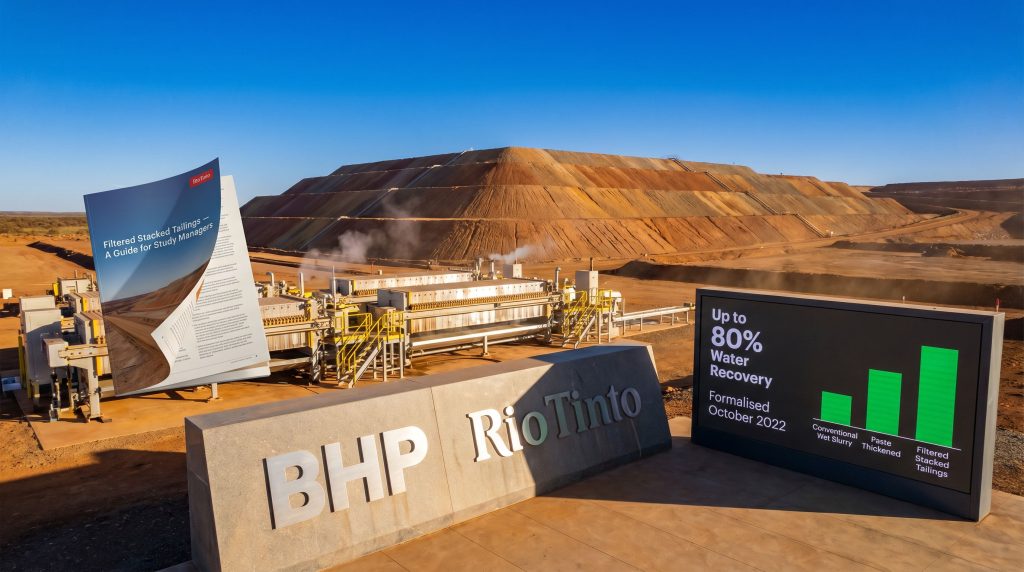
| Water recovery rate | 0 to 20 percent | Up to 80 percent |
| Free water in storage | High | Negligible |
| Liquefaction risk | High | Very low |
| Storage footprint | Large | Significantly reduced |
| Dam construction requirements | Extensive and ongoing | Minimal |
| Long-term monitoring liability | High | Substantially lower |
| Capital cost profile | Lower upfront | Higher upfront |
The water recovery dimension is particularly significant for operations in water-stressed regions. Recovering up to 80 percent of process water for reuse directly reduces freshwater procurement costs — a material operational saving in jurisdictions where water is both scarce and expensive.
How the BHP and Rio Tinto Tailings Management Consortium Is Structured
The consortium's architecture reflects a deliberate departure from the conventional model of proprietary technology development. Rather than treating filtered tailings methodology as intellectual property to be commercially exploited, BHP and Rio Tinto have positioned their collaboration as a pre-competitive platform where shared risk and shared knowledge serve both companies' long-term interests.
The operational model is built around three interconnected pillars:
Pillar One: Joint Technical Research and Open Publication
Technical findings, methodologies, and lessons learned are documented and released as publicly accessible resources. This directly addresses the historical knowledge gap in the industry, providing practitioners with validated frameworks rather than requiring each operator to develop equivalent capability independently.
Pillar Two: Pilot-Scale Technology Testing
Large-volume filtration trials at BHP's copper operations in Chile provide real-world data on how filtered tailings systems perform at meaningful production scales. This is particularly important because pilot-scale performance does not always translate directly to full operational environments.
Pillar Three: Ecosystem Engagement and Partner Development
The May 2023 global call for expressions of interest opened the consortium's network to technology providers, equipment manufacturers, reagent specialists, cross-industry innovators, university research groups, and early-stage deep-technology startups. This multi-stakeholder structure transforms the initiative from a bilateral corporate project into something closer to an industry platform.
Rio Tinto's tailings management programme contributes a particularly important knowledge base to this collaboration. The company's bauxite residue filtration operations, active since 2005, provide more than two decades of operational experience with large-scale dewatering systems, offering a critical institutional foundation even though bauxite residue behaves differently from hard-rock mining tailings.
The Two Technical Publications That Define the Consortium's Contribution
In May 2026, the consortium released two technical publications that represent the most substantive publicly accessible frameworks for filtered tailings evaluation and implementation currently available to industry practitioners.
Filtered Stacked Tailings: A Guide for Study Managers
This practitioner-focused handbook addresses a gap that has historically frustrated project teams considering a transition away from conventional storage. Prior to its publication, no standardised methodology existed for evaluating filtered tailings options during early-stage project studies, meaning each operator effectively had to construct their own analytical framework from scratch.
The guide provides:
- A structured evaluation methodology applicable at pre-feasibility and feasibility stages
- Documented lessons from previous filtered tailings projects across multiple jurisdictions, enabling teams to avoid known pitfalls
- Decision-relevant considerations that influence project outcomes at the study level, including site-specific factors that can significantly alter the economic and technical case
- Practical tools designed to produce more rigorous and consistent evaluation processes across different project teams
The primary audience includes project study managers, feasibility engineers, and sustainability specialists at operations where the transition from wet to filtered storage is under active consideration.
Unlocking Large Tonnage Filtered Tailings Stacks: A Geotechnical Perspective
The second publication addresses what the consortium identifies as the current frontier challenge in filtered tailings adoption: scaling the technology to the production volumes characteristic of major global mining operations. Practitioners seeking to understand how this connects to mine reclamation strategies will find this framework particularly relevant to long-term site planning.
| White Paper Focus Area | Content Description |
|---|---|
| Geotechnical framework | Forward-looking design principles for high-volume stacked configurations |
| Knowledge gap analysis | Identified research priorities required for wider industry adoption |
| Compaction methodology | New approaches to achieving target density in large-scale stacking operations |
| Density management | Structural approaches to achieving consistency across high-tonnage stacks |
| Long-term performance | Considerations for facility integrity over extended operational and post-closure periods |
The emphasis on compaction and density management reflects a sophisticated technical insight. Filtered tailings at large scale do not simply behave as a bigger version of a small pilot. The geomechanical properties of filter cake under high loading conditions introduce complexities that require purpose-built design frameworks, not linear extrapolations of existing pilot data. This BHP and Rio Tinto guide for study managers establishes the foundational research agenda for resolving those complexities.
The next major ASX story will hit our subscribers first
Rethinking the Cost Equation: Capital Outlay Versus Lifecycle Liability
One of the most persistent barriers to filtered tailings adoption has been the perception that higher upfront capital costs make the technology economically uncompetitive. However, this framing reflects an incomplete analysis that treats filtration plant capital expenditure in isolation from the full spectrum of financial obligations associated with tailings management.
A more rigorous total cost of ownership assessment produces a materially different picture:
Capital cost considerations:
- Filtration plant capital expenditure is higher than for conventional slurry pumping infrastructure
- Dam construction and ongoing raise costs are substantially reduced or eliminated with filtered stacking systems
- Water management infrastructure requirements decrease significantly when recovery rates approach 80 percent
Operating cost considerations:
- Water recovery at scale directly reduces freshwater procurement and treatment costs, particularly valuable in water-stressed regions
- Tailings transport by truck or conveyor can be more energy-efficient than long-distance slurry pumping in certain configurations
- Long-term monitoring, maintenance, and remediation obligations are considerably lower for dry-stack facilities
Risk-adjusted financial benefits:
- Catastrophic failure events generate legal liability, regulatory penalties, emergency response costs, and remediation expenditures that dwarf the cost differential between conventional and filtered systems
- Social licence considerations directly affect operating timelines and access to future permits
- Institutional investors with ESG mandates increasingly price environmental governance quality into cost of capital assessments
When total lifecycle obligations, water recovery economics, and risk-adjusted liability are incorporated into the analysis, the financial case for filtered tailings systems is considerably more compelling than a simple capital cost comparison suggests.
The Broader Reform Ecosystem the Consortium Operates Within
The BHP and Rio Tinto tailings management consortium does not stand alone. It operates within a wider network of industry initiatives that collectively represent the most sustained structural reform effort in tailings governance in the sector's history. Consequently, understanding this ecosystem is essential for practitioners navigating the evolving regulatory and technical landscape.
The GeoStable Tailings Consortium explores a complementary approach involving the integration of tailings with waste rock to create geotechnically stable landforms. The Future Tails Initiative, a collaborative research and capability-building programme involving BHP, Rio Tinto, and the University of Western Australia's engineering school, focuses on developing the long-term technical workforce the industry will need to implement these transitions at scale.
Both BHP and Rio Tinto have embedded GISTM compliance into their internal governance structures through independent audits, systematic consequence classification reviews, and formalised community engagement protocols. In addition, their approach to natural capital in mining increasingly informs how each company accounts for environmental obligations within broader asset valuations.
The consortium's decision to publish its findings openly rather than protecting them commercially accelerates capability building across the entire industry, including among smaller operators who lack the internal resources to develop equivalent methodologies independently. Effective mining waste management at a sector-wide level depends precisely on this kind of knowledge democratisation.
What This Collaboration Signals for the Future of Mining Practice
The formation and ongoing output of the BHP and Rio Tinto tailings management consortium represents more than a technical initiative. It reflects a structural shift in how the industry's largest operators conceptualise their obligations, their risks, and their relationship to the broader sector ecosystem.
Pre-competitive collaboration of this kind acknowledges that certain categories of risk — those with systemic consequences for communities, environments, and industry reputation — cannot be effectively managed through competitive individual approaches. When a tailings dam fails, the reputational and regulatory consequences extend well beyond the operating company. The entire sector absorbs a portion of the damage through tightened regulatory scrutiny, elevated insurance costs, and deteriorating social licence in affected regions.
By building shared frameworks, testing technology at scale, and distributing findings without commercial restriction, the consortium creates a self-reinforcing improvement cycle. Technical publications inform practitioner decisions, field experience generates new data, updated methodologies are redistributed, and the collective knowledge base advances. This continuous feedback loop represents a fundamentally more efficient model for addressing complex shared technical challenges than parallel proprietary development programmes running in isolation.
The geotechnical challenges at large-tonnage scale identified in the consortium's white paper remain the primary unresolved frontier. Understanding how filtered tailings stacks behave under the loading conditions, climatic variations, and operational timescales typical of major mining operations will require sustained research investment and data sharing from multiple operational environments.
For practitioners, investors, and regulators tracking the evolution of tailings management globally, the consortium's work offers the clearest publicly available window into where the technology is today, where the knowledge gaps remain, and what the next phase of development will need to address. Both technical publications are available directly through BHP's sustainability resources portal and represent essential reference material for anyone involved in evaluating or implementing filtered tailings systems.
Further coverage of tailings management developments and broader mining industry practice is available at resourcesreview.com.au.
Want to Stay Ahead of Significant ASX Mineral Discoveries Before the Broader Market?
Discovery Alert's proprietary Discovery IQ model delivers real-time alerts on high-potential ASX announcements, transforming complex mineral data into actionable investment insights for both short-term traders and long-term investors — explore the historic returns major discoveries have generated to understand the opportunity at stake, and begin your 14-day free trial at Discovery Alert to position yourself ahead of the market.