May 11, 2026
When the Ground Tells a New Story: Structural Geology and the Race to Secure Critical Minerals
Mineral exploration has always been a discipline of interpretation. Geologists do not see ore directly — they read the language of rock, structure, and chemistry, building mental models of what lies beneath the surface. For decades, the most transformative moments in exploration history have not come from drilling deeper into a known deposit, but from recognising that an entirely different geological story was unfolding underfoot. That kind of paradigm shift is precisely what has occurred at the Pioneer Minerals Springfield tungsten gold gallium project in Idaho — a development that carries implications well beyond a single junior explorer's portfolio.
When big ASX news breaks, our subscribers know first
Idaho's Springfield Project and the Multi-Commodity Imperative
The global critical minerals landscape has undergone a structural shift of its own over the past several years. Commodity markets that once operated in relative obscurity — gallium, tungsten, germanium — have moved to the centre of geopolitical and industrial strategy. The reasons are practical: these materials underpin the technologies that modern defence, energy transition, and semiconductor manufacturing cannot function without.
Furthermore, the geopolitics in mining sector has fundamentally reshaped how Western governments and corporations think about supply chain resilience. Gallium is perhaps the most striking example. According to the U.S. Geological Survey (USGS), the United States produces virtually no primary gallium domestically, relying instead on imports at a time when China controls an estimated 80% or more of global gallium output. China's introduction of gallium and germanium export restrictions in 2023 sent an unmistakable signal to Western supply chain planners: dependency on a single geopolitical adversary for foundational semiconductor materials is an unacceptable strategic risk.
Gallium in semiconductors is not an abstraction. Gallium nitride (GaN) is embedded in radar and electronic warfare systems, in 5G base station infrastructure, and in the power electronics of electric vehicles. Tungsten, meanwhile, carries its own strategic weight — its extreme melting point (the highest of any element at 3,422°C) and exceptional hardness make it indispensable for armour-piercing munitions, aerospace components, and industrial cutting tools. The strategic role of tungsten in modern industry and defence cannot be overstated, and the United States has no meaningful domestic tungsten production, importing essentially all of its supply.
Against this backdrop, the Pioneer Minerals Springfield tungsten gold gallium project occupies a genuinely unusual position. It is one of a very small number of U.S.-domiciled exploration projects pursuing all three of these commodities — tungsten, gold, and gallium — within a single coherent geological system. That convergence is not merely a marketing proposition. It reflects a specific set of geological conditions that, if validated through drilling, would represent a meaningful contribution to domestic critical minerals supply chain optionality.
Context for Investors: Early-stage exploration projects carry substantial uncertainty. The presence of high-grade surface samples does not guarantee the existence of an economic mineral resource. All assessments below should be read with that risk framework in mind. This article is informational only and does not constitute financial advice.
Understanding the Springfield Project's Geological Architecture
A Site With History and Untapped Modern Potential
The Springfield project sits within Pioneer Minerals' (ASX: PMM) North Pine Project land package in Idaho. The historic Springfield Mine documented tungsten extraction activity dating back to the 1950s, yet the site received essentially no systematic modern exploration in the decades that followed. This kind of dormancy is actually common in the critical minerals processing challenges sector — historical operations were often selective and limited in scope, leaving broader geological potential entirely uncharacterised.
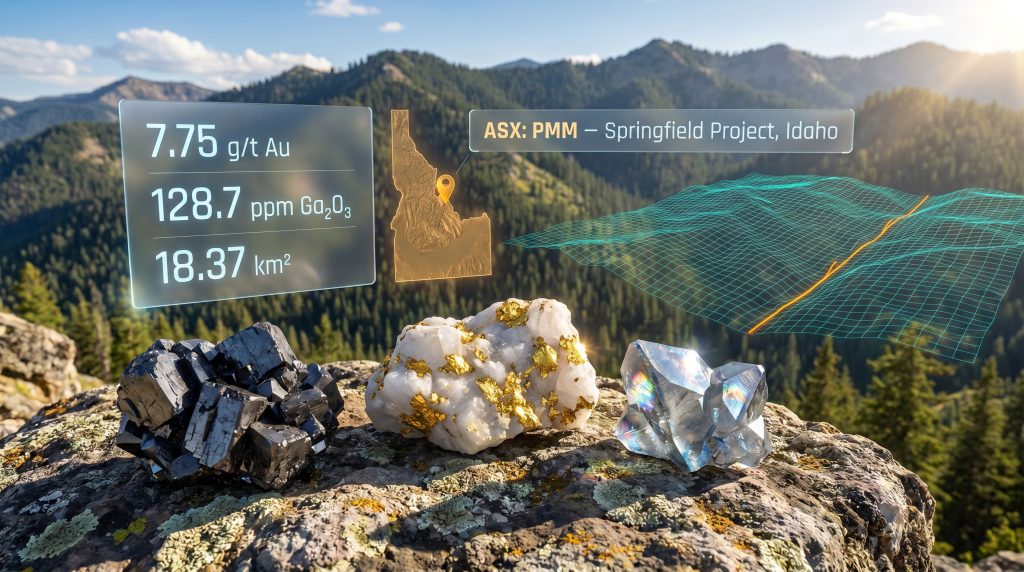
Pioneer Minerals has physically staked 212 lode claims covering approximately 18.37 square kilometres of ground. These claims are registered under the U.S. Bureau of Land Management (BLM) first-come, first-served tenure system. It is important to note that final confirmation of tenure status remains pending, which is a standard procedural phase under U.S. federal land administration rather than an unusual complication.
What the Surface Sampling Has Already Revealed
Before the most recent structural interpretation work, reconnaissance rock-chip sampling at Springfield had already returned results that warranted serious geological attention:
- Gold values reaching up to 7.75 g/t from rock-chip sampling — a grade level that compares favourably to many advanced-stage gold exploration projects
- Gallium assay results of 128.7 ppm Ga₂O₃ and 94.8 ppm Ga₂O₃, representing high-grade outcomes in the context of a global gallium market where primary production is extremely limited
- Widespread tungsten mineralisation across the historic mine area consistent with skarn-style ore deposit controls
The table below contextualises Springfield's three commodity targets:
| Commodity | Best Rock-Chip Result | U.S. Critical Mineral Status | Primary Application |
|---|---|---|---|
| Tungsten | Very high-grade (historical + recent chips) | Yes (USGS listed) | Defence, aerospace, industrial cutting |
| Gold | Up to 7.75 g/t | No (precious metal) | Revenue diversifier, jewellery, electronics |
| Gallium | Up to 128.7 ppm Ga₂O₃ | Yes (USGS listed) | GaN semiconductors, defence electronics, 5G |
A particularly significant geological observation from the sampling programme is the indication that gallium mineralisation at Springfield may follow pathways that are independent of the tungsten host phases. In plain terms, gallium and tungsten may be concentrated in separate but co-located mineralogical environments within the same broader system. If confirmed through petrographic analysis and drilling, this would mean Springfield hosts two overlapping but distinct deposit styles — substantially increasing the project's overall resource optionality.
The LiDAR Survey: How Laser Technology Rewrote the Geological Model
What LiDAR Actually Does in a Forest-Covered Terrain
Light Detection and Ranging (LiDAR) is a remote sensing technology that emits rapid laser pulses toward the ground surface and measures the time taken for each pulse to return. By collecting millions of these measurements, the system generates an extraordinarily detailed three-dimensional point cloud of the terrain below.
What makes LiDAR particularly powerful in mineral exploration — especially in vegetated, mountainous environments like Idaho — is its ability to strip away the digital representation of forest cover and expose the bare-earth topography underneath. The result is a centimetre-scale terrain model that reveals geological structures (faults, fractures, lithological contacts, drainage anomalies) that are completely invisible to conventional aerial photography or satellite imagery.
For geologists interpreting mineralisation controls, this level of resolution allows structural lineaments to be mapped with a precision that would take months of ground-based survey work to replicate. At Springfield, the LiDAR interpretation has delivered results that have materially altered the project's exploration model.
The Three Key Structural Findings
1. A Major NE-Trending Cross-Cutting Fault
The most consequential output of the LiDAR interpretation is the identification of a major northeast-trending fault that cuts directly through the historic Springfield Mine area. This structure was entirely absent from the prior geological model. Cross-cutting faults are significant in ore deposit geology for a specific mechanical reason: when two fault systems intersect, they create zones of dilation — essentially fracture networks where fluid pressure drops, causing hydrothermal fluids carrying dissolved metals to precipitate their mineral cargo.
These intersection zones are among the highest-probability drill targets in structural geology, having been responsible for some of the world's most significant ore discoveries. The fact that this NE-trending structure passes through the historic mine area — where mineralisation has already been confirmed — introduces a new vector of targeting logic that did not previously exist. It raises the prospect that mineralisation at Springfield is structurally controlled not just by the primary ore trend, but by a more complex two-fault architecture.
2. Extensive Faulting at Granitic-Carbonate Contacts
The LiDAR work has also mapped pervasive faulting along the contacts between granitic intrusive rocks and carbonate host rocks across the broader project area. This is geologically critical because these contact zones define the fundamental ore-forming environment for skarn deposits — the deposit style most globally associated with tungsten mineralisation.
Skarn formation occurs when magmatic-hydrothermal fluids derived from cooling granite intrusions react with adjacent limestone or dolomite units. The chemical interaction drives metasomatic replacement reactions, converting carbonate rock into silicate mineral assemblages and precipitating economically significant concentrations of tungsten (typically as scheelite, calcium tungstate), gold, copper, and in some cases gallium-bearing sulphides. The identification of multiple granitic-carbonate contacts through LiDAR mapping substantially expands the number of geologically valid target zones across Springfield's 18.37 square kilometre footprint.
3. An Ambiguous but Significant Geophysical Anomaly
A geophysical anomaly identified within the study area carries two distinct geological interpretations, and both are meaningful:
- Roof pendant interpretation: A roof pendant is a remnant of older country rock (in this case likely carbonate material) that has become enclosed within a younger granitic intrusion as the magma crystallised around it. These structures are particularly prospective for contact metasomatic (skarn) tungsten mineralisation because they represent localised carbonate targets in close proximity to the heat and fluid source of the intrusion.
- Massive pyrrhotite interpretation: Pyrrhotite is a magnetic iron sulphide mineral that frequently occurs in spatial association with tungsten skarn systems. Its presence as a massive body would indicate intense hydrothermal activity at depth — a condition highly favourable for the precipitation of tungsten and associated metals.
The upcoming electromagnetic (EM) geophysical survey will be instrumental in resolving this ambiguity, as the conductivity response of massive pyrrhotite is distinctly different from that of a silicate-dominated roof pendant structure.
Geological Note: The distinction between these two interpretations matters practically for drill targeting — but either outcome carries positive implications for tungsten prospectivity at depth.
From Structural Discovery to Drill Targets: The Exploration Logic
Why the New Model Changes Everything About Targeting
Prior to the LiDAR interpretation, Springfield's exploration model was essentially one-dimensional — guided by the footprint of historical mine workings and the surface geochemistry surrounding them. The identification of the NE-trending cross-cutting fault introduces a second structural axis, creating a more complex geometric framework where multiple prospective zones can now be defined based on fault intersection geometry rather than proximity to old workings alone.
This is not a subtle upgrade. In exploration terms, moving from a single-vector target model to a multi-structural intersection model is analogous to going from searching along a single corridor to recognising an entire network of interconnected rooms. The discovery substantially increases the statistical probability of encountering high-grade mineralisation in drilling, because intersection zones are where fluid focusing and metal precipitation tend to be most intense.
The Systematic Exploration Sequence
Pioneer Minerals is pursuing a disciplined, staged exploration methodology at Springfield. The sequence is structured to progressively narrow uncertainty before committing drilling capital:
- LiDAR Structural Interpretation (completed) — High-resolution terrain modelling to define fault architecture and lithological contacts across the full project area
- Electromagnetic (EM) Survey (next planned step) — Geophysical mapping of conductive bodies at depth, informed directly by LiDAR-defined structural targets; will resolve the roof pendant vs. pyrrhotite ambiguity and identify buried conductive targets beneath the cover sequence
- Integrated Target Refinement — Merging of LiDAR structural data, EM geophysics, and existing surface geochemistry into a unified geological model with ranked drill targets
- Maiden Drill Programme — First systematic drilling to test structural intersection zones, assess mineralisation continuity at depth, and investigate the spatial relationship between gallium and tungsten host phases
- Resource Definition — Subject to positive drilling results, progression toward a JORC-compliant mineral resource estimate
This workflow reflects standard industry practice for systematic critical mineral project development and mirrors the approach used at several globally significant skarn discoveries in the past decade.
The Gallium Dimension: Why Independent Host Phases Matter
Gallium's Unusual Geochemical Behaviour
Most investors familiar with mining projects think of mineralisation in relatively straightforward terms — ore is either there or it isn't, and it forms through a single dominant process. Gallium challenges this framework because of its geochemical nature as a dispersed trace element.
Unlike tungsten, which forms discrete primary minerals (scheelite, wolframite), gallium does not typically form its own mineral phases. Instead, it substitutes isomorphically into the crystal lattices of other minerals — particularly sphalerite (zinc sulphide) and certain aluminium-bearing silicates — by replacing atoms of similar ionic radius and charge. This means gallium enrichment is controlled by the distribution of its host minerals, not by a separate mineralising event.
The significance of Springfield's data suggesting that gallium follows independent host pathways from tungsten is therefore substantial. It implies that gallium at Springfield may be concentrated within a separate mineral phase that is distributed differently from the scheelite-dominant tungsten zones. If petrographic work confirms this, the resource model for Springfield would need to account for two spatially overlapping but mineralogically distinct deposit styles within the same system.
From a practical standpoint, this could mean:
- Separate sampling and assay protocols to characterise each commodity stream independently
- Distinct processing flowsheets or co-recovery circuits for gallium vs. tungsten concentrate
- The possibility that gallium-rich zones extend beyond the footprint of the primary tungsten deposit, expanding the overall project area of interest
The U.S. Gallium Supply Crisis in Context
China's 2023 export restrictions on gallium and germanium represented a watershed moment for Western technology supply chains. The U.S. semiconductor industry, which relies on gallium arsenide (GaAs) and gallium nitride (GaN) substrates for high-performance electronic components, found itself confronting a structural vulnerability it had acknowledged in policy documents for years but had not acted on with sufficient urgency. In addition, this supply shock has accelerated the search for critical minerals for defence and advanced technology applications across Western nations.
Springfield's gallium grades — with individual rock-chip samples returning results well above 128 ppm Ga₂O₃ — are notable in this context. Global primary gallium recovery is predominantly a byproduct of aluminium (bauxite) refining, making dedicated gallium exploration projects extremely rare. A U.S.-based project with surface-level gallium enrichment of this character warrants serious geological investigation.
The next major ASX story will hit our subscribers first
Strategic Positioning and Development Progress
Processing Concept Work Already Underway
Pioneer Minerals has engaged Mineral Technologies to conduct a processing concept study and preliminary plant design for Springfield. This is a meaningful early-stage investment in demonstrating technical viability — a prerequisite for attracting off-take interest and project financing further down the development pathway.
The processing challenge at a multi-commodity skarn project like Springfield is both a risk and an opportunity. Tungsten concentrate recovery typically involves gravity separation and flotation circuits. Gold and gallium co-recovery would require additional processing consideration, but the economic case for optimising a three-commodity flowsheet is potentially compelling if grades prove consistent at depth.
Regulatory Framework and Access
The company has been progressing surface access and environmental compliance approvals with the U.S. Forest Service (USFS), which governs exploration activities on federal land in Idaho. Milestones in this regulatory pathway underpin Pioneer's planned exploration timeline through the remainder of 2026. It should be noted that routine regulatory processes of this kind are standard requirements for all exploration companies operating on federal land and do not represent extraordinary project-specific support or designation.
Pioneer Minerals by the Numbers
| Metric | Detail |
|---|---|
| ASX Ticker | PMM |
| Market Capitalisation | ~$13.25 million (as of May 12, 2026) |
| Share Price | $0.125 |
| Project Location | Idaho, USA |
| Land Package | 212 lode claims, ~18.37 km² |
| Tenure Status | Pending BLM confirmation |
| Project Stage | Early-stage exploration, pre-resource |
| Next Milestone | Electromagnetic (EM) geophysical survey |
A market capitalisation of approximately $13.25 million reflects the reality that Springfield is at an early exploration stage with no JORC-compliant resource defined. For risk-tolerant investors who understand junior mining economics, such a valuation implies that the market has attributed minimal speculative premium to the structural discoveries and multi-commodity geochemical results to date — suggesting that the upcoming EM survey and maiden drilling programme carry meaningful re-rating potential if results are positive. This assessment is speculative, and investors should conduct independent due diligence. Furthermore, Pioneer's latest drilling update provides additional context on the project's evolving exploration strategy.
Frequently Asked Questions
What commodities does the Pioneer Minerals Springfield tungsten gold gallium project target?
Springfield targets three distinct commodities: tungsten and gallium (both classified as U.S. critical minerals) and gold (a precious metal). The project's multi-commodity nature means that exploration success in any one of the three streams could independently justify development economics, while all three together would represent a rare and strategically significant combination.
What makes the NE-trending fault discovery geologically significant?
Cross-cutting fault systems create structural intersection zones where hydrothermal fluids tend to concentrate and precipitate mineralisation most intensely. The fact that this fault was previously unrecognised means the project's drill target inventory has been materially expanded by geological data rather than speculation.
Why is gallium mineralisation that is independent of tungsten pathways potentially important?
If gallium at Springfield is hosted in a distinct mineral phase from tungsten, the two commodity systems can be evaluated and potentially developed somewhat independently. This adds resource optionality — it means the gallium-enriched zones may have a different and potentially broader spatial distribution than the tungsten zones, creating a larger aggregate footprint of economic interest.
What is the current stage of the project?
Springfield is at an early exploration phase. High-resolution LiDAR structural interpretation has been completed, surface geochemical sampling has returned high-grade multi-commodity results, and the next step is an electromagnetic geophysical survey followed by a maiden drill programme. No JORC mineral resource estimate has been defined.
What is LiDAR and why is it particularly useful at Springfield?
LiDAR is a laser-based remote sensing technology that generates centimetre-resolution three-dimensional terrain models capable of penetrating forest canopy digitally to reveal underlying geological structures. In Idaho's mountainous, vegetated terrain, LiDAR allows structural mapping at a level of detail that would be prohibitively time-consuming through ground-based survey methods alone. According to Pioneer's recent ASX announcement, this technology has proved instrumental in reshaping the project's geological understanding and defining the next phase of targeted exploration activity.
This article is intended for informational purposes only and does not constitute investment advice. Investing in early-stage exploration companies involves significant risk, including the possible loss of capital. Readers should conduct their own independent research and seek advice from a qualified financial adviser before making any investment decisions. The Pioneer Minerals Springfield tungsten gold gallium project remains at a pre-resource exploration stage, and positive surface results do not guarantee the existence of an economically viable mineral deposit.
Want to Know When the Next Major Critical Minerals Discovery Hits the ASX?
Discovery Alert's proprietary Discovery IQ model scans ASX announcements in real time, instantly identifying significant mineral discoveries across tungsten, gallium, gold, and more than 30 other commodities — so subscribers can act before the broader market catches on. Explore how historic discoveries have generated exceptional returns and begin a 14-day free trial at Discovery Alert to position yourself ahead of the next major find.