August 1, 2026
The Hidden Demand Driver That Could Rewrite Crude Oil Forecasts Through 2028
Energy markets operate on cycles that often take years to fully materialise. Supply shocks compress inventories, emergency reserves get drawn down to stabilise prices, and then a long, often underappreciated rebuilding phase quietly reshapes the demand landscape for years afterward. That rebuilding phase is now underway on a scale not seen in modern oil market history, and strategic oil reserve buying through 2028 remains significantly underestimated by many market participants focused on the more visible OPEC+ supply story.
The 2026 Strait of Hormuz disruption removed an estimated 1.5 billion barrels from effective global inventory circulation, according to Reuters calculations drawing on data from the International Energy Agency, OPEC, and the U.S. Department of Energy. That single figure captures the magnitude of the challenge now facing governments worldwide: how to rebuild emergency buffers that took decades to accumulate, against a backdrop of rising OPEC+ output and politically constrained spending environments. Understanding the crude oil price drivers at play here is essential context for what follows.
When big ASX news breaks, our subscribers know first
Understanding the Scale of What Was Lost
The IEA's coordinated emergency release of 400 million barrels in response to the Strait of Hormuz crisis was unprecedented in the agency's history. To put that in context, the previous largest coordinated release, following Russia's invasion of Ukraine in 2022, involved approximately 120 million barrels. The 2026 drawdown was more than three times that scale.
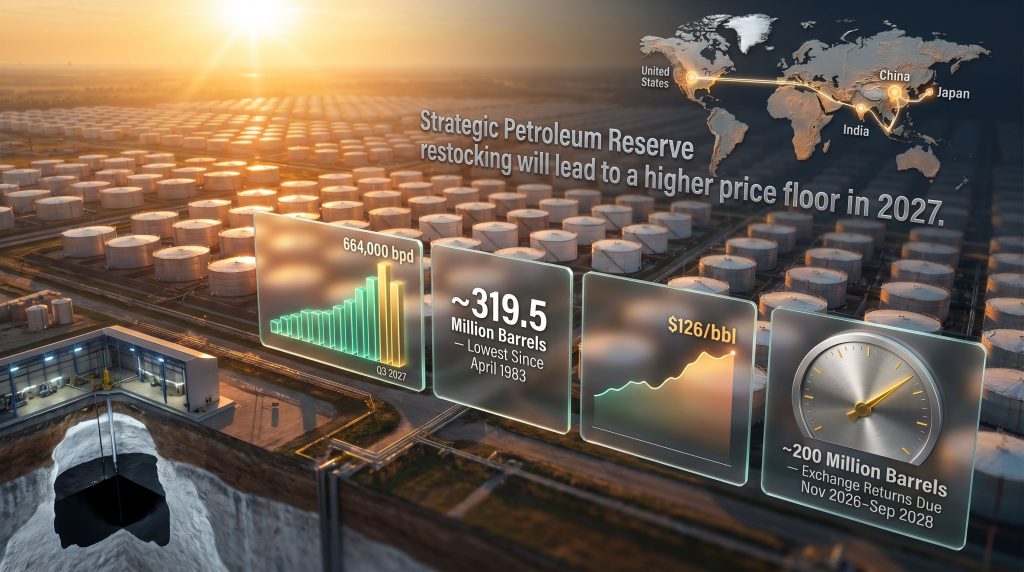
Brent crude surged above $126 per barrel in late April 2026, while U.S. crude approached $120 per barrel in early March 2026 as the disruption took hold. The IEA release helped arrest those price spikes, but at a significant cost to the emergency buffer available to member states.
The emergency reserves that governments draw on during supply crises are not replenished automatically. They require deliberate policy decisions, budget allocations, and in some cases, years of sustained purchasing activity. The depletion of 2026 has set in motion a restocking cycle that will add meaningful demand pressure to global crude markets through at least 2028.
How SPR Exchange Agreements Work: A Mechanism Most Investors Don't Fully Understand
The mechanics of how the United States will rebuild its reserves differ fundamentally from how most market participants assume government oil buying works. The dominant pathway is not open-market purchasing, but rather an exchange-based replenishment structure with important financial and timing characteristics.
Under the exchange agreements activated during the crisis, companies that borrowed crude from the Strategic Petroleum Reserve are contractually obligated to return oil at a premium above the original volume. The U.S. Department of Energy projects receiving approximately 1.28 barrels for every barrel released, translating to an estimated return of around 200 million barrels from the 172 million barrels released under the IEA programme.
Why This Distinction Matters for Restocking Dynamics
This distinction matters enormously for understanding U.S. restocking dynamics:
- No new Congressional appropriations are required for baseline inventory recovery
- Return flows are scheduled to commence in November 2026 and run through September 2028
- The exchange premium functions as a built-in volume accelerator, delivering more crude than was originally released
- U.S. Energy Secretary Chris Wright confirmed Washington is additionally exploring pathways to push reserves beyond 500 million barrels, well above what exchange returns alone would deliver
As of early July 2026, U.S. SPR inventories stood at approximately 319.5 million barrels, the lowest level recorded since April 1983. The scale of the rebuild ahead is substantial.
| Replenishment Pathway | Fiscal Requirement | Volume Impact | Timeline |
|---|---|---|---|
| U.S. Exchange Returns | None (contractual) | ~200 million barrels | Nov 2026 to Sep 2028 |
| U.S. Direct Purchases | Budget appropriation needed | Discretionary, above 400M target | Open-ended |
| IEA Member Discretionary Buying | National budget approvals | Variable by country | Predominantly 2027-weighted |
| Asian Strategic Expansion | National infrastructure investment | Structural, multi-year | 2026 through 2030+ |
It is also worth noting that the U.S. government had originally planned to repurchase oil directly at $79 per barrel or below as part of post-2022 replenishment efforts. When prices exceeded that cap in March 2024, those purchase plans were cancelled outright. This means the current recovery cycle operates almost entirely through the exchange mechanism, not open-market buying, which reshapes how the demand impact translates to price dynamics.
Quantifying the Crude Demand Uplift: Phase-by-Phase Projections
Strategic oil reserve buying through 2028 is projected to contribute meaningfully to global crude demand, however, the timing of that contribution is not uniform. Commodities analytics firm Kpler projects the restocking cycle will add up to 664,000 barrels per day (bpd) of additional crude demand by Q3 2027, with an interim contribution of approximately 506,000 bpd in Q4 2026.
To put those numbers in perspective, 664,000 bpd represents roughly equivalent to the combined daily consumption of a mid-sized European nation. Against a backdrop of global demand running in the range of 100 to 103 million bpd, this restocking demand is meaningful, particularly given that it coincides with a period when OPEC+ is simultaneously unwinding production cuts.
Phase 1: Q4 2026 (Initial Return Flows)
- Additional demand contribution: approximately 506,000 bpd
- Driven primarily by U.S. exchange agreement return schedule activations
- Partially offset by incremental OPEC+ volumes entering the market
Phase 2: Q1 to Q3 2027 (Peak Restocking)
- Additional demand contribution: up to 664,000 bpd
- Broadens to include discretionary rebuilding by IEA member nations including Japan, South Korea, and select European states
- Coincides with anticipated OPEC+ production surplus, creating a partial natural demand buffer
Phase 3: Q4 2027 Through 2028 (Gradual Normalisation)
- U.S. SPR projected to approach pre-crisis levels by approximately July 2028
- Asian discretionary stockpiling continues independently of IEA coordination
- China's structural buying behaviour adds a persistent, price-sensitive demand layer
Furthermore, Christopher Haines, Head of Oil at Energy Aspects, has characterised SPR restocking as a mechanism that will establish a higher price floor in 2027 by absorbing supply that would otherwise pressure prices lower. The logic is straightforward: every barrel diverted into strategic storage is a barrel that does not reach the commercial market, reducing the effective surplus that weighs on pricing.
The Non-U.S. IEA Restocking Picture: Why 2027 Is the Key Year
While the U.S. restocking timeline is mechanistically locked in through exchange agreements, the trajectory for other IEA member states is considerably less predictable. Kpler's senior oil analyst Naveen Das has described the non-U.S. IEA restocking picture as more heavily weighted toward 2027 and fundamentally discretionary in nature.
This discretionary character introduces a range of variables that could either accelerate or delay restocking demand from these nations:
- Oil price sensitivity: Lower crude prices reduce the fiscal cost of replenishment and tend to accelerate government buying decisions
- Budget approval cycles: Unlike the U.S. exchange mechanism, most IEA member governments must secure budget appropriations before purchasing crude
- Political prioritisation: Energy security has moved up the policy agenda following the 2026 disruption, but competing fiscal priorities remain a constraint
- Import dependency: Nations with high Gulf import exposure, particularly Japan and South Korea, have stronger strategic motivation to rebuild than those with more diversified supply chains
The timing sensitivity of IEA member discretionary buying to oil price levels means that the very OPEC+ surplus that analysts expect to emerge in 2026 and 2027 could, paradoxically, incentivise faster reserve rebuilding by making replenishment more affordable. In addition, OPEC's market influence over pricing dynamics makes this interplay particularly complex to forecast.
China's Strategic Buying Model: A Price-Triggered Demand Engine
China's approach to strategic petroleum reserve management follows a well-documented price-responsive logic. According to Michael Haigh, Global Head of Commodities Research at Societe Generale, Chinese state entities historically accelerate strategic purchases when Brent crude trades below its 12-month moving average. When prices fall below that threshold, filling strategic storage becomes an attractive use of lower-cost barrels.
In 2025, China added approximately 1.1 million bpd to strategic inventories, reaching an estimated 1.4 billion barrels by December 2025. That buying pace, sustained over an extended period, represents one of the most significant structural demand forces in the global crude market, and one that operates largely outside the IEA framework.
As of mid-2026, Brent front-month futures were trading around $78 per barrel, marginally above the 12-month moving average of approximately $76.59 per barrel according to LSEG data. A sustained move below that average would likely trigger renewed Chinese strategic buying, adding further demand absorption on top of IEA member restocking activity.
What makes China's SPR behaviour particularly significant from an investor perspective is its asymmetric nature. When prices fall, Chinese buying tends to intensify, creating a structural demand floor that limits downside. When prices rise above the moving average, that buying slows or stops entirely, reducing its inflationary contribution. This makes it a self-correcting mechanism embedded in the global crude demand structure.
How Geopolitical Pressures Shape Asian Buying Behaviour
Consequently, the US-China oil price impact from ongoing trade tensions adds another layer of complexity to Chinese reserve strategy. Geopolitical friction tends to reinforce China's motivation to hold larger strategic buffers as a hedge against supply disruption risk.
The next major ASX story will hit our subscribers first
Asia's Infrastructure Expansion: Building Capacity for the Next Crisis
Beyond the immediate restocking cycle, the 2026 supply shock has catalysed a structural expansion of strategic storage infrastructure across Asia. This is a longer-duration demand story that extends well beyond 2028.
| Country | Strategic Storage Initiative | Scale |
|---|---|---|
| China | 11 new strategic oil storage sites under construction | Expansion beyond current ~1.4B barrel holdings |
| India | Padur and Chandikhol expansion projects | More than doubling existing SPR capacity |
| Philippines | National strategic petroleum reserve development | Supported by Japan |
India's expansion programme is particularly noteworthy. As a nation heavily reliant on Gulf crude supply routes, the same routes disrupted in early 2026, India's motivation to hold larger strategic buffers is both geopolitically rational and fiscally supportable given its rising economic scale. Doubling SPR capacity at Padur and Chandikhol represents a multi-year demand commitment that will require sustained crude purchasing to fill the expanded facilities.
The OPEC+ Offset Dynamic and the Self-Correcting Price Floor
One of the more nuanced aspects of the current oil market setup is how SPR restocking demand interacts with the OPEC+ supply unwind. Under conventional market dynamics, progressive OPEC+ output increases would be expected to suppress prices as additional barrels accumulate in commercial inventories. The restocking cycle introduces a countervailing absorption mechanism that partially neutralises that pressure.
The net effect can be understood through a simple framework:
- OPEC+ increases output, adding barrels to the global supply pool
- Simultaneously, governments absorb hundreds of thousands of bpd into strategic storage
- Commercial market sees a smaller effective surplus than headline OPEC+ production data implies
- Price floor is higher than it would be in the absence of restocking demand
The critical variable is timing alignment. If peak restocking demand of up to 664,000 bpd arrives in Q3 2027, as Kpler projects, during the same window that OPEC+ surplus volumes are building, the offset could be substantial enough to prevent the sharp price correction that unmanaged surplus conditions would normally produce. However, tariff-driven market volatility could complicate this dynamic considerably, particularly if trade policy uncertainty weighs on broader economic activity.
Key Risk Factors That Could Disrupt the Restocking Timeline
No demand forecast operates in isolation, and the SPR restocking story carries its own set of material risks:
Price ceiling risk: If crude prices recover sharply above $90 to $100 per barrel, discretionary IEA member restocking could slow significantly. The U.S. DOE's 2024 experience, when direct purchase plans were cancelled because market prices exceeded the $79 per barrel target cap, illustrates precisely how price-sensitive government buying programmes can be.
Legislative constraints: Existing U.S. legislation permits SPR inventories to fall within a range of 238 to 410 million barrels by 2028 while still meeting statutory import coverage requirements. This range implies that political appetite for pushing inventories well above 400 million barrels may encounter legislative friction, even if exchange returns technically allow it.
Geopolitical re-escalation: Geopolitical trade tensions of the kind that triggered the 2026 crisis could resurface. A renewed supply disruption in Gulf shipping lanes before reserves have been meaningfully rebuilt could trigger another round of emergency releases, resetting the restocking timeline entirely.
Demand uncertainty: Broader macroeconomic weakness could reduce commercial crude consumption, partially offsetting the demand support from strategic buying.
What Investors Should Watch Through 2028
For those tracking crude oil markets, strategic oil reserve buying through 2028 offers several concrete indicators worth monitoring:
- Weekly U.S. DOE SPR inventory data: The progression from 319.5 million barrels toward the 400 million barrel threshold will confirm whether exchange returns are tracking to schedule
- Brent versus 12-month moving average spread: Any sustained close below approximately $76.59 is likely to activate Chinese strategic buying, adding an incremental demand layer
- IEA member government budget cycles: Autumn 2026 and early 2027 budget announcements from Japan, South Korea, and European governments will signal the pace of discretionary rebuilding
- OPEC+ output progression relative to restocking absorption rates: The gap between these two forces determines whether a price floor holds or is overwhelmed by surplus
In addition, Australia's fuel security initiatives represent a relevant parallel, illustrating how mid-sized economies are responding to the same strategic imperatives driving demand across Asia and the IEA membership more broadly.
Disclaimer: This article is intended for informational purposes only and does not constitute financial advice. Forecasts, projections, and analyst commentary referenced throughout involve inherent uncertainty and should not be relied upon as the basis for investment decisions. Oil market dynamics are subject to rapid change in response to geopolitical, macroeconomic, and policy developments. Past patterns in strategic reserve buying behaviour may not be repeated.
Want to Stay Ahead of the Next Major Resource Discovery?
While crude oil markets reshape themselves through strategic reserve restocking cycles, commodity-driven opportunities are simultaneously emerging across the ASX — and Discovery Alert's proprietary Discovery IQ model delivers real-time alerts the moment significant mineral discoveries are announced, turning complex market signals into clear, actionable insights. Explore Discovery Alert's dedicated discoveries page to understand how historic mineral discoveries have generated substantial returns, and begin your 14-day free trial today to position yourself ahead of the broader market.