
June 5, 2026
Understanding the Architecture of Crude Oil Futures Markets
Crude oil futures markets operate as sophisticated financial ecosystems where contract standardisation meets dynamic price discovery mechanisms. The foundation of these markets rests on precisely defined instruments that enable participants ranging from individual speculators to multinational energy corporations to establish positions reflecting their market outlook and operational needs. Furthermore, crude oil futures trading has become essential for both commercial hedgers and financial investors seeking exposure to energy markets.
Contract Structure and Electronic Infrastructure
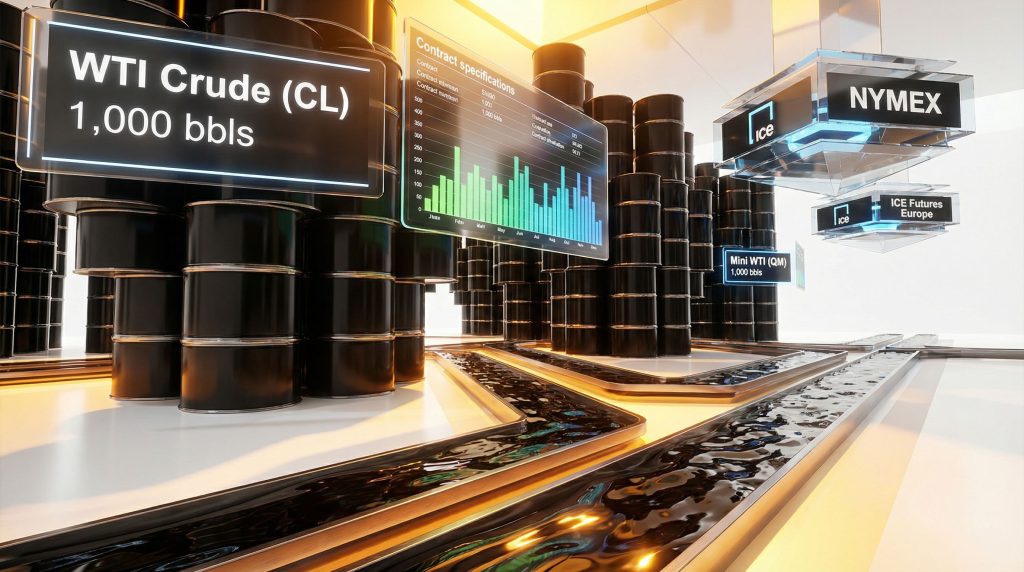
The modern crude oil futures trading landscape centres around standardised contracts traded on electronic platforms that have revolutionised market access and execution efficiency. West Texas Intermediate contracts on NYMEX consist of 1,000-barrel units with $0.01 per barrel minimum price increments, creating $10 profit or loss movements for each cent of price change. This mathematical relationship provides the foundation for precise risk calculation and position sizing across different participant categories.
Electronic trading systems operate continuous sessions spanning global time zones, with NYMEX crude oil futures maintaining nearly 24-hour availability Monday through Friday. The technological infrastructure supports thousands of transactions per second while managing complex clearing and settlement procedures that ensure contract integrity across millions of barrels in daily trading volume.
Key Contract Specifications:
- Standard WTI (CL): 1,000 barrels, $0.01 tick size, physical delivery at Cushing, Oklahoma
- Mini WTI (QM): 500 barrels, $0.025 tick size, reduced margin requirements
- Micro WTI (MCL): 100 barrels, $0.01 tick size, accessible capital requirements
- Brent Crude (BZ): 1,000 barrels, ICE platform, European delivery mechanisms
Physical Delivery and Financial Settlement Mechanics
Crude oil futures contracts maintain direct connections to physical oil markets through delivery provisions that anchor financial prices to actual supply-demand fundamentals. While most futures positions close through offsetting trades before expiration, the delivery option ensures that futures prices track spot crude prices closely as contract expiration approaches.
WTI crude delivery occurs at Cushing, Oklahoma, which functions as the primary North American crude oil pricing hub due to its strategic pipeline connections and storage capacity. This geographic concentration creates basis relationships between Cushing prices and crude values at refineries, ports, and production centres across North America.
Brent crude settlement involves either financial settlement based on dated Brent assessments or physical delivery through North Sea loading programmes. Consequently, the flexibility between settlement methods accommodates different participant needs while maintaining price discovery accuracy for European and global crude markets.
When big ASX news breaks, our subscribers know first
Strategic Impact of Contract Size Selection on Trading Performance
Contract specifications fundamentally determine the accessibility and risk profile of crude oil futures trading strategies. The mathematical relationship between contract size, margin requirements, and account capital creates distinct trading environments that favour different approaches and participant categories. In addition, understanding these relationships is crucial for implementing effective oil price movements analysis in trading decisions.
Recent MCX crude oil activity illustrates these dynamics in practice. February delivery contracts gained ₹75 per barrel (1.31% increase) to ₹5,821 per barrel with 12,180 lots traded, while March contracts advanced ₹88 per barrel (1.53% increase) to ₹5,825 per barrel across 560 lots. This trading activity demonstrates how contract months with different expiration dates can experience varying liquidity levels and price movements.
Capital Allocation and Leverage Analysis
| Contract Type | Notional Value | Typical Margin | Leverage Ratio | Account Size Suitable |
|---|---|---|---|---|
| Standard CL | $64,000 | $3,000-8,000 | 8x-21x | $25,000+ |
| Mini QM | $32,000 | $1,500-4,000 | 8x-21x | $12,500+ |
| Micro MCL | $6,400 | $300-800 | 8x-21x | $2,500+ |
Professional traders recognise that leverage ratios remain consistent across contract sizes, but absolute dollar exposure varies dramatically. A $0.50 per barrel adverse movement generates $500 loss on standard contracts, $250 loss on mini contracts, and $50 loss on micro contracts. This scaling allows traders to maintain consistent risk percentages relative to account size whilst accessing crude oil price movements.
Position Sizing Mathematics for Risk Management
Effective position sizing requires calculating maximum acceptable loss per trade as a percentage of account capital, then determining appropriate contract quantities based on stop-loss distance. Professional commodity traders typically risk 1-2% of account capital per individual position, with total energy exposure limited to 10-15% of portfolio value.
For a trader with $100,000 capital limiting risk to 2% per trade ($2,000 maximum loss), the calculation process involves:
- Determine stop-loss distance based on technical analysis or volatility measures
- Calculate loss per contract for the chosen stop distance
- Divide maximum acceptable loss by loss per contract to determine position size
- Verify that total position value remains within concentration limits
Multi-Factor Price Volatility Drivers in Energy Markets
Crude oil futures prices respond to an intricate web of supply-demand variables operating across different timeframes and geographic regions. Recent market conditions demonstrate how geopolitical uncertainties, OPEC+ policy decisions, and fundamental demand patterns create competing price pressures that professional traders must navigate. Furthermore, comprehensive oil price rally analysis helps traders understand these complex market dynamics.
Analysis from commodity research specialists indicates that crude prices experienced upward momentum despite persistent geopolitical risks. Peace talks between Russia and Ukraine concluded without breakthrough agreements, whilst US-Iran negotiations faced uncertainty regarding enriched uranium stockpiles. These developments created potential supply disruption scenarios that traders incorporated into risk assessments.
OPEC+ Production Strategy and Market Signalling
Saudi Arabia's decision to reduce official selling prices for March Arab Light crude to Asian buyers marked the fourth consecutive monthly decrease, though the reduction proved smaller than market expectations. This pricing strategy reflects OPEC+ managing global market share whilst supporting price levels through calibrated supply adjustments. However, understanding the OPEC meeting impact remains crucial for traders anticipating market direction.
The measured approach to price cuts suggests OPEC+ confidence in medium-term demand fundamentals despite near-term economic uncertainties. Professional analysts interpret these signals as indicating:
- Demand Assessment: Smaller cuts suggest adequate global consumption levels
- Competition Management: Pricing designed to maintain market share against US shale production
- Inventory Strategy: Balancing production with storage costs and financing considerations
- Revenue Optimisation: Managing fiscal needs of member countries whilst supporting prices
Supply Disruption Risk Assessment
Geopolitical developments create discontinuous supply shocks that generate significant price volatility in crude oil futures markets. The Russia-Ukraine conflict has removed approximately 3 million barrels daily of crude and refined products from global markets, establishing a structural supply deficit that supports prices above $60 per barrel despite broader economic concerns.
Similarly, potential sanctions affecting Iranian crude exports could eliminate an additional 1.5-2 million barrels daily from global supplies. These supply-side risks create asymmetric price patterns where upside breakouts often exceed downside corrections, particularly when global spare production capacity remains limited.
Critical Supply Variables:
- OPEC+ Spare Capacity: Approximately 2-3 million barrels daily available for production increases
- US Strategic Petroleum Reserve: Contains 400+ million barrels for emergency releases
- Seasonal Maintenance: Refinery turnarounds temporarily reduce crude demand by 1-2 million barrels daily
- Transportation Constraints: Pipeline capacity, tanker availability, and port infrastructure limitations
Advanced Technical Analysis Frameworks for Futures Trading
Professional crude oil futures trading requires sophisticated analytical approaches that integrate technical price patterns with fundamental supply-demand dynamics. The high-volatility environment of energy markets creates opportunities for various trading methodologies whilst demanding precise risk management protocols. For instance, traders can enhance their strategies by studying oil price crash insights to better understand market downturns.
Volume Profile and Liquidity Analysis
Volume profile analysis reveals price levels where significant trading activity occurred, creating support and resistance zones that persist across multiple trading sessions. In crude oil futures, these levels often correspond to fundamental price points such as production breakeven costs, refinery margins, or previous OPEC+ target prices.
Professional traders monitor volume concentration at specific price levels to identify:
- High Volume Nodes: Price levels with sustained trading interest that often provide support or resistance
- Low Volume Areas: Prices with minimal trading history that may see rapid movement during breakouts
- Profile Migration: Shifts in volume concentration that indicate changing market sentiment
- Value Area Tracking: The price range containing 70% of trading volume over specified periods
Seasonal Pattern Recognition and Calendar Spread Analysis
Crude oil markets exhibit predictable seasonal patterns driven by refinery operations, driving habits, and heating demand cycles. Professional traders structure calendar spread positions to capture these recurring price relationships whilst minimising directional market exposure.
Seasonal Trading Opportunities:
- Spring Refinery Turnarounds (April-May): Temporary demand reduction creates contango opportunities
- Driving Season Premium (May-September): Gasoline demand supports crude prices and backwardation
- Hurricane Season Risk (June-November): Gulf Coast production disruptions create volatility spikes
- Winter Heating Demand (December-February): Distillate consumption supports crack spreads
Momentum and Mean Reversion Strategy Integration
Crude oil futures exhibit both trending and range-bound characteristics depending on the dominant market forces. Trend-following systems perform well during periods of clear fundamental shifts, whilst mean reversion approaches succeed when prices oscillate around equilibrium levels determined by supply-demand balance.
Professional traders often employ hybrid strategies that adapt to changing market conditions:
Trend Following Indicators:
- Moving average crossovers using 20-day and 50-day periods
- Breakout systems based on 20-day or 40-day price channels
- Momentum oscillators with extended lookback periods
- Volatility-adjusted position sizing during trending markets
Mean Reversion Techniques:
- Bollinger Band compression and expansion patterns
- RSI divergence analysis combined with price action
- Support and resistance bounce trading at key technical levels
- Statistical arbitrage between crude and refined product prices
Commercial Hedging Applications and Speculative Dynamics
The crude oil futures market serves dual functions as a risk management tool for commercial participants and a speculation vehicle for financial traders. This interaction between hedgers and speculators creates the liquidity and price discovery mechanisms that make crude oil futures trading among the most actively traded commodity contracts globally. Additionally, US oil production impact significantly influences these market dynamics.
Producer Hedging Strategies and Operational Integration
Oil production companies utilise futures contracts to lock in selling prices for future output, protecting against price declines that could jeopardise project economics or cash flow requirements. The hedging process involves establishing short positions in futures contracts corresponding to expected production volumes.
Shale oil producers, whose operations typically require 12-18 month payback periods, actively hedge production using various contract combinations:
- Outright Short Hedges: Direct futures sales covering 6-12 months of production
- Collar Strategies: Combining sold call options with purchased put options to create price floors and ceilings
- Three-Way Collars: Adding sold put options to generate premium income whilst maintaining downside protection
- Basis Swaps: Managing location differentials between field prices and futures delivery points
What Are the Key Benefits of Refinery Risk Management?
Refineries face complex exposure to both crude oil input costs and refined product selling prices. The crack spread represents the difference between crude oil costs and refined product revenues, providing a direct measure of refining profitability.
Professional refinery hedging programmes typically involve:
Input Cost Management:
- Long crude oil futures positions covering 3-6 months of planned throughput
- Rolling hedge strategies that maintain consistent price protection
- Basis risk management for refineries receiving non-WTI crude grades
- Storage hedge strategies during periods of planned inventory builds
Product Price Protection:
- Short positions in gasoline and heating oil futures matching output projections
- Seasonal adjustments reflecting changing refined product demand patterns
- Quality differential hedging for premium gasoline and ultra-low sulfur diesel
- Export hedge programmes for refineries serving international markets
Risk Management Protocols and Operational Excellence
Professional crude oil futures trading demands comprehensive risk management frameworks that address market risk, operational risk, and regulatory compliance requirements. The volatile nature of energy markets creates both substantial profit opportunities and potential for significant losses, making systematic risk controls essential for long-term success.
Position Risk Controls and Account Protection
Effective risk management begins with position sizing that limits individual trade losses to manageable percentages of account capital. Professional traders typically implement multiple layers of risk control:
Individual Trade Risk Management:
- Maximum risk per trade: 1-2% of account capital
- Stop-loss orders placed immediately upon position entry
- Position size calculation based on stop distance and account risk tolerance
- Maximum holding period limits to prevent indefinite loss exposure
Portfolio-Level Risk Controls:
- Total energy exposure limited to 10-15% of investment capital
- Correlation limits preventing excessive concentration in related positions
- Maximum drawdown triggers requiring position reduction or trading suspension
- Daily mark-to-market monitoring with margin call prevention protocols
Operational Risk Management and Technology Requirements
Modern crude oil futures trading relies heavily on electronic systems for order entry, position monitoring, and risk management. Technology failures or connectivity issues can create significant losses during volatile market conditions, making operational risk management crucial.
Essential Technology Infrastructure:
- Primary and backup internet connections from different providers
- Professional trading platforms with direct market access capabilities
- Real-time position monitoring and profit/loss tracking systems
- Mobile trading access for position management during travel or system outages
- Automated risk monitoring with alert systems for position limits and margin requirements
How Do Regulatory Compliance Requirements Affect Trading?
Crude oil futures trading involves various regulatory requirements depending on participant type and position size. Large traders must comply with position reporting requirements, whilst all participants face pattern day trader rules and margin requirements set by exchanges and brokers.
Key Compliance Considerations:
- Position Limits: CFTC-established limits on speculative positions in crude oil futures
- Large Trader Reporting: Daily position reports required when holdings exceed specified thresholds
- Pattern Day Trader Rules: Minimum equity requirements for frequent traders
- Tax Implications: Section 1256 treatment for futures contracts affecting tax planning
The next major ASX story will hit our subscribers first
Global Economic Factors and Market Integration
Crude oil futures prices maintain complex relationships with broader economic indicators, currency movements, and monetary policy decisions. These macroeconomic connections create additional layers of analysis that professional traders incorporate into their decision-making processes. Moreover, understanding these relationships becomes crucial for crude oil futures trading success.
Currency Impact and Dollar Strength Dynamics
Crude oil futures trade in US dollars, creating inverse relationships between dollar strength and oil prices. When the dollar appreciates against major currencies, oil becomes more expensive for international buyers, typically reducing demand and pressuring prices lower.
Recent trading sessions demonstrated these dynamics as WTI crude futures for March delivery advanced 1.17% to $64.03 per barrel whilst Brent crude gained 1.02% to $68.24 per barrel. These gains occurred despite dollar strength in international markets, suggesting that fundamental supply-demand factors overcame currency headwinds.
Interest Rate Environment and Commodity Investing
Interest rate levels influence crude oil futures through multiple channels including storage economics, alternative investment returns, and economic growth expectations. Higher interest rates increase the cost of carrying inventory, making current consumption more attractive relative to future consumption and supporting prompt month prices relative to deferred contracts.
The Federal Reserve's monetary policy stance affects commodity investing in several ways:
- Real Returns: Higher nominal rates may reduce commodity allocation if inflation expectations remain stable
- Economic Growth: Rate increases designed to slow economic expansion typically reduce oil consumption
- Speculation: Higher rates increase the opportunity cost of commodity speculation relative to fixed-income alternatives
- Currency Effects: Rate changes influence dollar strength and international oil demand patterns
Technology Integration and Market Evolution
The crude oil futures market continues evolving through technological innovation, algorithmic trading adoption, and alternative data integration. These developments affect market structure, liquidity provision, and price discovery mechanisms in ways that traders must understand and adapt to.
Electronic Trading and High-Frequency Activity
Electronic trading platforms have democratised access to crude oil futures whilst enabling high-frequency trading strategies that provide liquidity and narrow bid-ask spreads. The transition from open outcry trading floors to electronic systems reduced transaction costs whilst increasing trade execution speed and accuracy.
Modern trading infrastructure supports:
- Microsecond Execution: Order processing and fill confirmation within microseconds
- Algorithm Integration: Automated trading systems managing large position implementation
- Smart Order Routing: Optimisation of execution across multiple liquidity pools
- Risk Management Automation: Real-time position monitoring and automatic stop-loss execution
Alternative Data and Artificial Intelligence Applications
Professional traders increasingly utilise alternative data sources including satellite imagery of oil storage facilities, vessel tracking data, and social sentiment analysis to gain trading advantages. These data sources provide insights into supply-demand fundamentals that may not be immediately reflected in traditional reports.
Emerging Data Applications:
- Satellite Analysis: Storage tank levels at major crude oil facilities
- Shipping Data: Vessel movements indicating crude oil trade flows
- Economic Indicators: Real-time economic activity measures correlating with oil demand
- Weather Analytics: Hurricane tracking and temperature forecasts affecting seasonal demand
Traders seeking to implement these strategies can access professional oil futures trading platforms that provide the necessary tools and analytics. Furthermore, understanding current WTI crude oil prices remains essential for making informed trading decisions.
Professional crude oil futures traders who master contract specifications, risk management protocols, and multi-factor market analysis position themselves to capture opportunities in one of the world's most actively traded commodity markets whilst protecting capital through systematic risk controls.
The crude oil futures market represents a sophisticated intersection of commercial hedging needs, speculative opportunities, and global economic forces. Success requires understanding contract mechanics, implementing robust risk management, and maintaining awareness of the fundamental and technical factors driving price volatility in energy markets.
Ready to Capitalise on Energy Market Opportunities?
Discovery Alert's proprietary Discovery IQ model delivers real-time insights on significant ASX mineral discoveries, including energy and commodity sectors that correlate with oil market movements. Stay ahead of market developments by exploring Discovery Alert's proven track record of major discoveries and begin your 14-day free trial today to gain actionable intelligence across all commodity markets.