August 13, 2026
What Drives Crude Oil Price Volatility During Middle East Conflicts?
Energy markets operate within a complex web of physical supply constraints and psychological risk factors that extend far beyond simple production arithmetic. When regional conflicts threaten critical energy infrastructure, market participants must rapidly price not only immediate supply losses but also the cascading effects of potential transport disruptions, refinery shutdowns, and strategic chokepoint closures. This multi-layered risk assessment creates volatility patterns that often exceed the mathematical relationship between actual supply reduction and price increases.
The geopolitical risk premium embedded in oil pricing reflects traders' understanding that Middle East energy infrastructure represents both high-value targets and systemic vulnerabilities within global supply chains. Recent market behaviour demonstrates this principle clearly: Brent crude oil price jumps of 4.4 per cent occurred on March 18, 2026, pushing prices to $107.95 per barrel after reaching intraday highs of $108.60, while US West Texas Intermediate crude gained 2 per cent to $98.12 during the same session.
Furthermore, understanding these dynamics requires examining how trade war oil trends have historically influenced market behaviour. Additionally, the role of OPEC market influence becomes particularly pronounced during geopolitical tensions.
The Geopolitical Risk Premium in Energy Markets
Market psychology during energy security crises reveals distinct behavioural patterns amongst institutional traders, hedge funds, and commodity speculators. When infrastructure attacks target strategic facilities, price discovery mechanisms immediately incorporate multiple scenario probabilities rather than responding solely to confirmed production losses. This explains why benchmark crude futures settled above $100 per barrel for four consecutive sessions following initial threats against regional energy facilities.
Analysis from SEB indicates that attacks on Iran's South Pars field specifically drove oil and gas price increases, with expectations that further infrastructure escalations would continue raising prices. This assessment highlights how market participants distinguish between different types of supply disruptions—viewing targeted infrastructure attacks as more systemically threatening than temporary production cuts or maintenance shutdowns.
However, recent oil price rally analysis shows how broader economic factors can compound geopolitical risks. In addition, the trade war market impact demonstrates how multiple risk factors interact to create complex pricing dynamics.
Market Psychology During Energy Security Crises
Trader behaviour exhibits specific characteristics when critical energy chokepoints face potential closure. Unlike typical supply-demand imbalances, geopolitical threats create information asymmetries where market participants must price unknown probabilities of escalation, duration uncertainty, and potential cascade effects across multiple production regions.
The distinction between actual supply losses and perceived supply risks becomes crucial during crisis periods. As MUFG research indicates, supply relief remains limited when Iraq's production operates at roughly one-third of pre-crisis levels whilst tanker traffic through critical waterways faces ongoing restrictions. This demonstrates how partial recovery signals fail to normalise prices when fundamental transport bottlenecks persist.
Current inventory data reveals additional complexity in crisis market dynamics. US crude stocks rose 6.56 million barrels in the week ended March 13, 2026, significantly exceeding the expected 380,000 barrel increase forecast in Reuters polling. This counterintuitive inventory build during geopolitical crisis periods suggests either supply chain disruption effects or strategic positioning by market participants anticipating prolonged volatility.
When big ASX news breaks, our subscribers know first
Why the Strait of Hormuz Remains the World's Most Critical Energy Chokepoint
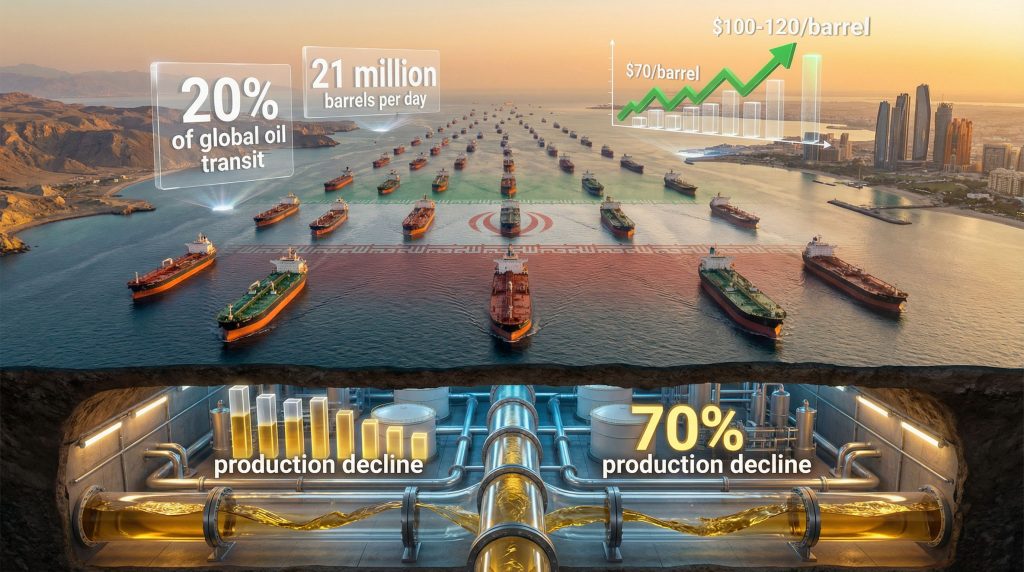
Global energy security hinges on a handful of geographic bottlenecks where massive volumes of oil and gas transit through narrow waterways vulnerable to disruption. The Strait of Hormuz represents the most critical of these chokepoints, handling approximately 20 per cent of global oil transit in normal conditions. When regional conflicts threaten this waterway's accessibility, the mathematical impact on global supply calculations creates immediate price responses across all major crude benchmarks.
Strategic Importance to Global Energy Flows
The concentration of energy flows through Hormuz creates systemic vulnerability that extends beyond the simple percentage of global production at risk. Daily transit volumes through this chokepoint represent the primary export route for multiple major producing nations, creating interdependencies where disruption affects not only Iranian production but also Iraqi, Kuwaiti, and other regional exporters.
During the current crisis, tanker traffic through the Strait of Hormuz remains largely restricted, according to market analysis, creating logistical bottlenecks that prevent even partial production recovery from reaching global markets. This demonstrates how chokepoint vulnerabilities can amplify the market impact of regional production disruptions far beyond their immediate scope.
Economic Ripple Effects of Hormuz Disruptions
When Hormuz transit faces restrictions, the economic consequences cascade through multiple layers of the global energy system. Primary effects include immediate price responses across Brent crude and WTI benchmarks, but secondary impacts extend to natural gas pricing, LNG shipment routes, and regional refinery operations that depend on reliable feedstock delivery.
The geographic concentration of refining capacity near Hormuz export terminals means that chokepoint disruptions affect not only crude oil exports but also refined product availability in global markets. This dual impact on both upstream production and downstream processing creates compound supply constraints that traditional reserve releases cannot easily address.
Regional production dependencies illustrate the interconnected nature of Middle East energy systems. Iraq's oil production from main southern oilfields declined 70 per cent to 1.3 million barrels per day during recent tensions, demonstrating how Hormuz accessibility directly affects production decisions across multiple countries sharing the same export infrastructure.
How Regional Energy Infrastructure Attacks Create Market Cascades
Energy infrastructure attacks generate market effects that extend far beyond the immediate production capacity targeted, creating cascading disruptions through interconnected pipeline networks, processing facilities, and export terminals. The systematic targeting of critical energy nodes demonstrates sophisticated understanding of how to maximise economic impact through strategic infrastructure disruption.
Primary Target Analysis
Iran's South Pars field and Asaluyeh refinery facilities sustained direct damage, with reports indicating that some tanks and gas facilities in the Asaluyeh refinery complex had been hit. These attacks specifically targeted dual-purpose infrastructure serving both domestic energy needs and export capacity, multiplying the economic consequences of each successful strike.
The Revolutionary Guards' threats against energy facilities across Saudi Arabia, UAE, and Qatar represent strategic escalation beyond single-country targeting. This expanded threat matrix forces market participants to price simultaneous risks across multiple major producing regions rather than isolated facility damage.
Supply Chain Disruption Patterns
Iraq's experience illustrates typical cascade patterns following infrastructure attacks. Oil production from Iraq's main southern oilfields, which handle most of the country's crude production and export operations, plunged by 70 per cent to just 1.3 million barrels per day. This dramatic reduction occurred not primarily due to direct attacks on Iraqi facilities, but because of transport and export limitations created by regional infrastructure disruption.
Recovery efforts demonstrate the complex logistical challenges of restoring normal operations. Iraq's North Oil Company resumed exports via pipeline after Baghdad and the Kurdistan Regional Government reached agreement to restart flows, with officials seeking to pump at least 100,000 barrels per day through available port facilities. However, this recovery rate represents only a fraction of normal export capacity.
Libya's National Oil Corporation provides a parallel example of infrastructure adaptation, announcing that flows from the Sharara oilfield were being gradually redirected through alternative pipelines after a fire broke out. Such operational flexibility requires pre-existing alternative routing capacity and demonstrates the importance of redundant infrastructure systems.
The interconnected nature of regional energy systems means that attacks on key facilities create bottlenecks affecting multiple production areas. When critical processing, transport, or export infrastructure faces disruption, the economic impact spreads across all production feeding into those systems, creating supply losses that exceed the immediate damage footprint.
What Strategic Petroleum Reserve Releases Reveal About Market Intervention
Government intervention through strategic petroleum reserve releases represents a critical tool for managing oil price volatility during geopolitical crises, though the effectiveness of such measures depends on multiple factors including release timing, volume coordination amongst consuming nations, and market absorption capacity. The decision calculus for reserve utilisation reveals important insights about official assessment of crisis duration and supply disruption severity.
Government Response Mechanisms
Strategic reserve releases require careful coordination amongst major consuming nations to maximise market impact whilst preserving emergency stocks for potentially worse scenarios. The International Energy Agency typically coordinates such responses, bringing together member nations' reserves to create sufficient market intervention capacity to influence global pricing.
The timing of reserve releases proves crucial for market effectiveness. Early intervention can prevent panic buying and speculative position building, whilst delayed responses may require much larger volumes to achieve similar price moderation effects. Current market conditions, with Brent crude futures maintaining levels above $100 per barrel for multiple consecutive sessions, suggest ongoing official assessment of whether intervention thresholds have been met.
Market Absorption Capacity
Reserve releases must enter existing supply chain infrastructure to reach refineries and end users, creating logistical constraints on how quickly released barrels can provide actual supply relief. Pipeline capacity, refinery processing schedules, and transportation networks all influence the speed at which strategic reserves can substitute for disrupted commercial supplies.
Market participants distinguish between announced reserve releases and actual barrel delivery, often maintaining elevated pricing until physical supply replacement becomes evident in inventory statistics and terminal loading schedules. This explains why price moderation effects may lag behind official intervention announcements.
The scale of disruption affects reserve release effectiveness significantly. When supply losses involve multiple producing regions and transport chokepoints, the volume of reserves required to offset market psychology may exceed comfortable drawdown levels for government stockpiles designed for emergency scenarios.
Where Oil Price Volatility Creates Investment Opportunities and Risks
Energy sector volatility during geopolitical crises creates distinct investment dynamics across equity markets, commodity futures, and derivative instruments. Investors must navigate between fundamental supply-demand analysis and sentiment-driven price movements that can persist for extended periods regardless of underlying production recovery trends.
Energy Sector Equity Responses
Major oil companies experience asymmetric stock performance during crude price spikes, with upstream producers typically benefiting more directly from higher commodity prices than downstream refiners and distributors. However, geopolitical volatility adds complexity to these traditional relationships, as operational exposure to affected regions can offset price benefits.
Regional energy companies face particularly acute risk assessment challenges during Middle East conflicts. Companies with significant Middle East operations must balance higher commodity prices against operational disruption risks, evacuation costs, and potential asset damage or seizure.
Integration across the energy value chain influences company sensitivity to price volatility. Vertically integrated companies may experience internal hedging effects where upstream gains partially offset downstream margin pressure, whilst pure-play operators face more direct commodity exposure.
Commodity Trading Dynamics
Futures market positioning reveals sophisticated trader responses to geopolitical developments, with large speculative positions often preceding major price movements during crisis escalation. The commitment of traders reports typically show increased long positioning by managed money and hedge funds during sustained geopolitical uncertainty.
Options market activity expands dramatically during crisis periods, as volatility premiums rise and traders seek asymmetric risk exposure through call option strategies or protective put positions. Implied volatility often remains elevated long after initial crisis triggers, reflecting ongoing uncertainty about conflict duration and escalation potential.
Contango versus backwardation patterns in the futures curve provide important signals about market expectations for crisis resolution. Steep backwardation typically indicates immediate supply tightness with expectations for eventual normalisation, whilst persistent contango may suggest longer-term structural supply concerns.
How Energy Security Concerns Drive Long-Term Market Restructuring
Sustained geopolitical instability in major energy producing regions catalyses structural changes in global energy investment patterns, supply chain diversification strategies, and infrastructure development priorities. These longer-term adaptations often prove more economically significant than immediate price volatility effects.
Diversification Strategies Emerging from Crisis
Major energy consuming nations typically accelerate investment in alternative supply sources following prolonged Middle East supply disruptions. This includes increased capital allocation to production development in politically stable regions, strategic partnership agreements with non-Middle East producers, and infrastructure investments supporting supply chain diversification.
Corporate energy security strategies evolve during extended crisis periods, with companies reassessing geographic concentration risks and operational contingency planning. This may include inventory strategy changes, supply contract diversification, and alternative sourcing relationship development. For instance, analysing energy exports challenges reveals how nations adapt their export strategies during volatile periods.
Policy Implications for Energy Independence
Government energy security policies undergo significant revision following major supply disruptions, often resulting in accelerated domestic production incentives, renewable energy transition support, and strategic reserve capacity expansion. These policy shifts can create lasting changes in energy market structure extending well beyond immediate crisis resolution.
International cooperation frameworks for energy crisis management typically strengthen during and after major disruptions, as consuming nations recognise the benefits of coordinated response capabilities. Such cooperation may include expanded information sharing, joint reserve management protocols, and coordinated demand reduction measures.
Infrastructure hardening investments receive increased priority following targeted attacks on energy facilities. This includes physical security enhancements, redundant capacity development, and cyber security improvements for critical energy infrastructure systems.
The next major ASX story will hit our subscribers first
What Historical Precedents Teach About Oil Price Recovery Patterns
Historical analysis of oil price behaviour during and after major Middle East conflicts reveals consistent patterns in market recovery dynamics, though the specific timing and magnitude of price normalisation varies significantly based on conflict duration, infrastructure damage scope, and policy response effectiveness.
Comparative Analysis of Past Middle East Crises
The 1973 Oil Embargo established the template for politically motivated supply disruptions, demonstrating how producer cooperation can create sustained price elevation lasting multiple years. However, this crisis differed from current infrastructure-focused conflicts in that it involved coordinated production cuts rather than facility damage requiring physical repair.
The 1979 Iranian Revolution provides closer parallels to current infrastructure disruption patterns, as revolutionary upheaval disrupted production and export capacity for extended periods. Price recovery in this case required both political stabilisation and infrastructure reconstruction, extending the impact duration beyond simple production restoration.
The 1990 Gulf War introduced the modern precedent for targeted infrastructure attacks during military conflicts. Coalition forces specifically targeted Iraqi and Kuwaiti energy infrastructure, requiring extensive post-conflict reconstruction. Recovery patterns from this period indicate that price normalisation typically requires both conflict resolution and visible infrastructure repair progress.
Recovery Timeline Expectations
Market memory effects influence price recovery patterns, with traders maintaining elevated risk premiums long after immediate crisis resolution. This psychological factor can sustain higher commodity prices even when physical supply capacity has been restored, as market participants remain sensitive to renewed conflict potential.
Infrastructure repair requirements directly affect recovery timelines. Simple production cuts can be reversed relatively quickly once political agreements are reached, whilst physical facility damage requires construction timelines that may extend recovery periods by months or years.
According to Bloomberg's analysis of the current crisis, "Iranian officials confirmed significant damage to key South Pars gas field infrastructure and oil processing facilities." This level of infrastructure damage suggests recovery timelines extending beyond immediate political resolution.
Long-term structural changes in global energy flows often persist beyond immediate crisis resolution. Major supply disruptions typically accelerate existing diversification trends and create new supply relationships that may permanently alter global energy trade patterns.
Regional security considerations continue influencing energy investment decisions long after specific conflicts end. This sustained risk awareness can limit reinvestment in affected regions and support alternative supply development in more stable areas.
Key Market Metrics and Investment Strategy Implications
Current market conditions reveal several critical indicators for investors navigating energy sector volatility during geopolitical crises. Brent crude oil price jumps of over 4 per cent in single trading sessions demonstrate the intensity of market reactions to infrastructure threats, whilst sustained elevation above $100 per barrel indicates persistent supply concern rather than temporary speculation.
Portfolio Risk Assessment
Energy sector allocation strategies must account for both upside potential from higher commodity prices and downside risks from operational disruption in affected regions. Geographic diversification within energy portfolios becomes particularly important during sustained Middle East instability.
Currency hedging considerations affect energy investment returns significantly during geopolitical crises. Oil-importing economies typically experience currency weakness during energy price spikes, whilst major producer currencies may strengthen, creating additional return variability for international energy investors.
Alternative Energy Investment Acceleration
Geopolitical energy supply disruptions consistently accelerate alternative energy investment interest, as both institutional and government investors seek to reduce exposure to politically unstable supply sources. This trend creates secondary investment opportunities in renewable energy development, energy storage systems, and efficiency technologies.
Energy security concerns drive policy support for domestic energy development, creating investment opportunities in previously uneconomic production projects and technologies. These policy-driven investment themes often persist beyond immediate crisis resolution, creating longer-term structural opportunities.
Furthermore, market observers note that Brent crude oil price jumps during infrastructure crises often coincide with increased investment flows into energy security technologies and alternative supply development projects.
Contemporary market analysis suggests that sustained Brent crude oil price jumps above $100 per barrel create economic incentives for previously marginal production projects whilst simultaneously driving policy support for energy independence initiatives across major consuming nations.
Investment Risk Disclaimer: The analysis presented reflects current market conditions and historical patterns that may not predict future performance. Energy sector investments involve significant volatility risks, geopolitical exposure, and commodity price sensitivity. Investors should conduct thorough due diligence and consider professional advice before making investment decisions based on geopolitical energy market analysis. Past performance and historical crisis patterns do not guarantee similar outcomes in current or future market conditions.
Are You Positioned for the Next Major Resource Discovery?
While oil markets dominate headlines during geopolitical crises, savvy investors recognise that significant opportunities often emerge in overlooked mineral discoveries that can deliver exceptional returns regardless of energy sector volatility. Discovery Alert's proprietary Discovery IQ model delivers real-time alerts on significant ASX mineral discoveries, instantly empowering subscribers to identify actionable opportunities ahead of the broader market whilst energy markets remain focused elsewhere. Begin your 14-day free trial today and secure your market-leading advantage in the mining sector.