June 12, 2026
When Weather Becomes a Financial Event: Understanding Alumina's Energy Vulnerability
The alumina refining industry operates on a principle most investors rarely consider: continuous high-temperature heat is not optional. Unlike many manufacturing processes that can idle or throttle back with relative ease, the Bayer process and rotary kiln calcination at the heart of alumina production demand uninterrupted energy supply. When that supply is severed, even briefly, the consequences ripple outward through production schedules, shipping commitments, and quarterly earnings with surprising speed and scale.
This structural reality is what makes the Cyclone Narelle impact on Alcoa Pinjarra refinery operations so instructive, not just as a weather event, but as a case study in industrial vulnerability, commodity market sensitivity, and the compounding nature of operational risk in bulk materials processing.
When big ASX news breaks, our subscribers know first
Western Australia's Position in Global Alumina Trade
Before examining the mechanics of the disruption, it is worth establishing what is actually at stake geographically. Western Australia is not merely a significant alumina producer; it is one of the foundational pillars of global seaborne alumina supply. The Darling Range, stretching south of Perth, sits atop one of the most accessible bauxite deposits on Earth, and Alcoa has built an integrated industrial system around this resource over several decades.
The company operates three refineries in the region: Pinjarra, Wagerup, and Kwinana. Together, these facilities form one of the largest integrated alumina production networks outside China. The Pinjarra refinery alone carries an annual nameplate capacity of 4.7 million tonnes, placing it firmly among the highest-output alumina facilities in the Southern Hemisphere.
What makes this cluster strategically significant is not just raw volume. It is the interconnected nature of the supporting infrastructure, including LNG supply pipelines, bauxite rail networks running from Jarrahdale and Huntly mine areas, and dedicated port facilities at the Port of Bunbury and Kwinana. This integration creates operational efficiency under normal conditions, but it also creates a web of interdependencies that extreme weather can exploit simultaneously.
The Calcination Problem: Why LNG Is Non-Negotiable
To understand why Cyclone Narelle's disruption of LNG supply lines was so consequential, it helps to understand what alumina refining actually requires energetically.
The Bayer process converts bauxite ore into alumina through a series of chemical and thermal steps. The final and most energy-intensive stage is calcination, where aluminium hydroxide is heated in rotary kilns to temperatures exceeding 1,000 degrees Celsius to drive off chemically bound water and produce the finished alumina powder. This process cannot be run at partial temperatures without compromising product quality. It requires sustained, high-volume gas combustion running continuously across multiple kiln units simultaneously.
At Pinjarra, LNG is the primary fuel for this calcination process. The refinery draws from pipeline infrastructure connected to Western Australia's gas network. When Cyclone Narelle struck in March 2025 and disrupted upstream LNG supply lines, the refinery faced an immediate and inescapable constraint: without sufficient gas, kiln throughput must be reduced. There is no straightforward backup for the scale of energy involved.
This is what industry insiders sometimes describe as a single-point-of-failure scenario, where a single infrastructure dependency, when severed, cannot be substituted quickly enough to prevent production impact.
Quantifying the Damage: Shipments, Costs, and Market Signals
Alcoa's Chief Financial Officer Molly Beerman disclosed the financial dimensions of the disruption at the Wells Fargo Industrials and Materials Conference in Chicago, providing specific figures that allow for precise analysis.
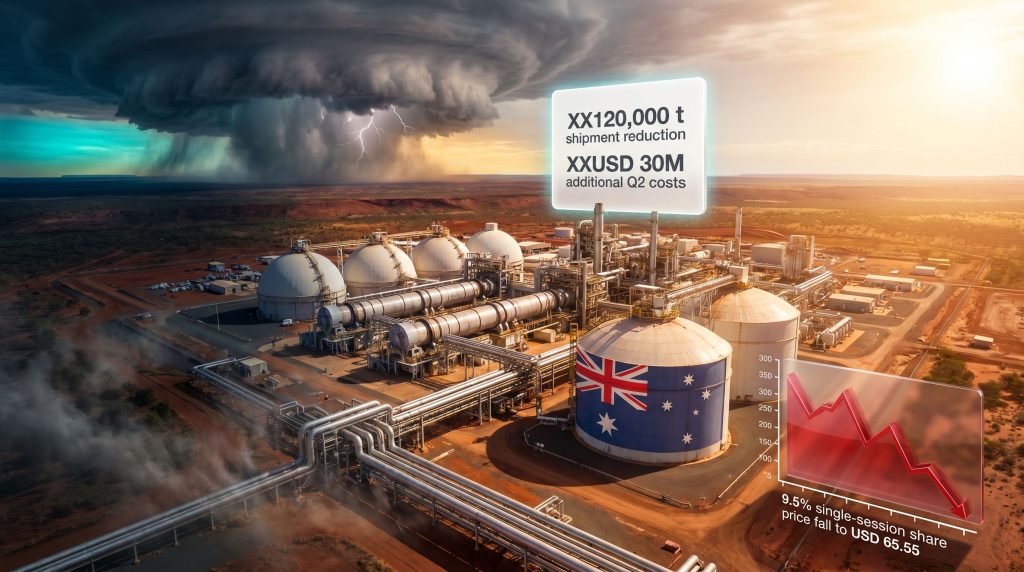
The key operational impact was a projected decline of approximately 120,000 tonnes in alumina shipments from Pinjarra in Q2 2025 relative to Q1 2025. Measured against the refinery's annual capacity, this represents roughly 10% of a single quarter's expected output, a meaningful volume reduction concentrated in a narrow window.
The financial consequence was equally specific. Alcoa estimated that the Cyclone Narelle impact on Alcoa Pinjarra refinery operations would increase Q2 production costs by approximately USD 30 million. This cost escalation reflects several compounding mechanisms that occur when a high-fixed-cost industrial facility is forced to reduce throughput:
- Emergency energy procurement at elevated spot rates to partially offset supply shortfalls
- Fixed operating costs spread across a smaller output base, increasing the per-tonne cost of production
- Logistics rerouting expenses as port closures disrupted normal vessel scheduling
- Equipment recommissioning costs incurred when resuming normal operational rates after a controlled pullback
The Pinjarra disruption did not occur in isolation. Simultaneously, Alcoa's Sao Luis refinery in Brazil was absorbing an estimated USD 15 million in additional fuel costs during Q2, attributable to energy market volatility linked to the ongoing Middle East conflict and its effects on shipping and fuel procurement.
| Cost Impact Source | Q2 2025 Additional Cost |
|---|---|
| Pinjarra (Cyclone Narelle, LNG disruption) | USD 30 million |
| Sao Luis, Brazil (Middle East conflict, fuel costs) | USD 15 million |
| Total additional Q2 alumina segment cost burden | USD 45 million |
Bauxite Quality Degradation: The Slower-Moving Crisis Beneath the Headline
One dimension of the Pinjarra situation that receives far less attention than weather events is the underlying deterioration in bauxite ore quality being mined from Alcoa's Western Australian leases. This is a geological reality that compounds cyclone-related disruptions in ways that are less visible but potentially more consequential over the long term.
As mining progresses deeper and further into maturing ore bodies, the reactive alumina content of bauxite typically declines while silica and other impurities increase. For refinery operators, this means the ore-to-alumina conversion ratio worsens over time. More bauxite must be mined, transported, and processed to produce the same tonne of finished alumina, pushing per-unit costs upward across the entire production chain.
Beerman's remarks at the Wells Fargo conference specifically identified declining bauxite quality as one of the structural pressures facing the Western Australian refinery portfolio, distinct from and additive to the cyclone-related disruption. This is a particularly important signal for long-term investors, because declining ore quality is not a problem that resolves with the next quarter. It reflects the maturation of mine areas that have been in operation for decades and will require either new resource development, blending strategies, or process chemistry adjustments to manage.
The convergence of weather-driven acute disruptions and geology-driven structural cost increases at the same facilities creates a compounding pressure that quarterly earnings figures often fail to fully capture.
The Alumina Segment Goes Underwater: What Does That Mean in Practice?
Beerman's assessment of Alcoa's alumina segment position during Q2 2025 was unusually direct for a public conference setting. She indicated that, taken as a whole, the alumina business would operate in a loss-making position during the affected period, a characterisation that carries significant weight given the scale of Alcoa's alumina operations.
For an alumina segment to be loss-making, the spot and contracted alumina price realised must fall below the fully loaded cost of production, including energy, labour, maintenance, and logistics. The fact that this threshold was crossed reflects not just the cyclone's incremental USD 30 million cost impact, but the broader pricing environment in which global alumina prices have been suppressed by the continued expansion of Chinese refining capacity.
China industrial demand and alumina output have grown substantially over the past decade, driven by domestic bauxite imports from Guinea and Indonesia and the construction of large-scale Bayer process refineries. This capacity expansion has structurally capped alumina prices at levels that compress margins for higher-cost producers, including those in Australia where energy and labour costs are substantially elevated relative to Chinese operations.
The Cyclone Narelle impact on Alcoa Pinjarra refinery therefore did not cause the alumina segment to become loss-making on its own. It pushed an already-marginal operation below breakeven by adding acute costs to a business already navigating a challenging price environment.
The next major ASX story will hit our subscribers first
Market Reaction and Investor Psychology
The speed and magnitude of the market's response to Beerman's disclosures illustrates a well-documented pattern in commodity processing equities: investors tend to reprice margin compression signals aggressively when they arrive in clusters rather than individually.
Alcoa's shares fell 9.5% in a single session, closing at USD 65.55 following the conference. A nearly 10% single-day decline for a major industrial company reflects more than a reaction to USD 45 million in additional costs. It reflects a reassessment of the structural profitability outlook for the alumina segment as a whole, a recognition that the combination of low prices, declining ore quality, energy vulnerability, and geopolitical cost pressures represents a systemic challenge rather than a temporary setback.
For investors monitoring the alumina sector, this pattern carries a practical implication. When multiple independent risk factors converge in the same earnings period, even a single catalyst such as a weather event can function as the trigger that forces a broader repricing of structural risk that had previously been discounted or deferred. Furthermore, top aluminium producers globally are watching this situation closely, as it has broader implications for the entire supply chain.
Supply Chain Consequences: From Pinjarra to Asian Smelters
The downstream consequences of the Pinjarra disruption extended well beyond Alcoa's own financial results. Alumina is the direct feedstock for primary aluminium smelting, and any sustained reduction in Australian supply creates price and availability pressures for smelters in East Asia and the Middle East who depend on seaborne Australian product.
Alcoa's response to Middle Eastern smelter customers facing production constraints linked to the regional conflict added a further layer of complexity. Rather than serving those customers with their contracted volumes, Alcoa redirected some allocated alumina shipments toward China, which represents the most liquid spot market for seaborne alumina. While commercially rational, this redirection concentrates supply flows and can amplify spot price signals in non-Chinese trade lanes.
Port disruptions from Cyclone Narelle compounded the volume reduction effect. Alumina is a bulk commodity requiring continuous vessel scheduling across dedicated loading facilities. Even short-duration port closures create multi-week scheduling backlogs as vessel rotations are disrupted, pushing actual shipment shortfalls beyond what the production curtailment figures alone would suggest.
Historical Context and the Case for Energy Resilience Investment
Cyclone Narelle is not the first extreme weather event to affect Western Australian alumina infrastructure. Tropical Cyclone Seroja in 2021 created port closure and supply chain delays across the region, and periodic flooding events have historically disrupted bauxite rail networks connecting Darling Range mine areas to refinery stockpiles.
| Event | Primary Disruption Type | Key Impact |
|---|---|---|
| Cyclone Narelle (March 2025) | LNG supply interruption and port closures | ~120,000t shipment reduction, USD 30M cost increase |
| Tropical Cyclone Seroja (2021) | Port closures, supply chain delays | Varied across regional operators |
| Historical flooding events | Bauxite rail network disruptions | Periodic short-term throughput curtailments |
The pattern across these events points toward a structural gap in industrial resilience planning for the region. Current infrastructure design generally assumes that individual disruption types, whether gas supply, port access, or rail logistics, are unlikely to occur simultaneously. However, Cyclone Narelle demonstrated that a single cyclone event can trigger multiple infrastructure failures concurrently, overwhelming the managed-response protocols that refineries have developed for isolated disruptions.
Industry conversations following the Pinjarra event have increasingly focused on three potential resilience investments:
- Dual-fuel or backup energy systems capable of temporarily substituting alternative fuels for LNG in calcination processes during supply interruptions
- Strategic on-site LNG storage to buffer refinery operations through short-duration pipeline supply disruptions without immediate production curtailment
- Renewable energy integration pathways, particularly as part of the broader green metals transition where green hydrogen is emerging as a longer-term calcination fuel substitute that would reduce dependence on pipeline gas infrastructure entirely
What Comes Next for Alcoa's Western Australian Portfolio?
With LNG supply restored following the cyclone's passage, Pinjarra is expected to return toward normal operational rates through subsequent quarters. However, the USD 30 million Q2 cost burden will weigh on full-year alumina segment metrics, and analysts will be watching closely for evidence that Q3 shipment volumes have fully recovered to pre-disruption levels.
The more consequential questions are structural rather than cyclical. Alcoa faces a portfolio of Western Australian refineries navigating simultaneously declining ore quality, suppressed alumina prices, and demonstrated vulnerability to energy infrastructure disruptions in a region with an active cyclone season. These pressures are not independent; they interact and amplify each other in ways that make the path to sustained profitability in the segment genuinely challenging.
The Path Forward: Resilience and Decarbonisation
Capital allocation decisions for the Western Australian network will likely face increasing scrutiny. In addition, the mining decarbonisation benefits of reducing LNG dependency are becoming increasingly difficult to ignore from both a financial and strategic standpoint. Potential strategic responses include:
- Targeted infrastructure investment to reduce LNG dependency through renewable mining solutions that offer long-term cost stability
- Operational flexibility arrangements enabling faster production scaling in response to market conditions
- Longer-term portfolio rationalisation if structural profitability cannot be restored under current market conditions
Consequently, the Cyclone Narelle impact on Alcoa Pinjarra refinery serves as a defining case study for how climate exposure, geological maturation, and commodity price cycles interact in ways that go well beyond what traditional risk modelling typically captures.
Disclaimer: This article contains forward-looking statements, financial estimates, and market projections based on publicly disclosed information. These statements involve inherent uncertainty and should not be construed as investment advice. Past performance and historical event patterns do not guarantee future outcomes. Readers should conduct independent research before making investment decisions.
Want to Stay Ahead of Major ASX Mineral Discoveries Before the Broader Market?
Discovery Alert's proprietary Discovery IQ model delivers real-time alerts on significant ASX mineral discoveries, transforming complex commodity data into clear, actionable insights for both short-term traders and long-term investors. Explore how historic discoveries have generated substantial returns on Discovery Alert's dedicated discoveries page and begin your 14-day free trial today to secure a genuine market-leading edge.