August 6, 2026
The Model Plant Methodology: How Mining's Smartest Operators Are Rebuilding Processing From the Ground Up
Across the global mining industry, a quiet but consequential shift is underway. Rather than deploying technology upgrades piecemeal across dozens of sites, leading operators are adopting a fundamentally different philosophy: build one facility to near-perfection, document every outcome, and then replicate the blueprint at scale. This approach, known as the model plant methodology, is transforming how the industry thinks about digital transformation, capital allocation, and operational risk.
Vale's decision to open a model plant in Itabira with AI applied to operations at its Conceição 2 processing facility represents one of the most sophisticated executions of this strategy seen anywhere in global iron ore production. Understanding what this deployment actually involves, from its engineering architecture to its financial logic, reveals something far more significant than a single technology upgrade.
When big ASX news breaks, our subscribers know first
What the Model Plant Concept Actually Means in Industrial Practice
The term "model plant" is frequently misunderstood. It does not refer to a facility that is simply newer or better equipped than its peers. A true model plant is an intentional proof-of-concept infrastructure designed from the outset to generate a transferable operational template. Every system installed, every process optimised, and every performance outcome recorded at a model plant is oriented toward one ultimate objective: replication.
This distinction matters enormously from both an operational and an investment perspective. When a mining company invests in a model plant, the return on that capital is not confined to the productivity gains at the single site. The genuine financial leverage comes from applying the validated blueprint across an entire processing network, multiplying the efficiency gains many times over without repeating the full cost of the original discovery process.
For Vale, whose iron ore processing operations span multiple facilities across Minas Gerais and beyond, the Conceição 2 facility in Itabira was selected to carry this architectural responsibility.
The Conceição 2 Facility: Why Itabira Was the Right Starting Point
The Itabira mining complex occupies a historically significant position in Brazilian iron ore production. Located in the Iron Quadrangle region of Minas Gerais, this geological formation contains some of the world's highest-grade iron ore deposits, predominantly in the form of itabirite and high-grade hematite. The Iron Quadrangle has been the backbone of Brazil's iron ore export economy for decades, and Itabira sits at its operational core.
Conceição 2 functions as a wet processing facility within Vale's integrated Itabira operations. Wet processing, also known as beneficiation via classification and separation in aqueous circuits, is particularly well-suited to AI-driven optimisation because it involves continuous fluid dynamics, particle size distributions, and chemical interactions that generate vast quantities of real-time sensor data. These are precisely the conditions under which machine learning models demonstrate their greatest advantage over conventional process control systems.
The infrastructure density required to support AI at this scale is substantial. Vale's deployment at Conceição 2 involved:
| Hardware Component | Quantity / Scale | Operational Function |
|---|---|---|
| Automated instruments | ~7,300 units | Real-time data capture across processing circuits |
| Surveillance and process cameras | 100+ units | Visual monitoring of material flow and equipment status |
| Online iron-content sensors | Integrated network | Continuous ore grade measurement at processing points |
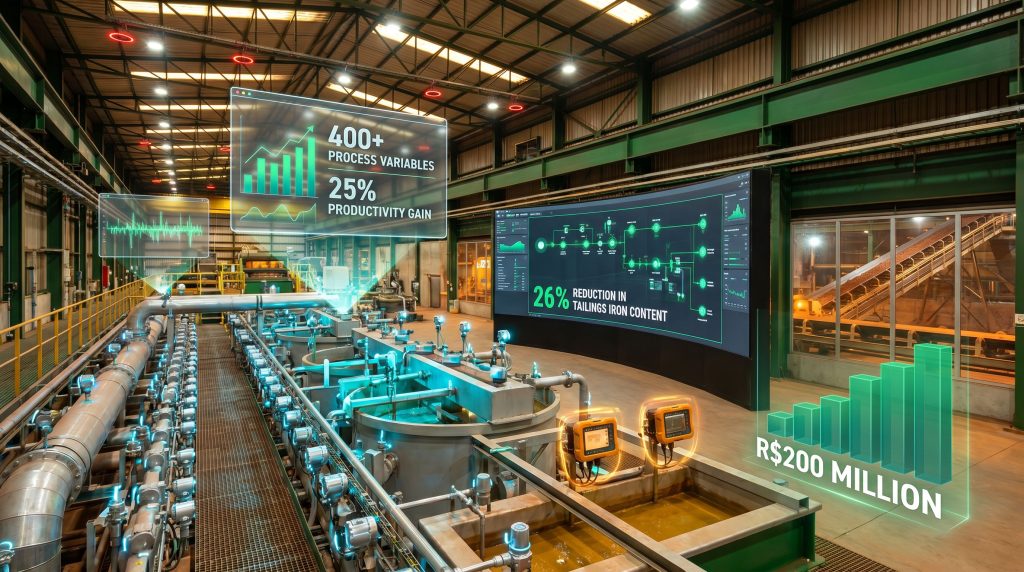
| Process variables monitored | 400+ | Dynamic AI-driven adjustment parameters |
The sheer density of instrumentation at Conceição 2 creates what engineers refer to as a high-fidelity digital twin of the physical plant. Every material movement, every pump pressure fluctuation, and every separation efficiency reading is captured, transmitted, and interpreted by the AI system in real time.
Breaking Down the R$200 Million Investment: Where the Capital Went
The approximately R$200 million committed to the Conceição 2 AI upgrade is a substantial figure by any measure, but contextualising it within mining industry capital expenditure norms reveals why this investment is considered strategically efficient.
Traditional processing facility upgrades in iron ore operations typically involve physical infrastructure expansion: new ball mills, additional thickeners, or extended conveyor systems. These are high-cost, long-lead-time investments with site-specific returns. The AI deployment at Conceição 2 follows a different capital logic entirely.
Rather than expanding physical throughput capacity, the investment is focused on extracting more value from existing ore volumes by reducing losses and improving process efficiency. This is sometimes described in the industry as sweating existing assets, and it typically delivers faster returns and lower capital intensity than greenfield or brownfield physical expansion.
Furthermore, AI-powered mining efficiency at this scale demonstrates that the R$200 million deployment at Conceição 2 functions as a proof-of-concept asset designed to generate a replication blueprint. The true financial return is multiplied across every subsequent facility that adopts the same architecture, meaning the effective cost-per-site of the AI system decreases substantially with each rollout.
Inside the AI System: How 400+ Variables Are Managed Simultaneously
From SCADA to Adaptive AI: A Fundamental Shift in Process Control
To appreciate what Vale has built at Conceição 2, it helps to understand what came before it. For decades, mineral processing facilities have relied on Supervisory Control and Data Acquisition systems, universally known as SCADA, to monitor plant operations. SCADA systems are effective at collecting data and alerting operators to threshold breaches, but they are fundamentally passive: they present information and wait for human decisions.
AI-driven adaptive process control operates on an entirely different principle. Rather than alerting a human operator that slurry density has drifted outside acceptable parameters, the AI system detects the trend before it becomes a problem, calculates the optimal corrective adjustment across multiple interdependent variables simultaneously, and implements the change autonomously. The speed and precision of this response is orders of magnitude beyond what any human operator can achieve across 400+ variables at once.
This is the core technical advantage. Iron ore beneficiation is not a linear process. Adjusting one variable, such as feed rate to a spiral concentrator, creates cascading effects across downstream separation stages. An AI system trained on historical and real-time plant data can model these interdependencies and optimise the entire circuit holistically, rather than managing each variable in relative isolation.
Online Iron-Content Sensing: The Metallurgical Game-Changer
One of the least discussed but most consequential components of the Conceição 2 system is its network of online iron-content sensors. In conventional processing operations, ore grade measurement relies on laboratory assay cycles. Samples are collected, transported to the laboratory, prepared, and analysed using techniques such as X-ray fluorescence. This process typically takes hours, meaning that process adjustments are always responding to conditions that existed in the past rather than conditions that exist right now.
Online iron-content sensors, deployed at multiple points throughout the processing circuit, deliver continuous grade measurements without the laboratory delay. When integrated with the AI control system, this enables truly real-time grade-based process optimisation, where separation parameters are adjusted dynamically in response to fluctuations in the incoming ore characteristics. This is particularly valuable in itabirite deposits, where ore grade can vary meaningfully over short distances due to the banded nature of the iron formation.
What a 25% Productivity Gain and 26% Tailings Iron Reduction Actually Mean
Decoding the Productivity Metric
Vale has reported a 25% productivity improvement during the pilot phase at Conceição 2. This figure requires careful interpretation. In iron ore processing, productivity can be expressed in several ways, and the specific metric being applied shapes the significance of the outcome considerably.
The three most common frameworks for interpreting such a gain are:
- Throughput productivity: More tonnes of ore processed per hour using the same physical infrastructure and energy inputs.
- Recovery productivity: A higher percentage of the iron present in the feed ore successfully reporting to the product stream rather than being lost to tailings.
- Cost productivity: A lower operational cost per tonne of iron ore product, achieved through efficiency gains across the processing circuit.
In practice, Vale's reported improvement likely captures elements of all three. AI-driven process optimisation characteristically improves all these dimensions simultaneously because the underlying mechanism, tighter control over interdependent variables, benefits throughput, recovery, and cost efficiency at the same time.
The Tailings Iron Content Reduction: Why 26% Matters More Than It Appears
The reported 26% reduction in tailings iron content is arguably the more technically significant of the two headline figures. To understand why, it is necessary to understand what tailings iron content actually measures.
Tailings iron content is the concentration of recoverable iron remaining in the waste stream discharged after processing. Every percentage point of iron reporting to tailings rather than to the product represents ore that was mined, crushed, moved, and processed, but ultimately not monetised.
A 26% reduction in tailings iron content means that significantly more of the iron present in the raw ore feed is now being captured in the saleable product stream. This improvement flows directly into two financial outcomes: higher revenue per tonne of ore processed, and lower effective unit costs once the fixed costs of mining and crushing are spread across a larger recovered iron volume.
From an environmental perspective, this metric carries equal significance. Lower iron content in tailings means that the waste streams generated by processing contain less residual value and, over time, contribute to lower total tailings volumes. In Brazil, where tailings dam safety has been a subject of intense regulatory and public attention following the Mariana and Brumadinho disasters, any technology that measurably reduces tailings generation rates carries substantial non-financial value as well.
The next major ASX story will hit our subscribers first
The Replication Strategy: Scaling the Blueprint Across Vale's Network
How the Model Plant Blueprint Gets Transferred
The true test of the model plant methodology is not whether it works at the first site. It is whether the architecture is genuinely transferable across a portfolio of facilities that differ in ore body characteristics, processing circuit configurations, and operational history.
Vale's iron ore operations span multiple processing nodes across Minas Gerais, each with distinct geological inputs and infrastructure histories. Successfully deploying the Conceição 2 AI architecture at a second, third, or tenth facility requires careful standardisation of the data ingestion layer, the machine learning model training protocols, and the sensor calibration procedures that underpin the system's accuracy. In this respect, data-driven mining operations are reshaping how the industry approaches multi-site rollouts at scale.
The critical challenge in multi-site AI replication is that machine learning models trained on data from one facility do not automatically transfer their predictive accuracy to a facility with different ore characteristics or circuit configurations. This means that each new site deployment requires a period of model training and validation against site-specific conditions, even when the underlying software architecture is standardised.
How Vale Compares to Global Peers on AI and Automation Adoption
| Mining Operator | AI/Automation Focus Area | Reported Operational Outcome |
|---|---|---|
| Vale (Brazil) | Real-time process variable control, tailings reduction | 25% productivity gain (pilot), 26% tailings iron reduction |
| BHP (Australia) | Autonomous haulage, predictive maintenance | Reduced unplanned downtime across Pilbara operations |
| Rio Tinto (Australia) | Mine of the Future program, autonomous drilling | Improved drill accuracy and fleet utilisation rates |
| Anglo American (Global) | FutureSmart Mining, coarse particle recovery | Reduced water consumption in processing |
What distinguishes Vale's approach is its focus on the processing circuit itself, rather than on mobile fleet automation or predictive maintenance. Process-level AI optimisation directly affects the fundamental economics of ore beneficiation in ways that fleet automation does not. It is the difference between moving ore more efficiently and extracting more value from every tonne of ore that moves.
Market and Product Quality Implications for Steel Mill Buyers
Iron ore sold into the seaborne market is priced not only on volume but on product specification consistency. Steel mills operating blast furnaces or direct reduction facilities rely on predictable iron content, silica levels, and alumina concentrations in their ore inputs to maintain stable metallurgical performance. When processing variability causes product specification drift, steel mills face efficiency losses of their own in the form of flux adjustments, yield variability, and energy consumption changes.
AI-driven process control at Conceição 2 directly addresses this quality consistency challenge. By maintaining tighter control over separation parameters in real time, the system produces a more uniform product specification across production shifts and across varying ore feed conditions. Consequently, for Vale's relationships with Asian steel producers — a dynamic explored in depth through the China steel and iron ore market outlook — this consistency premium has tangible commercial value that extends beyond the processing cost savings visible on Vale's own income statement. In addition, as green steel pricing trends continue to evolve, higher-grade, consistent iron ore products will command increasing attention from steelmakers seeking to manage both cost and carbon intensity.
Key Takeaways: What This Deployment Signals for the Broader Industry
Vale opens model plant in Itabira with AI applied to operations — and this is more than an operational milestone for one company. It represents a broader inflection point for how large-scale mineral processing will be managed across the coming decade. Furthermore, Vale's AI-powered plant in Minas Gerais has already drawn significant attention from industry observers tracking the pace of technology adoption in iron ore. Several industry-wide signals emerge from this deployment:
- AI is entering the processing core. Until recently, mining automation has been concentrated in haulage fleets and drilling equipment. The Conceição 2 deployment marks a significant maturation, with AI now operating at the heart of the beneficiation circuit itself.
- The model plant methodology is becoming a strategic norm. Companies that pilot AI at one facility and replicate systematically will outpace those attempting broad simultaneous deployments with insufficient validation.
- Tailings management is increasingly a financial, not just an environmental, metric. Reducing tailings iron content creates direct revenue recovery, making ESG-driven processing improvements simultaneously commercially attractive.
- Grade consistency will become a competitive differentiator. As AI-controlled facilities deliver more uniform product specifications, buyers will increasingly price this reliability into long-term supply agreements.
- The capital efficiency of processing AI is structurally superior to physical expansion. Achieving a 25% productivity improvement through software and sensors at an existing facility represents a fundamentally different return profile than building equivalent capacity through physical infrastructure. Mining Magazine has also reported on Vale's broader automation ambitions, reinforcing that this deployment is part of a wider strategic commitment to technology-led operational improvement.
Disclaimer: This article contains references to operational performance metrics and financial figures reported by Vale in connection with the Conceição 2 AI deployment. Readers should note that pilot-phase results may not persist at the same magnitude across full-scale or multi-site rollouts. This content is intended for informational and educational purposes only and does not constitute financial or investment advice.
Want to Capitalise on the Next Major Mining Discovery Before the Market Moves?
Discovery Alert's proprietary Discovery IQ model delivers real-time alerts on significant ASX mineral discoveries, transforming complex geological and market data into actionable investment insights — ideal for both short-term traders and long-term investors. Explore how historic mineral discoveries have generated substantial returns and begin your 14-day free trial today to position yourself ahead of the broader market.