August 6, 2026
The Economics of Resource Sovereignty: Why Guinea's Bauxite Strategy Is Rewriting the Rules
Across the African continent, a fundamental recalibration is underway in the relationship between resource-rich nations and the commodities beneath their soil. For decades, the dominant model involved foreign capital extracting raw materials, exporting them with minimal processing, and repatriating profits. Guinea, sitting atop the world's largest bauxite reserves, is now executing a deliberate departure from that model, and the formalisation of the Nimba Mining Company mining convention in Guinea represents one of the most structurally significant milestones in that transition.
Understanding what this convention actually means, and why its architecture matters far beyond a routine regulatory filing, requires examining both the geology that makes Guinea irreplaceable and the institutional machinery being built to leverage it.
When big ASX news breaks, our subscribers know first
Guinea's Bauxite Dominance: A Geological Reality With Economic Consequences
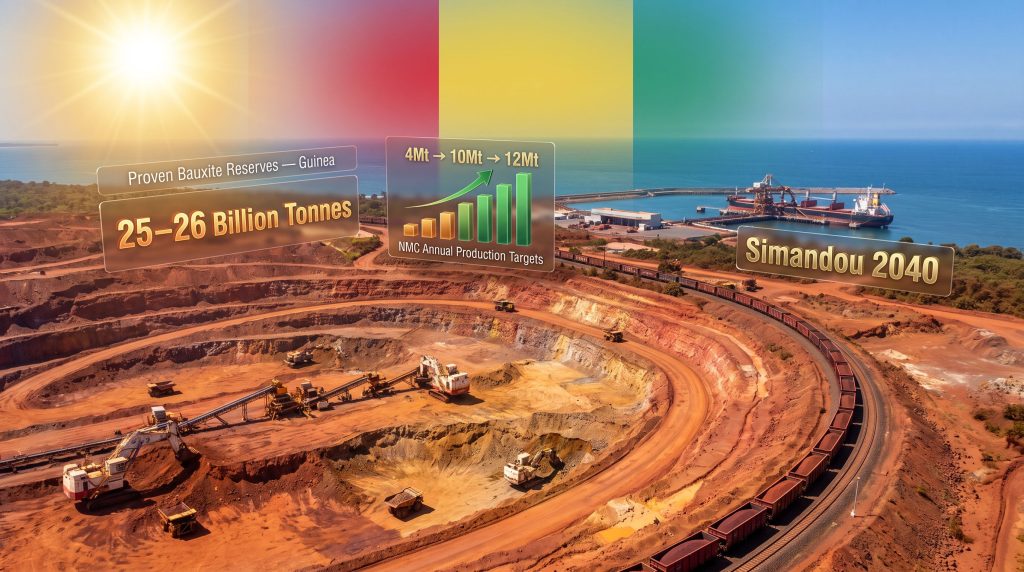
Guinea holds an estimated 25 to 26 billion tonnes of proven bauxite reserves, a figure that places it in an entirely different category from every other nation on earth. To put that in perspective, Australia, the second-largest reserve holder, controls roughly 6 billion tonnes. Guinea's geological endowment is not merely abundant; it is strategically unmatched.
Bauxite is the primary ore from which aluminium is refined. The process moves through two stages: bauxite is first processed into alumina through the Bayer process, then alumina is smelted into aluminium metal via electrolysis. Guinea has historically operated only at the first link in this chain, exporting raw ore at the lowest point in the value curve. Understanding global bauxite production trends helps contextualise why this matters so significantly for Guinea's strategic position.
The per-tonne revenue differential between raw bauxite and refined alumina is substantial, with alumina typically commanding multiples of the bauxite export price depending on prevailing commodity markets. This economic reality forms the strategic backdrop against which Guinea's national mining architecture must be understood.
What Makes Guinean Bauxite Technically Attractive
Guinean bauxite is characterised by relatively high available alumina content and favourable gibbsite mineralogy, meaning the aluminium-bearing mineral is in a form that responds well to standard low-temperature digestion in the Bayer process. This reduces refinery operating costs compared to processing boehmitic or diasporic bauxites common in other regions. For any future domestic refinery, this is a meaningful technical advantage, as feedstock quality directly influences energy consumption and reagent costs at the processing stage.
The deposits are also largely lateritic in character, sitting near the surface, which supports lower strip ratios and comparatively straightforward open-cut mining operations. This geological accessibility partially explains why Guinea's bauxite industry has attracted sustained international interest despite the country's infrastructure and governance challenges.
The Formation and Mandate of Nimba Mining Company
Nimba Mining Company was formally established on August 5, 2025, through a state-directed acquisition of assets previously operated by Guinea Alumina Corporation (GAC), a subsidiary of Emirates Global Aluminium (EGA). NMC's creation made it Guinea's first fully nationally owned integrated mining, logistics, and value-addition company operating across the bauxite supply chain.
The company's operational scope is deliberately comprehensive:
- Extraction operations at the Tinguilinta mine
- Rail infrastructure rehabilitation and management connecting the mine to the coast
- Export terminal operations at the Port of Kamsar
- Feasibility development for a domestic alumina refinery
This integrated mandate distinguishes NMC from a conventional state mining company that simply holds extraction rights. The inclusion of logistics and downstream processing within a single organisational framework signals an intent to control margin at every stage of the value chain, not merely at the point of ore removal.
What the NMC Mining Convention Actually Establishes
A mining convention in the Guinean legal context is a bilateral instrument between the state and the operating company. It is not simply a licence; it is a comprehensive legal architecture governing every material dimension of the relationship. The NMC convention, granted by presidential decree, covers the following framework elements:
| Convention Element | Scope of Governance |
|---|---|
| Fiscal Regime | Tax rates, royalties, profit-sharing structures |
| Customs Framework | Duty treatment for imported equipment and exported ore |
| Environmental Obligations | Land rehabilitation, emissions controls, water management |
| Social Commitments | Local employment targets, community investment requirements |
| Duration and Renewal | Operational term length, extension triggers, exit conditions |
| Investment Protections | Legal stability guarantees across political transitions |
Why Presidential Decree Matters as a Legal Instrument
The distinction between a decree-based convention and a ministerially negotiated agreement is not merely procedural. A convention granted by presidential decree carries executive-level authority, which provides a higher tier of legal insulation against routine legislative or administrative changes. For a company making multi-year capital commitments across mine development, rail infrastructure, and refinery feasibility, this level of legal certainty directly affects the bankability of investment cases.
"Decree-based conventions are particularly important in jurisdictions where parliamentary composition or ministerial priorities can shift rapidly. By anchoring NMC's legal framework at the executive level, the Guinean state has created a more durable investment environment than a ministerial instrument alone could provide. However, investors and counterparties will note that executive authority itself is subject to political transitions, and the enforceability of such protections across future governance changes remains a key due diligence question."
The convention also establishes a system of reciprocal obligations. The state commits to regulatory predictability; NMC commits to production milestones, local employment targets, and domestic value creation. This mutual accountability structure is a meaningful evolution from older concession frameworks that placed obligations primarily on the operating company with limited state reciprocity.
How NMC's Convention Differs From Guinea's Legacy Mining Agreements
It is important to clarify a distinction that generates confusion in commentary on Guinea's mining sector. The Nimba Mining Company mining convention in Guinea is entirely separate from the Nimba iron ore mining convention, which dates to the early 2000s and was amended in 2019 to accommodate the SMFG, Euronimba, and HPX iron ore development structure. These are distinct instruments governing different commodities, different deposits, and different legal entities.
NMC's convention differs structurally from earlier Guinean bauxite agreements in several dimensions:
| Dimension | NMC Framework | Legacy Foreign-Operator Models |
|---|---|---|
| Ownership | 100% state-owned | Foreign majority or joint venture |
| Value Retention Focus | Domestic processing mandate | Export royalty optimisation |
| Legal Instrument | Presidential decree | Ministerial negotiation |
| Downstream Scope | Alumina refinery feasibility included | Typically extraction-limited |
| Political Risk Profile | State-aligned | Subject to renegotiation pressure |
Operational Achievements and the Production Ramp-Up Trajectory
NMC's first year of operation, measured against the complexity of what was undertaken, represents a meaningful operational achievement. Within 12 months of formation, the company's teams rehabilitated the Tinguilinta mine, restored associated rail infrastructure, reactivated the Port of Kamsar export terminal, and achieved exports exceeding four million tonnes.
Rehabilitating a mine, railway, and port simultaneously within a single fiscal year is operationally demanding under any circumstances. The fact that this was accomplished by a newly formed state entity, drawing on Guinean teams rather than established foreign operational frameworks, adds additional context to the scale of the undertaking.
The production trajectory NMC is targeting is ambitious:
| Milestone | Volume and Timeline |
|---|---|
| Year 1 Exports Achieved | 4 million tonnes |
| 2026 Production Target | 10 million tonnes |
| 2027 Annual Run Rate Target | 12 million tonnes |
| Alumina Refinery Feasibility Capacity | 1.2 million tonnes per annum |
| IBS Subcontract Volume | 32 million tonnes over 5-year initial term |
Moving from 4 million tonnes in year one to 10 million tonnes in year two represents a 150% volume increase within a single calendar year. Achieving this requires simultaneous scaling of workforce capacity, equipment deployment, logistics throughput at the Port of Kamsar, and regulatory compliance systems. Each of these dimensions carries execution risk, and investors should treat the 2026 target as an ambitious aspiration rather than a confirmed outcome.
Furthermore, the IBS Group subcontracting agreement, signed on January 29, 2026, covering a minimum of 32 million tonnes over an initial five-year term at Tinguilinta, provides a contractual foundation for sustaining the ramp-up trajectory and offers some third-party validation of the operational scope NMC is pursuing.
The Sangarédi Asset Transfer and NMC's Resource Consolidation Path
NMC's current production base at Tinguilinta is not the ceiling of its resource ambition. A May 2026 agreement between the Republic of Guinea, GAC, and Emirates Global Aluminium created a pathway for the potential transfer of GAC's Sangarédi bauxite assets to NMC.
The Sangarédi deposit is among Guinea's most strategically significant bauxite formations, known for high-quality ore and substantial reserve volumes. If this transfer is completed, NMC's resource base would expand materially beyond its current operational footprint, and its long-term production capacity would increase accordingly.
This consolidation pathway reflects a broader pattern: the progressive centralisation of Guinea's most significant bauxite assets under national ownership, using NMC as the institutional vehicle. Consequently, analysts tracking the leading bauxite mines globally should monitor this consolidation closely, as it is reshaping competitive dynamics across the sector.
The next major ASX story will hit our subscribers first
Alumina Refining: The Downstream Prize and Its Significance
NMC's feasibility studies for a 1.2 million tonne per annum alumina refinery are the most strategically consequential element of its current work programme, even though they remain at the study stage.
The economic case for in-country processing is compelling. Guinea currently exports raw bauxite at prices that reflect the ore's value before transformation. The refining margin, the difference between the cost of processing bauxite into alumina and the price alumina commands in international markets, currently accrues to facilities in China, Australia, and the Middle East.
Regional precedent for in-country refining investment is emerging. In May 2026, Chalco agreed to construct a $1 billion alumina plant in Guinea, demonstrating that international capital is beginning to treat Guinean-based refining as a viable proposition. For comparison, the recent alumina joint venture activity in other markets further illustrates how capital is increasingly flowing towards integrated processing models. NMC's own refinery feasibility, if it leads to a sanctioned project, would represent Guinea's transition from ore exporter to industrial processor.
The Simandou 2040 Context
NMC has positioned itself as an intended pillar of Simandou 2040, Guinea's national strategic framework for maximising mineral resource value over a multi-decade horizon. This framework envisions Guinea evolving from a raw commodity supplier into a value-added mineral economy, with domestic alumina production as one foundational pillar.
The Simandou 2040 designation gives NMC's mandate an explicitly long-term, policy-embedded character. Its objectives are not purely commercial; they carry a national industrialisation function that reflects an evolving resource security strategy — one that will shape how the company prioritises capital allocation, partnership structures, and regulatory engagement over time.
Regulatory and Governance Risk Considerations
Guinea's political environment has undergone material transitions since 2021, and any analysis of NMC's convention that omits this context is incomplete. The decree-based legal structure is designed to provide durability across political cycles, but the enforceability of convention protections during future governance transitions is a question that counterparties and investors will weigh carefully.
Additional risk dimensions include:
- Environmental compliance: Guinea's bauxite sector has faced scrutiny over dust management, water contamination near operations, and community displacement. As NMC scales to 10 to 12 million tonnes annually, these compliance pressures will intensify.
- Workforce capacity: The ramp-up from 4 to 10 million tonnes requires a commensurate expansion of trained operational personnel, which takes time even with strong institutional support.
- Infrastructure bottlenecks: Rail and port capacity are finite, and the Tinguilinta-to-Kamsar logistics corridor will face increasing throughput demands as production volumes rise.
- Downstream capital requirements: A 1.2 Mtpa alumina refinery represents a transformational capital commitment. Securing financing for an asset of this scale in Guinea will require robust investor confidence in the regulatory framework, a challenge the mining convention directly addresses but cannot fully resolve alone.
Frequently Asked Questions: NMC Mining Convention in Guinea
What is the Nimba Mining Company mining convention in Guinea?
The Nimba Mining Company mining convention in Guinea is a legally binding bilateral agreement, granted by presidential decree, that establishes the complete regulatory framework governing NMC's operations across the bauxite value chain. It covers fiscal arrangements, customs treatment, environmental obligations, social commitments, and investment protections for the full duration of NMC's operations.
When was NMC established and what assets does it operate?
NMC was formally created on August 5, 2025, following the state-directed acquisition of assets previously held by Guinea Alumina Corporation. Its primary operational assets are the Tinguilinta bauxite mine, associated railway infrastructure, and the Port of Kamsar export terminal.
What are NMC's production targets?
NMC is targeting 10 million tonnes of bauxite production in 2026, scaling to a 12 million tonne annual run rate from 2027, following its inaugural year in which exports exceeded 4 million tonnes.
What is the planned alumina refinery?
NMC is conducting feasibility studies for a 1.2 million tonne per annum alumina refinery, designed to process domestically mined bauxite and capture refining margins currently generated outside Guinea.
Is the NMC convention the same as the Nimba iron ore convention?
No. These are entirely separate legal instruments. The Nimba iron ore convention governs a foreign-investor-led iron ore development structure and dates to the early 2000s. NMC's mining convention governs bauxite operations under a 100% state-owned national company.
Key Takeaways for Industry Observers and Investors
The formalisation of the Nimba Mining Company mining convention in Guinea is not a routine administrative milestone. It represents a structural inflection point in how Guinea governs its most economically significant natural resource. Several dimensions warrant attention, particularly for major aluminium producers watching Guinea's evolving industrial policy with close interest.
- The decree-based convention provides investment-grade legal certainty that earlier ministerial frameworks could not offer, directly improving the bankability of NMC's long-term capital programme.
- The 150% production ramp targeted between 2025 and 2026 carries genuine execution risk across workforce, logistics, and compliance dimensions simultaneously.
- The alumina refinery feasibility study is the single most transformative element of NMC's mandate; if sanctioned, it would represent Guinea's most significant industrial infrastructure investment in decades.
- The Sangarédi asset transfer pathway, if completed, would materially expand NMC's resource base and reinforce Guinea's policy of national consolidation over its bauxite sector.
- The Simandou 2040 alignment signals that NMC carries a dual function — commercial operator and national industrialisation vehicle — which will shape its priorities in ways that differ from purely commercial mining enterprises.
This article contains forward-looking statements regarding production targets, feasibility studies, and strategic ambitions. These involve assumptions and uncertainties; actual outcomes may differ materially. Nothing in this article constitutes investment advice. Readers should conduct independent due diligence before making investment decisions related to Guinea's mining sector or any entities operating within it.
Want to Stay Ahead of Major Mineral Discoveries Before the Broader Market Does?
Discovery Alert's proprietary Discovery IQ model delivers real-time alerts on significant ASX mineral discoveries, instantly transforming complex mineral data into actionable investment insights for both traders and long-term investors — explore the historic returns major discoveries have generated and begin your 14-day free trial today to secure a market-leading advantage.