August 6, 2026
Why the ICE Cost Playbook No Longer Works in an EV World
For most of the twentieth century, automotive profitability rested on a remarkably stable foundation. Mechanical complexity was a feature, not a flaw. The more intricate the powertrain, the more service revenue flowed back through dealer networks. Stamping lines, powertrain assembly, and multi-tier supplier relationships formed a cost architecture that rewarded scale and punished deviation. Steel and aluminium moved in predictable cycles. Component lifecycles were measured in decades.
That architecture is now structurally misaligned with where the industry is heading. Understanding how the EV transition is reshaping cost models for international automotive OEMs requires more than tracking battery prices. It demands a complete reframe of where value originates, how risk accumulates, and which capabilities separate profitable manufacturers from those quietly absorbing losses on every unit they sell.
When big ASX news breaks, our subscribers know first
What Electrification Actually Does to a Cost Structure
The transition from internal combustion to battery-electric propulsion is frequently described as a powertrain substitution. In practice, it is a wholesale reorganisation of the automotive value chain.
EVs require approximately 25% fewer components than comparable ICE vehicles and around 65% less assembly time, according to industry analysis. The total parts value of an EV, excluding the battery pack, is estimated to be roughly 15% lower than an equivalent ICE vehicle. On the surface, this sounds like a cost advantage. The reality is considerably more complicated.
The mechanical complexity that drove aftersales revenue has largely disappeared. Research from MSX estimates that aftersales revenue potential for EVs may be as much as ~60% lower than for ICE vehicles, as reduced component counts eliminate the service and parts demand that historically subsidised thin manufacturing margins. For legacy OEMs whose dealer networks depend on service revenue, this structural shift represents an existential renegotiation of the entire business model.
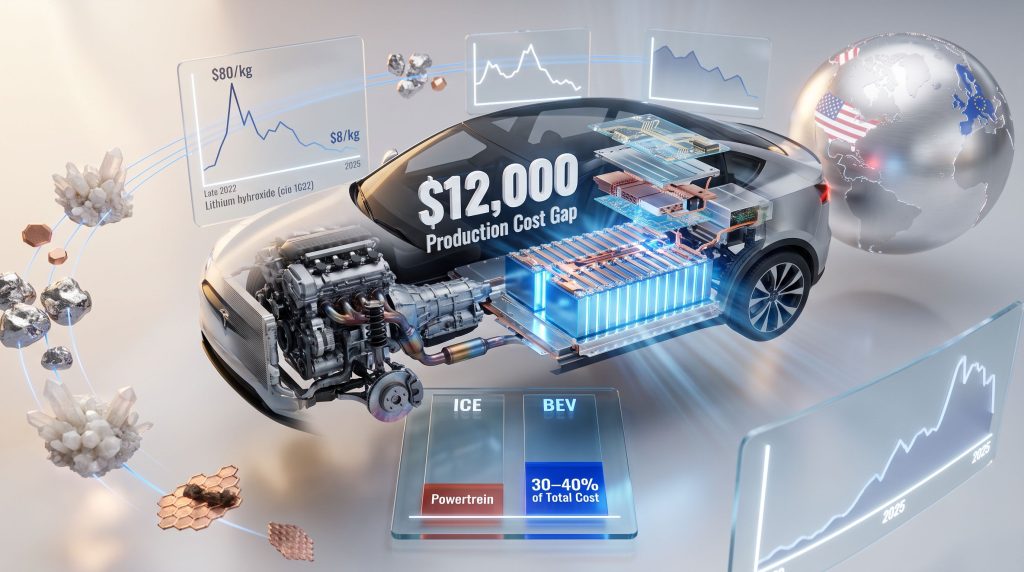
Meanwhile, the cost savings from simpler assembly are more than absorbed by battery packs, power electronics, and software investment. McKinsey analysis places the production cost premium for EVs over comparable ICE vehicles at approximately $12,000 per vehicle in certain segments, with many manufacturers operating at or near breakeven during early volume ramp phases.
The Battery Pack: Dominant Cost Variable, Dominant Risk
Industry estimates consistently place battery packs at 30 to 40% of total BEV production cost, with some analyses citing figures approaching 40% of total vehicle cost. KPMG research indicates the battery alone adds approximately 30 to 50% to EV production cost relative to ICE equivalents. No other single component in automotive history has carried this proportion of total vehicle cost.
| Cost Category | ICE Vehicle | BEV |
|---|---|---|
| Powertrain Components | High | Low (fewer moving parts) |
| Battery Pack | Negligible | 30–40% of total cost |
| Assembly Complexity | High | ~65% less time |
| Software and Electronics | Low | High and growing |
| Aftersales Revenue Potential | High | ~60% lower |
| Raw Material Volatility Exposure | Moderate (steel/aluminium) | High (Li, Ni, Co, graphite, Mn, Cu) |
This concentration of cost in a single component that is itself dependent on volatile raw materials creates a risk profile with no ICE-era equivalent. Battery cost management has become the single most consequential lever in EV profitability, more impactful than factory efficiency gains or labour optimisation programmes.
The Raw Materials Reality: From Steel to a Broader Critical Minerals Exposure
Electrification has not replaced commodity exposure. It has multiplied and intensified it. Where ICE manufacturers primarily managed steel and aluminium price cycles, EV-focused OEMs must now simultaneously track lithium, nickel, cobalt, graphite, manganese, copper, and aluminium, each carrying distinct supply-chain risk profiles and geopolitical sensitivities. The evolving battery raw materials market further amplifies these pressures, adding new layers of complexity to procurement planning.
Lithium: The Most Volatile Input in Modern Automotive History
No battery material better illustrates the new procurement environment than lithium. Fastmarkets data shows lithium hydroxide prices surging above $80 per kilogram in late 2022, driven by surging EV demand projections and constrained supply. By 2025, prices had collapsed to approximately $8 per kilogram as supply expansion dramatically outpaced actual demand growth. That is a decline of roughly 90% in under three years.
For automotive procurement teams accustomed to managing steel price cycles measured in percentage points, this magnitude of volatility represents an entirely different category of risk. Multi-year vehicle programmes locked in cost assumptions at peak lithium pricing faced severe margin compression as market conditions reversed. The lithium market downturn has consequently forced OEMs to fundamentally reconsider how they model and hedge raw material exposure across long-duration vehicle programmes.
Prolonged low lithium prices create a paradox that procurement teams must actively monitor: the same conditions that support near-term OEM margins are simultaneously discouraging new mine development, building the conditions for a future supply squeeze if EV demand accelerates ahead of investment cycles.
Battery Chemistry as a Strategic Hedge
One response to this volatility has been the strategic deployment of different battery chemistries. The rapid adoption of lithium iron phosphate (LFP) chemistry is particularly instructive. LFP batteries use lithium carbonate rather than lithium hydroxide, and they entirely avoid cobalt and nickel, two materials with their own concentrated production geographies and political risk profiles.
Chemistry selection now functions as a three-way trade-off between performance, affordability, and commodity price exposure. OEMs deploying multi-chemistry strategies across their model ranges are effectively building a portfolio hedge against single-material price shocks. This is a form of financial risk management embedded into engineering decisions, a concept with no meaningful precedent in ICE-era product planning.
Nickel and Cobalt: The Geopolitical Dimension
Nickel and cobalt markets introduce a layer of risk that pure price analysis cannot fully capture. Both materials are subject to highly concentrated production geographies, meaning that supply security and price stability are distinct, and sometimes competing, objectives. The industry-wide shift toward lower-cobalt and cobalt-free chemistries reflects not only cost discipline but a deliberate attempt to reduce exposure to materials where supply concentration creates systemic vulnerability. Furthermore, advances in battery recycling breakthrough technologies are beginning to offer OEMs an alternative pathway to securing these critical inputs outside of primary mining supply chains.
Trade Policy Fragmentation and the End of the Global Cost Model
Understanding how the EV transition is reshaping cost models for international automotive OEMs requires confronting a structural change in global trade: sourcing decisions can no longer be evaluated on commodity prices alone.
Frameworks including the USMCA and the U.S. Inflation Reduction Act have created powerful incentives for North American supply chain localisation. However, domestic supply chains introduce their own cost challenges: tighter regional supply availability, local price premiums, and heightened sensitivity to domestic policy shifts that can change with political cycles.
Steel and aluminium markets are increasingly fragmented by Section 232 duties, anti-dumping measures, and regional trade restrictions. The complex relationship between tariffs and supply chains is exemplified by Honda's reported exposure to significant profit losses, which also intersected with Section 232 steel duties and automobile tariffs, illustrating how these variables interact to compound cost pressures in ways that no single hedging strategy can fully neutralise.
Honda's broader strategic response is itself instructive. The company suspended key elements of its North American EV strategy, redirecting focus toward hybrid and ICE vehicles after concluding that EV business viability in that market was insufficiently certain to justify planned capital deployment. This decision reflects a wider pattern of OEMs recognising that a single global EV investment trajectory is no longer viable. China's rapid rise in EV adoption is accelerating this fragmentation, forcing Western manufacturers to fundamentally rethink their cost portfolios and competitive positioning.
A single global EV cost model has become structurally impossible to maintain. OEMs must now plan by geography, powertrain mix, battery chemistry, and vehicle segment, with each combination carrying a distinct raw material and cost exposure profile.
BEV market share in Europe reached approximately 20% during the first five months of 2026, yet growth remains concentrated in Western European markets. Hybrid vehicles continued to represent the largest powertrain category across the region during this period, creating a more complex planning environment for OEMs that had assumed a linear shift toward full electrification.
Carbon and Compliance Costs Enter the Automotive Margin Equation
Beyond commodity and tariff exposure, carbon and compliance considerations are becoming direct margin variables for international OEMs. European manufacturers face a particularly complex environment in which battery material procurement decisions must be evaluated simultaneously against financial cost, emissions performance, and evolving regulatory requirements.
For steel and aluminium specifically, producers investing in decarbonisation infrastructure are beginning to pass through green premiums to buyers. Supplier selection in these categories is evolving from pure price comparison toward a dual-axis evaluation framework that weighs financial cost alongside carbon intensity.
Mercedes-Benz's partnership with Hydro to incorporate verified post-consumer recycled aluminium into series EV production represents an early example of how circular material strategies are becoming embedded in mainstream procurement. This development signals a broader shift: emissions profiles of upstream materials are becoming procurement-relevant data points, not background environmental metrics.
Regulatory complexity adds a further dimension. Emissions compliance frameworks across the EU, North America, and Asia-Pacific are not harmonised, creating a multi-jurisdictional burden for international OEMs. It requires real-time visibility into upstream material emissions that most procurement organisations are only beginning to build.
Dynamic Procurement Frameworks: The CFaR Approach
Greater volatility is rendering traditional annual procurement budgets structurally inadequate for EV programmes. The scale and speed of commodity price movements in battery materials require procurement and finance teams to adopt risk quantification tools that were previously confined to energy trading desks.
Cash Flow at Risk (CFaR) methodology is emerging as a central framework for this purpose. CFaR quantifies the potential financial impact of commodity price movements across defined probability ranges, allowing teams to establish predefined hedging triggers when exposure exceeds acceptable thresholds. Rather than reacting to market movements after they have affected margins, CFaR-based frameworks establish systematic governance that aligns procurement, treasury, and strategy functions around a shared risk language.
How Leading OEMs Are Restructuring the Value Chain
| Strategic Response | Cost Objective | Risk Addressed |
|---|---|---|
| Battery-cell joint ventures | Reduce pack cost per kWh | Supply security, cost opacity |
| LFP chemistry adoption | Lower material cost per vehicle | Cobalt/nickel price volatility |
| Localised sourcing programmes | Tariff mitigation, IRA compliance | Trade policy disruption |
| Recycling and circular supply | Reduce virgin material dependency | Long-term supply constraints |
| CFaR-based hedging frameworks | Protect margin from spot volatility | Commodity price risk |
| Modular EV platform design | Amortise R&D across more models | High per-unit development cost |
McKinsey analysis suggests flexible manufacturing architectures can defer approximately 25% of large-scale capital expenditure. Integrated control of battery cells, motors, inverters, and pack assembly can reduce total vehicle cost by approximately 2 to 3% compared to full outsourcing strategies. Modular platform design and virtual prototyping can improve R&D efficiency by an estimated 15 to 20%.
The next major ASX story will hit our subscribers first
Beyond EVs: The Competing Demand Vectors Tightening Future Supply
A dimension of the battery materials market that is underappreciated in mainstream automotive analysis is the emergence of competing demand vectors that have nothing to do with passenger vehicle electrification. The broader critical minerals demand outlook is consequently far more complex than EV sales forecasts alone would suggest. Three structural forces are intensifying competition for future battery material supply:
- Grid-scale energy storage, expanding rapidly as renewable energy penetration increases and grid operators require dispatchable capacity buffers.
- AI and data centre infrastructure, driving accelerating demand for backup power and uninterruptible power supply battery systems as digital infrastructure scales globally.
- National security and defence applications, with governments across multiple jurisdictions now formally treating battery mineral supply chains as strategic national assets.
These demand vectors create a scenario in which prolonged low commodity prices, particularly in lithium, are actively discouraging the mine development and refining capacity investment needed to meet aggregate future demand across all three categories. OEMs that did not secure long-term offtake agreements during the current low-price window may face significant cost exposure when the next demand acceleration cycle arrives.
R&D and Capital Expenditure: The Hidden Transition Burden
The full cost picture of how the EV transition is reshaping cost models for international automotive OEMs extends well beyond material and tariff exposure. International OEMs face substantial upfront expenditure on EV-specific platforms, factory retooling, digitalisation infrastructure, and workforce retraining, all of which precede the volume-based cost reductions that eventually make EV production economically competitive with ICE manufacturing.
Traditional piece-price logic, in which engineering and tooling costs were amortised into unit pricing across high production volumes, is increasingly unsuitable for EV component programmes. New EV components frequently do not fit legacy volume assumptions, forcing OEMs and suppliers to separately negotiate engineering costs, design fees, and tooling investment from ongoing unit pricing. This restructures the entire commercial relationship between OEMs and their supply bases, requiring cost modelling by programme phase, technology maturity, and volume ramp trajectory rather than by part number alone. Research into the long-term outcomes of the EV transition consistently highlights this capital intensity as one of the most underestimated challenges facing legacy manufacturers.
Frequently Asked Questions: EV Cost Models and OEM Strategy
What is the biggest cost difference between building an EV and an ICE vehicle?
The battery pack is the most significant differential, representing approximately 30 to 40% of total BEV production cost. Despite EVs requiring fewer components and less assembly time, the battery more than offsets these savings at current production scales, contributing to an estimated $12,000 higher production cost per vehicle in some segments.
Why are battery raw material prices so volatile?
Battery materials such as lithium, nickel, and cobalt are subject to concentrated production geographies, long mine development lead times, and demand cycles that are difficult to forecast accurately. Lithium hydroxide prices fell from over $80 per kilogram in late 2022 to approximately $8 per kilogram by 2025, a decline driven by supply expansion outpacing demand growth.
How does trade policy affect EV production costs for international OEMs?
Tariffs on steel, aluminium, and imported vehicle components add direct cost burdens that cannot be offset by commodity price movements alone. Localisation incentives may also introduce regional supply premiums and reduce sourcing flexibility.
What is Cash Flow at Risk (CFaR) in the context of automotive procurement?
CFaR is a financial risk methodology that quantifies the potential impact of commodity price movements on operating cash flows across a defined probability range, enabling procurement and finance teams to establish systematic hedging triggers rather than responding reactively to market movements.
Why is battery chemistry selection a strategic cost decision?
Different chemistries rely on different raw materials. LFP batteries avoid cobalt and nickel entirely, offering cost and supply-chain advantages. NMC chemistries offer higher energy density but carry greater exposure to nickel and cobalt price volatility. Chemistry selection therefore directly shapes a vehicle programme's commodity risk profile across its entire production lifecycle.
The Capabilities That Will Define Competitive Advantage
Three structural shifts now define the new automotive cost paradigm for any OEM with serious EV ambitions:
- Battery materials have displaced mechanical components as the primary margin driver, requiring procurement strategies built around commodity intelligence and forward-looking market analysis rather than supplier negotiation alone.
- Trade policy and regionalisation are fragmenting global sourcing economics, making geography-specific cost modelling a prerequisite for accurate vehicle programme profitability assessment.
- Static annual budgets are being replaced by dynamic risk frameworks, with procurement, finance, and strategy teams increasingly aligned around shared market intelligence and quantified exposure management tools.
The manufacturers best positioned to navigate the EV transition profitably will not simply be those that build the most compelling electric vehicles. They will be those that have engineered the most resilient, data-driven, and adaptable cost architectures to support them, securing supply during low-price windows, hedging intelligently across chemistry and geography, and maintaining the real-time market visibility needed to make faster, more informed decisions in an environment where the cost variables change faster than any traditional budget cycle can accommodate.
For teams seeking deeper market intelligence on battery raw materials, automotive procurement trends, and EV supply chain dynamics, Fastmarkets' automotive and battery materials coverage provides independent pricing benchmarks and forward-looking analysis designed to support decision-making across the full EV cost spectrum.
Want to Track the Next Major Battery Minerals Discovery Before the Market Moves?
Discovery Alert's proprietary Discovery IQ model delivers real-time ASX alerts on significant lithium, nickel, cobalt, and copper discoveries — translating complex mineral data into actionable insights at the precise moment announcements hit the exchange. Explore how historic mineral discoveries have generated substantial returns, and begin your 14-day free trial today to position yourself ahead of the next major find in the critical minerals space.