July 22, 2026
When Niche Manufacturing Meets Strategic Withdrawal: The Emerging MMC Opportunity
The advanced materials sector operates on a paradox that most investors overlook. The most technically sophisticated products frequently sit inside corporate structures that are fundamentally misaligned with their potential. When a global mining conglomerate with decades of institutional knowledge in a niche composite material decides to step away, the instinct is to ask what went wrong. More often, the answer has nothing to do with the material itself and everything to do with where it sits on a priority list measured in billions, not millions.
That dynamic is exactly what underpins the Cymat Rio Tinto aluminium composites agreement, a commercial arrangement that transfers more than four decades of proprietary metal matrix composite knowledge from one of the world's largest mining organisations into the hands of a specialist manufacturer purpose-built to extract maximum value from it.
When big ASX news breaks, our subscribers know first
Understanding Aluminium Metal Matrix Composites: More Than Just a Lightweight Alloy
To appreciate the strategic weight of this agreement, it helps to understand what aluminium metal matrix composite actually is and why it commands attention in engineering circles that most investors never hear about.
MMC is not a simple aluminium alloy. It is produced by infusing a base aluminium matrix with hard ceramic particles, most commonly silicon carbide, during the manufacturing process. The result is a material that carries the low density characteristic of aluminium while inheriting the hardness, stiffness, and wear resistance more typically associated with ceramics or cast iron.
Why MMC Outperforms Cast Iron in Critical Applications
The performance contrast between MMC and conventional cast iron is most pronounced in two specific environments. Furthermore, as regulatory pressure intensifies across Europe, these performance distinctions are becoming commercially decisive for procurement teams at major vehicle manufacturers. Key applications include:
- Braking systems for heavy commercial vehicles, where components are subjected to sustained high-temperature friction cycles
- Rail braking applications, where wear resistance and weight reduction carry direct operational cost benefits
- High-load automotive drivetrain components, where reducing unsprung mass improves fuel efficiency and vehicle dynamics
- Aerospace and defence adjacent applications, where the weight-to-strength ratio is a primary engineering constraint
Cast iron brake discs are effective but carry a significant mass penalty. An MMC brake disc can deliver equivalent or superior thermal and mechanical performance at a fraction of the weight, which matters enormously as European regulators tighten emissions standards that account not just for exhaust output but for particulate matter generated by braking systems themselves. In addition, green materials pricing trends are making lightweight alternatives increasingly attractive to manufacturers facing cost and compliance pressure simultaneously.
Why Rio Tinto's Exit Is a Portfolio Decision, Not a Product Failure
Rio Tinto has operated its proprietary MMC business for more than 40 years, a tenure that speaks to genuine technical competence in this material. The decision to exit is not a reflection of MMC's declining commercial relevance. It is a textbook example of portfolio rationalisation at scale. Indeed, Rio Tinto aluminium operations across its global footprint are increasingly being directed toward large-scale, capital-intensive priorities rather than niche manufacturing verticals.
For a mining major whose core revenue streams are measured in billions of dollars across iron ore, copper, aluminium, and lithium, a niche manufacturing operation generating revenues in the single-digit millions occupies management bandwidth and capital allocation attention that cannot be justified against larger competing priorities. The product works. The customers are real. But the business unit does not move the needle at the corporate level.
When a global mining organisation with over four decades of operational history in a specialised product line decides to exit, it almost never signals that the product has peaked. It signals that the product no longer fits the scale at which that organisation operates. The opportunity created at that moment belongs to whichever smaller, more focused operator can absorb the capability and grow it without the constraints of a $50 billion balance sheet demanding proportional returns.
This dynamic is increasingly common across the materials sector. Large miners have accumulated niche processing and manufacturing capabilities through decades of vertical integration, only to find that sustaining them internally becomes harder to justify as commodity cycles demand capital concentration at the extraction level. The broader mining asset sales trend reflects this shift, with major producers systematically divesting non-core positions to specialist operators.
Breaking Down the Cymat Rio Tinto Aluminium Composites Agreement: Commercial Structure
The commercial terms of the Cymat Rio Tinto aluminium composites agreement are structured in a way that limits Cymat's financial exposure while preserving substantial upside if the business scales as projected.
| Commercial Term | Detail |
|---|---|
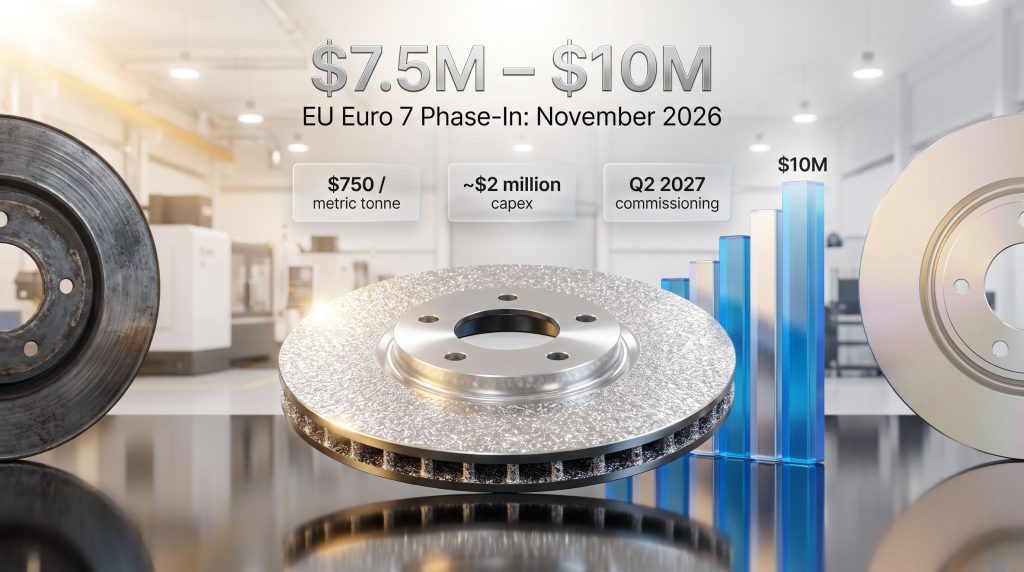
| Royalty Payment Rate | $750 per metric tonne of MMC sold or used |
| Agreement Duration | Five years |
| Maximum Total Payment Cap | $500,000 |
| Projected Annual Revenue Uplift | $7.5 million to $10 million |
| Estimated Capital Expenditure | Approximately $2 million |
| Target Full Commissioning Date | Early Q2 2027 |
| Primary End Markets | European commercial vehicles, rail |
| Regulatory Catalyst | EU Euro 7 (phase-in from November 2026) |
The royalty cap of $500,000 over five years is a particularly important structural element. It means that regardless of how aggressively Cymat scales MMC production and sales, Rio Tinto's total compensation from the arrangement is ceiling-limited. For Cymat, this creates a scenario where the cost of accessing four decades of proprietary customer relationships and commercial knowledge is essentially fixed, while the revenue potential scales with execution.
Historical sales volumes provided during the transition process suggest annual incremental revenues in the $7.5 million to $10 million range, which at the upper end represents a meaningful step-change for a company of Cymat's scale.
What Is Actually Being Transferred
The agreement encompasses more than a customer list. The full scope of what moves from Rio Tinto to Cymat includes:
- Established commercial customer relationships with European brake disc manufacturers serving heavy commercial vehicle and rail markets
- Active business development enquiries regarding MMC as a cast iron replacement, driven by Euro 7 compliance pressure
- Knowledge transfer support facilitated through Cymat's partnership with MC21, a US-based specialist MMC producer
- Commercial rights to supply existing Rio Tinto MMC customers without interruption during the transition period
Cymat's Operational Roadmap: From Letter of Intent to In-House Production
The transition from Rio Tinto customer to independent MMC producer is structured across three distinct operational phases, each serving a different risk management function.
Phase 1: Immediate Supply Continuity
Cymat has begun sourcing MMC from MC21, ensuring that transferred customers experience no disruption during the period between the agreement signing and the establishment of Cymat's own production capability. This is a critical commercial consideration. Customer relationships built over decades are fragile during ownership transitions, and any supply gap could permanently redirect purchasing decisions.
Phase 2: Capital Deployment
Approximately $2 million in capital expenditure will be directed toward installing state-of-the-art MMC production equipment within Cymat's existing Mississauga, Ontario facility. The financing mix is expected to combine equipment financing facilities, potential federal and provincial grant applications, and existing cash reserves. Importantly, the Mississauga plant already houses SAF manufacturing operations, meaning infrastructure, utilities, and technical workforce requirements have significant overlap with what MMC production demands.
Phase 3: Full Commissioning
Cymat is targeting complete in-house MMC production capability by early Q2 2027. At that point, the company will not simply replicate Rio Tinto's historical MMC offering. The MC21 partnership is expected to enable a broader range of MMC compositions than Rio Tinto historically produced, opening access to customer segments and applications that were never part of Rio Tinto's commercial footprint.
The MC21 Partnership: A Strategic Technology Bridge
MC21's role in this arrangement deserves closer examination. The US-based producer brings high-end MMC manufacturing expertise that accelerates Cymat's production learning curve significantly. Rather than developing MMC manufacturing capability from first principles, Cymat is effectively licensing operational knowledge from an established niche producer while simultaneously supplying existing customers through that same channel. The partnership reduces execution risk during the most critical period of the transition.
Three Strategic Benefits That Compound Over Time
The Cymat Rio Tinto aluminium composites agreement delivers three distinct strategic advantages that interact and reinforce each other as the business matures.
Benefit One: An Uncorrelated Revenue Stream
MMC sales into automotive and rail braking applications operate on procurement cycles and demand drivers that are largely independent of the factors affecting Cymat's existing SAF business verticals, which include nuclear shielding, military applications, and architectural panels. Adding a substantial revenue stream governed by different demand dynamics reduces Cymat's exposure to cyclical weakness in any single vertical.
Benefit Two: Structural Input Cost Reduction for SAF Manufacturing
This benefit is less obvious but potentially more impactful over the long term. MMC is Cymat's primary raw material input for producing stabilised aluminium foam. By bringing MMC production in-house, Cymat removes the external margin embedded in every tonne of MMC it currently purchases from third-party suppliers. This directly reduces the cost of goods for SAF production, which the company has identified as a key factor limiting its price competitiveness in high-volume automotive applications where SAF has historically struggled to win on cost.
Controlling the primary input material for your core product is not merely a supply chain optimisation. It is a structural repositioning that changes the unit economics of every SAF tonne produced thereafter. For Cymat, this could be the margin improvement that makes automotive SAF commercially viable at scale for the first time.
Benefit Three: Expanded MMC Composition Capability
Because Cymat will be able to customise the ceramic particle type, size distribution, and volume fraction within its MMC formulations, it gains the ability to develop new SAF variants tailored to applications that standard MMC inputs cannot currently address. This creates a product development pathway that did not exist before the agreement and opens the possibility of entering SAF market segments where Cymat currently has no presence.
The next major ASX story will hit our subscribers first
Euro 7 and the Regulatory Tailwind Reshaping Brake Component Markets
The timing of the Cymat Rio Tinto aluminium composites agreement relative to the EU's Euro 7 regulatory framework is commercially significant, though it is worth being precise about what this means in practice.
Euro 7 extends emissions regulation beyond exhaust gases to include non-exhaust particulate matter, specifically the fine particles generated by brake disc and pad wear. Cast iron brake discs are the primary source of these restricted emissions. The regulation introduces measurable limits on brake-generated particulate output, with a phased implementation schedule beginning in November 2026 for certain vehicle categories. Consequently, procurement decisions at major European vehicle manufacturers are accelerating considerably ahead of that deadline.
| Regulatory Milestone | Timeline |
|---|---|
| Euro 7 Phase-In Begins (Commercial Vehicles) | November 2026 |
| Broader Passenger Vehicle Application | Phased post-2026 |
The practical consequence for brake disc manufacturers is that they must either demonstrate that their cast iron products meet the new particulate limits, which is technically challenging, or begin evaluating non-ferrous alternatives. MMC brake discs generate significantly less particulate matter than cast iron equivalents, which is why Rio Tinto had already been receiving active enquiries from European manufacturers exploring MMC as a compliance solution. Those enquiries now transfer to Cymat.
It is important to note that Euro 7 represents a regulatory framework rather than a confirmed project-specific mandate, and the commercial opportunity it creates will depend on how rapidly individual manufacturers adopt MMC-based solutions. However, the structural direction is clear, and Cymat's production timeline to Q2 2027 positions it to service that demand as it materialises through the late 2020s.
What This Transaction Reveals About the Advanced Materials Sector
The Cymat Rio Tinto aluminium composites agreement is a case study in how value migrates between industry tiers when large organisations rationalise non-core assets. Major aluminium mining companies built vertically integrated materials businesses during an era when controlling every step of the value chain from ore to finished product was considered strategically sound. The economics of that model have shifted considerably.
Today, the competitive advantages that matter most in niche advanced materials manufacturing are speed of application development, customer-specific customisation capability, and cost structure agility. These are attributes that a focused specialist can deliver more effectively than a diversified miner managing a portfolio measured in hundreds of operational sites globally. Furthermore, shifts in mining policy in America are prompting additional strategic reassessment across the sector as major producers reconsider where to concentrate their capital.
For investors and industry observers, the pattern is worth tracking. When large miners exit niche manufacturing positions, the businesses they leave behind frequently perform better under specialist ownership than they did inside the conglomerate, precisely because the new owner can dedicate focused management attention and capital allocation to a scale of operation that is genuinely meaningful to them.
Cymat's existing familiarity with MMC as both a raw material consumer and a technical operator makes it unusually well-positioned to capture that value. The combination of an established customer base, a capped royalty structure, a credible technology partner in MC21, and a facility already equipped with relevant manufacturing infrastructure reduces the execution risk that typically accompanies this type of asset transfer. In addition, the Euro 7 regulatory framework provides a durable structural tailwind that did not exist when Rio Tinto first built its MMC business, adding a dimension of demand momentum that should support commercial growth well into the next decade.
This article contains forward-looking statements regarding projected revenues, production timelines, and regulatory outcomes. These projections are based on publicly available information and should not be construed as financial advice. Investors should conduct independent due diligence before making investment decisions based on any information contained herein.
Want to Track the Next Major Materials or Mining Discovery Before the Market Does?
Discovery Alert's proprietary Discovery IQ model delivers real-time alerts on significant ASX mineral discoveries, instantly translating complex data across more than 30 commodities into clear, actionable insights for investors at every experience level. Explore how historic discoveries have generated substantial returns on Discovery Alert's dedicated discoveries page, and begin your 14-day free trial today to position yourself ahead of the broader market.