June 15, 2026
The Economics of Distance: How Refining Capacity Rewires Global Shipping Revenue
Few forces reshape commodity trade flows as quietly, yet as profoundly, as the commissioning of large-scale refining infrastructure in markets that were previously net importers. For decades, the business model underpinning Atlantic basin product tanker economics relied on a simple asymmetry: crude oil-rich nations in West Africa lacked the downstream processing capacity to convert their own resources into usable fuels, creating a structural dependency on European and American refiners. That dependency generated predictable, high-volume, long-haul shipping demand across some of the world's most lucrative tanker corridors. What happens when that asymmetry begins to collapse? The answer is now visible in real-time trade data, and the numbers are striking.
Dangote refinery cuts West Africa fuel imports with a speed and scale that few industry observers anticipated, compressing shipping demand, redirecting trade flows, and forcing a fundamental reassessment of how Atlantic basin product tanker markets will be priced and utilised through the remainder of this decade.
When big ASX news breaks, our subscribers know first
The Scale of the Facility That Changed the Equation
Located in the Lekki Free Zone near Lagos, the Dangote Oil Refinery is not simply the largest refinery on the African continent. With a nameplate capacity of 650,000 to 700,000 barrels per day, it ranks among the largest single-train refining complexes anywhere in the world. That distinction matters because single-train architecture implies a unified, highly integrated processing system rather than a collection of modular units, delivering efficiencies of scale that smaller, multi-train facilities cannot replicate.
For context, Nigeria's pre-Dangote domestic refining landscape was characterised by chronic underperformance. The country's four state-owned refineries, with a combined nameplate capacity of roughly 445,000 barrels per day, operated well below design rates for years, leaving Nigeria importing the majority of its refined fuel needs despite being one of Africa's largest crude oil producers. This paradox — exporting raw crude while paying international prices for finished petroleum products — represented a significant structural drain on Nigeria's trade balance and foreign exchange reserves.
The Dangote facility fundamentally inverts that equation. Rather than exporting crude at commodity prices and reimporting value-added products at a premium, Nigeria can now process its own hydrocarbons domestically and capture the refining margin that previously flowed to European processors. Furthermore, this shift has profound implications for resource energy exports and downstream value capture across other commodity-producing nations.
What the Trade Data Reveals: Month-Over-Month and Year-on-Year Shifts
The magnitude of the market shift is most clearly captured through two separate analytical lenses: month-over-month volume changes and year-on-year comparisons.
Breaking Down the April to May Import Compression
According to S&P Global's Commodities at Sea platform, West Africa's clean refined fuel imports contracted from approximately 997,000 barrels per day in April to 765,000 barrels per day in May, representing a month-over-month decline of nearly 23%. That is not a seasonal fluctuation or a demand-side contraction. It reflects a supply-side substitution driven by rising domestic output.
| Metric | April (bbl/day) | May (bbl/day) | Change |
|---|---|---|---|
| West Africa Clean Fuel Imports | ~997,000 | 765,000 | ▼ ~23% |
| West Africa Total Imports (YoY) | ~1,140,000 | ~642,000 | ▼ ~44% |
The year-on-year comparison, cited by BIMCO, is even more instructive. Total West African fuel imports fell by as much as 44% over the April to May window compared with the same period the prior year. That scale of reduction cannot be explained by any single macroeconomic variable. It points directly to a structural supply substitution effect driven by the Dangote refinery's accelerating production ramp.
Analysts tracking Nigerian clean petroleum product imports have projected a 39% year-on-year reduction by mid-2025, according to S&P Global Commodities at Sea data. This trajectory signals not a temporary dip but a durable realignment of supply architecture across the region. Consequently, understanding commodity price impacts across the broader energy value chain becomes increasingly important for investors and analysts monitoring these structural shifts.
The Lomé Offshore Hub: A Quiet Casualty of Domestic Refining
One of the less-discussed consequences of this shift involves offshore storage and blending hubs like Lomé, Togo. These facilities historically functioned as strategic distribution nodes, receiving large cargoes from European refineries and redistributing smaller parcels to coastal West African markets. As domestic Nigerian supply displaces imported product, the commercial rationale for maintaining large inventories at these offshore hubs diminishes. Lomé's strategic role as a fuel redistribution centre is being quietly eroded by the same force compressing long-haul import demand.
Tanker Market Disruption: Which Segments Are Absorbing the Most Pain
The shipping market consequences of this structural shift are not distributed evenly. Different tanker classes carry product over different distances and trade routes, and the impact correlates directly with exposure to the West Africa import corridor.
| Tanker Class | Tonne-Mile Change (YoY) | Key Driver |
|---|---|---|
| LR1 Product Tankers | ▼ 88% | Loss of West Africa long-haul import demand |
| LR2 Product Tankers | ▼ 78% | Structural reduction in European-origin cargo |
| MR Product Tankers | ▼ ~4% | Partially offset by 34x increase in Americas volumes |
Why Large-Range Tankers Are the Primary Victims
LR1 and LR2 tankers are purpose-built for long-haul, high-volume refined product movements. Their economics depend on consistent employment across intercontinental routes. BIMCO data shows that LR1 tonne-miles fell 88% year-on-year during the April to May period, while LR2 tonne-miles declined 78%. Together, these two classes accounted for 55% of total tonne-mile losses across the Atlantic basin during this window.
The underlying mechanic is straightforward but important to understand: tonne-miles represent both volume and distance. Even if a tanker continues to move product, if that product travels a shorter distance because supply originates domestically rather than from a European refinery, the shipping revenue generated per unit of cargo collapses. This is why the Dangote refinery cuts West Africa fuel imports effect is felt so acutely in tanker earnings even before physical voyage volumes decline to their full extent.
MR Tanker Resilience: The Americas Offset Explained
Medium-range tankers showed considerably more resilience, with tonne-miles falling only ~4% year-on-year despite a sharp reduction in West African import flows from all major traditional loading regions. The explanation lies in an extraordinary surge in volumes from the Americas, which increased 34-fold during the same period, largely absorbing the shortfall from European and Middle Eastern origins.
This offset is significant but should not be mistaken for structural strength. A 34-fold volume increase from the Americas is partly a product of cargo displacement, where shippers and traders redirect available vessels toward alternative trade routes to maintain utilisation. Whether this Americas-driven demand proves durable depends on factors unrelated to West African refining dynamics. In addition, trade volatility hedging strategies are becoming increasingly relevant for operators navigating these shifting corridor dynamics.
The Rotterdam-to-Lagos corridor, once a cornerstone of MR tanker employment in the Atlantic, has experienced measurable freight rate compression as Nigerian domestic supply progressively displaces European imports along this route. According to S&P Global Commodity Insights, freight rates on the UK/Continent-to-West Africa lane have declined, reflecting reduced competition for cargo across this trade path.
The Refinery's Export Pivot: From Domestic Supplier to Regional Exporter
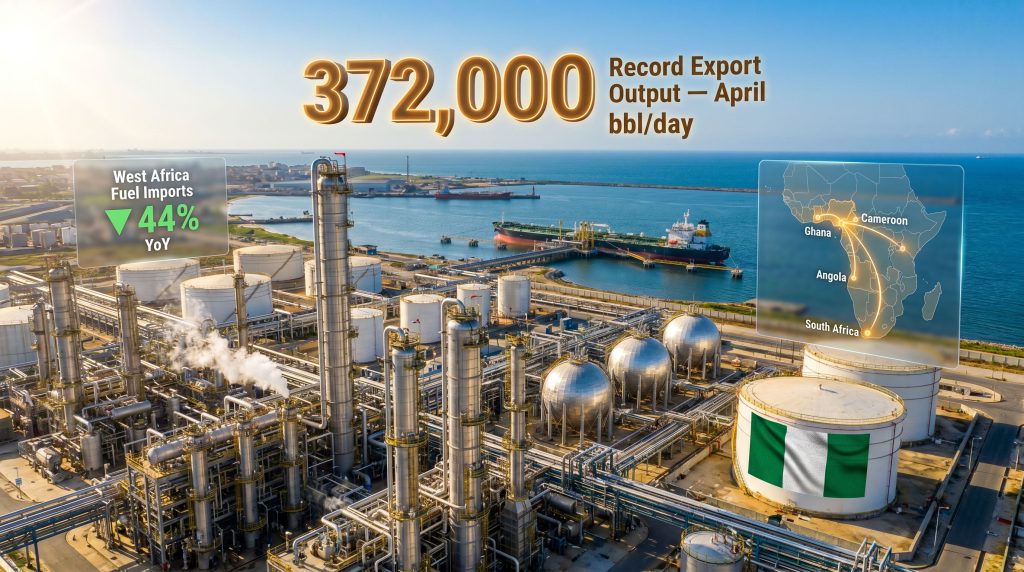
Perhaps the most underappreciated dimension of the Dangote facility's market impact is its transformation from a domestic supply solution into an active regional export platform. In April, the refinery reportedly exported a record 372,000 barrels of refined products per day, a figure that positions it as a meaningful participant in African intra-regional trade flows rather than simply a Nigerian demand replacement.
By mid-2025, industry data indicated that the refinery was supplying approximately 80% of Nigeria's domestic gasoline demand, with analysts projecting that figure could approach 90% as production ramp-up continues. The trajectory toward near-complete domestic self-sufficiency in gasoline is significant because it removes one of the largest and most consistent sources of MR tanker employment in the Atlantic basin.
Export destinations receiving Dangote-refined product include:
- Cameroon — benefiting from geographic proximity and established trade infrastructure
- Ghana — historically one of the most import-dependent markets in the subregion, and therefore highly responsive to a competitively priced regional supplier
- Angola — emerging as a downstream diversification market with growing import requirements
- South Africa — a long-haul destination whose inclusion signals the refinery's capacity to compete on price and product specification at significant distance
This export orientation carries its own set of structural implications. It means the Dangote refinery is not merely replacing imported volumes in Nigeria; it is competing for market share across a broader West and Southern African geography that previously relied on European, Middle Eastern, and Asian refiners.
Is This Shift Permanent? The Bull and Bear Cases
The Case for a Durable Structural Decline in West African Fuel Imports
Several factors support the view that the reduction in West African fuel imports represents a lasting realignment rather than a cyclical fluctuation:
- Refinery ramp-up trajectory: Large-scale refining facilities typically increase utilisation rates progressively over several years following commissioning. If the Dangote refinery follows this pattern, production volumes will continue growing, further reducing the residual import market.
- Economic incentive alignment: Processing crude domestically and capturing the refining margin is economically superior to crude export and product reimport for any nation with sufficient refining capacity. Nigeria's fiscal incentives favour maximum domestic refinery utilisation.
- Infrastructure investment signals: The export supply chain being built around the refinery — including port infrastructure and downstream distribution networks — suggests a long-term operational commitment rather than a transitional phase.
The Counterargument: Why Import Volumes Could Temporarily Recover
Analysts caution that operational interruptions at a facility of this scale, whether from planned maintenance cycles, unplanned equipment failures, or feedstock supply disruptions, can temporarily reverse import substitution trends. Nigerian refining history includes multiple instances where state refinery downtime triggered short-term import spikes, and the Dangote complex, despite its engineering sophistication, is not immune to this risk.
Additional variables that could influence near-term import volumes include:
- Crude oil feedstock availability and pricing dynamics affecting refinery input costs
- Seasonal demand fluctuations across West African markets
- Product specification mismatches between domestically refined output and specific market requirements
- Logistics bottlenecks in domestic distribution infrastructure limiting effective market penetration
The next major ASX story will hit our subscribers first
Regional Energy Architecture: Winners, Losers, and Adaptation Strategies
The redistribution of refined fuel trade flows creates distinct winners and losers across the West African subregion. Countries that historically sourced product through the Lomé offshore hub or via direct European imports face a strategic decision: adapt procurement strategies to take advantage of Nigerian-origin supply, or maintain existing import relationships at potentially higher delivered costs.
From a geopolitical lens, Nigeria's emergence as a net exporter of refined petroleum products strengthens its economic influence within the Economic Community of West African States (ECOWAS). Energy independence at scale historically translates into stronger regional negotiating leverage, and Nigeria's ability to offer competitively priced refined product to its neighbours creates new dimensions of economic interdependence.
The infrastructure dimension is equally important and often overlooked. Domestic refining at scale demands parallel investment in pipelines, storage terminals, logistics networks, and retail distribution systems. Without these downstream investments, refinery output cannot efficiently reach end consumers, limiting the effective market penetration of domestically produced fuel and, by extension, slowing the pace of import substitution.
Summary: Quantifying the Dangote Effect
| Indicator | Data Point | Source |
|---|---|---|
| West Africa clean fuel import decline (MoM) | ▼ 23% (April to May) | S&P Global Commodities at Sea |
| West Africa total import decline (YoY) | ▼ 44% (April to May period) | BIMCO |
| Nigerian clean product import forecast decline | ▼ 39% YoY by mid-2025 | S&P Global CAS Analysts |
| Refinery daily export record | 372,000 bbl/day (April) | Industry reports |
| Dangote share of Nigerian gasoline demand | ~80% (April) | Economist Intelligence Unit |
| LR1 tanker tonne-mile decline | ▼ 88% YoY | BIMCO |
| LR2 tanker tonne-mile decline | ▼ 78% YoY | BIMCO |
| MR tanker tonne-mile decline | ▼ ~4% YoY | BIMCO |
Frequently Asked Questions
How much has the Dangote Refinery reduced West Africa's fuel imports?
West Africa's clean fuel imports fell by approximately 23% month-over-month between April and May, dropping from around 997,000 barrels per day to 765,000 barrels per day. Year-on-year, total West African imports fell by as much as 44% during the same period, according to BIMCO and S&P Global data.
Which tanker classes have been most affected?
LR1 and LR2 product tankers suffered the sharpest declines, recording tonne-mile contractions of 88% and 78% respectively year-on-year. Together they accounted for more than half of total Atlantic basin tonne-mile losses during the April to May window.
Is the refinery now exporting to other African countries?
Yes. The facility recorded peak exports of 372,000 barrels per day in April and has been supplying markets including Cameroon, Ghana, Angola, and South Africa, signalling its transformation from a domestic supply solution into a regional export competitor.
Could import volumes temporarily recover?
Operational disruptions, planned maintenance, or feedstock supply issues could trigger short-term import rebounds. The structural trend is directionally clear, but it remains vulnerable to operational volatility at the facility level.
What share of Nigerian gasoline demand does the refinery supply?
Approximately 80% of Nigeria's domestic gasoline demand was being met by the Dangote refinery as of April, with the trajectory pointing toward further increases as production capacity is more fully utilised.
How has the Rotterdam-to-Lagos corridor been affected?
This once-dominant Atlantic product tanker corridor has experienced meaningful freight rate compression as domestic Nigerian supply progressively displaces European-origin imports, according to S&P Global Commodity Insights.
What Africa's Largest Refinery Signals for Continental Energy Development
The Dangote refinery's market impact extends well beyond shipping economics or even Nigerian energy policy. It represents a replicable template for downstream industrialisation in resource-rich African economies that have historically exported raw commodities while importing finished goods. The value retention argument is compelling: by processing crude domestically, Nigeria captures refining margins, creates industrial employment, reduces foreign exchange outflows on fuel imports, and builds technical capability in high-complexity manufacturing.
For investors and energy market analysts tracking African downstream development, the critical question is whether other crude-producing African nations will pursue similar strategies. Angola, Equatorial Guinea, and potentially others have the feedstock base to support domestic refining expansion. The Dangote facility's commercial success, or lack thereof over the coming years, will serve as the most closely watched data point in answering that question.
Furthermore, the broader implications for global oil futures and Atlantic basin price benchmarks are becoming increasingly relevant as West African refining capacity scales. Similarly, the LNG supply outlook across the continent will likely be shaped by analogous downstream investment trajectories in the years ahead.
Looking through 2026 and beyond, the most likely scenario involves a continued but uneven decline in West African fuel import volumes, punctuated by temporary reversals during refinery maintenance periods and gradually deepening as downstream distribution infrastructure matures. The Atlantic basin tanker market will need to recalibrate its utilisation assumptions accordingly, with LR class vessels facing the most structurally challenging environment and MR operators navigating a more complex, multi-corridor demand picture than the Lagos-focused trade architecture of previous decades.
This article is based on publicly available trade data and industry analysis. Forecast figures and year-on-year projections reflect analyst estimates from S&P Global Commodities at Sea and BIMCO and should not be interpreted as investment advice. Readers should conduct independent due diligence before making any financial or investment decisions based on commodity market trends.
For ongoing coverage of African energy market dynamics and broader petroleum sector developments, readers can explore related analysis at Business Insider Africa.
Want to Identify the Next Major Resource Discovery Before the Market Does?
The structural shifts reshaping global commodity trade flows — from West African refining capacity to Atlantic basin tanker economics — underscore how quickly resource infrastructure can redraw investment landscapes, making real-time intelligence more valuable than ever. Discovery Alert's proprietary Discovery IQ model instantly translates significant ASX mineral discovery announcements into actionable alerts, helping investors capitalise on transformative opportunities as they emerge — explore historic discovery returns or start your 14-day free trial today.