
June 15, 2026
When Supply Chains Become the Battlefield: Industrial Metals in the Age of Conflict
Commodity markets have a long memory for energy shocks, but a short one for everything else. Decades of Middle Eastern conflict have trained investors to reach immediately for oil futures when regional tensions escalate, treating industrial metals as a secondary consideration that eventually normalises once tanker routes stabilise. That mental model is breaking down in real time. The Iran war industrial metals supply outlook has introduced a fundamentally different transmission mechanism into metals markets, one that bypasses the mine gate entirely and strikes instead at the invisible infrastructure that converts raw materials into refined industrial inputs.
Understanding why this matters requires stepping back from price charts and examining the underlying chemistry and logistics of how metals actually reach manufacturing supply chains.
When big ASX news breaks, our subscribers know first
The Anatomy of an Infrastructure Supply Shock
Traditional geopolitical supply disruptions are relatively straightforward to analyse. A mine closes, output falls, inventories draw down, prices rise. The disruption has a clear geographic address and a quantifiable production loss. However, this situation operates through an entirely different architecture, which is precisely why it is more difficult to price accurately and more persistent once it takes hold.
The disruption sits across three distinct layers simultaneously:
- Processing input availability – specifically the sulphur-to-sulphuric acid pipeline that underpins copper and nickel hydrometallurgical operations across Central Africa and South America
- Energy cost transmission – Brent crude moving from approximately $72 to above $90 per barrel since the conflict began, directly inflating diesel costs at open-pit mining operations worldwide
- Shipping corridor repricing – effective closure of the Strait of Hormuz removing a critical artery for both energy commodities and industrial metal flows, driving freight cost escalation across seaborne commodity markets
Each layer compounds the others. Higher energy costs raise sulphur production costs. Restricted shipping constrains sulphur distribution. Constrained sulphur availability limits acid production. Limited acid supply, furthermore, caps copper output regardless of what happens at the mine face itself.
Sulphur: The Hidden Chokepoint Nobody Was Watching
Of all the transmission mechanisms reshaping the Iran war industrial metals supply outlook, the sulphur supply chain is the least understood by generalist investors and the most consequential for near-term production volumes.
Sulphur is a byproduct of crude oil and natural gas refining. It has no substitute in the hydrometallurgical processing of copper and nickel ores, where sulphuric acid is used as the primary leaching reagent to dissolve metal values from oxide and mixed-oxide ore types. The process is called heap leaching or solvent extraction-electrowinning (SX-EW), and it accounts for a significant share of copper production in both Chile and the Democratic Republic of Congo.
When Hormuz transit volumes collapsed following the effective closure of the strait, Middle Eastern refinery output and sulphur export volumes came under simultaneous pressure. The result was a price shock that more than doubled sulphur spot prices, creating both a cost crisis and a physical availability constraint for processing operations thousands of kilometres from the conflict zone.
The downstream consequences are substantial:
- Wood Mackenzie estimates that sulphur supply disruptions could eliminate up to 125,000 tonnes of copper output in the Democratic Republic of Congo
- Morgan Stanley analyst Amy Gower has flagged a further 200,000 tonnes of Chilean copper production at risk, a vulnerability compounded by China's concurrent ban on sulphuric acid exports
- Combined, these two risk pools represent approximately 325,000 tonnes of potential copper output at risk from a single input supply chain
"The sulphur-to-sulphuric acid pipeline is the most underappreciated transmission mechanism between Middle Eastern conflict and global copper mine output. It is not a direct supply shock at the resource level. It is a processing input shock that strikes further downstream, making it harder to hedge and slower to resolve."
China's decision to restrict sulphuric acid exports introduces a second, independent pressure vector. Even if Hormuz disruptions ease, Chilean operators face a reduced sourcing universe for acid imports, consequently tightening the supply constraint from both ends simultaneously. These compounding pressures are reshaping the copper supply crunch in ways that extend well beyond traditional mine-level disruptions.
Aluminium: The Most Directly Exposed Metal in the Short Term
While copper's exposure is primarily indirect, aluminium carries the highest concentration of direct supply disruption risk. The Middle East accounts for roughly 10% of global refined aluminium production, with major smelter capacity concentrated in Bahrain and the UAE.
Producers including Alba in Bahrain and EGA in the UAE have curtailed output following infrastructure damage caused by Iranian strikes, with disrupted alumina supply chains compounding the operational impact. Port closures and force majeure declarations have, in addition, translated physical infrastructure damage into measurable reductions in refined metal availability.
The price impact has been immediate. Aluminium has reached a four-year price peak, reflecting both the acute supply compression from Gulf smelter curtailments and the continuation of structural demand growth that was already tightening the market before the conflict began. For a broader perspective on these supply chain risks, analysts have noted the multi-layered nature of the disruption across the entire metals complex.
| Driver | Pre-Conflict Status | Post-Conflict Impact |
|---|---|---|
| Data centre construction demand | Rising steadily | Continued upward pressure |
| EV and grid electrification demand | Rising steadily | Continued upward pressure |
| Gulf smelter output | Stable | Curtailed, force majeure declared |
| Alumina supply chain | Functional | Disrupted by Iranian strikes |
| Regional freight and logistics | Normal | Elevated costs, port closures |
The structural demand case for aluminium was already well established before any geopolitical event intervened. Electric vehicles require aluminium for body panels, battery enclosures, and structural components. Data centre construction uses aluminium extensively in cooling systems and structural frameworks. Electricity grid expansion programmes globally require aluminium conductor materials. The conflict has superimposed a supply shock onto a demand trajectory that was already running ahead of production capacity growth.
Copper: Near-Record Prices Driven by Converging Pressures
Iran is not a copper-producing nation of significance, which has led some market commentators to understate the metal's exposure to the conflict. This framing misidentifies where the risk actually sits.
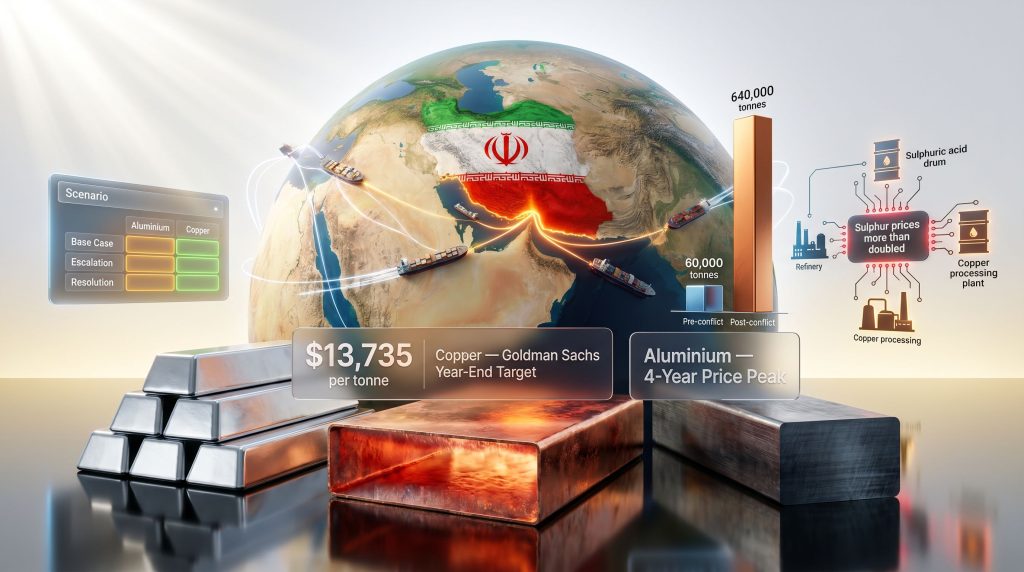
Copper is trading near its all-time closing high, and the Goldman Sachs analyst team has dramatically revised its deficit forecast, moving from a projected shortfall of 60,000 tonnes to 640,000 tonnes outside the US market. The bank simultaneously raised its year-end price target by 10% to $13,735 per tonne. These are not incremental adjustments — they reflect a fundamental reassessment of the supply picture. Understanding the copper price growth drivers behind this reassessment reveals how deeply structural forces are amplifying conflict-related pressures.
The indirect risk channels driving this reassessment include:
- Sulphuric acid input disruption – up to 325,000 tonnes of output at risk across DRC and Chile combined, as detailed above
- Energy cost inflation – higher diesel prices directly increasing cash costs at open-pit operations globally, squeezing margins at higher-cost producers
- Freight and logistics repricing – elevated shipping costs raising the delivered cost of copper concentrates to smelters worldwide
- Structural demand acceleration – AI infrastructure buildout, EV adoption curves, and grid modernisation programmes all intensifying copper consumption simultaneously
What Is the Goldman Sachs Copper Price Forecast for 2025-2026?
Goldman Sachs has set a year-end copper price target of $13,735 per tonne, revised upward by 10%, with its projected copper deficit outside the US market expanding from 60,000 tonnes to 640,000 tonnes. This reflects both ongoing structural demand growth from AI infrastructure and electric vehicle adoption, and conflict-related tightening of processing input supply chains.
Steel Semis and Iron Ore: Repricing Ahead of Physical Shortages
Iran occupies a meaningful position in global steel export markets, particularly for semi-finished products including billets, slabs, and rebar that feed downstream manufacturing operations. Port paralysis and regional shipping disruption have already removed measurable volumes of these products from the seaborne market.
Wood Mackenzie has observed that steel semi prices have repriced ahead of physical shortages fully materialising, a classic supply risk premium dynamic where markets anticipate forward tightness and adjust prices before inventory drawdowns confirm the shortage in warehousing data. This pattern is also evident when examining the broader China steel and iron ore market, where demand-side dynamics are intersecting with conflict-driven supply pressures.
Iron ore's exposure profile is structurally different. Major producing operations in Australia and Brazil are geographically remote from the conflict zone and face no direct interruption to mine output. The iron ore market impact arrives instead through operating cost inflation, with elevated fuel prices raising the cash cost base across energy-intensive mining and beneficiation operations. The risk for iron ore is margin compression at higher-cost producers rather than a volume-level supply crisis.
The next major ASX story will hit our subscribers first
Structural Demand Megatrends: Why This Shock Hits Different
The Iran war industrial metals supply outlook cannot be properly evaluated without understanding the demand context into which this supply disruption has landed. The conflict has not manufactured a deficit. It has, however, deepened and accelerated imbalances that were already developing.
Three converging demand megatrends were outpacing supply capacity expansion before the first Iranian strike was reported:
- AI and data centre infrastructure – copper-intensive power distribution, aluminium cooling and structural systems, with hyperscaler capital expenditure programmes running into hundreds of billions of dollars annually
- Electric vehicle manufacturing at scale – copper wiring harnesses, aluminium body structures and battery housings, with EV penetration rates climbing across major markets
- Electricity grid modernisation – both copper and aluminium are non-substitutable conductor materials in transmission and distribution networks being upgraded globally to handle increased renewable generation and electrification loads
Furthermore, the critical minerals demand outlook underscores how deeply embedded these metals are in the energy transition, making demand-side deceleration unlikely in the near to medium term.
Craig Miller, CEO of Valterra Platinum, has stated that metals demand would continue expanding on the back of the energy transition and artificial intelligence investment wave, even as the supply side has consistently failed to keep pace with that growth trajectory.
This pre-existing structural gap is what transforms an otherwise manageable geopolitical supply disruption into a multi-year price event. When markets are already running near capacity without buffer inventory, even modest additional supply constraints can generate disproportionate price responses.
Scenario Framework: Three Pathways for the Next 12-24 Months
| Scenario | Conflict Duration | Hormuz Status | Aluminium Outlook | Copper Outlook | Key Risk Factor |
|---|---|---|---|---|---|
| Base Case | 6-12 months | Partially restricted | Tighter supply, sustained elevated prices | Deficit expands to 640,000t | Sulphur chain stress persists |
| Escalation | 12-24 months | Fully closed | Severe supply crunch, new capacity offline | Additional 200,000t+ at risk | Energy cost spiral compounds input shortage |
| Resolution | Under 6 months | Reopened | Supply begins normalising | Structural deficit persists regardless | Demand-side correction risk |
A critical insight often missed in scenario analysis is that even rapid conflict resolution does not reset supply chains instantaneously. Processing infrastructure that has sustained damage requires months to years of repair and recommissioning. Sulphur logistics networks need refinery restarts, shipping contract renegotiation, and inventory rebuilding across multiple geographic nodes. The Financial Times, citing analyst consensus, has noted that elevated metal prices could persist for years rather than quarters, regardless of how quickly the immediate security situation stabilises.
Key Indicators to Monitor as Leading Signals
For investors and industry operators navigating this environment, tracking the right leading indicators matters more than watching headline price movements. Prices are a lagging confirmation of supply dynamics that are already in motion.
| Metal | Direct Supply Risk | Indirect Cost Risk | Price Sensitivity | Estimated Recovery Timeline |
|---|---|---|---|---|
| Aluminium | High (Gulf smelter curtailments) | Medium | High, four-year price peak | 6-18 months |
| Copper | Low-Medium (sulphur input chain) | High (energy costs) | Very High, near all-time high | 12-24 months |
| Steel Semis | Medium (Iran export disruption) | Medium | High, repricing ahead of shortage | 3-12 months |
| Iron Ore | Low | Medium (freight and fuel) | Moderate | Near-term normalisation possible |
| Nickel | Medium (sulphuric acid inputs) | High | Elevated | 6-18 months |
The most sensitive early warning indicators include:
- Sulphur spot prices – movements here precede copper processing cost changes by weeks, making them a valuable forward signal
- LME aluminium registered inventory levels – declining warehouse stocks signal genuine physical tightness distinct from speculative positioning
- Brent crude trajectory – the direct transmission channel to global mine operating costs across all energy-intensive metals
- Strait of Hormuz vessel transit data – shipping volume through the strait as a proxy for supply chain normalisation progress
- Institutional deficit forecast revisions – when Goldman Sachs and Morgan Stanley simultaneously revise their supply models, the direction of revision matters as much as the absolute numbers
The Strategic Takeaway for Industrial Metals Markets
The defining characteristic of the current supply disruption is its location within the value chain. Disruptions at the mine face are visible, quantifiable, and attract immediate analyst attention. Disruptions in processing inputs, shipping corridors, and energy supply infrastructure are, by contrast, slower to surface in official production statistics, more difficult to hedge against, and considerably harder to reverse once established.
This structural positioning means the Iran war industrial metals supply outlook is likely to maintain its influence over price formation well beyond whatever timeline the immediate conflict follows. Aluminium faces the most acute near-term supply compression. Copper faces the most significant long-term deficit expansion, supported by both conflict-related processing input stress and structural demand growth that operates on a decade-long timescale.
Steel semis are experiencing real-time price discovery ahead of confirmed physical shortages. Iron ore and nickel face cost-driven margin pressure rather than volume-level crises, but higher-cost operations in both sectors face genuine profitability challenges if energy prices remain elevated.
The market is not simply pricing a geopolitical risk premium that will evaporate when headlines change. It is pricing the intersection of a structural supply-demand imbalance that predates the conflict, a processing input shock that will outlast the immediate security situation, and a demand growth trajectory from AI infrastructure, electrification, and energy transition investment that shows no sign of deceleration.
Disclaimer: This article is intended for informational and analytical purposes only. It does not constitute financial advice or a recommendation to buy or sell any security or commodity. Commodity price forecasts cited from Goldman Sachs, Morgan Stanley, and Wood Mackenzie represent those institutions' published estimates and are subject to revision. Readers should conduct independent research and consult qualified financial advisers before making investment decisions.
Want to Capitalise on the Next Major Mineral Discovery Before the Market Catches On?
Discovery Alert's proprietary Discovery IQ model delivers real-time alerts on significant ASX mineral discoveries — cutting through complex commodity data to surface actionable opportunities the moment they emerge, whether in copper, aluminium, or any of the 30-plus commodities it tracks. Explore historic discoveries and their extraordinary returns, then begin your 14-day free trial at Discovery Alert to position yourself ahead of the next major find.