July 22, 2026
Understanding the Scale: What Makes Data Center Power Demand Different?
Data centers represent a fundamentally different type of electrical load compared to traditional industrial facilities. Unlike manufacturing plants that cycle production based on demand, or residential areas that follow predictable daily patterns, data center power demand operates as constant baseload consumers requiring uninterrupted power 24/7/365.
Key Technical Characteristics:
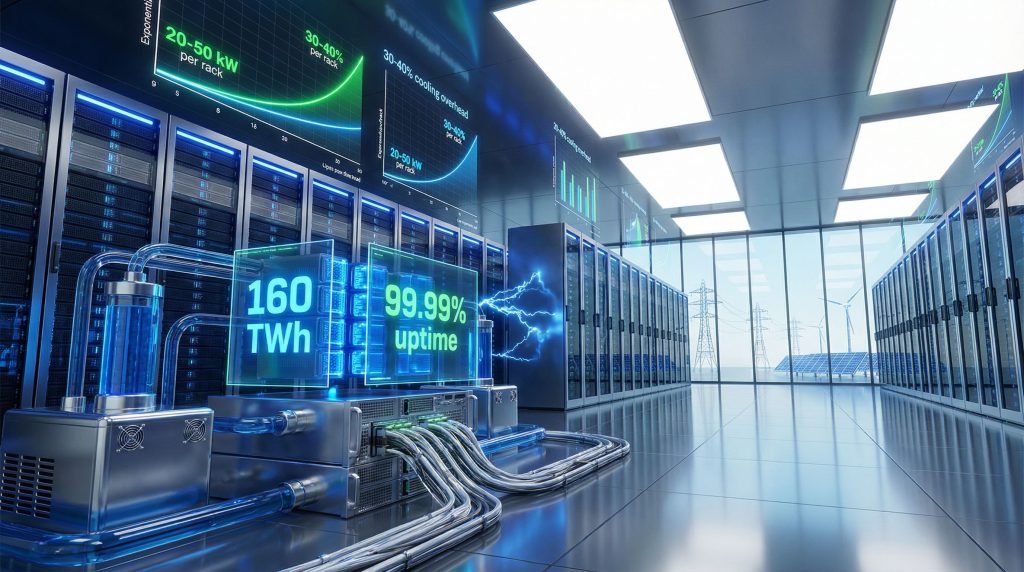
• Power density: Modern AI-optimized facilities require 20-50 kW per rack versus 5-10 kW for traditional servers
• Uptime requirements: 99.99% availability standards translate to less than 53 minutes of downtime annually
• Cooling overhead: Represents 30-40% of total facility power consumption
• Load predictability: Minimal seasonal variation creates consistent grid demand
The distinction between data center loads and traditional industrial loads represents a fundamental shift in grid management philosophy. Unlike manufacturing facilities or residential areas with cyclical demand patterns, data centers operate as rigid, non-negotiable baseload consumers with minimal throttling capacity. This creates what grid operators term "inelastic demand"—the load cannot easily reduce during peak grid stress periods.
AI workload processing requires sustained computational state; interrupting or reducing power degrades model accuracy and training stability. Traditional industrial processes can pause production runs or shift schedules; AI training cannot.
Real-world comparative analysis reveals the stark difference in scale. Amazon's AWS US East (N. Virginia) region maintains an estimated 500-800 MW sustained draw. A traditional U.S. city of similar geographic scale, such as Charlottesville, Virginia (population ~50,000), peaks at 150-200 MW with significant daily variation. The data center load equals an entire mid-sized city but with zero off-peak reduction.
When big ASX news breaks, our subscribers know first
What's Driving the Exponential Growth in Power Requirements?
The surge in data center power demand stems from three converging technological trends that fundamentally alter computational power requirements.
Artificial Intelligence Workloads
AI training and inference operations require specialised processors (GPUs, TPUs) that consume 300-700 watts per chip compared to 100-200 watts for traditional CPUs. A single AI training cluster can demand 10-20 megawatts continuously for weeks or months.
Cloud Migration Acceleration
Enterprise digital transformation has accelerated post-2020, with organisations moving mission-critical workloads to cloud infrastructure. This shift concentrates computing power in hyperscale facilities rather than distributed corporate data centres.
Edge Computing Proliferation
The growth of IoT devices, autonomous vehicles, and real-time applications requires processing closer to end users, driving construction of thousands of smaller edge data centres globally.
| Workload Type | Power per Server (kW) | Typical Rack Density (kW) | Cooling Ratio |
|---|---|---|---|
| Traditional Enterprise | 0.5-1.0 | 5-8 | 1:1 |
| Cloud Computing | 1.0-2.0 | 8-15 | 1.2:1 |
| AI/ML Training | 2.0-4.0 | 20-50 | 1.5:1 |
| High-Performance Computing | 3.0-5.0 | 30-80 | 1.8:1 |
AI training and inference represent a qualitative shift from traditional computing workloads. Unlike database query processing (sporadic, variable), AI workloads exhibit sustained, parallel computation across thousands of GPUs simultaneously. This creates continuous thermal output with no idle periods, synchronised power demand unlike traditional loads that randomise across time, and cooling inflexibility where thermal gradients must remain within 5°C within chip clusters.
Post-pandemic enterprise digital transformation accelerated movement toward hyperscale facilities because distributed corporate data centres became operational liabilities due to staffing constraints and geographic separation. Cloud providers achieved economies of scale delivering 3-5× better power efficiency than enterprise-managed infrastructure, while remote work normalised dependence on cloud-based collaboration tools.
Furthermore, GPU architecture contains 4,000-16,000 cores versus CPUs with 8-64 cores. Each core requires power regulation, memory bandwidth, and interconnect bandwidth. Heat density in GPU clusters can reach 60-80 kW/m³ versus traditional server racks at 15-20 kW/m³, necessitating liquid cooling rather than air cooling systems.
Regional Power Grid Impact: Where Infrastructure Meets Demand
Different geographic regions face varying degrees of strain as data center deployment accelerates, with some areas approaching critical capacity constraints.
North America: The Virginia Bottleneck
Northern Virginia hosts a disproportionately large share of North American internet traffic and serves as a critical interconnection hub for transatlantic data flows. Loudoun County alone contains over 25 million square feet of data centre space, representing approximately 45% of U.S. data centre capacity.
The regional grid operator (PJM) published capacity projections showing 30+ GW of data centre interconnection requests pending as of 2024. Current PJM data centre demand ranges 15-18 GW. Tripling this load would reach 45-54 GW by 2030, requiring estimated $20-40 billion in transmission and distribution improvements.
Europe: Aging Infrastructure Challenges
European grids face significant modernisation challenges, with 40% of transmission infrastructure over 40 years old according to European Commission reports. Much European transmission infrastructure was installed during 1970s-1980s post-war reconstruction and standardisation periods.
European Commission estimates indicate €200-300 billion required for grid modernisation by 2030, with IRENA suggesting €400+ billion for renewable integration infrastructure. This aging infrastructure struggles to accommodate new data centre developments while managing variable renewable energy integration.
Ireland has implemented moratorium policies in Dublin due to grid capacity constraints, later relaxing restrictions for projects meeting renewable energy and efficiency criteria. Amsterdam has implemented capacity restrictions in specific areas due to grid congestion concerns identified by TenneT, the Dutch transmission operator.
Asia-Pacific: Rapid Expansion Pressures
Singapore temporarily banned new data centres in 2019 due to land and power constraints, later lifting restrictions with strict efficiency requirements including PUE below 1.3 standards. This policy framework demonstrates the challenges faced by city-states balancing digital infrastructure needs with physical limitations.
China represents a massive and growing segment of global data center power demand, though exact figures require verification from multiple sources due to data availability challenges. Government efficiency mandates reflect recognition of the sector's growing energy footprint.
Technical Solutions: How the Industry Is Adapting Infrastructure
Data centre operators are implementing multiple strategies to address power constraints and improve efficiency across their operations.
Advanced Cooling Technologies
• Liquid cooling systems: Direct-to-chip cooling reduces energy consumption by 20-30% compared to traditional air cooling
• Free cooling optimisation: Utilising outside air temperatures reduces mechanical cooling loads
• Waste heat recovery: Capturing server heat for district heating systems or industrial processes
Power Infrastructure Innovations
• On-site generation: Installing natural gas turbines, fuel cells, or renewable energy systems
• Battery storage integration: Utility-scale storage systems provide grid stability and backup power
• Microgrid development: Self-contained power systems reduce grid dependence
Efficiency Optimisation
• AI-driven power management: Machine learning algorithms optimise cooling and power distribution
• Server virtualisation: Consolidating workloads reduces physical hardware requirements
• Chip-level improvements: Next-generation processors offer better performance per watt
Modern data centres require tighter voltage regulation (typically ±3-5% variance tolerance) compared to industrial facilities (±10% tolerance). Harmonic distortion limits remain below 5% THD (Total Harmonic Distortion) for IT equipment versus 10-15% for general industrial loads, necessitating power factor correction and dedicated voltage regulation infrastructure.
Grid Integration Challenges: Technical Hurdles and Solutions
The integration of massive data centre loads creates several technical challenges for electrical grid operators and utility companies.
Frequency Regulation Issues
Large data centres can cause grid frequency fluctuations when loads change rapidly. Modern facilities implement power factor correction and voltage regulation equipment to maintain grid stability.
Transmission Capacity Limitations
Existing transmission lines often lack capacity for multi-hundred megawatt data centre campuses. Solutions include:
• High-voltage direct current (HVDC) transmission lines
• Smart grid technologies for load balancing
• Distributed generation to reduce transmission requirements
Interconnection Queue Delays
New data centres face 3-7 year waiting periods for grid connections in constrained regions. Fast-track solutions include:
• Brownfield development at existing industrial sites
• Shared transmission infrastructure
• Temporary generation during construction phases
As the grid integrates variable renewable energy sources, traditional heavy spinning turbines (coal, gas, nuclear) that provided physical inertia to maintain frequency stability are being retired. Solar panels and wind turbines don't provide this mechanical inertia. Consequently, advanced grid-forming inverters must now synthetically replicate that stabilising inertia, preventing grid brittleness and blackouts when renewable output fluctuates.
Power Purchase Agreement Evolution: New Contract Structures
Traditional power procurement models are evolving to address the unique requirements of data centre operations and sustainability commitments.
24/7 Carbon-Free Energy Matching
Rather than annual renewable energy credits, advanced operators pursue hour-by-hour clean energy matching, requiring:
• Diverse renewable portfolio (solar, wind, storage)
• Real-time energy tracking systems
• Flexible contract structures
Hybrid Power Agreements
Modern contracts combine multiple energy sources and storage to ensure reliability:
• Baseload nuclear or hydroelectric power
• Variable renewable generation
• Battery storage for peak demand
• Backup generation capabilities
Grid Services Revenue Streams
Data centres increasingly participate in grid services markets:
• Demand response programmes during peak periods
• Frequency regulation services
• Capacity market participation
The market is experiencing increased volatility with instances of negative pricing when excess solar generation forces prices below zero at midday, followed by price spikes reaching $500+ per MWh during evening peak demand. Simple "pay-as-produced" PPAs cannot manage this volatility, driving adoption of complex Hybrid PPAs and 24/7 Carbon-Free Energy contracts that bundle multiple generation sources with storage.
The next major ASX story will hit our subscribers first
Future Infrastructure Requirements: 2025-2030 Projections
Industry forecasts indicate data center power demand will continue growing rapidly, requiring significant infrastructure investments and technological advances.
Capacity Expansion Needs
• United States: 100+ GW of new data centre capacity projected by 2030
• Global market: $500+ billion in infrastructure investment required
• Grid upgrades: $200+ billion in transmission and distribution improvements
Emerging Technologies
• Small modular reactors (SMRs): Nuclear power specifically designed for data centre loads
• Advanced geothermal: Enhanced geothermal systems for baseload renewable power
• Green hydrogen: Long-term storage for renewable energy integration
Regulatory Developments
• Efficiency standards for new data centre construction
• Grid integration requirements for large facilities
• Carbon accounting and reporting mandates
S&P Global Energy projects global data center power demand could reach 2,200 terawatt-hours (TWh) by 2030. This represents roughly the total electricity consumption of India, but unlike a country's variable energy demand, data centre consumption represents constant baseload hunger without throttling capacity.
China is pivoting from solar panel dominance toward green hydrogen leadership. Chinese electrolyzer costs have crashed below $100 per kilowatt versus Western competitors struggling to reach $250/kW. China plans 4.5 GW of electrolyzer installations in 2026, positioning themselves as the Saudi Arabia of the green energy era through molecule exports rather than just infrastructure sales.
Regional Case Studies: Different Approaches to Power Challenges
Singapore's Efficiency-First Strategy
Singapore requires new data centres to achieve Power Usage Effectiveness (PUE) below 1.3 and demonstrate tropical cooling innovations. The city-state prioritises high-value computing workloads over basic storage functions.
Ireland's Capacity Management
Ireland implements a moratorium on new data centres in the Dublin area during peak demand periods, whilst encouraging development in regions with surplus renewable generation capacity.
Netherlands' Heat Recovery Mandate
Dutch regulations require new data centres to demonstrate waste heat utilisation plans, connecting facilities to district heating networks or industrial processes.
China's Industrial Strategy
China is shifting from guaranteed solar pricing to competitive bidding, signalling the end of "growth at all costs" phase. They have won the solar supply chain war and are now moving to the next battlefield: green hydrogen and energy molecule exports.
Investment Implications: Infrastructure as the New Bottleneck
The data centre power challenge creates investment opportunities across multiple sectors as traditional technology valuations give way to infrastructure-focused strategies.
Grid Infrastructure Plays
Companies specialising in transmission equipment, smart grid technologies, and grid-scale storage benefit from mandatory infrastructure upgrades driven by data centre growth. Cable giants like Prysmian and Nexans report factories booked for years building subsea interconnectors. Heavy electrical engineers like Siemens Energy and Hitachi Energy remain the only providers capable of building massive transformers and switchgear for these loads.
Distributed Energy Resources
On-site generation, battery storage, and microgrid solutions become essential for data centre developers seeking reliable, sustainable power sources. For instance, the U.S. is installing almost 15 GW of new battery capacity in 2026 alone, with Germany and Australia following suit.
This growing sector ties directly to the broader battery metals investment landscape, whilst supporting the critical minerals energy transition across multiple applications. The demand for energy storage systems also impacts uranium market trends as nuclear power emerges as a baseload solution.
Cooling and Efficiency Technologies
Advanced cooling systems, power management software, and energy-efficient hardware command premium valuations as operators prioritise efficiency improvements. Liquid cooling reduces energy consumption by 20-30% compared to traditional air cooling, making it essential for high-density AI workloads.
For the hyperscalers (Amazon, Microsoft, Google), traditional utility connections taking five years are unacceptable. They are bypassing the grid entirely through data centres colocated with nuclear plants (like the Three Mile Island deal) or exploring small modular reactors and solid oxide fuel cells on campus. Big Tech is becoming an electric utility with a side business in software.
Western governments are moving toward "more interventionist industrial strategy" with greater government involvement through equity stakes. The challenges of grid modernisation, nuclear power, and critical raw materials green transition are too capital-intensive and risky for private markets alone. We are entering an era where government serves as both regulator and shareholder.
Conclusion: The Physics of Digital Growth
The transition is forcing abandonment of simple Power Purchase Agreements toward complex, flexible contracts. Big Tech must invest in on-site generation and Battery Energy Storage Systems to ensure reliability. Geopolitically, China's pivot from solar panel manufacturing dominance to green hydrogen market control signals the next phase of energy competition.
We are moving from an era of "Zero Marginal Cost" to "Marginal Cost Reality" where every new AI token requires specific electricity and water inputs. Every new data centre demands substations, transmission lines, and government permits requiring multi-year approval processes. The friction has returned, and it carries substantial costs.
The companies and regions that successfully navigate this transition will be those that invest early in grid infrastructure, embrace advanced cooling and power technologies, and develop sustainable energy strategies. Furthermore, many operators are exploring innovative solutions such as the development of battery-grade lithium refinery projects to secure supply chains for critical energy storage components.
The future belongs not to the fastest algorithms, but to the most efficient and reliable power delivery systems. The bottleneck is no longer the code—it's the copper, the transformers, and the sheer raw wattage required to keep the digital simulation running. In a hardware-constrained world, the only work that matters is building the physical infrastructure that powers our digital future.
Looking to Capitalise on Critical Infrastructure Investments?
The data centre power revolution is driving unprecedented demand for critical minerals used in grid infrastructure, energy storage systems, and power management technologies. Discovery Alert's proprietary Discovery IQ model delivers real-time notifications on significant ASX mineral discoveries, instantly identifying actionable opportunities in the commodities powering this infrastructure transformation. Begin your 30-day free trial today to position yourself ahead of this rapidly evolving market.