July 22, 2026
The Thermal Energy Problem That Coal Has Owned for Decades
Across the world's most energy-intensive industries, the pathway to decarbonisation keeps running into the same wall: heat. Electricity can power motors, lighting, and increasingly even transportation, but replacing the raw thermal output of a coal-fired boiler at industrial scale is a fundamentally different challenge. For alumina refining, cement production, and steel manufacturing, the temperatures required are extreme, the energy volumes enormous, and the infrastructure already locked in over decades of capital investment.
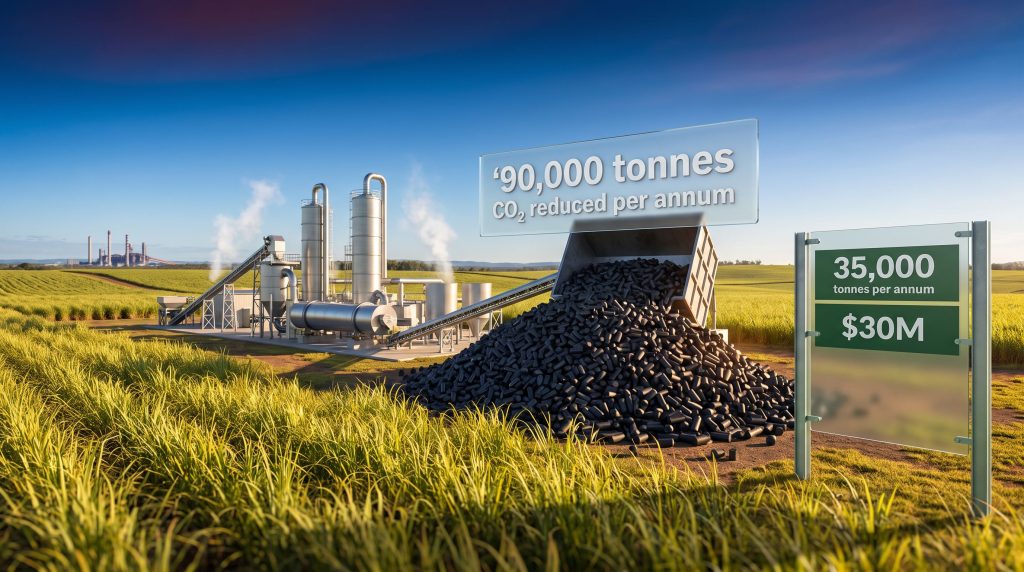
This is precisely why a proposed $30 million biochar production facility in central Queensland is drawing significant attention from industrial decarbonisation watchers. The Rio Tinto biochar facility in central Queensland, if approved and built as proposed, would not only supply bio pellets to one of Australia's most emissions-intensive industrial corridors, it would test whether a locally grown grass crop can structurally displace coal in a major mining company's energy supply chain.
The implications extend well beyond one refinery, one company, or even one region.
When big ASX news breaks, our subscribers know first
Why Alumina Refining Is Uniquely Hard to Decarbonise
The Bayer Process and Its Thermal Demands
Alumina refining operates through what is known as the Bayer process, a chemical sequence that extracts aluminium oxide from bauxite ore using caustic soda and sustained high-temperature heat. The process requires continuous operation of large boilers generating steam at significant pressures and temperatures, making it fundamentally dependent on reliable, high-energy fuel inputs.
Rio Tinto's Gladstone operations, including the Yarwun alumina refinery, represent one of the most concentrated clusters of fossil fuel-dependent industrial activity in Queensland. The combination of continuous process requirements and high thermal intensity means that simply switching off coal boilers and connecting to the electricity grid is not a commercially or technically viable near-term option.
Three broad decarbonisation pathways are being explored across the global alumina sector:
- Direct electrification of thermal processes, which requires grid capacity upgrades, new equipment investment, and significant lead times
- Green hydrogen as a fuel substitute, which remains capital-intensive and is constrained by production infrastructure availability
- Biomass and bio pellet blending, which can be incorporated into existing boiler systems without wholesale equipment replacement
The third pathway is currently the most commercially accessible, which is precisely what the SuperChar agreement with Rio Tinto is designed to explore at scale.
The Boynedale Facility: Structure, Scale, and Strategic Fit
What SuperChar Is Proposing to Build
SuperChar Limited has lodged a development application with Gladstone Regional Council for a $30 million biochar production facility in Boynedale, a former dairy farming district located approximately 50 kilometres from Gladstone. The region's prior agricultural use, combined with its climate profile and water availability, makes it agronomically well-suited to large-scale cultivation of bana grass as an industrial biomass feedstock.
This would be SuperChar's first commercial-scale production facility. The company has existing bana grass plantation trials operating in Ingham and Mossman in Far North Queensland, which have provided early-stage agronomic and processing data to support the Boynedale application.
The Rio Tinto Off-Take Agreement: Key Commercial Terms
The commercial relationship between SuperChar and Rio Tinto anchors the project's bankability and provides a credible demand signal for investors and funding bodies evaluating the proposal.
| Metric | Detail |
|---|---|
| Agreement duration | Five years |
| Initial annual supply volume | 35,000 tonnes |
| Projected annual CO₂ reduction | 90,000 tonnes |
| Confirmed blending ratio (feasibility study) | Up to 30% bio pellets |
| Target blending ratio under new agreement | Up to 50% bio pellets |
| Facility capital cost | $30 million AUD |
| Distance from Gladstone refineries | ~50 kilometres |
| Projected direct employment | ~25 jobs |
| Target commercial operations date | 2028 (subject to approvals) |
Rio Tinto has confirmed that a prior feasibility study, conducted across its Gladstone refinery boilers, validated that a blend of up to 30 per cent bio pellets with coal is technically workable. The new agreement is structured to push that boundary further, targeting blending ratios of up to 50 per cent as the companies accumulate operational data.
The carbon arithmetic is compelling: at 35,000 tonnes of bio pellets per annum, Rio Tinto estimates a reduction of approximately 90,000 tonnes of CO₂ equivalent emissions each year. If the 50 per cent blending target is achieved and supply volumes scale accordingly, the abatement potential increases materially beyond that baseline figure.
Bana Grass: An Underappreciated Industrial Feedstock
Agronomic Characteristics That Matter for Industrial Supply Chains
Bana grass (Pennisetum purpureum hybrid) is not a new crop, but its potential as an industrial-scale biomass feedstock for pyrolysis-based processing is less widely understood than its use as cattle fodder in tropical regions. Several agronomic characteristics make it particularly well-suited to the industrial supply chain role SuperChar is designing around it:
- Perennial growth habit: Unlike annual energy crops such as sorghum, bana grass does not need to be replanted each season. Once established, it regrows after each harvest, reducing labour costs, soil disturbance, and cultivation inputs over the long term.
- High biomass yield per hectare: The grass grows rapidly in semi-tropical climates, producing large volumes of raw feedstock from a given land area relative to competing biomass crops.
- Low agricultural input requirements: Bana grass requires comparatively modest fertiliser and water inputs once established, which improves the lifecycle emissions profile of the resulting bio pellets.
- Dual-use potential: The same crop can supply both the industrial pyrolysis process and, when processed differently, produce a high-protein animal feed product with 15 to 18 per cent protein content, making it directly competitive with conventional livestock supplements.
Bana grass has a long history as a fodder crop across Central Africa and Central America, where its nutritional profile for ruminants is well documented. Its application as a pyrolysis feedstock for industrial energy purposes is a more recent and commercially less-tested development, which is part of what makes the SuperChar-Rio Tinto agreement scientifically and commercially significant.
The Multi-Product Value Logic
One of the less obvious but financially important features of the Boynedale facility design is its multi-stream output structure. Rather than operating as a single-product bio pellet plant entirely dependent on one industrial customer, the facility is designed to produce:
- 35,000 tonnes per annum of industrial bio pellets for supply to Rio Tinto's Gladstone refineries
- 25,000 tonnes per annum of charcoal briquettes for domestic and commercial cooking markets
- High-protein animal feed pellets derived from bana grass biomass residuals, targeting livestock producers
This diversification reduces the project's financial exposure to any single demand source and creates multiple independent revenue streams from the same feedstock and processing infrastructure. For a first-of-kind facility seeking project finance, that structure meaningfully improves the risk profile presented to lenders and equity investors.
How Pyrolysis Works at Industrial Scale
From Paddock to Pellet: The Process Explained
Understanding what happens inside a pyrolysis facility helps clarify why it is considered environmentally preferable to conventional biomass combustion and why it generates no liquid or solid waste streams requiring disposal.
- Cultivation and harvest: Bana grass is grown on contracted farmland across the Boynedale region and harvested on a rotation schedule that preserves the perennial root system for subsequent regrowth.
- Feedstock preparation: Harvested material is processed to reduce moisture content and achieve consistent particle sizing, which is critical for uniform thermal conversion outcomes.
- Pyrolysis thermal treatment: Prepared biomass is loaded into a pyrolysis reactor and heated at high temperatures in a low-oxygen or oxygen-free environment. Without oxygen to sustain combustion, the organic material thermally decomposes rather than burns.
- Bio pellet and biochar formation: The solid carbon-rich output of pyrolysis is processed into standardised pellets calibrated to the energy density, moisture, and combustion characteristics required by Rio Tinto's boiler systems.
- Quality assurance and dispatch: Pellets are tested against agreed specifications before being transported the approximately 50 kilometres to Rio Tinto's Gladstone operations.
A critical technical distinction: Pyrolysis produces no chemical by-products, no liquid effluent requiring treatment, and no solid waste requiring landfill or disposal. This is fundamentally different from conventional coal combustion, which produces ash, particulate matter, and gaseous emissions requiring management. The environmental permitting pathway for pyrolysis facilities is therefore considerably less complex than for combustion-based alternatives.
Carbon Accounting: Why Biochar Can Be Carbon-Negative
The lifecycle carbon accounting for bio pellets produced through pyrolysis is more nuanced than a simple substitution calculation. Several factors interact:
- Carbon captured by growing bana grass from atmospheric CO₂ through photosynthesis represents a genuine drawdown of greenhouse gases.
- When bio pellets are combusted in industrial boilers, that carbon is re-released, creating a broadly carbon-neutral cycle rather than the net-positive emissions profile of fossil coal.
- Any biochar fraction that is not combusted but is instead applied to soil or otherwise sequestered represents a permanent or semi-permanent carbon sink, pushing the lifecycle accounting toward net-negative emissions in some analytical frameworks.
- Because the Boynedale site was previously cleared agricultural land used for dairy farming, the land-use change component of the lifecycle calculation is minimal, which strengthens the carbon credentials of the resulting pellets.
Rio Tinto's Broader Decarbonisation Portfolio
Why the SuperChar Deal Is One Piece of a Larger Strategy
Rio Tinto has been explicit that the SuperChar bio pellet agreement represents one of several simultaneous strategies being pursued to reduce fossil fuel dependency across its Queensland alumina operations. This portfolio framing is important context for understanding both the ambition and the limitations of the Boynedale project.
The company's broader decarbonisation investigations for alumina refining include green iron production technologies, green hydrogen as a fuel substitute, direct electrification of thermal processes, and renewable energy procurement agreements. Each of these carries a substantially longer development and commercialisation timeline than bio pellet blending, which can be implemented using existing boiler infrastructure with comparatively modest capital modification.
Rio Tinto's biocarbon activities also span multiple geographies and application contexts. Furthermore, the company has pursued a biocarbon joint venture in Quebec, Canada, targeting metallurgical applications for aluminium smelting inputs. In Western Australia, Rio Tinto's BioIron pilot programme has investigated biomass-based direct reduction of iron ore as a potential pathway to Rio Tinto green steelmaking chemistry. In Queensland, the SuperChar agreement focuses specifically on thermal energy substitution in alumina refining boilers.
The geographic and technical breadth of this biocarbon investment portfolio reflects a clear strategic judgement: no single low-carbon input technology will dominate across all of the company's refining and smelting operations. Instead, site-specific solutions calibrated to local feedstock availability, existing infrastructure, and operational requirements are being developed in parallel.
The next major ASX story will hit our subscribers first
Regional Economics: What the Project Means for Boynedale
Employment, Community, and the Contract Farming Model
The Boynedale district's transition away from dairy farming over the preceding decade has left a gap in the local agricultural economy that the SuperChar project could partially address. The initial operational phase is projected to support approximately 25 direct jobs across the processing facility and contracted farming activities.
Local farmer Paul Whiteman established a 12-hectare trial crop of bana grass on his property in May 2026, making him one of the first growers in the region to participate in SuperChar's supply development programme. His assessment of the crop's early performance has been positive, with germination and growth accelerating as soil temperatures warmed through the season.
The contract farming model SuperChar is employing distributes both agricultural risk and capital requirements across multiple farm operators rather than concentrating them in a single vertically integrated land holding. This structure has several practical advantages for regional uptake:
- Existing landholders can integrate bana grass cultivation into their current operations without wholesale property restructuring.
- The dual-use nature of bana grass as both an industrial feedstock and a cattle feed supplement gives farmers additional optionality in how they deploy the crop.
- On-farm income generated through bana grass supply contracts could reduce the need for off-farm employment commutes that currently characterise the local workforce, with some residents driving up to 45 minutes each way into Gladstone for work.
The social dimension of the project is particularly relevant given declining school enrolments in the Boynedale area, which reflect broader rural population pressures. On-farm employment creation has the potential to retain young families in the region in a way that purely extractive or resource-based industries historically have not. Consequently, the mining decarbonisation benefits here extend well beyond emissions reduction into genuine regional economic regeneration.
Approvals, Funding, and the Path to 2028
What Still Needs to Happen
The Boynedale facility remains subject to Gladstone Regional Council approval of its development application, which was lodged earlier in 2026. Council approval represents the primary near-term regulatory threshold before construction can commence. In addition, the project sits within Queensland's broader industrial transition landscape, which the Queensland Government has actively supported through its decarbonisation policy frameworks.
SuperChar has described its funding position as well advanced while simultaneously indicating that government financial support is being pursued. The distinction between an advanced private funding position and confirmed government co-investment is important: no government funding commitment has been publicly confirmed for the project.
The secured five-year commercial off-take agreement with Rio Tinto substantially strengthens the project's case for project finance, as it provides lenders with a creditworthy, volume-committed revenue stream from the outset of commercial operations. This is precisely the kind of demand certainty that makes first-of-kind industrial projects fundable rather than merely theoretically viable.
Investor note: Projects of this type carry meaningful execution risk between development application and first commercial delivery. The 2028 target for initial bio pellet supply to Rio Tinto is contingent on council approval, construction completion, agronomic ramp-up of bana grass supply, and commissioning of pyrolysis processing equipment within a compressed timeline. Each of these dependencies introduces schedule risk that prospective investors and funding partners should evaluate independently. Nothing in this article constitutes financial advice.
A Replicable Template for Regional Biomass-to-Industry Projects
Why Boynedale's Design Logic Matters Beyond Queensland
The structural architecture of the SuperChar-Rio Tinto arrangement — a perennial biomass crop cultivated through a contract farming model, processed through a multi-product pyrolysis facility, with an anchor industrial off-take agreement providing revenue certainty — represents a potentially replicable template for other biomass-to-industry projects. Furthermore, the role of renewable energy in mining transitions more broadly mirrors the logic being demonstrated here: locally sourced, low-carbon inputs replacing fossil fuel dependency at industrial scale.
Northern Australia has extensive areas of suitable land for perennial biomass cultivation, proximity to emissions-intensive industrial operations in the resources sector, and agricultural communities that have experienced declining incomes from conventional farming over recent decades. The combination of those factors creates conditions in which the Boynedale model could be adapted to other feedstocks, other industrial customers, and other regional contexts.
Whether the Rio Tinto biochar facility in central Queensland performs as projected will generate commercially significant data on four questions that currently lack robust empirical answers at Australian scale:
- Can bana grass be cultivated reliably at volumes sufficient to sustain a 35,000 tonne per annum bio pellet supply chain in central Queensland's climate?
- Does pyrolysis-processed bana grass bio pellet perform consistently at 50 per cent blending ratios in alumina refinery boilers without adverse operational effects?
- Can the multi-product revenue model — combining industrial bio pellets, consumer briquettes, and animal feed — generate sufficient returns to sustain a commercially viable operation without ongoing subsidy?
- Does the contract farming supply model create sufficient on-farm income to retain agricultural producers in the region at the volumes required?
The answers to those questions will matter not only to Rio Tinto and SuperChar, but to every industrial operator in Australia that is currently staring at a coal-fired boiler and asking whether the Rio Tinto biochar facility in central Queensland proves biomass is a realistic bridge to a lower-emissions future.
Want to Track the Next Major ASX Mineral Discovery Before the Market Does?
Discovery Alert's proprietary Discovery IQ model scans ASX announcements in real time, instantly identifying significant mineral discoveries and turning complex data into actionable investment insights — explore historic discoveries and their returns to understand the opportunity, then start your 14-day free trial at Discovery Alert and position yourself ahead of the broader market.