July 22, 2026
Southern Iraq's Underdeveloped Giant: Why the Halliburton Contract for Bin Omar and Sindbad Fields Matters
Across the global oil industry, the gap between declared reserve potential and actual production output has rarely been wider than in southern Iraq. Basra's subsurface holds some of the most geologically generous hydrocarbon accumulations on the planet, yet decades of underinvestment, infrastructure deficits, and complex geopolitical dynamics have consistently suppressed the region's output. The Halliburton contract for Bin Omar and Sindbad fields in southern Iraq, formally executed in July 2026, represents a deliberate attempt by Iraq's Basra Oil Company to close that gap using a contract structure specifically designed to import technical expertise without surrendering sovereign control.
Understanding why this deal is structured the way it is, what it aims to achieve, and where the execution risks lie requires more than a surface reading of production targets. It demands an appreciation of Iraq's evolving field development philosophy, the technical complexity of managing giant underdeveloped reservoirs, and the strategic logic embedded in the decision to partner with a major US oilfield services company.
When big ASX news breaks, our subscribers know first
Contract Architecture: What BOC and Halliburton Actually Agreed To
The contract awarded by Basra Oil Company (BOC) to Halliburton covers two distinct southern Iraq assets simultaneously under an integrated framework combining Integrated Field Management Services (IFMS) with Engineering, Procurement, and Construction Management (EPCM) functions. The primary contract term runs for five years, with an optional three-year extension that could extend the total engagement to eight years. The contract was formally signed on July 5, 2026, though its commercial foundations were established considerably earlier, with a Heads of Agreement receiving cabinet-level approval in January 2025.
A critical structural feature of this arrangement is what it explicitly excludes. BOC retains complete ownership and operatorship of both fields throughout the contract lifecycle. Halliburton's role is purely technical and managerial, not proprietary. There is no production-sharing mechanism, no equity stake, and no licensing transfer involved. This architecture is not accidental.
Iraq's approach reflects a broader sovereign preference: access world-class technical capability and digital infrastructure from international operators without any dilution of state ownership over the underlying asset base.
This model contrasts sharply with the licensing round frameworks that characterised Iraq's field development strategy in the post-2003 period, where international oil companies received revenue entitlements tied directly to production increments. The current structure keeps all upside economics with the Iraqi state while externalising technical execution risk to a global specialist. Furthermore, understanding the wider oil geopolitics and supply context helps explain why Iraq is pursuing this particular approach now.
The Two Fields: Reserve Scale, Location, and Strategic Importance
Both fields sit within the Basra region of southern Iraq, a geological province that forms part of the broader Mesopotamian Foredeep basin. This basin's carbonate reservoir systems, particularly within the Cretaceous-age Mishrif and Yamama formations, are among the most productive in the world on a per-well basis when properly developed.
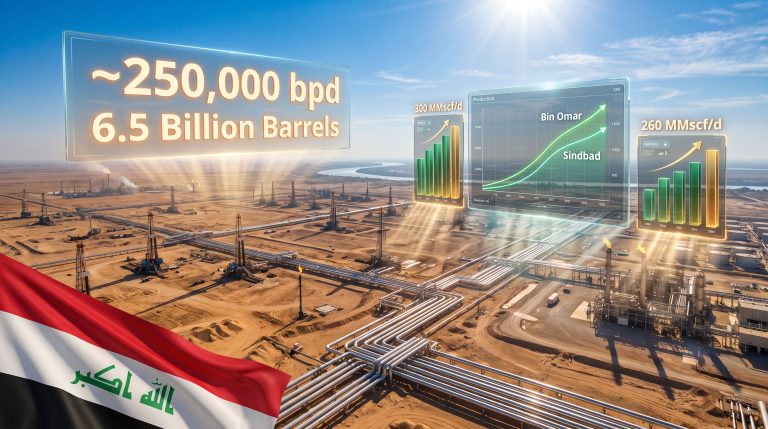
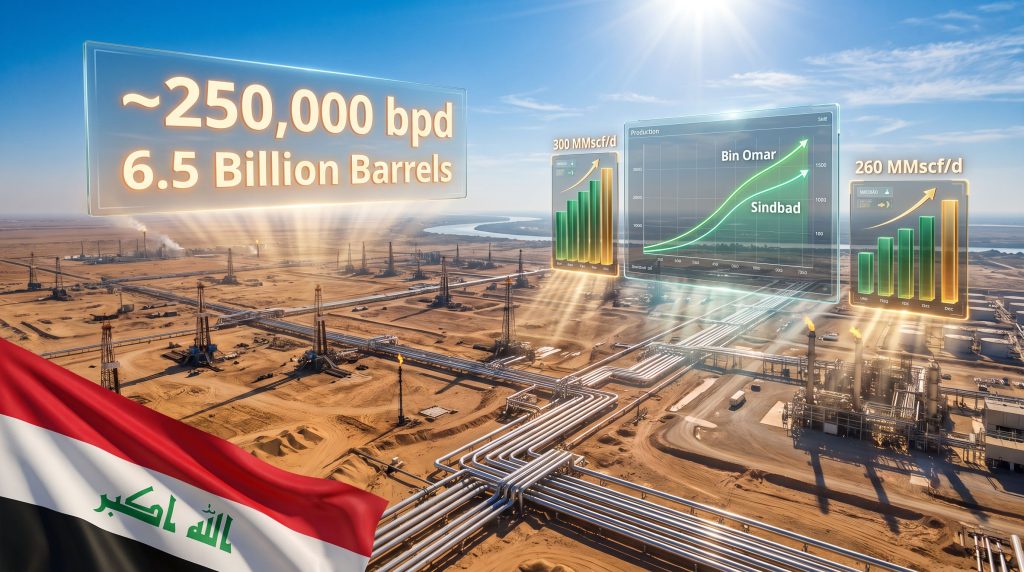
Nahr Bin Omar (commonly referred to as Bin Omar or Bin Umar across industry sources) carries an estimated recoverable reserve base of approximately 6.5 billion barrels of oil. That figure alone positions it among southern Iraq's most consequential underdeveloped assets. Fields of this scale have genuine long-cycle production potential, meaning a properly executed development program could sustain plateau output for decades rather than years.
Sindbad field is a separate southern Iraq asset targeted for concurrent development under the same contractual umbrella. Its production trajectory runs alongside Bin Omar's but operates from a different baseline and targets a somewhat lower output ceiling.
The geographic proximity of both fields to Basra's existing pipeline, processing, and export infrastructure is practically significant. Greenfield developments in remote basins require parallel investment in trunk infrastructure that can consume years and billions of dollars before a single barrel reaches export terminals. The Basra cluster's established logistics network, however, substantially reduces this lead time and capital burden.
Production Targets: Oil and Gas Ambitions in Numbers
The production objectives embedded in this contract are ambitious but clearly defined. Iraq's Oil Minister confirmed the following targets for the five-year primary contract period:
| Field | Crude Oil Target | Associated Gas Target | Current Gas Baseline |
|---|---|---|---|
| Bin Omar (Nahr Bin Omar) | 150,000 bpd | 300 MMscf/d | Not disclosed |
| Sindbad | 80,000 to 100,000 bpd | 260 MMscf/d | 240 MMscf/d |
| Combined Total | ~250,000 bpd | ~560 MMscf/d | — |
Several dimensions of this table deserve closer attention than the headline numbers alone suggest.
The Gas Dimension: More Than a Byproduct
Iraq's chronic associated gas flaring problem has been well-documented in international energy research for years. Vast volumes of gas produced alongside crude oil have historically been burned off at the wellhead because the infrastructure to capture, process, and distribute it either did not exist or was economically deprioritised relative to the crude export revenue stream.
The consequences are threefold. First, flaring represents a direct destruction of economic value that could otherwise feed domestic power generation or industrial consumption. Second, it creates significant carbon emissions, drawing international criticism and complicating Iraq's engagement with global climate frameworks. Third, and most immediately consequential for Iraq's fiscal position, the shortfall in domestic natural gas supply has forced the country to import large volumes from Iran, draining foreign exchange reserves.
The Sindbad field's gas target of 260 MMscf/d against a current baseline of 240 MMscf/d represents an incremental capture increase of approximately 20 MMscf/d. While that increment appears modest in isolation, the Bin Omar target of 300 MMscf/d from a currently underdeveloped baseline represents a far more substantial new supply contribution. Combined, these fields are projected to deliver over 550 MMscf/d of associated gas into Iraq's domestic supply network, directly addressing the import dependency problem at its source.
Halliburton's Technical Toolkit: What Gets Deployed and Why It Matters
Beyond the headline contract structure, the specific technical services Halliburton is contracted to deliver reveal the depth of operational challenge embedded in developing these fields efficiently. The service scope spans four primary functional areas:
- Field Development Planning covering subsurface characterisation, reservoir modelling, and multi-decade production forecasting to optimise well placement and recovery strategy across both assets.
- Production Optimisation utilising real-time monitoring systems and intervention workflows designed to maximise recovery rates and extend plateau production periods.
- Digital Technology Integration through Halliburton's proprietary Landmark software platform, which functions as an integrated digital environment connecting subsurface data, well planning workflows, drilling operations, and production management into a single decision-support ecosystem.
- EPCM Services managing the engineering, procurement, and construction execution across both field development programs to deliver surface facilities on schedule and within capital budgets.
Landmark Software: The Digital Architecture Underneath the Physical Oilfield
The deployment of Landmark software deserves particular focus because it represents something qualitatively different from conventional contractor support. Landmark creates what is effectively a digital twin of the subsurface and surface operating environment, allowing geoscientists, reservoir engineers, drilling teams, and production managers to work from shared, continuously updated datasets rather than siloed information environments.
In practical terms, this means well placement decisions at Bin Omar are informed by integrated subsurface models updated in near-real time as new wells are drilled and production data flows in. Dry hole risk decreases, capital efficiency improves, and BOC's own internal technical teams develop capabilities through direct engagement with the platform. The knowledge transfer dimension is strategically valuable for Iraq's long-term goal of reducing dependency on foreign technical expertise.
Placing 250,000 bpd in Iraq's National Production Context
Iraq currently produces in the range of 4.0 to 4.3 million bpd of crude oil, maintaining its position as one of OPEC's largest producers. A combined incremental contribution of approximately 250,000 bpd from Bin Omar and Sindbad at full ramp-up would represent a 5 to 6 percent uplift to national output, a meaningful addition by any measure.
Iraq has repeatedly articulated longer-term production aspirations exceeding 5 million bpd. Closing the gap between current output and that ambition requires systematically unlocking underdeveloped southern fields. Nahr Bin Omar, with its 6.5 billion barrel reserve base sitting largely untapped, consequently sits at the top of that development priority list. The crude oil market overview for 2025 underscores just how significant incremental supply additions of this scale can be to global pricing dynamics.
The broader geopolitical context is also relevant here. Iraq's Oil Minister has confirmed that the government intends to continue signing contracts with major international companies, with a stated preference for US-based partners, and has committed to removing administrative and logistical obstacles to accelerate contract execution. This signals an intentional alignment of commercial and diplomatic interests that shapes the operating environment for this specific contract. In addition, OPEC market influence remains a critical variable in determining how much of this incremental Iraqi production ultimately reaches global markets.
The next major ASX story will hit our subscribers first
Risk Landscape: Where Execution Could Fall Short
No honest analysis of a project of this scale and complexity is complete without a rigorous assessment of the risks that could impair delivery against stated targets.
Infrastructure Bottlenecks: Even with Basra's existing logistics network, achieving 150,000 bpd at Bin Omar requires parallel upgrades to water injection systems, fluid processing facilities, and pipeline takeaway capacity. These investments must be sequenced correctly to avoid creating production ceilings well below target rates.
OPEC+ Quota Compliance: Iraq operates under OPEC+ output management agreements. Material production increases from newly developed fields create potential compliance tensions if aggregate national output approaches or exceeds agreed ceilings. Iraq has historically faced criticism from other OPEC+ members for production quota overruns, making this an ongoing diplomatic and commercial management challenge.
Drilling Campaign Execution: Delivering 150,000 bpd at Nahr Bin Omar within a five-year window requires a sustained, high-tempo drilling program. This depends on rig availability, drilling contractor performance, supply chain reliability, and consistent capital allocation from BOC across the full contract period.
Gas Monetisation Infrastructure: Capturing 300 MMscf/d at Bin Omar is not simply a wellhead challenge. It requires processing plants, compression systems, and pipeline connectivity capable of handling and transporting those volumes into the domestic distribution network. Building this infrastructure in parallel with drilling operations demands precise project coordination.
Partial Execution Scenario: Even if targets are achieved at only 70 percent of their stated levels, the project still delivers approximately 175,000 bpd of incremental crude and around 390 MMscf/d of gas capture. Both figures represent material strategic value for Iraq's production and import-substitution objectives, and this downside resilience is an important consideration when evaluating the contract's strategic significance. Furthermore, the broader commodity price impacts flowing from sustained Iraqi output growth will reverberate well beyond the Basra region.
The Joint Management Model: A Structural Innovation Worth Watching
The BOC-Halliburton framework is increasingly representative of a broader shift in how resource-rich national oil companies across the Middle East are approaching technical partnerships. The traditional dichotomy between full state control and international licensing rounds is giving way to a more nuanced middle ground. According to reporting on the deal, this model is drawing attention from industry observers as a potential blueprint for similar arrangements across the region.
| Feature | Traditional Licensing Model | Joint Management Model |
|---|---|---|
| Asset Ownership | Shared or partially transferred | 100% retained by BOC |
| Revenue Entitlement | Production sharing with IOC | Service fee structure |
| Technology Access | Variable and often limited | Embedded via digital platform |
| State Operatorship | Shared or delegated | Fully maintained |
| Capital Risk Allocation | Shared with international partner | Primarily state-borne |
| Knowledge Transfer | Incidental | Structurally embedded |
If Halliburton successfully executes this contract and delivers against production and gas capture targets, the BOC-Halliburton model could become a template applied across other underdeveloped assets within BOC's broader portfolio. Zawya's coverage of the signing highlights that Iraqi officials have already signalled intent to replicate this contracting structure elsewhere. The digital infrastructure embedded through Landmark software would create a standardised operational foundation that scales more efficiently with each successive field brought under the same framework.
Disclaimer: Production targets, reserve estimates, and financial projections referenced in this article are drawn from official BOC and Iraqi Ministry of Oil statements. Actual outcomes depend on execution, capital availability, regulatory conditions, and commodity market factors. This article does not constitute investment advice.
Further Reading
Readers seeking additional context on Iraq's oil sector development trajectory and Basra Oil Company's field expansion programs can access related reporting and official communications via the Oil & Gas Journal at ogj.com and BOC's official publications at boc.oil.gov.iq.
Want to Stay Ahead of Major Resource Discoveries Shaping Global Commodity Markets?
While Iraq's giant oilfields reshape global supply dynamics, significant mineral discoveries on the ASX are quietly generating extraordinary returns closer to home — and Discovery Alert's proprietary Discovery IQ model ensures subscribers receive real-time alerts the moment these opportunities emerge. Explore historic discoveries and their market-moving returns, then begin your 14-day free trial to position yourself ahead of the broader market.