
August 6, 2026
When Volume and Value Move in Opposite Directions: Understanding the Diamond Market's Current Paradox
Few industries illustrate the tension between operational momentum and commercial reality as vividly as rough diamond mining. A producer can extract more carats, sell more carats, and generate more revenue than the prior year — and still be operating in a structurally weaker market. That is precisely the lens through which De Beers' first quarter 2026 production and sales data deserves to be read.
The headline figures are unambiguously strong on a volume basis. However, stripping away the output numbers to examine what each carat is actually worth reveals a market still searching for a durable pricing floor.
When big ASX news breaks, our subscribers know first
De Beers Rough Diamond Production Up 17%: What the Output Numbers Actually Mean
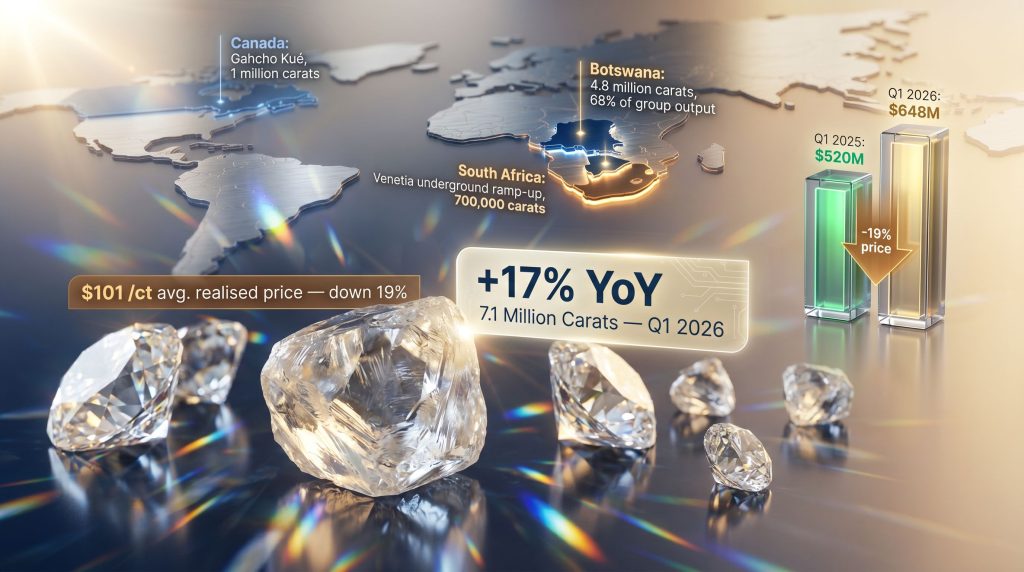
De Beers rough diamond production up 17% year-on-year to 7.1 million carats for the quarter ended March 31, 2026 is the kind of figure that reads well in a headline. But context transforms interpretation. The sequential recovery was even more striking, with output climbing 88% quarter-on-quarter from a heavily suppressed Q4 2025 baseline — a rebound that reflects operational factors rather than any meaningful surge in consumer demand for natural diamonds.
Both primary growth drivers were operationally predetermined rather than market-responsive. A planned ore release from a new area at the Gahcho Kué joint venture mine in Canada, and the continued processing of higher underground ore volumes at the Venetia mine in South Africa, together accounted for the majority of the year-on-year production increase. These are scheduled outcomes of capital programmes that were set in motion years earlier, not reactive decisions to chase rising diamond prices.
This distinction matters enormously for market interpretation. Production growth driven by mine transition schedules and ore release programmes carries a fundamentally different signal than growth driven by producers ramping up output in response to strengthening demand. In the current environment, De Beers is producing more simply because its mines are at a stage in their operational cycles where more ore is available — not because the market is calling for it.
Furthermore, according to De Beers' official Q1 2026 production report, the critical distinction for Q1 2026 is that volume and value are moving in opposite directions. A 17% increase in production alongside a 19% decline in average realised price tells a more nuanced story than output data alone can convey.
How De Beers' Regional Operations Performed Across Q1 2026
Understanding the aggregate figure requires disaggregating the regional contributions, because the story varies considerably by geography.
Botswana: Orapa Recovers as Jwaneng Holds Steady
Botswana remained De Beers' dominant production base, delivering 4.8 million carats and representing approximately 68% of total group output. Year-on-year growth was a modest 5%, but the sequential comparison tells a more dramatic story: output surged 156% quarter-on-quarter, reflecting the sharp rebound from a suppressed Q4 2025 baseline.
The primary technical driver was higher recovered grade at the Orapa mine. In diamond mining, recovered grade refers to the number of carats extracted per tonne of ore processed — and improvements in this metric can arise from mining into higher-grade ore zones or from improved processing plant efficiency. The transcript does not quantify the magnitude of the grade improvement at Orapa, but the 156% sequential volume surge indicates the shift was material.
The Jwaneng mine, which operates as one of the world's most valuable diamond mines by the quality and revenue potential of its production, held output broadly flat relative to Q1 2025. This stability at Jwaneng suggests production there is being managed within existing operational parameters rather than being expanded, which is consistent with a cautious approach to adding high-value supply into a market where average realised prices are declining. Botswana's performance here reflects why it remains one of the most significant global diamond producers in the world today.
South Africa: Venetia Underground Transition Delivers Structural Growth
The Venetia mine produced 700,000 carats in Q1 2026, representing a 53% increase year-on-year and 49% quarter-on-quarter. This performance is structurally driven by the ongoing transition from open-pit to underground mining operations — one of the most capital-intensive mine conversion projects in southern Africa's diamond sector.
The transition to underground mining at Venetia extends the operational life of a deposit that would otherwise have been exhausted once the open pit reached its economic limit. Underground ore volumes being processed are now at a level that is making a measurable difference to group output, confirming that the ramp-up phase is delivering tangible results against the significant capital investment committed to the project.
It is worth noting that underground mining typically accesses ore at greater depths where diamond grades can differ materially from surface or near-surface ore bodies. The characteristics of the underground ore at Venetia — including average stone size and quality distribution — will influence not just production volumes but the per-carat value profile of South African output in coming quarters. Understanding the mine development economics behind such transitions is essential context for interpreting these results.
Canada: A Scheduled Event, Not a Market Signal
Canadian operations contributed 1 million carats in Q1 2026, with growth attributable entirely to a planned ore release from a new mining area at the Gahcho Kué joint venture. This is a scheduled operational milestone, not a response to market conditions. For supply forecasting purposes, this distinction is important: production from this source reflects mine sequencing rather than demand-driven decision-making, and output from this area could moderate once the planned ore release cycle is complete.
Namibia: Fleet Maintenance Creates Temporary but Quantifiable Drag
Namibian output declined 12% year-on-year to 600,000 carats, with the shortfall driven by scheduled maintenance on two vessels at Debmarine Namibia, compounded by the decommissioning of two vessels during 2025. Marine diamond recovery — the process of extracting diamonds from the seabed off the Namibian coastline — is highly capital-intensive and operationally sensitive to vessel availability.
The decommissioning of vessels without confirmed replacement units represents a structural reduction in Debmarine's recovery capacity, not merely a temporary maintenance interruption. The 21% sequential improvement from Q4 2025 to Q1 2026 indicates the scheduled maintenance cycle has largely concluded, but the permanent capacity reduction from decommissioning warrants monitoring for its longer-term production ceiling implications.
Regional Production Summary: Q1 2026
| Region | Q1 2026 Output | YoY Change | QoQ Change | Primary Driver |
|---|---|---|---|---|
| Botswana | 4.8M carats | +5% | +156% | Higher recovered grade at Orapa |
| South Africa | 700,000 carats | +53% | +49% | Venetia underground ramp-up |
| Canada | 1.0M carats | Increased | N/A | Planned ore release at Gahcho Kué |
| Namibia | 600,000 carats | -12% | +21% | Vessel maintenance and decommissioning |
| Group Total | 7.1M carats | +17% | +88% | Multi-region operational recovery |
What De Beers' Sales Data Reveals About Rough Diamond Demand
The Divergence Between Volume Growth and Revenue Growth
Rough diamond sales for Q1 2026 totalled 7.7 million carats across two sightholder sales cycles, generating consolidated rough diamond sales revenue of $648 million. That compares with 4.7 million carats sold for $520 million across the same number of sight events in Q1 2025.
On a volume basis, sales grew by approximately 64% year-on-year. Revenue grew by only 25%. The arithmetic of this divergence is stark: significantly more carats were moved through the pipeline, but each carat generated meaningfully less value. This is not a rounding discrepancy — it reflects a fundamental compression in per-carat realised value across De Beers' sales portfolio.
Understanding the Sightholder System and Why It Matters Here
De Beers distributes the majority of its rough diamond production through a controlled selling system involving approved buyers known as sightholders. These buyers — typically large cutting and polishing operations — attend scheduled sales events called sights, where they are offered allocations of rough diamonds at prices set by De Beers.
The system has historically allowed De Beers to manage market supply with some degree of control, but it also means that when sightholders are under financial pressure or carrying excess inventory, demand signals can deteriorate rapidly. The fact that Q1 2026 sales volumes surged 64% while revenue grew only 25% suggests sightholders were absorbing a higher proportion of lower-value goods.
Price Compression: Two Compounding Forces
The consolidated average realised price declined 19% to $101 per carat in Q1 2026, driven by two compounding factors as reported by Mining Weekly (April 28, 2026):
- A 17% decrease in the average rough price index, reflecting broader market pricing weakness across the diamond sector
- A shift in the sales mix toward a higher proportion of lower-value goods, which mathematically reduces the average realised price per carat even before considering index movements
The approximately 2% gap between the price index decline (17%) and the total realised price decline (19%) is attributable to this mix effect. When a larger share of carats sold are smaller, lower-quality stones, the average falls faster than the index itself — a pattern that can indicate producers are prioritising inventory clearance over value preservation. The effect of commodity prices and miners more broadly confirms this is not an isolated phenomenon within the diamond sector.
When average realised prices fall at a faster rate than the broad rough price index, it typically signals that lower-quality or smaller-stone inventory is being prioritised for clearance. This pattern is worth tracking across subsequent quarters as an indicator of midstream pipeline health.
Is De Beers on Track to Meet Its Full-Year 2026 Production Guidance?
Guidance Maintained at 21 to 26 Million Carats
De Beers has reaffirmed full-year 2026 production guidance in the range of 21 million to 26 million carats. With Q1 output at 7.1 million carats, the company has completed approximately 27% to 34% of the guidance range after the first quarter — a pace broadly consistent with full-year achievement across most scenarios, assuming no major operational disruptions.
The decision to hold guidance steady, rather than revise upward on the back of a strong Q1 output result, is itself a meaningful signal. Management is not interpreting the operational rebound as grounds for optimism about full-year demand visibility. The wide guidance band of 5 million carats reflects deliberate flexibility in response to ongoing market uncertainty.
Scenarios for Hitting the Guidance Range Extremes
| Scenario | Implied H2 Trajectory | Key Assumptions |
|---|---|---|
| Lower bound (21M carats) | Significant production curtailment | Demand deterioration, tariff escalation, vessel issues |
| Upper bound (26M carats) | Sustained operational momentum | Gahcho Kué ore release continues, Venetia ramp-up holds |
| Midpoint (~23.5M carats) | Moderate sequential growth | Stable conditions, no major operational disruptions |
The lower bound scenario would require a material pullback from current production rates. The upper bound requires the Venetia underground ramp-up and Gahcho Kué ore release to sustain their current trajectories through year end — a plausible but not guaranteed outcome.
Three Structural Headwinds Compressing Rough Diamond Values
The broader market context shaping De Beers' performance involves three structural forces that are not transient or easily resolved.
1. The Midstream Inventory Overhang
The diamond supply chain from mine to retail involves an intermediate processing layer of cutters and polishers, primarily concentrated in Surat (India), Antwerp (Belgium), and Dubai. These midstream participants accumulated elevated rough diamond inventories during the demand slowdown of 2022 to 2024, and the process of working through this overhang has been slow and uneven.
Until midstream inventory levels normalise, sightholders have limited incentive to aggressively bid for additional rough supply, which suppresses the price floor that producers can defend. Price adjustments of 10% to 15% at recent sight events indicate that producers including De Beers have been prioritising volume clearance over price defence in the near term.
2. Geopolitical and Trade Route Disruption
Sanctions-related market fragmentation, trade route uncertainty, and geopolitical mining risks across multiple jurisdictions have altered the traditional flows of rough diamond distribution. The specific tariff impacts on diamond supply chains have not been quantified in available reporting, but the acknowledgment by De Beers management of ongoing geopolitical and tariff headwinds confirms these factors are materially affecting operational and commercial decision-making.
3. Lab-Grown Diamond Substitution Pressure
Perhaps the most structurally significant and least reversible force is the displacement of natural diamonds by laboratory-grown alternatives in the consumer jewellery market. Lab-grown diamonds have established a competitive pricing floor that is particularly acute at the lower end of the natural diamond quality spectrum.
This dynamic directly explains why De Beers' sales mix is skewing toward lower-value goods: the premium segment of the natural diamond market retains relative pricing resilience because lab-grown alternatives have not yet replicated the provenance, rarity narrative, or consumer aspirational associations of high-quality natural stones. However, commodity-grade natural diamonds face direct and growing substitution pressure from synthetic alternatives, and this is contributing to the per-carat value compression evident in De Beers' Q1 2026 sales data.
The implications for average realised price trajectories are significant. If lower-value natural diamonds continue to lose market share to synthetic alternatives, De Beers' sales mix will continue to skew toward higher-quality goods over time — but only if production from its premium mines, particularly Jwaneng, is maintained or expanded.
The next major ASX story will hit our subscribers first
What Anglo American's Planned De Beers Divestiture Means for the Diamond Sector
An Active Process at a Challenging Moment
De Beers has reiterated that parent company Anglo American continues to plan for the divestiture of the diamond business, as confirmed in the Q1 2026 reporting. The timing of this process — coinciding with an operationally recovering but commercially weak market — creates a genuinely complex transaction environment. Consequently, any prospective buyer must evaluate an asset portfolio of significant quality: world-class mine positions in Botswana, South Africa, Canada, and Namibia.
They must do so, however, against a backdrop of a 19% decline in average realised price, an unresolved midstream inventory overhang, and an ongoing structural threat from lab-grown alternatives. These mining asset sales in the current environment are rarely straightforward.
Key Strategic Variables for Potential Acquirers
A change in ownership could have meaningful consequences for how De Beers operates across several dimensions:
- The sightholder distribution system is one of the most distinctive mechanisms in global commodity markets. New ownership may seek to restructure or commercialise this system differently, altering long-standing relationships with diamond cutters and polishers worldwide.
- Capital allocation priorities may shift under new ownership, particularly regarding the capital-intensive underground transition at Venetia and any fleet renewal programme at Debmarine Namibia.
- The Botswana government relationship is a critical consideration. The Debswana mining joint venture, through which De Beers and the Botswana government jointly operate the Orapa and Jwaneng mines, means any acquirer inherits a significant sovereign partner relationship that shapes operational and commercial decision-making.
Transaction valuation will likely hinge substantially on how quickly the rough diamond price index recovers through the remainder of 2026. A 19% price decline in the most recent quarter creates a challenging negotiating environment for Anglo American as seller.
What to Watch Through the Rest of 2026
For industry observers and investors monitoring the rough diamond sector, several indicators warrant close attention in the coming quarters:
- Average rough price index trajectory — whether the 17% year-on-year decline reported in Q1 2026 stabilises, reverses, or continues into Q2 and Q3
- Midstream inventory normalisation — the pace at which cutting and polishing centres in Surat, Antwerp, and Dubai draw down accumulated rough inventories, which is a prerequisite for meaningful price recovery
- Venetia underground continuity — whether the 53% year-on-year production growth at Venetia is sustained as the ramp-up matures into steady-state underground production rates
- Debmarine Namibia fleet status — clarification on whether the decommissioned vessels will be replaced and what the long-term marine recovery capacity trajectory looks like
- Anglo American divestiture timeline — any update on the process, indicative valuations, or shortlisted acquirers would be a significant market event for the broader diamond sector
The operational picture at De Beers entering mid-2026 is one of genuine production recovery overlaid with persistent commercial weakness. Volume is up, but value per carat remains under pressure. The wide production guidance band reflects an honest acknowledgment that demand visibility remains limited — and until the midstream pipeline clears and the rough price index finds a durable floor, the disconnect between output data and commercial health is likely to persist.
This article is for informational purposes only and does not constitute financial advice. Forward-looking statements and market projections involve inherent uncertainty and should not be relied upon as the basis for investment decisions. Readers are encouraged to consult independent financial advisors before making investment decisions related to diamond sector equities or commodities.
Want to Stay Ahead of the Next Major ASX Mineral Discovery?
Discovery Alert's proprietary Discovery IQ model delivers real-time alerts on significant ASX mineral discoveries, instantly transforming complex data into actionable investment insights for both short-term traders and long-term investors — explore the historic returns major discoveries have generated to understand the opportunity, then begin your 14-day free trial at Discovery Alert to position yourself ahead of the broader market.