July 24, 2026
When Volume Becomes a Liability: Understanding the De Beers Diamond Production and Weak Diamond Market Crisis
The relationship between production output and market value has rarely been more distorted than it is in the natural diamond sector right now. Across most commodity markets, a near-doubling of quarterly output would be interpreted as a sign of operational strength. In the global diamond industry during 2026, however, it tells a more complicated story — one where geological productivity and commercial reality are moving in opposite directions. The forces reshaping De Beers diamond production and weak diamond market economics are not temporary dislocations but layered structural shifts redefining who buys natural diamonds, why they buy them, and at what price.
When big ASX news breaks, our subscribers know first
The Numbers Behind the Paradox: Production Up, Revenue Down
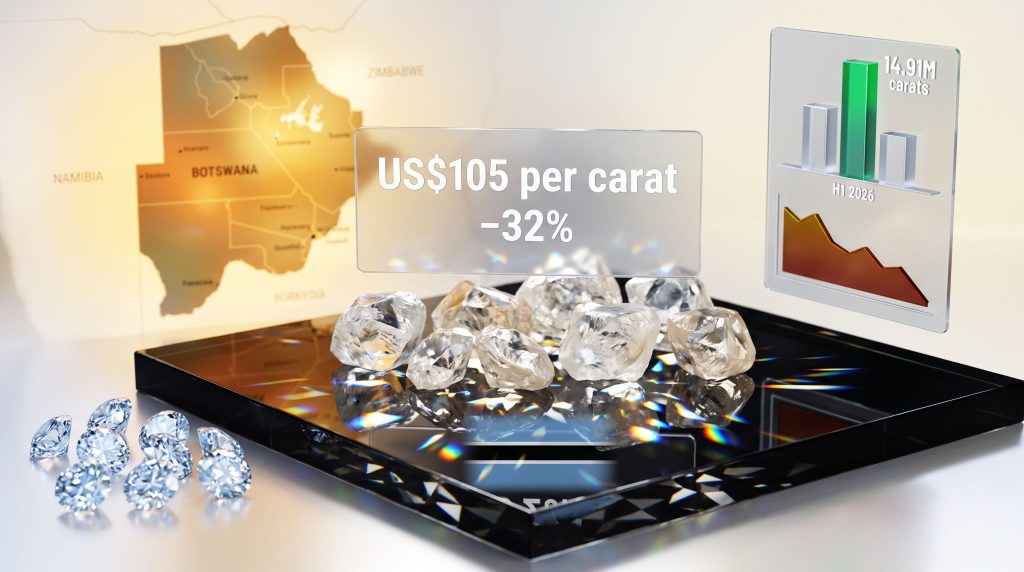
De Beers' first-half 2026 performance captures the central contradiction facing the natural diamond industry with striking clarity. The company produced 14.91 million carats across the first six months of the year, a 46% increase compared to the same period in 2025. Yet consolidated revenue fell 23% to US$1.31 billion, driven by a 32% collapse in the average realised price to just US$105 per carat.
The following table illustrates how dramatically the revenue equation has shifted despite the volume gains:
| Metric | H1 2025 (Estimated) | H1 2026 | Change |
|---|---|---|---|
| Production Volume | ~10.2M carats | 14.91M carats | +46% |
| Average Realised Price | ~US$154/carat | US$105/carat | -32% |
| Consolidated Revenue | ~US$1.70B | US$1.31B | -23% |
| Rough Diamond Sales Volume | ~12.3M carats | 14.78M carats | +20% |
Furthermore, what makes this divergence particularly instructive is that Q2 2026 rough diamond sales volumes were actually 7% lower than Q2 2025, despite significantly higher production. De Beers was deliberately not releasing all available inventory into the market — a rational response to weak pricing conditions, but one that underscores the depth of the demand problem.
Key Industry Insight: In the rough diamond trade, the distinction between production volume and sales volume is critically important. Producers can mine more carats while simultaneously selling fewer, choosing instead to absorb inventory rather than collapse spot prices further. This supply discipline is a calculated lever, but it has limits when inventory carrying costs are high.
Mine-by-Mine: Where the Carats Are Coming From
Botswana: The Orapa Restart and Jwaneng's Grade Advantage
The dominant contributor to De Beers' output surge was its Botswana operations, where combined first-half production reached 10.3 million carats, up 43% year-on-year. In Q2 alone, Botswana output more than doubled to 5.5 million carats.
Two distinct operational factors drove this result:
- The Orapa mine returned to full capacity following an extended maintenance programme conducted throughout 2025, which had deliberately suppressed prior-year production figures.
- The Jwaneng mine benefited from planned exploitation of higher-grade ore zones. Jwaneng, often described as the world's richest diamond mine by value, contains ore bodies with exceptional grade characteristics, meaning each tonne of rock processed yields a higher carat return.
Understanding ore grade is essential context here. Diamond mines are evaluated on carats per hundred tonnes (cpht) — a measure of how many carats can be recovered from processing a standardised volume of ore. Much like why grade is king in many mineral extraction operations, Jwaneng's cpht figures are among the highest globally, and accessing elevated-grade areas creates a meaningful production uplift without requiring increased processing capacity.
Canada: Gahcho Kué Opens a New Mining Front
The Gahcho Kué operation in Canada's Northwest Territories contributed 1 million carats in Q2 2026, with production growth driven by access to a newly opened mining area with materially superior ore grades. Gahcho Kué is a joint venture in which De Beers holds a majority interest, and the mine's transition into this new zone had been anticipated within its mine plan cycle.
Canada's diamond deposits are geologically younger in terms of their discovery history relative to Botswana's Kimberlite fields. However, Gahcho Kué's Kimberlite pipes have demonstrated strong grade consistency, making the opening of new ore zones a predictable production catalyst.
South Africa: Venetia's Underground Transition and Coming Suspension
The Venetia mine recorded a 24% increase in quarterly output to 700,000 carats, driven by higher throughput volumes from its underground operation. Venetia is currently midway through one of the mining industry's most complex operational transitions: converting from open-pit to underground extraction.
However, a critical operational decision overshadows this short-term gain. De Beers confirmed that Venetia will suspend production for approximately two years beginning in the second half of 2026. The rationale centres on cost management and capital deferral within a challenging market environment, rather than any geological constraint.
This suspension carries several implications:
- It removes a meaningful carat source from the annual output profile.
- It defers capital expenditure associated with the underground expansion, freeing cash flow during a period of compressed revenue.
- Notably, De Beers' full-year guidance of 21 to 26 million carats already incorporates this suspension, indicating the company had built the operational pause into its planning assumptions.
Why Natural Diamond Prices Are Structurally Under Pressure
The Lab-Grown Diamond Disruption: A Permanent Market Realignment
Perhaps no factor is reshaping the De Beers diamond production and weak diamond market dynamic more profoundly than the proliferation of laboratory-grown diamonds (LGDs). The technology used to produce synthetic diamonds — primarily Chemical Vapour Deposition (CVD) and High Pressure High Temperature (HPHT) methods — has advanced at a pace that has fundamentally altered production economics.
A CVD diamond grown in a laboratory is physically, chemically, and optically identical to a mined diamond. The only distinction is its origin, and for a growing proportion of consumers, that distinction carries diminishing commercial weight. Consider what has happened to the production cost curve:
- In 2016, growing a one-carat lab diamond cost approximately US$4,000 to US$5,000.
- By 2023, that cost had fallen to below US$300 per carat for many producers, according to industry analysis tracking the sector.
- The trajectory continues downward as Chinese manufacturers, now the world's dominant LGD producers, achieve further efficiencies of scale.
Structural Reality: Lab-grown diamonds are not competing with natural diamonds in the same way that cubic zirconia or moissanite historically did. LGDs carry genuine gemological credibility, graded by the same international bodies using the same 4C framework (cut, colour, clarity, carat weight). Their encroachment into natural diamond territory is therefore far more durable.
De Beers has explicitly acknowledged that lab-grown competition is disrupting the demand and pricing for lower-value natural stones. The midstream — which encompasses cutting and polishing centres in India, particularly Surat, as well as Belgium and Israel — is acutely feeling this pressure as margins on natural goods compress.
The Midstream Inventory Problem: A Diamond Pipeline Under Pressure
The diamond supply chain operates through a series of distinct commercial stages: mining, rough diamond sales through De Beers' own sales events called sights, cutting and polishing, wholesale distribution, and retail. The midstream has been carrying excess inventory for an extended period, creating a pipeline blockage that suppresses demand for new rough supply even when mining output recovers.
De Beers itself has been actively reducing approximately US$2 billion in inventory, a process that has mechanically increased the proportion of lower-value stones entering the sales mix and thereby compressed the average realised price. This is not a marketing failure; it is a deliberate balance sheet management exercise with predictable short-term price consequences.
Macroeconomic and Geopolitical Headwinds
Diamond jewellery occupies a unique position in luxury goods economics. It is simultaneously a consumer discretionary purchase and, in higher-value segments, a consideration tied to store of value dynamics seen across precious asset classes. Both of these characteristics make it sensitive to macroeconomic confidence cycles.
Several concurrent headwinds are suppressing demand across the industry's three largest consumer markets:
- United States: Persistent inflation concerns and elevated interest rates have moderated discretionary luxury spending relative to pandemic-era peaks.
- China: The post-Covid consumption recovery has been weaker than anticipated, with the domestic luxury goods market underperforming expectations in 2024 and 2025.
- India: Despite strong economic growth, the midstream trade's inventory problems have dampened Indian diamond manufacturers' appetite for new rough purchases.
Geopolitical instability, particularly the ongoing conflict in the Middle East, has added a layer of consumer uncertainty that disproportionately affects high-value discretionary categories.
The Anglo American Divestiture: Strategic Uncertainty at the Worst Possible Time
Anglo American's decision to divest its 85% stake in De Beers introduces a layer of strategic complexity that the company must navigate while simultaneously managing a deeply challenged market. Consequently, these circumstances echo broader mining consolidation trends playing out across the global resources sector.
Negotiations are reportedly advanced with a preferred consortium led by Gareth Penny, a former Chief Executive of De Beers who brings deep institutional knowledge of the company's operations, its critical Botswana relationships, and the rough diamond sales architecture.
However, several variables add complexity to the transition:
- The Government of Botswana, holding the remaining 15% stake, is evaluating whether to exercise pre-emptive rights to increase its ownership position. Given that Botswana accounts for the majority of De Beers' production through the Debswana joint venture, any shift in government ownership appetite is commercially significant.
- The Debswana partnership is not a simple mining joint venture. It underpins a substantial proportion of Botswana's national export revenues and fiscal receipts, creating a sovereign dimension to any ownership transition.
- A change in controlling shareholder during a period of market weakness introduces uncertainty around long-term sales agreements, capital expenditure commitments, and the marketing strategy for natural diamonds.
Investor Consideration: The valuation of De Beers in a divestiture process is complicated by the current pricing environment. A sustained recovery in rough diamond prices would materially improve the asset's worth, while further deterioration could affect deal structure or valuation multiples. The timing overlap between the divestiture and market weakness is a significant variable that prospective investors and analysts should monitor closely.
Revised Guidance and the Supply Discipline Strategy
De Beers reduced its 2026 full-year production guidance from 26 to 29 million carats to a revised range of 21 to 26 million carats. The revision reflects an explicit acknowledgement that managing supply in response to demand conditions is more commercially rational than volume maximisation in a weak pricing environment.
Anglo American has signalled that further production reductions remain on the table if market conditions deteriorate beyond current expectations. In addition, the way commodity prices and mining performance interact here is instructive — De Beers' supply strategy is now inherently reactive to demand signals, a fundamental departure from the historical model in which the company managed prices through controlling the global supply of rough diamonds more comprehensively.
The next major ASX story will hit our subscribers first
Is the Market in a Cyclical Trough or a Structural Decline?
This is the defining question for anyone assessing long-term exposure to natural diamond markets. The answer is unlikely to be binary; cyclical and structural forces are operating simultaneously.
| Scenario | Core Assumptions | Implied Outcome |
|---|---|---|
| Cyclical Recovery | Geopolitical stabilisation, consumer confidence rebounds, LGDs remain in lower segments | Natural prices recover 15–25% by 2027–2028 |
| Prolonged Stagnation | Macro uncertainty persists, LGDs expand into mid-market | Prices range-bound; volume growth offsets some revenue erosion |
| Structural Deterioration | LGDs capture mid-to-premium segments, generational demand shift accelerates | Sustained price compression; major supply rationalisation required |
Several factors support the cyclical recovery case. Natural diamond prices have historically rebounded following macroeconomic stress cycles. Premium-quality stones have demonstrated relative resilience, with the rough price index for higher-quality goods holding comparatively stable compared to lower-value categories.
Furthermore, younger, affluent consumers in emerging markets still assign cultural and emotional value to natural origin in engagement and wedding jewellery contexts. The structural deterioration argument, however, carries increasing empirical weight. The generational shift in consumer values, the accelerating cost decline in LGD production, and the credibility that laboratory-grown stones now carry in gemological grading systems all create headwinds that are not simply cyclical.
Key Takeaways for Investors and Industry Observers
- Production volume is a misleading headline metric in the current environment. The 46% first-half output increase at De Beers has generated less revenue, not more, because pricing erosion has overwhelmed volume gains.
- The inventory destocking cycle matters deeply. Until the approximately US$2 billion inventory overhang is cleared from both De Beers' own books and the broader midstream pipeline, average realised prices will remain under mechanical downward pressure.
- Lab-grown diamonds represent a permanent competitive force, not a passing fashion. Their expansion across quality tiers will be determined by how quickly production costs fall relative to the cultural premium consumers assign to natural origin.
- The Venetia suspension is a cost discipline signal, not a geological problem. De Beers is prioritising financial resilience over output volume, which is the appropriate strategic posture in the context of De Beers diamond production and weak diamond market conditions.
- The Anglo American divestiture introduces genuine strategic uncertainty around capital allocation, Botswana government relations, and the future commercial philosophy of one of the world's most consequential diamond producers. Investors should also be alert to management red flags that can emerge during ownership transitions of this complexity.
Disclaimer: This article contains forward-looking statements, scenario projections, and market analysis that are inherently speculative in nature. Historical financial performance and industry trends referenced herein do not guarantee future outcomes. Readers should conduct independent research and seek professional financial advice before making investment decisions related to the diamond mining sector or associated equities.
Want to Stay Ahead of Significant Mineral Discoveries on the ASX?
While the natural diamond sector navigates structural headwinds, other corners of the resources market continue to produce transformative discovery opportunities — and Discovery Alert's proprietary Discovery IQ model instantly identifies these high-potential ASX announcements the moment they emerge, turning complex mineral data into clear, actionable insights. Explore historic examples of exceptional discovery returns and begin your 14-day free trial today to position yourself ahead of the broader market.