July 23, 2026
When Production Records Diverge From Revenue Reality: Understanding De Beers' 2026 Market Position
Few scenarios in commodity markets are more instructive than one where output climbs sharply while revenue falls just as dramatically. This tension sits at the heart of De Beers' first-half 2026 performance, and it reveals something important about the structural forces currently reshaping the global rough diamond industry. Understanding De Beers rough diamond production requires moving well beyond headline numbers, much like how commodity prices and mining performance rarely tell the full story in isolation. Volume growth, on its own, tells only part of the story.
When big ASX news breaks, our subscribers know first
Why the 88% Production Jump Demands Careful Interpretation
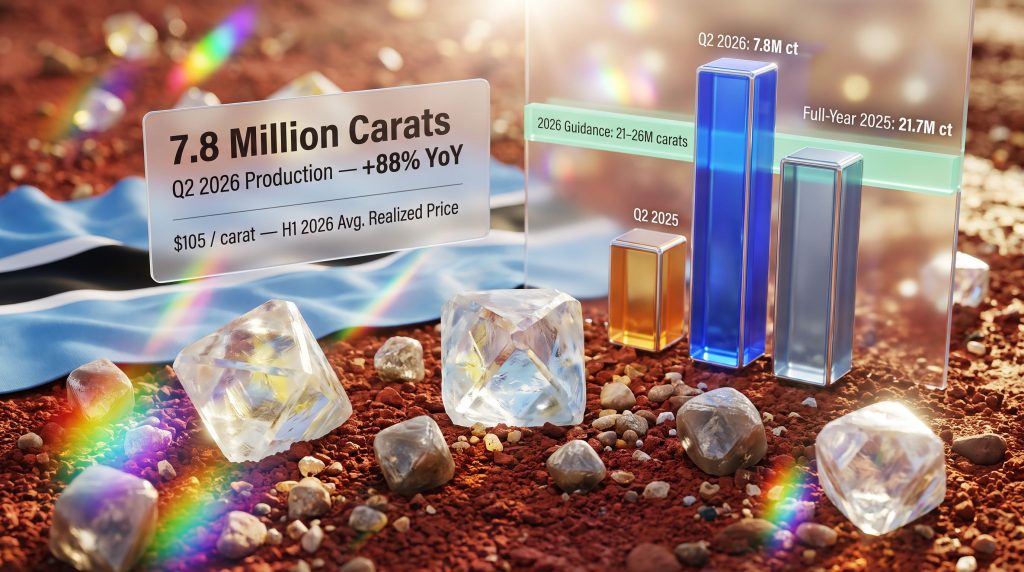
De Beers' Q2 2026 De Beers rough diamond production figure of 7.8 million carats represents one of the more visually dramatic year-on-year increases in the company's recent operational history. However, headline percentage changes in mining are frequently distorted by the conditions of the comparative period, and this case is no exception.
The outsized growth figure is largely a product of what did not happen in Q2 2025 rather than an extraordinary operational leap in 2026. During that earlier period, the Orapa mine in Botswana underwent an extended maintenance shutdown that suppressed output significantly. When production then resumed at or above normal rates in 2026, the mathematical comparison produced an inflated growth figure that flatters the underlying operational picture.
This statistical phenomenon, known in mining analysis as a base effect, is critical context for any investor or market participant interpreting De Beers' Q2 2026 results. The actual operational improvement is real but considerably more modest than the headline number implies.
The 2026 Production Guidance Range: Strategic Flexibility or Genuine Uncertainty?
De Beers has maintained its full-year 2026 production guidance at 21 to 26 million carats on a 100% basis, a range that spans five million carats. In most commodities, such a wide guidance band would signal significant operational uncertainty. In De Beers' case, it reflects something more deliberate: the company has constructed a guidance framework that gives it room to calibrate output in real time against demand signals from its Sightholder network.
The rough diamond market operates through a unique sales mechanism called the "Sight" system, where a pre-selected group of buyers known as Sightholders attend roughly ten selling events per year. Unlike auction or spot-market sales, Sightholders are offered a pre-determined parcel of goods at a price set by De Beers. This structure gives the company an unusual degree of pricing authority relative to other commodity producers, but it also means that buyer behaviour at each Sight becomes one of the most important leading indicators of underlying demand conditions.
The breadth of the 2026 guidance range reflects two planned H2 maintenance events at Orapa and Jwaneng, plus a proposed production pause at Venetia in South Africa, all of which introduce genuine variability into the full-year total. Whether output trends toward 21 or 26 million carats will depend heavily on how efficiently those maintenance programmes are executed and whether market conditions prompt any voluntary curtailment decisions.
Quarter-by-Quarter: Reading the 2026 Production Trajectory
| Period | Production Volume | Year-on-Year Change | Primary Driver |
|---|---|---|---|
| Full-Year 2025 | 21.7 million carats | -12% vs. 2024 | Demand-driven supply curtailment |
| Q1 2026 | 7.1 million carats | +17% YoY | Gahcho Kué ore release + Venetia underground ramp-up |
| Q2 2026 | 7.8 million carats | +88% YoY | Orapa maintenance base effect + high-grade ore at Jwaneng |
| 2026 Full-Year Guidance | 21-26 million carats | Unchanged | Planned H2 maintenance at Orapa and Jwaneng |
H1 2026 cumulatively produced approximately 14.9 million carats, which implies a requirement of roughly 6 to 11 million carats in H2 2026 to meet the full guidance range. Given planned maintenance at multiple major operations, the lower end of that range appears more probable unless schedules are compressed or high-grade ore extraction continues to outperform expectations.
A Mine-by-Mine Breakdown of De Beers Rough Diamond Production
Botswana: The Production Cornerstone
Botswana's operations contributed 5.5 million carats in Q2 2026, making it the undisputed engine of De Beers' consolidated output. The Jwaneng mine, in particular, carries strategic importance that extends well beyond its carat contribution. Furthermore, Jwaneng is consistently regarded as one of the most valuable diamond mines anywhere in the world when measured by revenue per carat rather than raw volume.
In this context, grade is king — Jwaneng's kimberlite pipe contains a comparatively high proportion of gem-quality stones, and the mine's deliberate shift toward higher-grade ore zones in 2026 reflects a considered quality-over-quantity strategy. When average realised prices are declining across the board, maximising the proportion of high-value stones in the production mix is one of the most effective tools available to defend revenue per carat.
Both Orapa and Jwaneng face scheduled plant maintenance in H2 2026, which will materially compress Botswana's contribution during that period. The Q2 figure of 5.5 million carats should therefore be treated as a cyclically elevated peak rather than a sustainable quarterly run-rate.
Canada: Grade-Driven Consistency at Gahcho Kué
The Gahcho Kué mine in Canada's Northwest Territories contributed 1.0 million carats in both Q1 and Q2 2026, with output sustained by the processing of high-grade ore from a newly accessed mining area. While Canada's contribution remains smaller in volume terms relative to Botswana, its strategic value lies in geographic and geopolitical diversification.
Gahcho Kué operates in a sub-Arctic environment that presents unique logistical challenges, including winter road access for heavy equipment and the need for specialised cold-weather processing infrastructure. Despite these complexities, the mine's ability to deliver consistent grade-driven output across both quarters of H1 2026 underscores its operational reliability as a non-African production anchor.
South Africa: Venetia's Underground Transition and the Planned H2 Pause
Venetia produced 0.7 million carats in Q2 2026, maintaining the momentum established during Q1 when output jumped 53% year-on-year as higher volumes of underground ore moved through processing. The transition from open-pit to underground mining at Venetia represents one of the most capital-intensive operational shifts in De Beers' recent history, with the underground project designed to extend the mine's productive life by decades.
However, a production pause planned for the second half of 2026 introduces a meaningful downside variable into the full-year consolidated total. This pause is most logically interpreted as an infrastructure optimisation event tied to the ongoing underground development rather than a signal of structural decline.
One technically important but underappreciated aspect of underground diamond mining transitions is the challenge of maintaining ore grade consistency during the shift from open-pit to underground extraction. Open-pit operations allow geologists to visually assess ore zones across wide surface areas, while underground mining requires more intensive channel sampling and grade control programmes to prevent dilution of ore with surrounding waste rock. Grade dilution during the ramp-up phase is a known risk that can temporarily suppress recovered carats per tonne.
Consequently, understanding cut-off grade economics becomes especially relevant during this transitional phase, as the threshold at which ore becomes economically viable to process shifts considerably when moving from surface to underground extraction methods.
Namibia: Marine Diamond Operations Under Fleet Transition Pressure
Namibia's output reached 0.5 million carats in Q2 2026, reflecting the retirement of the Coral Sea vessel from Debmarine Namibia's marine fleet and ongoing maintenance on the Mafuta vessel. These operational disruptions were partially offset by mining activity in higher-grade seabed areas at Namdeb.
Marine diamond mining in Namibia is among the most technically demanding extraction processes in the global mining industry. Debmarine Namibia deploys purpose-built vessel platforms that use remotely operated seabed crawlers and airlift systems to recover alluvial diamonds deposited along the Atlantic seafloor. The diamonds recovered from Namibia's marine operations are disproportionately high in gem quality, as the alluvial transport process that moved stones from inland kimberlite sources to the ocean floor over millions of years acted as a natural sorting mechanism, eliminating lower-quality material.
The Revenue Gap: What $105 Per Carat Reveals About Structural Pricing Pressure
| Metric | Q2 2026 | Q2 2025 | Change |
|---|---|---|---|
| Rough diamond sales volume (consolidated) | 6.0 million carats | 6.8 million carats | -12% |
| Consolidated revenue | $665 million | ~$1.2 billion | ~-45% |
| H1 2026 average realised price | $105/carat | ~$154/carat (implied) | -32% |
| Average rough price index change | -16% | N/A | Structural repricing |
The 32% decline in average realised price to $105 per carat across H1 2026 is the most strategically significant data point in De Beers' entire production report. It cannot be explained by demand weakness alone. In addition, three distinct forces are converging to compress rough diamond pricing at the lower end of the value spectrum:
-
Sales mix deterioration: A higher proportion of lower-value rough goods in the Sight allocations dragged down the blended average realised price across all consolidated sales.
-
Price index normalisation: The rough price index fell 16%, partly incorporating the rebalancing effects of De Beers' 2025 supply curtailment programme, which reduced full-year output by 12% to 21.7 million carats.
-
Lab-grown diamond competition: Synthetic diamonds have created a structural price floor problem in the lower-value natural rough segment, where lab-grown alternatives have achieved price parity or better for smaller, lower-clarity stones.
The bifurcation this creates within the natural diamond market is one of the more consequential structural dynamics in the sector. Higher-value natural diamonds, particularly large stones with exceptional clarity from operations like Jwaneng and Venetia, have demonstrated relative price resilience because lab-grown production struggles to replicate the rarity and provenance appeal of high-end naturals. Lower-value natural rough, however, now competes directly with synthetic alternatives that offer comparable optical properties at significantly lower price points.
Geopolitical and Macroeconomic Headwinds Weighing on Demand
The external environment facing the rough diamond market in H1 2026 has been unambiguously difficult. Several converging pressures have suppressed discretionary spending in key consumer markets:
-
Ongoing geopolitical tensions in the Middle East have dampened consumer confidence across Gulf luxury markets, which represent a meaningful segment of high-value diamond jewellery demand.
-
Broader macroeconomic uncertainty, including elevated interest rates in several major economies, has compressed mid-market jewellery spending where natural diamonds face their most direct competition from lab-grown alternatives.
-
Currency volatility in India, China, and the United States has added complexity to the rough-to-polished margin calculations that cutting and polishing centres in Surat and Antwerp rely upon when making buying decisions at each Sight.
When cutters and polishers see their margins compressed by unfavourable currency movements and weak retail demand, the natural response is to reduce inventory commitments at Sight events. This behavioural shift toward cautious restocking rather than confident forward buying is visible in Q2 2026's consolidated sales volume of 6.0 million carats, which came in 12% below the same period in 2025 despite higher production.
The next major ASX story will hit our subscribers first
Scenario Modelling: Three Pathways to Full-Year 2026 Output
| Scenario | H2 2026 Assumptions | Full-Year Implied Output | Key Risk Factor |
|---|---|---|---|
| Base Case | Orapa + Jwaneng maintenance proceeds as planned; Venetia pause executed | ~21-22 million carats | Maintenance schedule adherence |
| Upside Case | Maintenance shortened; Venetia pause deferred; Gahcho Kué sustains grade | ~24-26 million carats | Operational efficiency gains |
| Downside Case | Extended maintenance; voluntary market-driven curtailment added | Below 21 million carats | Demand deterioration triggers supply response |
The base case carries the highest probability given De Beers' stated maintenance commitments and the precedent of 2025's deliberate supply management. The downside case would require a material deterioration in Sightholder demand beyond what has already been observed. For instance, the upside case hinges on operational schedule compression that would be uncommon given the capital-intensive nature of large-scale processing plant maintenance at Orapa and Jwaneng.
Investor consideration: The above scenarios involve forward-looking assumptions and are inherently speculative. Actual production outcomes will depend on operational, market, and geological variables that cannot be predicted with precision. This analysis does not constitute financial advice.
Key Takeaways for Market Participants
-
Production recovery is real but overstated by the base effect at Orapa; H2 output will moderate materially as maintenance programmes proceed.
-
Revenue performance remains the critical metric to watch, with the average realised price of $105 per carat representing a structural repricing challenge that extends beyond cyclical demand softness.
-
Lab-grown diamond competition is a permanent structural feature of the lower-value natural rough segment, not a temporary disruption that will self-correct.
-
Botswana's operations are the swing factor for full-year output, with Jwaneng's ore grade trajectory and Orapa's maintenance duration together determining where consolidated production lands within the 21 to 26 million carat guidance range.
-
Sightholder buying behaviour at each remaining 2026 Sight represents the most accessible leading indicator of whether rough demand is stabilising or deteriorating further.
-
Venetia's underground transition remains a long-term positive for South African output quality and mine life, but the planned H2 pause reinforces that the transition period carries execution risk.
The story of De Beers rough diamond production in 2026 is ultimately one of operational resilience operating within a structurally repriced market. Volume recovery and revenue compression coexisting in the same reporting period is not a contradiction — it is the clearest signal yet that interpreting drill results and production data demands a more nuanced framework than headline numbers alone can provide. Furthermore, the mining industry evolution underway means that understanding value-per-stone economics, synthetic competition dynamics, and strategic ore grade decisions will define which producers navigate this transition most effectively. As De Beers itself has acknowledged, the structural pressures now facing the natural diamond sector require long-term strategic responses rather than short-term operational adjustments.
Want to Track the Next Major Mineral Discovery Before the Market Does?
Discovery Alert's proprietary Discovery IQ model delivers real-time alerts on significant ASX mineral discoveries, transforming complex geological and production data into actionable investment insights — exactly the kind of analytical edge that separates informed decisions from reactive ones. Explore how historic mineral discoveries have generated substantial returns and begin your 14-day free trial today to position yourself ahead of the broader market.