
July 23, 2026
Australia's Mining Tax and Royalty Framework: A System Built on Two Pillars
Few economic mechanisms shape national prosperity as quietly yet powerfully as the fiscal architecture underpinning resource extraction. In countries built on commodities, the question of how governments capture value from finite, publicly owned mineral wealth sits at the intersection of economics, political philosophy, and long-term budget strategy. Australia's system is among the most layered in the world, operating across federal and state tiers simultaneously, with each layer governed by its own legislation, its own calculation methods, and its own revenue logic.
Understanding how mining tax and royalty payments Australia generates actually flow through the economy requires untangling three distinct instruments that often get conflated in public debate: federal company tax, state and territory royalties, and the Petroleum Resource Rent Tax. Each targets a different base, responds to different market signals, and lands in a different government treasury. Together, they form a revenue architecture that has quietly funded hospitals, roads, and schools for decades.
When big ASX news breaks, our subscribers know first
The Structural Separation Between Federal Tax and State Royalties
The most fundamental distinction in Australia's mining fiscal framework is the separation between what a company owes Canberra and what it owes the relevant state or territory capital. These are not variations of the same instrument. They are entirely separate obligations, governed by separate legislation, collected by separate agencies, and calculated on different bases.
Federal company tax applies to net taxable profit at the standard corporate rate of 30 percent for large entities. It is, in principle, the same tax that applies to a supermarket chain or a telecommunications provider. What makes mining unusual is the sheer scale of profits involved and the cyclical nature of those profits, which creates dramatic year-to-year swings in federal tax receipts.
State and territory royalties operate on an entirely different premise. They are not a profit-based charge. They are compensation paid to the community for the permanent removal of a non-renewable resource that is legally owned by the public. This philosophical distinction matters enormously because it means royalty obligations can exist even when a mine is operating at a loss, depending on the royalty structure in place.
Royalties represent a form of resource rent capture at the extraction point, independent of corporate profitability. This creates a fundamentally different risk profile for state governments compared to the federal treasury, whose company tax receipts track commodity cycles far more closely.
Furthermore, according to Clayton Utz's analysis of mining royalties, a single mining operation in, say, the Pilbara or the Bowen Basin can simultaneously face obligations to the Australian Taxation Office for company tax, to the Western Australian or Queensland government for royalties, and potentially to the federal government for Petroleum Resource Rent Tax if the operation involves associated petroleum production. This multi-tiered exposure is not theoretical. It is the lived operational reality for every major resource company in the country.
FY2023-24 Mining Tax and Royalty Payments: The Numbers in Full
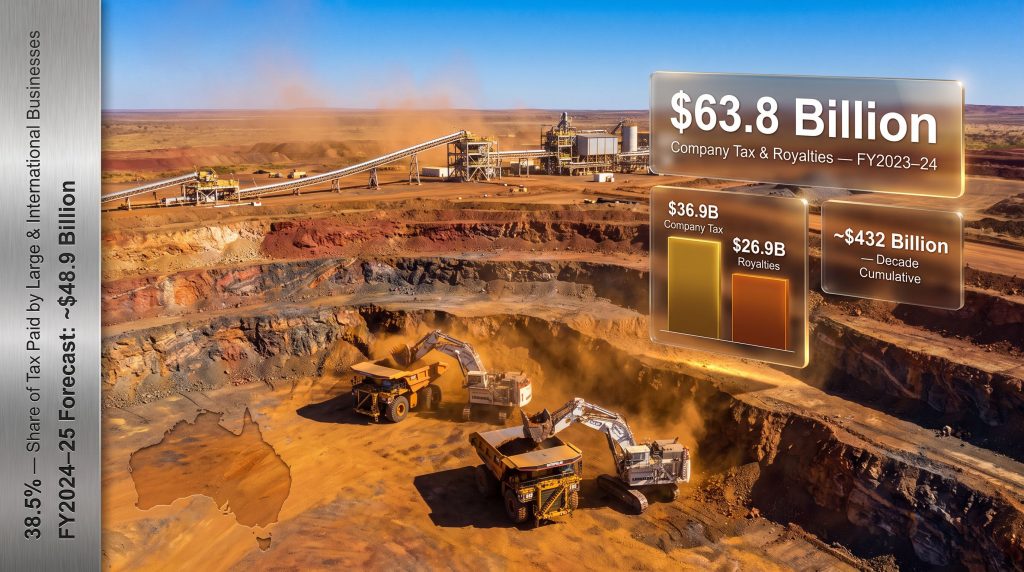
Australia's resources sector delivered AU$63.8 billion in combined company tax and royalty payments during the 2023-24 financial year, according to analysis prepared by EY-Parthenon for the Minerals Council of Australia. This represented a AU$10 billion reduction from the AU$73.8 billion recorded in 2022-23, a year that benefited from exceptional commodity price conditions following the energy market disruptions of 2021-22.
| Revenue Stream | FY2023-24 | FY2022-23 |
|---|---|---|
| Net Company Tax | $36.9 billion | Higher (record period) |
| State and Territory Royalties | $26.9 billion | Higher (record period) |
| Combined Total | $63.8 billion | $73.8 billion |
The year-on-year decline, while significant in absolute dollar terms, should be interpreted against a longer baseline. Cumulative combined payments over the past decade reached approximately $432 billion, a figure that underscores the structural rather than cyclical importance of mining to Australian public finances. Indeed, Australian minerals sector tax and royalty records highlight the sector's sustained fiscal significance over time.
It is worth noting that some published variants of the same EY-Parthenon analysis cite a combined figure of $59.4 billion, comprising $32.5 billion in company tax and $26.9 billion in royalties. The difference reflects variations in scope, methodology, or revision timing rather than conflicting datasets. Both figures, however, point to the same structural conclusion.
What Drove the Revenue Decline in FY2023-24
The Commodity Price Correction
The primary driver of reduced mining tax and royalty payments was a 13.4 percent decline in overall commodity prices across the financial year. Thermal coal and metallurgical coal led this correction, with prices retreating sharply from the extraordinary levels reached during the post-pandemic energy squeeze. Commodity price cycles such as this one have a direct and measurable impact on government revenue outcomes.
This matters for fiscal outcomes because coal royalties and company tax contributions from coal producers had been a significant component of the record FY2022-23 total. As prices normalised, two things happened simultaneously: company tax liabilities fell because taxable profits contracted, and in jurisdictions using ad valorem (value-based) royalty structures, royalty receipts also softened in line with realised prices.
Rising operating costs across the sector added a second layer of margin compression. Labour shortages, elevated diesel costs, and higher maintenance expenditure all reduced taxable income even before the commodity price effect fully flowed through.
How Royalty Structures Partially Insulated State Revenue
Not all revenue streams fell equally. State royalty receipts proved more resilient than federal company tax, partly because several jurisdictions had implemented structural royalty rate increases in the years preceding FY2023-24. Queensland and New South Wales both introduced higher coal royalty tiers, meaning that even as prices fell from peak levels, the rate applied to remaining revenue was higher than it would have been under previous regimes.
This highlights a dynamic that is not widely appreciated: state governments can engineer partial revenue floors through rate adjustments in ways that the federal government cannot replicate through company tax without legislative change at the corporate level.
The policy tension embedded in this dynamic is real. Higher royalty rates capture more revenue in the short term but alter the investment calculus for marginal projects, potentially reducing future production volumes and therefore future royalty-generating capacity.
Mining's Share of Total Australian Company Tax
Beyond the raw dollar figures, the sector's share of total Australian company tax collections is arguably the more striking metric. In FY2023-24, mining generated more than 25 percent of all company tax collected across the entire Australian economy. When the lens narrows to large and international businesses, the share rises to 38.5 percent.
| Metric | Mining Sector Figure |
|---|---|
| Share of total Australian company tax (FY2023-24) | Greater than 25% |
| Share of tax paid by large and international businesses | 38.5% |
| Decade cumulative company tax and royalties | ~$432 billion |
| FY2024-25 combined payment forecast | ~$48.9 billion |
No other single industry approaches these proportions. Financial services, retail, construction, and manufacturing each contribute meaningfully to Australian tax revenues, but none individually generates more than a quarter of all company tax. This concentration of fiscal contribution gives the resources sector an outsized role in federal budget outcomes, and it makes commodity price cycles a matter of genuine consequence for public service funding.
The Minerals Council of Australia has consistently highlighted that these contributions fund essential services across all states and territories, not only those where mining is concentrated. Education, healthcare, policing, and transport infrastructure are all partially underwritten by resource sector fiscal flows.
How Australian Royalty Regimes Actually Work
Calculation Methods Across Jurisdictions
Each state and territory administers its own royalty legislation with distinct rate structures, calculation methodologies, and payment schedules. There is no national royalty standard. The practical implication is that a company operating across multiple jurisdictions faces genuinely different compliance obligations in each.
| Royalty Method | How It Works | Common Application |
|---|---|---|
| Ad valorem (value-based) | Percentage applied to gross or net mineral value | Iron ore, gold, bauxite |
| Specific (tonnage-based) | Fixed rate per tonne extracted | Coal in some jurisdictions |
| Profit-based | Applied to net profits after allowable deductions | Used selectively |
The choice of calculation method has significant implications for revenue stability. Tonnage-based royalties generate predictable, volume-driven revenue regardless of price movements. Ad valorem royalties amplify boom-time revenues but compress during price downturns. Profit-based royalties offer the most progressive structure but have historically underperformed revenue expectations in Australian application.
The Deductibility Interaction
One aspect of the royalty-company tax relationship that frequently receives insufficient attention is the deductibility of royalty payments against federal company tax obligations. Because royalties are generally deductible as a business expense, the effective double-taxation impact of the dual-tier system is partially mitigated. However, the deduction is only valuable to the extent that a company is generating taxable profit. During loss periods, royalty deductions provide no immediate relief.
The next major ASX story will hit our subscribers first
How a Mining Company's Obligations Stack Up: Step by Step
-
Mineral extraction commences, triggering a royalty obligation at the state or territory level based on the applicable rate structure and calculation method.
-
Royalties are calculated on either the volume extracted, the gross sales value, or the net value after deductions, depending on the jurisdiction and commodity.
-
Annual taxable profit is assessed by the Australian Taxation Office, with royalty payments claimed as deductible business expenses, reducing the net company tax liability.
-
Federal company tax is assessed at 30 percent on net taxable income, after all allowable deductions including royalties, depreciation, and exploration expenditure.
-
For petroleum and LNG operations, the Petroleum Resource Rent Tax is assessed separately on project-level cash flows above a defined threshold return, creating a third simultaneous obligation layer.
The Outlook for FY2024-25 and the Normalisation Cycle
EY-Parthenon projects combined mining tax and royalty payments Australia will ease further to approximately $48.9 billion in FY2024-25 as commodity prices continue their post-cycle normalisation. While this represents a meaningful further reduction from FY2023-24, the figure remains remarkable in historical context: net company tax collections are still projected to be more than five times higher than those recorded in FY2015-16.
Several structural forces will shape the trajectory beyond FY2024-25:
-
Energy transition commodities such as Australia's critical minerals — including lithium, cobalt, nickel, and rare earth elements — are generating new royalty and tax revenue streams, though volumes remain modest relative to iron ore and coal. In this context, Australia's critical minerals sector represents a growing but still emerging component of the fiscal mix.
-
Iron ore price dynamics driven by China iron ore demand represent the single most consequential variable for Australian mining fiscal outcomes over the medium term.
-
Royalty rate policy risk at the state level remains a live variable, with the precedent set by Queensland and New South Wales coal royalty increases demonstrating that state governments are willing to adjust rates to capture higher revenue.
-
Capital investment cycles in new project development will determine future production volumes and therefore the royalty and tax-generating capacity of the sector in the years ahead.
-
Operating cost trajectories in labour and energy will continue to influence taxable margins independent of commodity price movements.
The Ongoing Policy Debate: Rent Capture and Fair Return
The question of whether Australia captures sufficient economic rent from its non-renewable resource base is one of the most contested in Australian fiscal policy. Industry representatives argue that mining already contributes disproportionately relative to its workforce share, that it bears unique geological and capital risk that justifies its fiscal treatment, and that excessive royalty rates threaten the marginal project economics that underpin future investment decisions.
Reform advocates counter that profit-based instruments like the PRRT have historically underperformed revenue expectations relative to actual extraction volumes, particularly in the LNG sector where complex project structuring has limited effective tax rates. Academic analysis of this gap has informed multiple Treasury reviews over the past decade.
In international context, Australia's effective combined royalty and tax rates are broadly competitive with peer resource-exporting nations including Canada, Chile, and South Africa, though direct comparisons are complicated by differences in commodity mix, project scale, and infrastructure ownership structures. Furthermore, the broader challenges facing Australia's resource exports add additional complexity to any straightforward international comparison.
The shifting dynamics of China steel and iron ore markets also introduce a layer of demand-side uncertainty that policymakers must account for when designing fiscal frameworks intended to remain functional across multiple commodity cycles.
The deeper issue is one of intergenerational equity. Non-renewable resources extracted today are permanently unavailable to future Australians. Whether the current fiscal framework adequately compensates the community for that permanent loss is a question that transcends any single budget cycle.
Key Figures: Australia's Mining Fiscal Contribution at a Glance
-
Combined mining tax and royalty payments reached $63.8 billion in FY2023-24
-
This was a $10 billion reduction from the FY2022-23 record, driven by a 13.4% commodity price decline
-
Mining generated more than 25% of all Australian company tax and 38.5% of tax paid by large businesses
-
Decade-long cumulative contributions reached approximately $432 billion
-
FY2024-25 combined payments are forecast at $48.9 billion, still more than five times the FY2015-16 baseline
-
State royalty receipts showed relative resilience due in part to structural rate increases in Queensland and New South Wales
-
The sector operates across three overlapping fiscal instruments: federal company tax, state royalties, and the PRRT for petroleum operations
This article draws on analysis prepared by EY-Parthenon for the Minerals Council of Australia covering FY2023-24 mining fiscal contributions. Forward-looking statements including FY2024-25 forecasts are projections based on commodity price normalisation assumptions and should not be interpreted as financial advice. Actual outcomes will depend on commodity market conditions, operating cost trajectories, policy changes, and other variables.
Want to Stay Ahead of the Next Major ASX Mineral Discovery?
Discovery Alert's proprietary Discovery IQ model delivers real-time alerts the moment significant mineral discoveries are announced on the ASX, transforming complex data across more than 30 commodities into clear, actionable insights for both short-term traders and long-term investors — start your 14-day free trial today, or explore Discovery Alert's discoveries page to see how historic finds have generated substantial returns.