July 23, 2026
Precious Metals at a Crossroads: Reading the Rally Beneath the Surface
The history of precious metals markets is littered with recoveries that looked compelling on the surface but unravelled quickly once macro conditions reasserted themselves. Distinguishing a genuine inflection point from a technically-driven bounce is one of the most consistently challenging problems investors face, and mid-2026 is presenting exactly that dilemma. Silver and gold prices rebound but rally may not last, according to multiple institutional voices, and the reasoning behind that scepticism runs deeper than simple price charts. For broader context, the precious metals market analysis from 2025 highlights how quickly sentiment can shift in this space.
When big ASX news breaks, our subscribers know first
Understanding the Current Rebound in Context
Price Action: What the Numbers Actually Tell Us
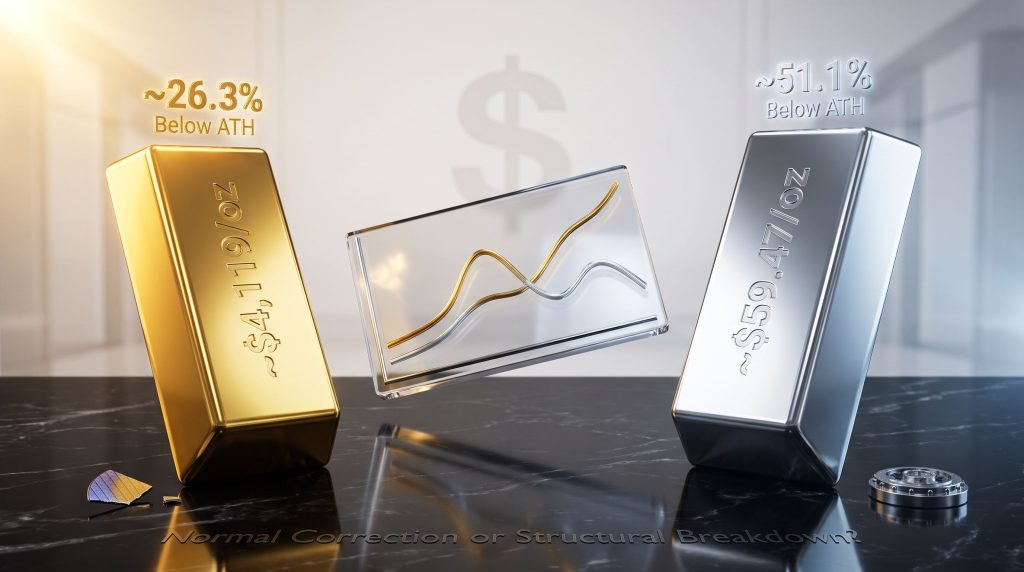
The week-over-week moves in both metals have been meaningful by any short-term measure. Spot silver climbed approximately 6.3% to trade near $59.47 per ounce, while spot gold advanced around 2.4% to approximately $4,119 per ounce. On their face, these are respectable gains. However, context changes the picture considerably.
ING commodities strategists characterised the move as a product of bargain hunting following a period of sustained weakness, with no material shift in the geopolitical or macroeconomic backdrop driving the recovery. That framing matters enormously: a technically reactive bounce and a fundamentally motivated re-rating are two entirely different animals, and investors who confuse the two risk mistiming their entries.
The scale of the drawdown from peak levels makes this distinction especially important:
| Metal | All-Time High (Jan 2026) | Recent Price | % Below ATH |
|---|---|---|---|
| Gold | ~$5,589/oz | ~$4,119/oz | ~26.3% |
| Silver | ~$121.67/oz | ~$59.47/oz | ~51.1% |
Silver's drawdown of more than 51% from its January 2026 all-time high is nearly double that of gold. This severity raises a critical question: is this a compressed buying opportunity, or is it evidence of a deeper structural deterioration in sentiment?
Both metals reached their all-time highs in late January 2026 after an extended rally that built through and beyond 2025. The magnitude of the subsequent correction, particularly for silver, is not a small technical pullback. It demands a more rigorous analytical framework than simple dip-buying logic provides.
The Macro Headwinds That Could Kill the Recovery
Dollar Strength and the Real Yield Problem
Two of the most reliable suppressors of precious metals performance are a strengthening U.S. dollar and rising real interest rates, and both are currently in play. A firmer dollar reduces the purchasing power appeal of dollar-denominated commodities for international buyers, compressing demand at the margin. More significantly, elevated real yields raise the implicit cost of holding non-yielding assets like gold and silver.
This relationship is well-established in market history: when real yields climb, the opportunity cost of precious metals exposure increases, and capital tends to flow toward yield-bearing alternatives. Investors sitting in treasury instruments or money market funds earning competitive real returns have less motivation to allocate to assets that generate no income. Until real yields fall or the dollar weakens materially, this headwind remains structurally intact.
Energy Markets and the Dual-Pressure Dynamic
Higher oil prices, driven in part by ongoing Middle East conflict, are creating a complex and somewhat contradictory set of pressures. On one hand, geopolitical instability of this nature has historically supported gold safe-haven demand for both metals. On the other hand, energy-driven inflation complicates the Federal Reserve's path toward rate cuts, potentially extending the period of elevated opportunity costs that weigh on precious metals.
ING strategists Warren Patterson and Ewa Manthey noted that markets are actively weighing softer U.S. economic data against the inflationary risks embedded in higher energy costs, a balancing act that creates genuine uncertainty about the direction of monetary policy and, by extension, the trajectory of precious metals.
The Death Cross Signal and What It Means for Gold
Technical analysis has added another layer of concern to the gold outlook. A death cross pattern, where a short-term moving average (commonly the 50-day) falls below a longer-term moving average (typically the 200-day), appeared on gold charts and was flagged by Bank of America in a mid-July 2026 note. This pattern is widely interpreted by technical traders as a bearish signal indicating potential further downside.
BofA's concern is not limited to the signal itself. The bank pointed to three compounding risk factors:
- The death cross formation on gold price charts
- Elevated net-long positioning in futures markets
- Structural similarities to patterns observed at previous major market peaks
Gold also recorded its worst quarterly performance in 13 years during Q2 2026, a data point that lends historical weight to the bearish technical case. Elevated net-long positioning is particularly dangerous in this context: if sentiment shifts, futures traders who are heavily positioned long may face forced liquidation, accelerating price declines well beyond what underlying fundamentals would justify.
Silver's Structural Edge: Why It May Outperform Gold
Industrial Demand as a Secondary Engine
One of the most analytically interesting aspects of the current environment is the divergence in the demand profiles of gold and silver. Gold is almost entirely a monetary and safe-haven asset. Furthermore, silver's industrial role creates a second demand engine that gold simply does not possess, functioning simultaneously as a monetary metal and a critical industrial input.
ING analysts noted that silver could continue to outperform gold if strength in industrial metals persists alongside safe-haven demand, with sentiment in the copper market providing correlated buying pressure for silver. This is not a trivial observation. When industrial metals cycle upward, silver tends to be pulled along by the same capital flows, giving it an asymmetric upside advantage relative to gold in certain macro environments.
Silver and the AI Hardware Supply Chain
One of the less widely discussed dynamics in silver markets is the metal's growing role in artificial intelligence infrastructure. Silver is a critical component in the manufacturing of semiconductors, supercomputing systems, and AI-related hardware. Crucially, there is currently no commercially viable substitute for silver in many of these high-performance applications.
The physics of electrical conductivity make silver uniquely suited for precision electronics at the performance levels demanded by modern AI workloads. The executive chair and CEO of U.S.-based gold and silver developer Hycroft Mining stated publicly that silver is feeding the AI revolution and the supercomputers, describing it as a metal that cannot be substituted in these applications. This structural demand dynamic is largely independent of monetary policy cycles, meaning that even in a high-rate environment, AI-driven industrial consumption continues to provide demand support that gold cannot access.
Comparative Framework: Gold vs. Silver
| Factor | Gold | Silver |
|---|---|---|
| Primary demand driver | Monetary/safe-haven | Industrial + monetary |
| Rate sensitivity | High | Moderate-High |
| Industrial exposure | Minimal | Significant |
| Volatility profile | Lower | Higher |
| AI/tech demand linkage | Negligible | Material |
| Current analyst outlook | Cautious to bearish | Mixed, selective upside |
What Institutional Analysts Are Actually Saying
UBS: The Floor Has Not Yet Been Established
UBS delivered one of the more pointed assessments of the silver outlook, reducing its threshold for an attractive entry point from approximately $55 per ounce down to a revised range of $48 to $50 per ounce. The bank's strategist Dominic Schnider cited persistent near-term headwinds including escalating Middle East tensions, higher opportunity costs from elevated rates, and continued U.S. dollar firmness as reasons why silver investment demand remains patchy and a solid price floor has yet to form.
UBS's assessment effectively communicates that the current price level does not yet represent a compelling risk-reward entry point. Patience, not positioning, appears to be the bank's recommended stance.
ING: A Reactive Bounce, Not a Structural Shift
ING's commodity strategy team positioned the recovery explicitly as a response to recent price weakness rather than a catalyst-driven re-rating. This framing implies that once the immediate bargain-hunting impulse is exhausted, prices could stagnate or retrace if no new fundamental driver emerges. The team acknowledged that silver's industrial exposure gives it a potential outperformance pathway, but conditioned that view on sustained momentum in industrial metals broadly.
The Mining Industry Perspective: Bull Market Intact
The operator view from within the mining sector offers a notably different interpretation. Hycroft Mining's CEO characterised recent price weakness as a normal correction within an ongoing bull market rather than evidence of structural breakdown. The supporting arguments are substantive:
- 17 consecutive months of net central bank gold demand purchases
- Gold's emergence as the leading reserve asset class, surpassing U.S. Treasuries in sovereign reserve portfolios
- Silver's irreplaceable role in industrial and technological supply chains
- The broader commodities fundamental backdrop remaining structurally supportive
This perspective reflects a longer time horizon than institutional traders typically operate on, and it frames the current correction as noise within a larger signal. Whether that signal ultimately reasserts itself depends heavily on the macro factors that institutional analysts are currently treating as headwinds.
Catalysts That Could Reignite a Genuine Rally
For the silver and gold prices rebound to evolve into something durable, several macro conditions would likely need to shift. The most impactful potential catalysts include:
- A dovish pivot or rate cut signal from the U.S. Federal Reserve, reducing real yield pressure on non-yielding assets
- A material weakening of the U.S. dollar index, improving commodity demand globally
- Escalation of geopolitical risk beyond current dynamics, driving large-scale safe-haven capital allocation
- Accelerated central bank diversification away from U.S. Treasury instruments into physical gold
- A sustained upturn in copper and broader industrial metals, creating correlated buying support for silver
The central bank buying theme deserves particular attention. Seventeen consecutive months of net purchases represent not just a demand floor but a signal about sovereign-level confidence in precious metals as reserve assets. This is a structural shift, not a short-term trade, and it is largely insensitive to month-to-month price volatility. It provides a demand baseline that meaningfully differentiates the current cycle from previous precious metals downturns.
The next major ASX story will hit our subscribers first
Navigating Precious Metals Volatility: An Investor Framework
Timeframe Determines Everything
The most important variable in assessing precious metals right now is investment horizon. Short-term and long-term investors are essentially looking at two different markets. In addition, the gold-silver ratio analysis provides further context for understanding how relative value between these two metals shifts across different cycles:
- Short-term: Elevated volatility, bearish technical signals, macro headwinds, and crowded positioning create a challenging environment for momentum-driven trades
- Long-term: Structural demand architecture, central bank buying, AI-linked industrial silver demand, and sovereign debt concerns provide a durable fundamental foundation
The tension between these two timeframes is the central analytical challenge of the current environment.
Risk Management in a High-Volatility Precious Metals Market
Several practical risk management considerations apply specifically to the current setup. Consequently, investors should weigh the following carefully before making allocation decisions:
- Elevated net-long futures positioning raises the risk of sharp, sentiment-triggered reversals that can materially overshoot on the downside
- Dollar-cost averaging or staged entry strategies reduce the risk of single-point timing errors in a volatile price environment
- Silver's higher volatility profile relative to gold amplifies both upside and downside scenarios, requiring careful attention to position sizing
- UBS's revised entry threshold of $48 to $50 per ounce for silver suggests that even after the recent correction, better entry points may still lie ahead
Indeed, analysts tracking post-correction stabilisation in precious metals broadly caution that current price action is more consistent with base-building than genuine trend reversal. Silver and gold prices rebound but rally may not last without a meaningful shift in the macro backdrop — a view that institutional consensus appears to support firmly heading into the second half of 2026.
Strategic patience is arguably the most defensible posture in the current environment. Multiple institutional analysts suggest that waiting for clearer signals from the Federal Reserve and U.S. dollar dynamics, rather than anticipating them, is the more prudent approach to building or expanding precious metals exposure.
Disclaimer: This article is intended for informational and educational purposes only and does not constitute financial advice. Precious metals markets involve significant risk, and past performance is not indicative of future results. Price forecasts and analyst targets referenced reflect institutional views at the time of publication and are subject to change. Readers should conduct their own due diligence and consult a qualified financial adviser before making investment decisions.
Want to Be First When the Next Major Precious Metals Discovery Hits the ASX?
Discovery Alert's proprietary Discovery IQ model delivers real-time alerts on significant ASX mineral discoveries, instantly transforming complex geological data into actionable investment insights — explore the historic returns major discoveries have generated and begin your 14-day free trial to position yourself ahead of the broader market.