
August 5, 2026
The Architecture of Systemic Fragility: Why Climate Shocks Are Now Central to Global Market Risk
For most of the past two decades, climate volatility sat quietly at the edge of institutional investment frameworks, treated as a slow-moving, long-horizon concern filed under ESG disclosures and sustainability reports. That classification is now obsolete. The convergence of tightening global food inventories, geopolitically fractured trade systems, and an increasingly unstable atmospheric cycle is forcing a rapid reclassification of climate black swan events and El Niño food prices from background variables into front-line pricing events. The 2026 El Niño cycle is the catalyst accelerating this shift, and the implications for commodity markets, emerging economies, and portfolio construction are substantial.
When big ASX news breaks, our subscribers know first
What Turns a Weather Event Into a Financial Market Shock
Defining the Climate Black Swan in Economic Terms
The concept of a black swan event, originally framed by Nassim Nicholas Taleb to describe rare, high-impact financial surprises, takes on a distinct and arguably more dangerous character when applied to climate disruptions. A climate black swan is not simply an extreme weather event. Its defining feature is the interaction between a climatic shock and the pre-existing structural vulnerabilities already embedded within supply chains, trade systems, and commodity markets.
This distinction carries significant analytical weight. A category-five typhoon striking a major rice-producing region during a year of abundant global stockpiles and low energy costs produces a very different market outcome than an identical storm hitting the same geography when global buffer stocks are already depleted, export restrictions are in place across key supplier nations, and fertiliser costs are elevated. The weather event may be identical in both scenarios. The economic black swan only materialises in the second.
"The most economically destructive climate events are not necessarily the most physically severe. They are the moderate-to-extreme events that collide with already-fragile market conditions, where the system has lost its capacity to absorb shocks."
This framing helps explain why major investment banks have begun reclassifying certain climate events as tier-one macro risk factors rather than environmental footnotes. HSBC's research published in mid-2026 highlighted how geopolitical instability and weather-driven supply disruption are functioning as compounding risk vectors, particularly across Asia's rice market. The dual-vector nature of the threat is what elevates it beyond conventional commodity risk modelling. Furthermore, understanding trade wars and supply chains is increasingly essential context for interpreting how climate disruptions translate into sustained market dislocations.
Why Traditional Risk Models Fall Short
Standard Value-at-Risk models and historical correlation matrices are structurally ill-equipped to capture climate black swan dynamics for several reasons:
- Non-linearity: Climate shocks do not compress prices gradually. They generate step-change repricing events that models calibrated on historical averages systematically underestimate.
- Simultaneity: Unlike most financial shocks, climate disruptions can hit supply destruction and demand panic at the same time, creating a double-sided price impulse.
- Feedback amplification: Policy responses such as export bans and strategic stockpiling, once activated by climate signals, can amplify the price impact well beyond what the underlying physical supply shortfall would justify.
- Correlation breakdown: In normal markets, commodity price movements are partially diversifiable. During climate black swan events, correlated failures across geographies and crop types compress diversification benefits.
How El Niño Mechanically Disrupts Global Agricultural Output
The Atmospheric and Oceanic Dynamics Behind ENSO
El Niño is one phase of the El Niño-Southern Oscillation (ENSO) cycle, a naturally recurring pattern driven by periodic warming of surface ocean temperatures across the central and eastern tropical Pacific. This warming disrupts the Walker Circulation, the atmospheric conveyor belt that normally drives moisture from the Pacific eastward toward Asia. When El Niño conditions develop, the Walker Circulation weakens or reverses, redirecting rainfall patterns globally.
The agricultural consequences are highly geography-specific:
- South and Southeast Asia: Reduced monsoon rainfall, prolonged dry spells, and below-normal soil moisture during critical planting and growing phases.
- East Africa: Heightened drought risk in the Horn of Africa alongside anomalous flooding in parts of southern and eastern Africa.
- South America: Drought stress across parts of Brazil and northern South America, affecting soybean, sugarcane, and maize production.
- Australia: Below-average rainfall across eastern and southern agricultural zones, historically correlating with reduced wheat output.
The mechanism connecting these atmospheric disruptions to food market pricing runs through a straightforward sequence: reduced rainfall drives soil moisture deficits, which compress per-hectare crop yields, which tighten available global supply, which elevates spot and forward commodity prices. In addition, the World Food Programme's analysis of El Niño's relationship with hunger underscores how these supply disruptions cascade far beyond commodity trading floors and into acute food security crises.
What the Historical Price Data Shows
Multiple institutional research bodies have attempted to quantify the average food price impact of El Niño episodes. While results vary across studies depending on methodology and the event sample used, a consistent directional finding emerges across the literature.
| Research Institution | Key Finding | Estimated Magnitude |
|---|---|---|
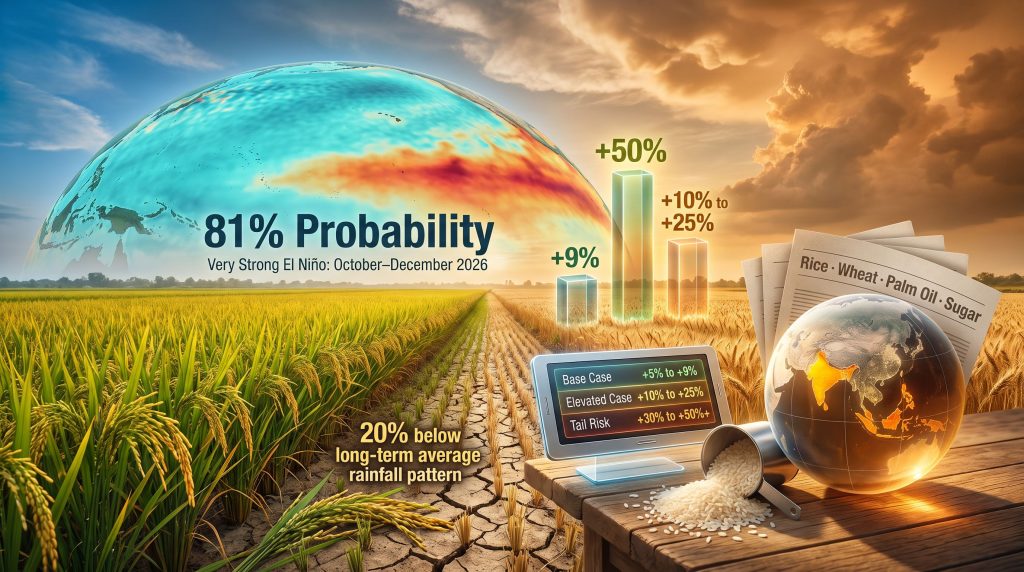
| European Central Bank (2023) | Strong El Niño raises global food commodity prices | Up to +9% at peak (~16 months post-onset) |
| Bank of Spain (2024) | El Niño increases global food commodity price growth | ~+9 percentage points one year post-shock |
| Reuters Analyst Consensus (2026) | Super El Niño commodity price shock projection range | +10% to +50% across key commodities |
| IMF Research | El Niño lifts nonfuel commodity prices and amplifies inflation | Most pronounced in food-import-dependent economies |
"The consistent finding across these institutions is that El Niño functions as a systematic risk amplifier for food prices, not a guaranteed trigger. The price response is conditioned heavily by the state of inventories, trade policy, and concurrent macroeconomic pressures at the time of onset."
The 2026 Forecast: Why Institutional Attention Is Elevated
The US National Oceanic and Atmospheric Administration (NOAA) has assigned an 81% probability to the development of a very strong El Niño between October and December 2026. Separately, NOAA forecasts a 97% probability that El Niño conditions will persist into early spring 2027, representing an unusually extended duration outlook. An event of this projected magnitude could rank among the largest El Niño episodes recorded since comprehensive monitoring began in 1950.
These are not trivial probability estimates. An 81% forecast probability for a very strong event places this El Niño outlook well outside the range of speculative forecasting and into the domain of near-consensus meteorological expectation. For commodity risk managers and macro investors, this creates an unusual situation: a tail-risk event with a high advance probability of occurrence. Economists are already warning that a super El Niño could deliver severe shocks to global food prices lasting well into 2028.
Asia's Rice Market: The Epicentre of Near-Term Supply Risk
India's Monsoon Deficit and Its Downstream Market Implications
India accounts for roughly 40% of global rice exports, making it the single most important supplier in the international rice trade. Any disruption to Indian rice production carries immediate and outsized consequences for global supply balances. As of mid-July 2026, India's cumulative southwest monsoon rainfall had recorded a deficit exceeding 20% below its long-term average, based on official Indian government meteorological data.
A monsoon deficit of this magnitude during the kharif (summer) cropping season, which is the primary rice-growing period in India, raises the risk of meaningful yield compression across major producing states. The downstream implications for export availability and global rice pricing are material. Consequently, commodity price impacts on mining and broader resources sectors also warrant attention, as agricultural and energy commodity cycles are increasingly interlinked.
How Importing Nations Are Repositioning Ahead of Anticipated Shortfalls
Anticipatory procurement behaviour is already reshaping regional trade flows across Asia. Several major rice-importing nations have moved proactively to build strategic reserves, a dynamic that creates its own demand-side pressure on global prices independent of actual supply losses.
| Country | Policy Response | Stockpile Target or Change |
|---|---|---|
| Malaysia | Extended rice reserve horizon from 3 months to 9 months | Targeting increase to 300,000 tonnes from 200,000 tonnes |
| Philippines | Government issued formal production risk warnings in May 2026 | Assessing adjustments to import volumes |
| Regional trend | Multiple importers front-loading purchases simultaneously | Creating compounding upward pressure on spot and forward prices |
Malaysia's stockpiling shift is particularly noteworthy. Moving from a three-month to a nine-month reserve target represents a tripling of the strategic buffer horizon, reflecting an institutional-level reassessment of supply security risk that goes well beyond routine inventory management.
"When multiple large importers simultaneously accelerate procurement in anticipation of future shortages, the act of stockpiling itself generates the price pressure that makes further stockpiling feel necessary. This self-reinforcing dynamic is one of the most underappreciated amplification mechanisms in food commodity markets."
The Philippines' warning that a severe El Niño could reduce national rice production by approximately 700,000 tonnes adds a direct supply-side dimension to this demand-driven pressure. The combination of reduced domestic production and accelerated import demand across the region creates a pincer effect on available global rice supply.
The Nuance Investors Must Not Miss: El Niño Is Not a Deterministic Price Trigger
Why Historical El Niño Episodes Have Varied in Their Price Impact
A critical analytical error in commodity risk assessment is treating El Niño onset as a deterministic indicator of food price spikes. The academic and institutional literature is clear that price outcomes across El Niño episodes vary significantly, sometimes producing weaker-than-expected global food price effects when one or more of the following conditions are present:
- Major producing regions outside the primary impact zone generate compensating surplus output.
- Global grain inventories at the time of onset are sufficiently elevated to buffer supply shortfalls.
- Policy responses, particularly rapid import facilitation and reserve releases, are implemented early and effectively.
- The event intensity, while statistically El Niño, remains at the moderate rather than strong end of the spectrum.
The Three-Condition Framework for a True Climate Black Swan
Research into historical food price crises consistently identifies a pattern: severe market disruptions do not arise from climate shocks in isolation. They emerge from the intersection of three simultaneously elevated risk conditions:
- Tight pre-existing inventories: Low global buffer stocks eliminate the system's capacity to absorb regional supply shortfalls without immediate price transmission.
- Concurrent geopolitical or trade policy disruption: Export restrictions, trade route fragmentation, or conflict-driven logistics breakdown compound weather-related supply losses.
- Elevated energy and input costs: High fertiliser and fuel prices reduce producers' capacity to compensate for weather-driven yield compression through intensified cultivation practices.
When all three conditions align with a strong El Niño event, the probability of a climate black swan events and El Niño food prices scenario rises dramatically. Investors should, therefore, be actively monitoring all three vectors, not the meteorological data alone. The geopolitical landscape for metals and mining provides useful parallel context, as the same geopolitical fracture lines that constrain mineral supply chains also compress agricultural trade flexibility.
Portfolio Implications: Repricing Commodity Risk for a Climate-Volatile World
Scenario Modelling Across Three El Niño Outcome Pathways
Given the inherent uncertainty in translating meteorological probability into commodity price outcomes, a scenario-based framework provides more decision-relevant analysis than point forecasts.
| Scenario | El Niño Intensity | Estimated Food Price Impact | Portfolio Risk Level |
|---|---|---|---|
| Base Case | Strong, within historical norms | +5% to +9% on global food commodity prices | Moderate; manageable through diversification |
| Elevated Case | Very strong, top-quartile historical event | +10% to +25% across exposed commodities | High; emerging market inflation and currency pressure |
| Tail Risk Case | Super El Niño plus geopolitical compounding | +30% to +50%+ on key commodities; localised shortages | Systemic; food security stress in import-dependent nations |
Asset Classes and Sectors Carrying the Highest Exposure
The transmission of a climate black swan event through financial markets follows identifiable pathways. Investors need to assess exposure across the following categories:
- Agricultural commodity futures: Direct exposure to supply compression in rice, wheat, palm oil, and sugar across Asia and South America.
- Food and beverage manufacturers: Margin compression risk from sustained input cost inflation, particularly for producers with limited pricing power or hedging capacity.
- Emerging market sovereign bonds: Nations with high food import dependency and food-heavy consumer price index baskets face dual pressure from inflation pass-through and potential currency depreciation.
- Freight and logistics operators: Demand surge from coordinated strategic stockpiling operations across multiple importing nations simultaneously.
- Agricultural insurance markets: Elevated claims pressure in affected growing regions, with potential for reserve adequacy stress in extreme scenarios.
The Dual-Shock Mechanism That Investors Rarely Model Correctly
Research from the World Food Programme highlights a structural feature of El Niño disruptions that standard commodity models frequently underweight: the simultaneous generation of drought and flooding across different geographic zones. An El Niño event does not create a single directional supply shock. It redistributes precipitation globally, creating drought conditions in some of the world's most critical growing regions while generating destructive flooding in others.
This dual-shock architecture means that even regions not directly experiencing drought can face food affordability crises through global price transmission. An importing nation whose domestic production is unaffected by the El Niño pattern may still face substantially higher food costs simply because the countries it relies on for imports are experiencing production losses. Understanding commodities market volatility and hedging is, however, increasingly important for navigating these compounding risks.
The next major ASX story will hit our subscribers first
Frequently Asked Questions: Climate Black Swan Events and El Niño Food Prices
What is a climate black swan event in financial markets?
A climate black swan is a sudden, high-impact climatic disruption that generates outsized economic damage through commodity market dislocation, supply chain compression, and inflationary pressure in ways that conventional risk models struggle to price in advance. The term emphasises the interaction between the physical weather event and the structural vulnerabilities already present in markets.
How much can El Niño raise global food prices?
Research from the ECB and Bank of Spain estimates that a strong El Niño can raise global food commodity prices by approximately 9 percentage points within 12 to 16 months of onset. Analyst projections for a super El Niño scenario suggest price shocks ranging from 10% to 50% across key exposed commodities, with some crops potentially experiencing larger spikes depending on pre-existing inventory conditions.
Which crops and regions carry the highest El Niño vulnerability?
Rice production across South and Southeast Asia carries the most direct near-term exposure, particularly in India, the Philippines, Indonesia, and Vietnam. Palm oil, wheat, and sugar also face meaningful supply-side risk. Regions dependent on the southwest Asian monsoon system are most directly affected due to El Niño's characteristic suppression of monsoon rainfall intensity.
Is a food price spike guaranteed if El Niño develops as forecast?
No. El Niño functions as a risk amplifier rather than a deterministic trigger. Historical episodes have varied considerably in their food price outcomes depending on event intensity, baseline inventory levels, and whether concurrent geopolitical or energy cost pressures were simultaneously elevated. A very strong event occurring during a period of tight inventories and fragmented trade policy carries materially higher price risk than the same event occurring during a period of abundant global stocks.
How are governments responding to El Niño food security risks in 2026?
Several major Asian importers have implemented proactive strategic stockpiling programmes. Malaysia has extended its rice reserve target from three months to nine months and is targeting a stock increase to 300,000 tonnes from a prior level of 200,000 tonnes. The Philippines issued formal production risk warnings in May 2026 following government assessments of potential domestic rice output reductions. These responses reflect a broader shift toward anticipatory food security positioning ahead of anticipated supply disruptions.
Climate Risk as a Permanent Portfolio Variable: The Structural Shift Underway
From Cyclical Footnote to Standing Risk Factor
The 2026 El Niño cycle is not simply another weather event requiring a temporary commodity allocation adjustment. It is accelerating a structural recalibration in how institutional investors classify, monitor, and price climate-related market risk across all asset classes. The core evolution is this: climate black swan events and El Niño food prices are being repositioned from long-horizon ESG considerations into near-term macro pricing variables that require active risk management within standard investment committee processes.
This has concrete implications for:
- Commodity hedging strategies: Risk managers are increasingly incorporating meteorological probability forecasts directly into forward hedging decisions rather than waiting for supply data to confirm physical shortfalls.
- Emerging market allocation frameworks: Portfolio construction for EM exposure now requires explicit assessment of food import dependency ratios, domestic food price sensitivity, and fiscal buffer adequacy.
- Central bank inflation forecasting: The persistence of food price shocks driven by El Niño events has direct monetary policy implications, particularly in economies where food represents a large share of consumer price index weights.
Furthermore, market volatility and tariff impacts represent an additional layer of complexity that investors must integrate alongside climate risk modelling when constructing robust portfolio frameworks.
"For global investors navigating the 2026 risk environment, the weather forecast is now a portfolio input. The critical insight is not whether El Niño develops as projected, but whether the three compounding conditions of tight inventories, trade policy fragmentation, and elevated input costs are simultaneously present when it does. That intersection is where climate black swans are made."
Want to Stay Ahead of the Next Major Mineral Discovery Amid Commodity Market Volatility?
As climate shocks and El Niño-driven food price disruptions reshape global commodity markets, the ripple effects extend well beyond agriculture — creating both risk and opportunity across the broader resources sector. Discovery Alert's proprietary Discovery IQ model delivers real-time alerts on significant ASX mineral discoveries, cutting through market complexity to surface actionable investment opportunities the moment they emerge — start your 14-day free trial today, or explore historic discoveries and their returns to understand what early positioning in a major find can truly mean for a portfolio.