August 5, 2026
Underground Coal's Quiet Backbone: Why Mining Services Contracts Drive East Coast Production
Australia's underground coal sector does not run on mine ownership alone. Beneath the headline figures of commodity pricing and export volumes lies a dense network of specialised services contractors whose operational expertise is the actual engine of production. In longwall underground environments, where geological conditions shift panel by panel and strata behaviour can change without warning, the calibre of the services partner matters as much as the mine's resource endowment. It is within this context that the Mastermyne Dendrobium mining services contract deserves careful examination, not simply as a revenue announcement, but as a window into how underground coal production is actually structured and sustained in New South Wales.
When big ASX news breaks, our subscribers know first
What Longwall Mining Actually Involves, and Why It Requires Specialist Contractors
The Mechanics of Longwall Coal Extraction
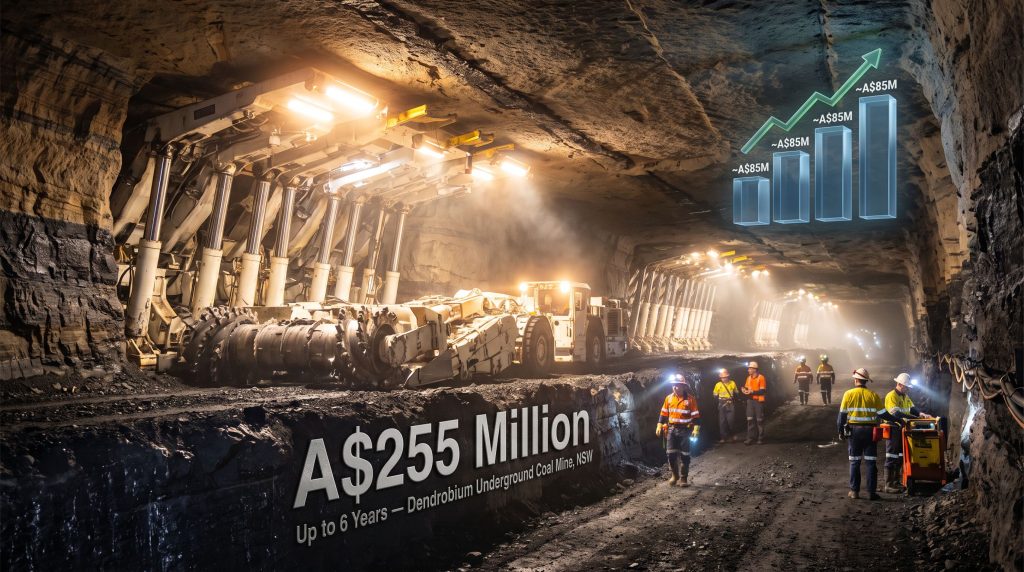
Longwall mining is the dominant method for high-volume underground coal recovery in Australian operations, and it bears little resemblance to the tunnelling imagery most people associate with underground work. In a longwall system, a mechanised rotating drum called a shearer traverses back and forth across a coal face that can extend several hundred metres in width. As the shearer cuts, hydraulic roof supports advance progressively, allowing the worked-out area behind the face to collapse in a controlled manner, a process known as goaf formation.
This controlled collapse is central to both the efficiency and the hazard profile of longwall mining. Managing the transition between supported and unsupported ground requires real-time strata monitoring, experienced supervisory personnel, and an intimate understanding of the local geology. It is precisely this technical complexity that makes experienced underground coal contractors difficult to replace and valuable to retain across multiple mine sites.
Strata Management: The Hidden Technical Demand
One factor rarely discussed in mainstream coverage of mining services contracts is the role of strata consolidation work as a precursor to broader operational engagement. Mastermyne's pre-existing presence at Dendrobium was centred on strata consolidation and project-related services, a technically demanding scope that involves reinforcing the integrity of underground roadways and panels through grout injection, rock bolting, and cable bolt installation.
This prior engagement is not incidental. It means Mastermyne's teams have accumulated direct knowledge of Dendrobium's specific rock mechanics, including the behaviour of the mine's host strata under varying load conditions. That accumulated geological familiarity is a genuine competitive advantage when transitioning to broader underground mining services delivery, reducing both mobilisation risk and the likelihood of early-stage operational disruptions.
Dendrobium Mine: Operational Context and Industrial Significance
Two Decades of Continuous Production
The Dendrobium underground metallurgical coal mine has been producing continuously since longwall operations commenced in April 2005, following a construction phase that began in January 2002. With more than two decades of operational history, the mine has cycled through multiple commodity price environments, ownership structures, and regulatory frameworks, yet maintained uninterrupted coal supply to domestic steelmakers.
Its current development consent extends to 2030, a relatively near-term horizon that shapes the commercial logic of any multi-year services contract awarded at the site. A six-year maximum contract duration terminating in 2032 would nominally exceed the current consent boundary, which introduces a nuance worth noting: the contract's full-term realisation is contingent on the mine's regulatory and operational continuity beyond 2030, something that is not guaranteed but is commercially anticipated by the parties involved.
Metallurgical Coal's Distinct Market Position
Unlike thermal coal, which faces structural demand headwinds from the global energy transition, metallurgical coal occupies a different industrial category. It functions as a chemical reductant in the blast furnace steelmaking process, where its carbon content and coking properties are essential to converting iron ore into liquid iron. No commercially scalable substitute currently exists for hard coking coal in conventional integrated steelmaking.
Furthermore, metallurgical coal prices continue to influence the commercial viability of long-term underground contracts, particularly in NSW where operational costs are structurally higher than in Queensland. Australian hard coking coal from NSW underground operations is regarded among the highest quality in the seaborne market, with low sulphur content and strong coke strength after reaction (CSR) values that Asian and domestic steelmakers specifically target.
Dendrobium's output feeds directly into BlueScope's Port Kembla Steelworks in NSW and Liberty Primary Steel's Whyalla operation in South Australia, two of the last remaining integrated steelworks in the country.
| Steel Facility | Location | Operator |
|---|---|---|
| Port Kembla Steelworks | New South Wales | BlueScope Steel |
| Whyalla Steelworks | South Australia | Liberty Primary Steel |
This domestic supply role gives Dendrobium a strategic industrial function that extends beyond pure export commodity economics, though it does not imply any form of government designation or special regulatory status.
Breaking Down the Mastermyne Dendrobium Mining Services Contract
Financial Architecture and Revenue Phasing
The Mastermyne Dendrobium mining services contract is structured around a two-year initial term, with two further two-year extension options available to the operator. According to the official announcement, the initial term is expected to generate gross revenues of approximately A$85 million, implying an annualised run rate of roughly A$42.5 million from the Dendrobium scope alone. If both extension options are exercised, total contract revenues could reach approximately A$255 million over the full six-year span.
| Contract Phase | Duration | Approximate Gross Revenue |
|---|---|---|
| Initial Term | 2 years | ~A$85 million |
| Extension Option 1 | +2 years | ~A$85 million (implied) |
| Extension Option 2 | +2 years | ~A$85 million (implied) |
| Total (Full Term) | 6 years | ~A$255 million |
The phased extension structure is standard practice in Australian contract mining and serves a specific commercial function: it allows the mine operator to assess contractor performance before committing capital to longer-term obligations. For the contractor, each extension represents a re-earned mandate rather than a guaranteed revenue stream, creating an ongoing performance incentive embedded in the contract architecture itself.
The GM3 Ownership Relationship: More Than a Client
GM3, the counterparty to this agreement, is a joint venture between Golden Energy and Resources and M Group. What makes this relationship commercially distinctive is that M Group also holds the position of Mastermyne's largest shareholder. This creates a layered commercial dynamic that goes well beyond a standard client-contractor arrangement.
When a contractor's largest shareholder is simultaneously the operator of the mine where the contractor is deployed, the alignment of incentives runs deeper than conventional arms-length contracting. Operational performance at Dendrobium has implications not just for contract renewal but for the broader shareholder relationship, creating a structural motivation for both parties to ensure the engagement succeeds.
Workforce Implications: Scale and Composition
The contract is expected to generate more than 140 new employment positions, adding substantially to Mastermyne's existing workforce at Dendrobium and its approximately 220-role engagement at the nearby Appin mine, which commenced in mid-2025 under a separate GM3 agreement.
| Site | Contract Start | Mastermyne Roles |
|---|---|---|
| Appin Mine | Mid-2025 | ~220 |
| Dendrobium Mine | September 2026 | 140+ |
| Combined GM3 Exposure | 360+ |
The workforce composition in underground coal services typically spans a range of certified classifications:
- Development miners certified for underground coal operations
- Longwall operators and face crew personnel
- Strata support specialists and technical officers
- Underground supervisors and deputy positions
- Equipment maintenance and logistics personnel
Each of these classifications requires specific certification under NSW mining safety legislation, meaning the workforce cannot simply be sourced from general labour markets. The scarcity of certified underground coal workers in NSW is a genuine constraint on how quickly any contractor can scale, and prior site familiarity at Dendrobium gives Mastermyne an advantage in retaining and redeploying personnel who already hold the relevant site inductions and competencies.
Strategic Implications for Mastermyne's Forward Order Book
FY27 Momentum and Pipeline Concentration
The Dendrobium award positions Mastermyne entering fiscal year 2027 with a materially strengthened contracted revenue base. The company's managing director and chief executive communicated that the order book and pipeline of opportunities across the East Coast coal basins remains robust, supported by persistent demand for specialist underground coal mining services. This language signals management confidence in both near-term execution and medium-term tendering activity.
However, investors and analysts should note that the combined Appin and Dendrobium exposure creates a concentrated reliance on a single counterparty, GM3, for a significant portion of the company's contracted revenue. Concentration risk in contract mining is a well-understood dynamic: multi-site relationships with a single operator amplify both the upside of a deepening partnership and the downside if that relationship encounters commercial or operational friction.
The Option Value Embedded in Mastermyne's Dendrobium Position
Beyond the contracted revenue, management has indicated the potential for additional scope expansion at the Dendrobium site. This represents an embedded option that does not appear in the current contract financials. In underground mining services, scope expansion typically occurs when a site's production requirements increase, when the incumbent contractor demonstrates capability across adjacent service lines, or when the operator seeks to consolidate its services supplier base further.
Given Mastermyne's prior strata consolidation work at the site and its expanding role under the new agreement, the conditions for further scope growth appear structurally present, though not guaranteed. In addition, broader mining industry consolidation trends across the East Coast basins may create further tendering opportunities for established underground contractors.
Structural Forces Driving Underground Coal Services Demand in NSW
Skills Scarcity as a Competitive Moat
The NSW underground coal industry operates within a structurally constrained labour market. Certified underground coal personnel take years to develop through traineeships, apprenticeships, and progressive competency assessments. The pool of workers qualified for deputy and supervisory roles is particularly limited, given the additional statutory responsibilities these positions carry under the NSW Coal Mine Health and Safety Act.
This scarcity creates a meaningful competitive moat for established contractors. Companies with existing certified workforces, active site presences, and the institutional knowledge to manage underground coal environments safely are difficult to displace, even when pure cost metrics might nominally favour an alternative bidder. Consequently, safety record and operational continuity carry significant weight in contract evaluations, as highlighted by recent attention to underground coal safety incidents across the industry.
Capital Discipline and the Outsourcing Trend
Major underground coal operators have progressively shifted toward outsourced services models over the past two decades, a trend accelerated by commodity price volatility experienced through multiple coal price cycles. Carrying a large permanent underground workforce through price downturns creates significant fixed cost exposure. Contracting that workforce through specialist providers transfers a portion of that risk while retaining access to the technical capability.
"In geologically complex underground coal environments, the cost of a poorly performing services contractor, measured in lost production, safety incidents, and equipment downtime, typically exceeds any marginal savings from selecting a lower-cost provider. This is why established operators with proven track records at specific sites hold a disproportionate advantage in contract renewal and expansion."
Seaborne Metallurgical Coal Demand and Its Influence on Contracting Activity
Sustained demand from Asian integrated steelmakers, particularly those operating blast furnace capacity in India, Japan, and South Korea, continues to support hard coking coal prices above the long-run cost curves of most Australian underground operations. India's steel production growth trajectory in particular represents a meaningful demand driver for high-quality coking coal imports over the medium term. Moreover, China steel demand and its structural evolution continues to shape how Australian coal exporters position themselves in the seaborne market.
Furthermore, iron ore market impacts from shifting trade tariff regimes in 2025 have reinforced the importance of metallurgical coal's distinct demand profile relative to broader steel input commodities. This offshore demand foundation reinforces the commercial rationale for multi-year services contracts at Australian metallurgical coal mines. When producers have confidence in sustained demand, they are more willing to commit to longer-term operational arrangements with services contractors, enabling the kind of six-year maximum structures represented by the Mastermyne Dendrobium mining services contract.
The next major ASX story will hit our subscribers first
Key Contract Metrics at a Glance
| Parameter | Detail |
|---|---|
| Counterparty | GM3 (Golden Energy and Resources / M Group JV) |
| Mine Location | New South Wales, Australia |
| Coal Type | Metallurgical (hard coking) coal |
| Mining Method | Longwall underground |
| Initial Term | 2 years |
| Extension Options | 2 x 2-year options |
| Maximum Duration | 6 years |
| Initial Term Revenue | ~A$85 million |
| Full-Term Maximum Revenue | ~A$255 million |
| New Roles Created | 140+ |
| Commencement | September 2026 |
| Development Consent Horizon | 2030 |
| Existing Mastermyne Scope | Strata consolidation and project services |
| Related GM3 Site | Appin Mine (~220 roles, mid-2025) |
Frequently Asked Questions
What is the total potential value of the Mastermyne Dendrobium mining services contract?
The maximum potential value is approximately A$255 million over six years, assuming both two-year extension options are exercised. The initial two-year term is expected to deliver gross revenues of around A$85 million. Further detail on the contract structure has been covered across Australian financial media following the formal announcement.
When does the Mastermyne Dendrobium contract begin?
Work is scheduled to commence in September 2026.
What type of coal does Dendrobium produce, and why does it matter?
Dendrobium produces metallurgical coal, which is a chemically distinct input to blast furnace steelmaking. Unlike thermal coal, it cannot be functionally substituted in conventional integrated steel production, which sustains long-run demand even as energy markets decarbonise.
Who is GM3, the mine operator?
GM3 is a joint venture between Golden Energy and Resources and M Group, with the latter also being Mastermyne's largest shareholder, creating an integrated commercial and ownership relationship between the two parties.
How many jobs does the Dendrobium contract create?
More than 140 new positions are expected to be generated, supplementing Mastermyne's existing workforce at the site and its approximately 220-role presence at the Appin mine.
Disclaimer: This article is intended for informational purposes only and does not constitute financial advice. Revenue figures cited are based on disclosed contract terms and involve forward-looking estimates that are subject to change depending on extension option exercise, operational performance, and market conditions. Readers should conduct their own due diligence before making any investment decisions.
Want to Stay Ahead of Significant ASX Mining Discoveries?
Discovery Alert's proprietary Discovery IQ model scans ASX announcements in real time, delivering instant alerts on high-potential mineral discoveries across coal, metals, and beyond — turning complex data into actionable investment insights for traders and long-term investors alike. Explore historic discovery returns on Discovery Alert's dedicated discoveries page and begin your 14-day free trial to position yourself ahead of the broader market.