August 24, 2026
The Geography of Capital: Why Egypt Has Become China's Most Strategic African Investment Partner
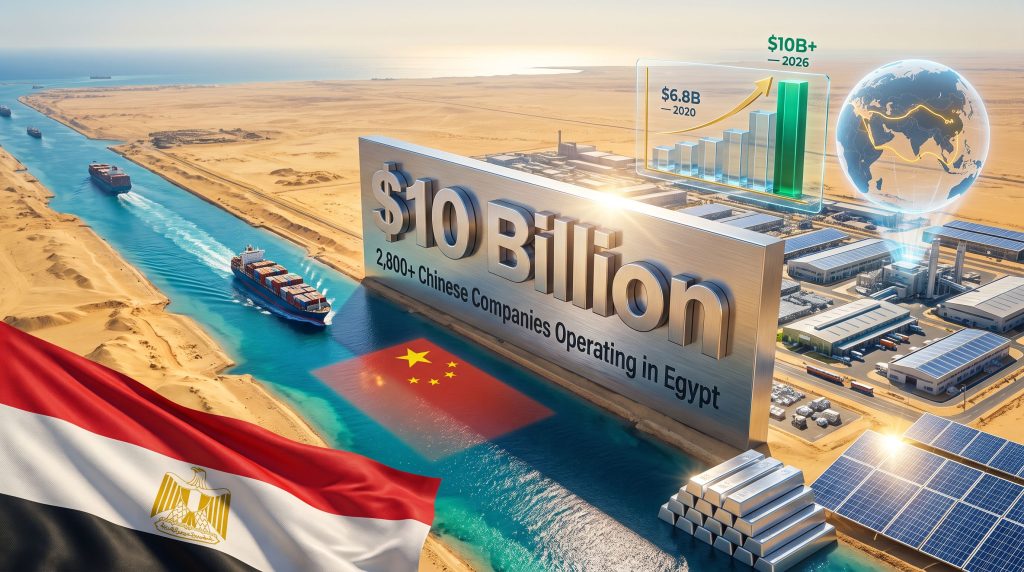
There are moments in economic history when a bilateral relationship quietly crosses a threshold that redefines the power dynamics of an entire region. The accumulation of Chinese investment in Egypt surpassing $10 billion is one of those moments. It did not happen overnight, and it was not the product of a single transformative deal. It emerged from more than two decades of compounding commercial logic, diplomatic architecture, and geographic inevitability.
Understanding why this number matters requires stepping back from the headline figure and examining the structural forces that made it possible, the sectoral anatomy of where the capital actually flows, and what the trajectory signals about Egypt's long-term position in the global economic order.
When big ASX news breaks, our subscribers know first
Egypt's Irreplaceable Position in the Global Trade Architecture
Not every country can claim to sit at the intersection of three continents. Egypt does. With coastlines on both the Mediterranean and the Red Sea, it physically connects Sub-Saharan Africa, the Arab world, and Europe through a single corridor. The Suez Canal, which handles approximately 12% of global seaborne trade, gives Egypt a form of geopolitical leverage that no amount of capital can manufacture elsewhere.
This geographic reality is not background noise in the China-Egypt investment story. It is the central thesis. For China, whose export economy depends on reliable access to European and African consumer markets, Egypt represents a manufacturing and logistics hub with unrivalled position. For Egypt, Chinese industrial capital represents a pathway to reduce the country's chronic dependence on imported finished goods and generate the foreign exchange earnings needed to service its external obligations.
The numbers that frame Egypt's economic context are significant:
- A population exceeding 105 million, making Egypt Africa's third most populous nation and its third-largest economy
- An acute domestic manufacturing deficit that creates structural demand for industrial investment
- A foreign exchange crisis that has made attracting hard-currency FDI a national priority
- Ongoing economic reform programmes designed to liberalise the investment environment and reduce state dominance
How Chinese Investment in Egypt Accumulated to $10 Billion
The path to $10 billion was neither linear nor driven by a single policy event. It reflects the sustained deepening of a relationship formalised under the Egypt-China Comprehensive Strategic Partnership, which represents the highest tier of diplomatic engagement in China's bilateral framework.
The capital accumulation timeline is instructive:
| Reference Point | Estimated Chinese Investment | Source Basis |
|---|---|---|
| 2020 | ~$6.8 billion | Cumulative investment stock |
| End-2024 | ~$9 billion | Direct investment research estimates |
| 2025 (GAFI data) | $8+ billion | 2,800+ active Chinese companies |
| 2026 (Egyptian PM statement) | $10+ billion | Broadest government-endorsed figure |
| SCZone-specific (end-2025) | ~$3.8 billion | Chinese-linked SCZone capital only |
The variation between reported figures is methodologically significant. Different totals reflect whether analysts are counting committed capital versus disbursed funds, or whether joint-venture valuations and concessional loan disbursements are included within the scope of measurement. The $10 billion figure confirmed by Egyptian Prime Minister Mostafa Madbouly at the third meeting of the Ministerial Committee for China Affairs represents the broadest government-endorsed estimate, encompassing the full commercial ecosystem.
According to Fast Company ME, Egypt's expanding cooperation with China spans an increasingly diverse range of sectors, reinforcing the view that this relationship is deepening structurally, not simply growing in volume.
The $10 billion figure is best understood as a floor, not a ceiling. With active pipeline discussions across desalination infrastructure, aluminium manufacturing, renewable energy, and agricultural technology all at various stages of development, continued capital accumulation is the structural baseline expectation, not an optimistic projection.
The Suez Canal Economic Zone: China's Industrial Anchor in North Africa
If there is one physical location that defines the China-Egypt investment relationship, it is the Suez Canal Economic Zone (SCZone). Chinese-linked investments within the SCZone have reached approximately $3.8 billion, representing roughly 50% of total SCZone investment recorded over the past three and a half years. This concentration is not accidental.
The SCZone's design creates a compelling proposition for Chinese manufacturers: production facilities located within one of the world's most strategically positioned free trade zones, with preferential access to both African markets under continental trade frameworks and European markets through Egypt's association agreements. For Chinese firms managing the political and commercial risks of the current global trade environment, manufacturing inside Egypt provides a form of export diversification that purely domestic Chinese production cannot replicate.
The sectors absorbing the most capital within this framework include:
- Industrial manufacturing: Export-oriented production facilities leveraging Egypt's trade access to over 50 African nations under the African Continental Free Trade Area
- Logistics and transportation infrastructure: Port-adjacent facilities and inland corridors supporting distribution across the region
- Energy systems: Solar and wind installations alongside emerging desalination projects addressing Egypt's acute freshwater scarcity
- Technology and telecommunications: Electronics assembly and communications hardware with localisation agreements designed to build domestic Egyptian capability
- Specialised chemicals and engineering: Import substitution investments targeting high-value industrial inputs
The $2 Billion Aluminium Signal: Understanding the New Pipeline
One of the most revealing developments in the current bilateral investment trajectory is the reported discussions around a $2 billion aluminium manufacturing hub targeting African and European export markets. This single prospective project, if realised, would represent a material addition to the existing stock of Chinese investment in Egypt.
The aluminium sector discussion is significant beyond its financial scale. It reflects a deliberate shift in the composition of Chinese investment away from pure logistics and light manufacturing toward capital-intensive heavy industry. Egypt's energy cost profile, particularly as renewable capacity expands, makes energy-intensive aluminium smelting economically viable in ways that would have been less compelling a decade ago.
Furthermore, this pattern — where energy infrastructure investment creates the preconditions for downstream industrial investment — illustrates how Chinese capital in Egypt operates as an interconnected ecosystem rather than a collection of independent deals. Notably, China's Xinfeng Steel has announced plans to build a $10 billion industrial complex in Egypt, a development that underscores the scale of Chinese industrial ambition in the country.
Sectoral Breadth: Where the $10 Billion Actually Goes
The geographic concentration in the SCZone coexists with remarkable sectoral breadth. The third meeting of Egypt's Ministerial Committee for China Affairs reviewed active cooperation across a striking range of industries:
- Industrial manufacturing within specialised economic zones
- Desalination infrastructure addressing long-term freshwater security
- Technology localisation programmes building domestic Egyptian manufacturing capacity
- Telecommunications networks supporting digital economy development
- Transportation logistics corridors integrated with port and canal infrastructure
- Mining sector development, an often-overlooked component of the bilateral portfolio
- Renewable energy installations across solar and wind
- Specialised chemicals and engineering targeting import substitution
- Agricultural technology transfer and food processing capacity building
- Agricultural export facilitation to expand Egyptian goods' access to Chinese markets
The inclusion of mining as a formal discussion point is particularly noteworthy. Egypt possesses significant mineral wealth, including gold deposits in the Eastern Desert, phosphate reserves, and various industrial minerals, that have historically been underexploited relative to their potential. Chinese involvement in this sector would extend the bilateral relationship into resource extraction, a dimension that carries its own set of strategic and sovereignty considerations. In addition, broader African mining finance trends suggest this move aligns with a wider continental pattern of Chinese capital targeting untapped resource potential.
The next major ASX story will hit our subscribers first
Governance Architecture: The Ministerial Committee Model
One of the less-discussed but structurally important aspects of the China-Egypt relationship is the institutional infrastructure that has been built to manage it. The Ministerial Committee for China Affairs, presided over by the Prime Minister and comprising ministers and senior officials from across the Egyptian government, represents a dedicated permanent coordination mechanism.
Government spokesperson Mohamed El-Homsany confirmed that the committee is actively identifying new project pipelines rather than simply monitoring existing commitments. This distinction matters enormously. A committee focused only on implementation management is reactive. A committee actively generating new project proposals operates as a forward investment pipeline, ensuring the bilateral relationship continues to deepen irrespective of changes in global geopolitical conditions.
The creation of a ministerial-level institutional framework dedicated exclusively to managing a single bilateral relationship signals that Egypt views the China partnership as requiring permanent structural management rather than periodic diplomatic attention.
Egypt Within China's African Investment Landscape
Placing the Chinese investment in Egypt surpassing $10 billion milestone in broader context requires understanding how China's African investment portfolio is structured. China has directed more than $170 billion toward African infrastructure and investment since 2000 across various financing mechanisms, making it the continent's largest bilateral development financier.
Egypt consistently ranks among the top three African recipients of Chinese FDI, alongside Ethiopia and South Africa. The comparative picture across Africa's major Chinese economic zone investments is instructive:
| Country | Primary Zone | Key Sectors | Estimated Scale |
|---|---|---|---|
| Egypt | Suez Canal Economic Zone | Manufacturing, logistics, energy, mining | $3.8B+ (Chinese-linked) |
| Nigeria | Lekki Free Trade Zone | Petrochemicals, manufacturing | $2B+ |
| Ethiopia | Eastern Industrial Zone | Textiles, light manufacturing | $1B+ |
| Zambia | Lusaka East MFEZ | Mining processing, manufacturing | $800M+ |
Egypt's advantage within this comparison is structural and irreproducible. No other African economic zone sits adjacent to a waterway handling 12% of global maritime trade. The geographic premium built into SCZone investments creates a competitive moat that fundamentally distinguishes Egyptian assets from comparable Chinese-backed zones elsewhere on the continent. However, it is worth noting that Egypt's mineral wealth investment dynamics share certain characteristics with other emerging markets navigating Chinese capital inflows.
Structural Risks and the Multi-Alignment Strategy
A complete analysis of Chinese investment in Egypt cannot ignore the structural risks that accompany deep bilateral economic integration. Several considerations warrant careful attention:
Concentration risk is the most immediate concern. Heavy dependence on a single bilateral partner for industrial development creates vulnerability if geopolitical conditions shift or if China's own economic trajectory changes. Egypt's experience managing its relationship with the IMF and Gulf sovereign wealth funds simultaneously with Chinese capital inflows suggests a deliberate diversification strategy, but the concentration of industrial zone investment with Chinese partners remains a structural exposure.
Debt sustainability is relevant where Chinese financing is structured as concessional lending rather than equity participation. Egypt's external debt position has been under significant pressure in recent years, and the terms of any debt-financed Chinese infrastructure investment require careful fiscal management.
Technology transfer authenticity represents perhaps the most strategically consequential risk. The depth of genuine capability transfer — as opposed to assembly operations dependent on Chinese inputs and expertise — will determine whether Egypt builds durable industrial sovereignty or remains structurally dependent on Chinese technical knowledge and supply chains.
Egypt's simultaneous engagement with Western multilateral institutions and Chinese bilateral partners reflects a deliberate multi-alignment foreign economic policy. This approach mirrors the broader geopolitical mining race dynamic, where nations leverage strategic resources and geography to attract competing global powers on favourable terms. The country's control of the Suez Canal provides meaningful leverage in negotiating the terms of Chinese engagement, a dynamic that distinguishes Egypt's position from many other BRI participant states.
Frequently Asked Questions
How much has China invested in Egypt in total?
Chinese investment in Egypt has surpassed $10 billion according to Egyptian government figures reported in 2026, with more than 2,800 Chinese companies currently operating across the country. Figures vary between $8 billion and $10 billion depending on methodology and measurement scope.
What sectors receive the most Chinese investment in Egypt?
The largest concentrations are in industrial manufacturing, infrastructure, energy (including renewables and desalination), telecommunications, transportation logistics, mining, and agriculture. The Suez Canal Economic Zone is the primary geographic hub.
Is Egypt part of China's Belt and Road Initiative?
Yes. Egypt formally joined the Belt and Road Initiative and is regarded as one of its anchor states in North Africa, with the BRI framework providing the diplomatic and financing infrastructure for much of the bilateral relationship. Consequently, the rare earth geopolitical impact of BRI investments is increasingly relevant to understanding Egypt's strategic positioning within this framework.
What is the Suez Canal Economic Zone's role?
The SCZone has attracted approximately $3.8 billion in Chinese-linked investment through end-2025, representing roughly 50% of total SCZone investment over the preceding three and a half years. It functions as Egypt's primary platform for export-oriented Chinese manufacturing.
What new sectors are being discussed for future investment?
Active pipeline discussions include desalination infrastructure, a potential $2 billion aluminium manufacturing hub, renewable energy expansion, mining development, and agricultural technology transfer, all reviewed at the third meeting of the Ministerial Committee for China Affairs. Furthermore, the broader critical minerals demand surge is likely to accelerate Chinese interest in Egypt's largely untapped mineral deposits in the years ahead.
Key Takeaways
- Chinese investment in Egypt has grown from approximately $6.8 billion in 2020 to over $10 billion by 2026, representing close to 47% growth across six years
- More than 2,800 Chinese companies now operate in Egypt, creating a deep commercial ecosystem extending well beyond government-to-government agreements
- The Suez Canal Economic Zone absorbs the largest single concentration of Chinese industrial capital, with its geographic position providing an advantage no other African economic zone can replicate
- Sectoral breadth has expanded to include mining, an underreported dimension of the bilateral relationship that carries significant long-term strategic implications
- The Ministerial Committee for China Affairs represents institutional commitment to deepening the relationship at the highest levels of government, functioning as an active investment pipeline generator rather than a passive oversight mechanism
- The $10 billion milestone is a floor, not a ceiling, with multiple large-scale projects in active discussion across energy, heavy industry, and agricultural sectors
Disclaimer: This article contains forward-looking statements, projections, and analysis based on publicly available information. Investment figures sourced from Egyptian government statements, GAFI data, and independent research may vary depending on methodology and measurement scope. This content is for informational purposes only and does not constitute financial or investment advice. Readers should conduct independent due diligence before making any investment decisions.
Want to Track the Next Major Mineral Discovery Before the Market Does?
Discovery Alert's proprietary Discovery IQ model delivers real-time alerts on significant ASX mineral discoveries — including in sectors like mining and resources that are increasingly attracting global capital — turning complex data into actionable insights for investors at every level. Explore historic discoveries and their returns, then begin your 14-day free trial to position yourself ahead of the market.