August 24, 2026
When Electricity Becomes an Existential Question for Industrial Communities
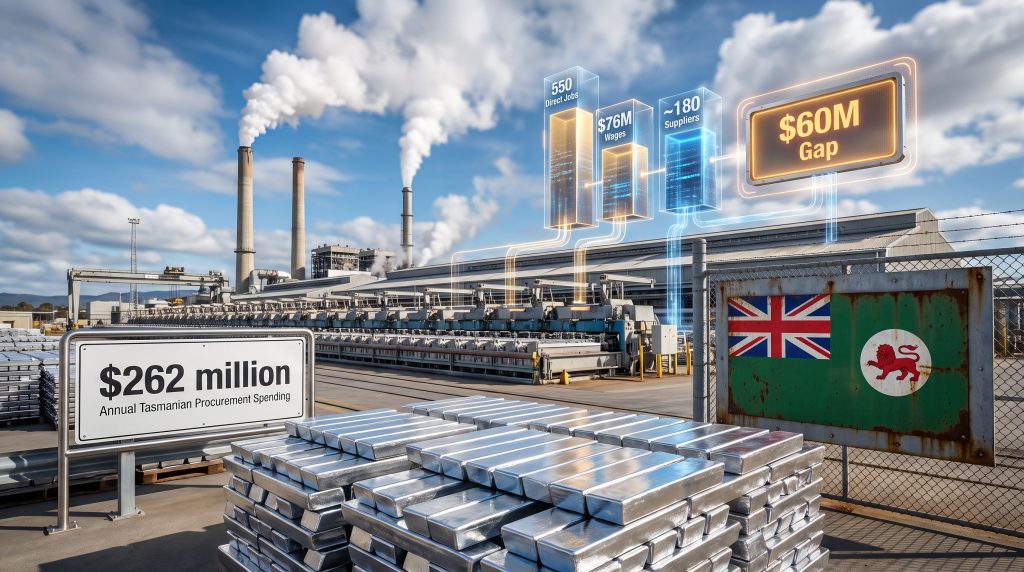
The fate of an entire regional economy can hinge on a number rather than a resource. In the case of northern Tasmania, that number is $60 million — the reported gap separating a functioning aluminium smelter from a potential closure that would reshape the economic landscape of an entire community for a generation.
Aluminium smelting is one of the most electricity-dependent industrial processes ever developed. The electrolytic reduction of aluminium oxide through the Hall-Héroult process consumes enormous quantities of continuous electrical current, meaning that power pricing is not merely an operating cost — it is the fundamental variable that determines whether a smelter remains commercially viable or becomes an expensive liability on a multinational's balance sheet.
Understanding why the Bell Bay Aluminium power deal has escalated into one of Australia's most consequential industrial negotiations requires stepping back from the immediate headlines and examining the structural forces that make aluminium smelters so uniquely vulnerable to energy market disruptions.
When big ASX news breaks, our subscribers know first
The Economics of Aluminium Smelting and Why Long-Term Contracts Are Non-Negotiable
How Electricity Becomes the Defining Variable
Globally, electricity costs typically account for 30 to 40 percent of total aluminium production costs. This is not a minor input — it is the single largest cost driver in the entire production chain, exceeding the cost of raw bauxite, alumina refining, and labour combined in many operational contexts.
This dependency creates an operational reality that distinguishes smelters from almost every other type of manufacturing facility:
- Aluminium smelters cannot be switched off and restarted without enormous cost and risk — the molten bath process requires continuous power to prevent metal from solidifying inside reduction cells
- Restarting a potline after an unplanned shutdown can take months and cost tens of millions of dollars in remediation
- Capital expenditure cycles at smelters typically span 10 to 20 years, meaning that investment decisions are only rational when power costs are locked in over equivalent timeframes
- Short-term contracts introduce cost uncertainty that makes sustained capital allocation economically irrational for global operators with competing investment priorities
Without long-term power price certainty, aluminium smelters operate in a state of structural investment paralysis. A global operator evaluating competing capital allocation opportunities across multiple continents will not direct funds to a facility where the fundamental cost variable remains unresolved.
This structural dependency is precisely why the Bell Bay Aluminium power deal matters so far beyond the immediate employment figures. It is also why the industry standard for smelter power agreements is a minimum of 10 years — and why community and industry leaders have specifically demanded a decade-long contract rather than another short-term extension. For context on how top aluminium companies approach these investment decisions globally, the pattern is consistent: long-term energy certainty is non-negotiable.
Bell Bay's Economic Footprint: Numbers That Reframe the Stakes
What the Smelter Actually Contributes to Tasmania
Bell Bay Aluminium produces approximately 190,000 tonnes of aluminium annually, positioning it among Australia's most significant primary metal production facilities. The smelter directly employs around 550 workers, with thousands more relying on connected supply chains and service industries throughout northern Tasmania.
The 2025 economic contribution data paints a detailed picture of just how deeply the facility is embedded in the regional economy:
| Economic Metric | 2025 Value |
|---|---|
| Total annual wages paid | ~$76 million |
| Capital investment | ~$40 million |
| Procurement spending with Tasmanian suppliers | ~$262 million |
| Number of Tasmanian supplier businesses | ~180 |
| Direct employment | ~550 workers |
These figures reveal something important that raw employment statistics often obscure: the procurement multiplier. At $262 million in annual supplier spending distributed across roughly 180 Tasmanian businesses, Bell Bay functions as an anchor customer for a significant portion of northern Tasmania's small and medium enterprise base. Logistics firms, engineering contractors, maintenance specialists, and materials suppliers all carry Bell Bay as a core revenue line.
The Municipal Finance Dimension
George Town Mayor Greg Kieser has been explicit about the local government implications of a potential closure. The rateable revenue that Bell Bay Aluminium generates underwrites a meaningful share of the municipality's capacity to fund community services and local infrastructure. If the smelter were to close, the resulting gap in council finances would be substantial — a fiscal shock that a relatively small local government would struggle to absorb without significant service reductions.
This is a dimension of industrial closure that rarely receives adequate attention. The loss cascades through three distinct layers: direct employment income, supply chain revenue, and municipal fiscal capacity — each compounding the economic damage of the original job losses.
The Power Deal Crisis: Anatomy of a $60 Million Impasse
A Timeline Built Around Successive Deadlines
The Bell Bay Aluminium power deal did not arrive at crisis point suddenly. It has followed a predictable progression from long-term contract expiry through interim extension to hard deadline:
| Period | Key Development |
|---|---|
| Pre-December 2025 | Long-term power agreement between Rio Tinto and Hydro Tasmania in place |
| 31 December 2025 | Original contract expires; 12-month short-term extension negotiated |
| July 2026 | Bell Bay Aluminium reported ineligible for federal green energy funding scheme |
| August 2026 | Rio Tinto signals internal deadline of end of August 2026 for new agreement |
| End of 2026 | Short-term extension expires; full resolution required |
Federal Bass MP Jess Teesdale stated publicly in July 2026 that Rio Tinto had set a firm end-of-August deadline, with the consequence of failing to meet it characterised as a very high risk of smelter closure. This framing transformed what had been a commercial negotiation into a political emergency with a visible countdown. The ABC's reporting on the federal funding ineligibility finding was particularly significant in accelerating that shift in public perception.
Why Hydro Tasmania Cannot Simply Close the Gap
Hydro Tasmania occupies a structurally awkward position in this negotiation. As Tasmania's state-owned power utility, it operates under a dual obligation: maintaining commercial sustainability as a business, and serving the broader public interest as a government asset.
The reported $60 million pricing gap represents the difference between what Rio Tinto requires to sustain acceptable operational economics and what Hydro Tasmania can offer within its own commercial constraints. Hydro Tasmania cannot absorb a gap of that magnitude without either government direction or budget compensation — doing so would effectively represent a subsidised power arrangement that would need to be funded from somewhere within Tasmania's fiscal framework.
State minister Jo Palmer has publicly described Hydro Tasmania's offer as strong, while simultaneously acknowledging that closing the remaining gap requires federal participation — drawing an explicit parallel to the interventions already delivered at Tomago Aluminium in New South Wales and Boyne Smelters in Queensland in 2026.
The Stakeholder Map: Four Parties, Four Different Agendas
Understanding Who Controls What
Unlike a standard bilateral commercial dispute, the Bell Bay power negotiation involves at least four decision-making parties with materially different incentives:
1. Rio Tinto evaluates Bell Bay as one asset within a globally diversified portfolio. Commercial viability criteria apply universally across the portfolio — a facility that cannot deliver acceptable returns faces rationalisation regardless of its community importance. The August deadline signals genuine urgency, not negotiating theatre. Furthermore, Rio Tinto's approach to the Gladstone aluminium repowering in Queensland offers a useful aluminium joint venture comparison point for how major operators structure energy transition arrangements.
2. Hydro Tasmania is simultaneously a commercial counterparty and an instrument of state energy policy. It has limited capacity to act independently of state government direction on pricing concessions of this scale.
3. The Tasmanian state government controls Hydro Tasmania as a state-owned enterprise, giving it indirect leverage but also fiscal responsibility for any gap-bridging mechanism. Premier Rockliff's government faces significant political pressure from the business and community coalition that has formed around the issue.
4. The federal government holds the precedent card. Having already deployed financial support at Tomago and Boyne, it faces political pressure to apply equivalent treatment to Bell Bay. However, the federal position, through a spokesperson for Industry Minister Tim Ayres, has emphasised that the Tasmanian government holds primary control over the supply of low-cost renewable electricity to Tasmanian industry — encouraging the state to deploy its own policy tools first.
The structural tension here is that each party has a rational reason to wait for another party to move first. This classic multi-party coordination problem is precisely what elevates commercial deadlines into political crises.
The Green Aluminium Paradox: A Clean Asset Denied Clean Credentials
Why Bell Bay's Renewable Credentials Matter More Than People Realise
Bell Bay Aluminium draws its power from Hydro Tasmania's hydroelectric generation fleet — making it one of a very small number of aluminium smelters globally that can credibly claim near-zero Scope 2 emissions from its power source. This positions the facility to produce what the industry increasingly calls green aluminium: primary metal manufactured with minimal direct carbon intensity.
Global demand for low-carbon aluminium is accelerating as manufacturers across the automotive, aerospace, and construction sectors face mounting obligations to reduce Scope 3 supply chain emissions. Automakers producing electric vehicles, for instance, face the irony of a carbon-intensive supply chain for the lightweight aluminium components that make their vehicles efficient. Consequently, green metals pricing dynamics are increasingly influencing how smelters like Bell Bay are valued by global buyers and investors alike.
The strategic paradox is stark: Bell Bay Aluminium, powered by renewable energy, was reportedly found ineligible for federal green energy funding in July 2026. This exclusion removed a significant potential pathway to lower effective power costs and undermined the commercial case that the facility's environmental credentials might otherwise have supported.
This raises a legitimate policy coherence question. If Australia's industrial decarbonisation strategy is intended to reward and preserve low-carbon manufacturing capacity, the exclusion of a hydroelectric-powered aluminium smelter from green energy support mechanisms represents a structural inconsistency that warrants examination.
The next major ASX story will hit our subscribers first
Comparing Australia's Aluminium Smelter Interventions
A National Pattern Emerging
The Bell Bay situation does not exist in isolation. Australia's aluminium smelting sector has faced a wave of energy-related viability challenges, and the federal government's response to comparable situations creates a clear precedent expectation:
| Smelter | State | Federal Involvement | Outcome |
|---|---|---|---|
| Tomago Aluminium | New South Wales | Financial support provided (2026) | Bailout secured |
| Boyne Smelters | Queensland | Financial support provided (2026) | Bailout secured |
| Bell Bay Aluminium | Tasmania | Federal position: state responsibility | Pending as of August 2026 |
Why Tasmania's Situation Has a Different Structural Character
The mainland smelters operate within competitive wholesale electricity markets where multiple generators compete on price. Tasmania's electricity system is fundamentally different: a single state-owned hydroelectric utility dominates supply, meaning that power pricing for major industrial customers is inherently a policy decision as much as a market outcome.
This structural difference cuts both ways. On one hand, it means the Tasmanian government has more direct leverage over the outcome than state governments in New South Wales or Queensland ever had. On the other hand, it means that Hydro Tasmania's pricing constraints are also set within a government framework, creating an inherent tension between the utility's commercial obligations and the political imperative to preserve industrial employment.
The Electricity Bill Feedback Loop: An Underappreciated Risk
What Closure Could Mean for Every Tasmanian Power User
Bell Bay Aluminium is among the largest single electricity consumers on the Tasmanian grid. Industrial electricity customers of this scale provide an essential economic function beyond their own operations: they absorb a substantial share of fixed grid infrastructure costs, effectively subsidising the per-unit power costs of smaller consumers including households and businesses.
If the smelter closes, Hydro Tasmania loses that anchor industrial load. The fixed costs of maintaining grid infrastructure do not disappear — they are redistributed across the remaining customer base. This creates a counterintuitive dynamic that has received insufficient public attention:
- Failing to close the power deal gap could ultimately increase electricity costs for ordinary Tasmanian households and small businesses
- The apparent cost of government intervention to bridge the $60 million gap may be substantially lower than the long-term cost of grid repricing across the entire Tasmanian customer base
- This feedback loop transforms the Bell Bay power deal from a narrow industrial policy question into a whole-of-economy electricity pricing issue
What a Viable Resolution Could Look Like
Structural Options for Bridging the Gap
Several mechanisms could, individually or in combination, close the $60 million pricing gap and deliver the 10-year agreement that industry leaders have called for:
-
State government direct allocation — The Tasmanian government directs Hydro Tasmania to price below full commercial cost recovery, compensating the utility through a direct budget appropriation. Fiscally straightforward but politically visible.
-
Federal co-investment framework — The federal government contributes a portion of the gap as an industrial support payment, framed as strategic manufacturing preservation — consistent with Tomago and Boyne precedents.
-
Green aluminium premium structure — A power pricing arrangement tied explicitly to Bell Bay's renewable credentials, potentially unlocking access to green aluminium export premiums that improve Rio Tinto's commercial position without requiring equivalent government expenditure.
-
Concessional financing mechanism — Governments provide a financial guarantee or concessional loan instrument that allows Hydro Tasmania to improve its pricing offer without immediate budget impact, spreading the fiscal cost across a longer timeframe.
Community and industry leaders have specifically called for a new 10-year power agreement rather than any further interim extension. The logic is sound: another short-term deal defers rather than resolves the fundamental investment certainty problem, and will simply recreate the current crisis in 12 or 24 months. The Gladstone aluminium repowering effort in Queensland demonstrates, however, that long-term structural solutions are achievable when all parties commit to a shared framework.
The Broader Signal: What This Negotiation Tells Investors About Australian Industrial Policy
Risk Perception and Long-Term Industrial Capacity
Beyond the immediate employment and community stakes, the Bell Bay Aluminium power deal has implications for how internationally mobile industrial capital perceives Australia as a host for energy-intensive manufacturing.
If a facility with demonstrably low-carbon credentials, a 550-person workforce, $262 million in annual regional procurement, and clear strategic value in a growing green aluminium market cannot secure a commercially viable long-term power agreement — the signal to other potential industrial investors is clear. Long-term operational certainty for energy-intensive industries in Australia carries meaningful policy risk, and investment decisions will reflect that assessment.
Aluminium is increasingly recognised as a critical material for the energy transition demand — used in solar panel frames, electric vehicle chassis, transmission infrastructure, and grid-scale storage systems. Allowing domestic primary smelting capacity to close increases Australia's dependence on imported aluminium, predominantly from jurisdictions with far higher carbon intensity production profiles. The climate math of that outcome is straightforwardly negative.
The Bell Bay decision will function as a reference point for future industrial energy negotiations across Australia. A constructive resolution would demonstrate that coordinated government action can preserve strategic manufacturing capacity. A failure would demonstrate the opposite, with consequences that extend well beyond northern Tasmania.
Disclaimer: This article contains analysis of publicly reported figures, policy positions, and economic projections. The outcome of the Bell Bay Aluminium power deal negotiations remains unresolved as of the date of publication. Readers should not interpret this analysis as financial advice. Economic projections and scenario analyses are inherently speculative and subject to change based on negotiation outcomes.
Want to Stay Ahead of the Next Major Resource Story Shaping Australian Markets?
Discovery Alert's proprietary Discovery IQ model delivers real-time alerts on significant ASX mineral discoveries, transforming complex resource data into actionable investment insights — explore historic discoveries and their market returns to understand just how transformative early positioning can be, then begin your 14-day free trial at Discovery Alert to ensure you never miss a market-moving announcement.