August 24, 2026
When Strategic Intent Meets Political Reality: The BHP Kalgoorlie Nickel Smelter Federal Support Debate
Across advanced economies, the gap between declaring a mineral strategically important and actually committing the fiscal resources to protect its processing infrastructure has emerged as one of the most consequential policy failures of the energy transition era. Australia is no exception. The country has built an increasingly sophisticated framework for identifying critical minerals, yet the architecture for translating that identification into durable industrial support remains inconsistent, geographically uneven, and often reactive rather than deliberate.
Nowhere is this tension more visible than in the ongoing debate surrounding the BHP Kalgoorlie nickel smelter federal support question, a dispute that has moved from regional concern to national policy flashpoint as BHP's February 2027 decision deadline draws closer.
When big ASX news breaks, our subscribers know first
How Australia's Industrial Support Framework Actually Works
Understanding the Kalgoorlie situation requires separating two concepts that are frequently conflated in public discussion: eligibility frameworks and site-specific rescue packages. Australia's $4 billion Critical Minerals Facility provides a financing mechanism through which eligible projects can access concessional loans and government co-investment. Nickel's addition to the federal Critical Minerals List in February 2024 extended theoretical eligibility to nickel processing operations, but eligibility is not commitment. The Critical Minerals List functions as a door, not a cheque.
This distinction matters enormously when examining recent federal spending decisions. Furthermore, the government's commitments to east-coast heavy industry have been substantial and direct, while WA's cornerstone nickel processing facility remains without a dedicated package. Australia's critical minerals strategy continues to evolve, yet the gap between policy intent and actual industrial support remains a persistent challenge.
Where Federal Industrial Support Has Actually Flowed
| Facility | Location | Federal Support Committed | Current Status |
|---|---|---|---|
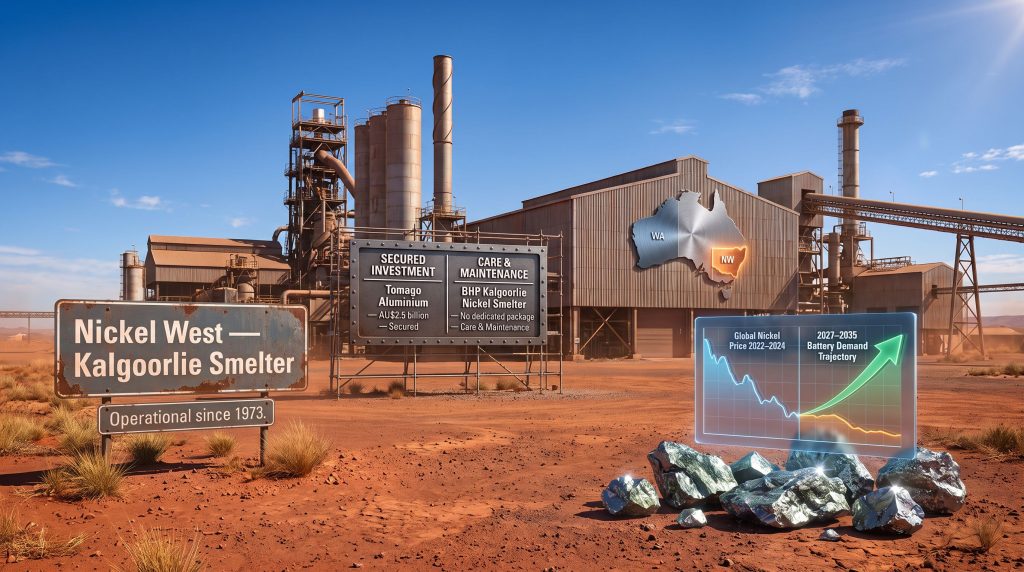
| Tomago Aluminium | New South Wales | AU$2.5 billion | Secured |
| Four East-Coast Smelters (combined) | Eastern Australia | AU$1.67 billion | Committed |
| BHP Kalgoorlie Nickel Smelter | Western Australia | No dedicated package | Care and Maintenance |
The financial asymmetry between east-coast smelter commitments and the absence of any dedicated Kalgoorlie support has become the central policy flashpoint in the current federal debate, raising questions about whether geography shapes industrial policy outcomes more than strategic logic does.
Federal Liberal MP Rick Wilson has publicly questioned this disparity, noting that nickel carries the same strategic classification as the minerals underpinning the east-coast support decisions, yet no comparable support has been extended to the Western Australian industry. The office of Industry Minister Tim Ayres has indicated ongoing collaboration with state governments and industry stakeholders, describing nickel as central to Australia's industrial future, but formal commitments remain absent.
A Five-Decade Asset at a Critical Crossroads
The Kalgoorlie Nickel Smelter is not a marginal facility. Commissioned in 1973, it represents more than five decades of operational history and sits at the heart of BHP's broader Nickel West portfolio, which also encompasses the Kwinana refinery further south. When the smelter entered care and maintenance in 2024 amid collapsing global nickel prices, the impact on the Goldfields region was severe: approximately 3,500 jobs across BHP's Nickel West operations were displaced, delivering a structural shock to a regional economy that had few immediate alternatives.
BHP's Four Strategic Pathways for Nickel West
BHP has confirmed it will complete a strategic review of its Nickel West operations by February 2027. The options under evaluation represent a wide spectrum of outcomes:
- Full operational restart contingent on improved nickel price conditions and commercial viability
- Extended care and maintenance while the market recovers and policy conditions evolve
- Divestment to a third-party operator, which could include foreign state-backed entities
- Permanent closure and decommissioning, which would eliminate domestic nickel sulphate processing capability
Each pathway carries distinct consequences for regional employment, downstream battery material supply chains, and Australia's sovereign processing capability. The February 2027 deadline is not arbitrary. It represents the outer boundary of what care and maintenance is commercially sustainable before the decision calculus shifts irreversibly toward closure or divestment.
A critical and underappreciated dimension of the Kalgoorlie smelter's strategic value lies in what it actually produces. The facility is capable of converting nickel concentrate into nickel matte, an intermediate product that feeds refining processes to ultimately produce nickel sulphate, the form used in lithium-ion battery cathodes. Losing this processing node does not simply mean losing a smelter; it means breaking a domestic battery supply chain link that would take years and substantial capital to rebuild.
The Complicating Factor: BHP's Own Prior Position
A politically significant wrinkle in the BHP Kalgoorlie nickel smelter federal support case is that BHP reportedly declined to seek taxpayer assistance at the time of the July 2024 suspension announcement. This position has complicated advocacy efforts, as it gives federal decision-makers a basis to argue the company itself did not initially frame the situation as requiring public intervention. However, BHP's evolving review process and the approaching February 2027 deadline leave open the possibility that commercial negotiations could shift significantly before the final decision is made.
Is There a Geographic Bias Built Into Australian Industrial Policy?
The political economy argument underpinning the east-west support disparity is uncomfortable but worth examining directly. Federal electoral mathematics are weighted toward population-dense eastern states, where industrial constituencies in New South Wales and Queensland carry significant seat counts. The Goldfields region, despite its economic contribution to the national minerals export base, does not generate comparable electoral leverage.
This dynamic does not necessarily reflect deliberate bias, but it produces structurally unequal outcomes. The principle of horizontal fiscal equity in Australian federalism holds that comparable economic circumstances should generate comparable policy responses. Applying that principle to industrial support decisions would require that a nickel smelter producing a battery-critical mineral receive treatment proportionate to that applied to aluminium smelters serving energy transition goals.
If the federal government's strategic rationale for east-coast smelter support centres on sovereign manufacturing capability and energy transition, does domestic nickel sulphate processing for battery supply chains not satisfy precisely the same logic?
The Western Australian state government's own co-investment posture in the Kalgoorlie case is also a relevant variable. The extent to which WA has contributed to or led a coordinated support case alongside the federal advocacy from figures such as Rick Wilson will shape how seriously Canberra treats the political risk of continued inaction.
A Sector Under Simultaneous Pressure
The BHP Kalgoorlie nickel smelter federal support debate cannot be evaluated in isolation from the broader collapse occurring across Western Australia's nickel sector. The industry is facing compounding structural pressures that make the policy decision significantly more complex than a simple commodity price recovery story.
Key Sector Indicators
- IGO's Nova nickel mine is scheduled for closure by the end of 2026, removing one of the primary domestic ore supply sources that would be needed to feed a restarted Kalgoorlie smelter
- Glencore's Murrin Murrin nickel and cobalt operation has been written down to zero value, a signal of deep structural pessimism from one of the sector's largest global operators
- Indonesian nickel supply expansion since 2022 has fundamentally suppressed global nickel spot prices, creating a structural rather than cyclical pricing problem that simple demand recovery cannot easily resolve
The feedstock viability question deserves particular attention. Even if BHP elected to restart the Kalgoorlie smelter and federal support were secured, the simultaneous closure of Nova and the distressed state of Murrin Murrin raises a critical question: where does the ore come from? A smelter without reliable concentrate supply is commercially indefensible regardless of how much government support is attached to it. This interconnected supply chain fragility is a dimension of the debate that receives insufficient attention in public commentary.
Global Price Dynamics and Long-Term Demand Trajectories
Indonesian nickel growth has created a structural price overhang that is unlikely to dissipate quickly, with the country's production growing dramatically since 2022 and now accounting for a disproportionate share of global supply growth. However, historical precedent from other commodity sectors suggests that low spot prices alone do not disqualify strategic intervention.
Both the aluminium and steel sectors have received sustained government support through price troughs based on long-term strategic assessments. The battery demand trajectory for nickel, particularly Class 1 nickel suitable for battery-grade sulphate production, remains structurally positive across the 2027–2035 window as electric vehicle penetration accelerates in key markets.
This is a technically important distinction. Indonesian laterite-derived nickel is predominantly processed through routes producing nickel pig iron and mixed hydroxide precipitate, which are not directly equivalent to the Class 1 nickel sulphate that Western Australian sulphide operations produce. Australian sulphide nickel, when processed through a facility like the Kalgoorlie smelter and the Kwinana refinery developments, yields a higher-purity product with a different and arguably more valuable role in the battery supply chain. This product quality differentiation is rarely captured in headline nickel price comparisons but is fundamental to understanding the true strategic value of the Kalgoorlie processing pathway.
Scenario Modelling: What the Three Futures Look Like
Scenario A: Permanent Closure
- Australia loses its domestic nickel sulphate processing capability, with no near-term replacement pathway
- Battery material supply chains become dependent on offshore refining, concentrated primarily in Asia
- Kalgoorlie-Boulder faces prolonged regional economic contraction with limited alternative industry drivers
- The Kwinana refinery downstream of the smelter also faces viability questions without Kalgoorlie matte supply
Scenario B: Divestment Without Federal Support
- The asset becomes available at potentially distressed valuations, creating acquisition opportunities for foreign state-backed entities
- Foreign Investment Review Board (FIRB) strategic asset considerations would apply, but a divestment process creates inherent sovereignty risks
- A new operator without federal co-investment may lack the balance sheet to sustain the restart period required before commercial viability is established
Scenario C: Federally Supported Restart
- Requires a clearly defined nickel price recovery threshold at which support becomes self-liquidating rather than an open-ended subsidy
- International precedents from the US Inflation Reduction Act and the EU Critical Raw Materials Act provide policy design templates for production-linked support that avoids straightforward bailout structures
- A co-investment requirement from BHP or an incoming operator would distribute risk and create accountability for commercial outcomes
- The Australia–US Critical Minerals Partnership and related bilateral frameworks could provide a mechanism for allied co-investment that strengthens the commercial case
The next major ASX story will hit our subscribers first
The Arguments For and Against Intervention
The Case for a Dedicated Package
- Nickel's formal critical minerals classification creates a policy obligation for treatment comparable to other supported sectors
- The AU$2.5 billion Tomago Aluminium commitment has fundamentally altered the political baseline; fiscal restraint arguments are difficult to sustain after commitments of that scale
- Sovereign processing capability carries national security dimensions in an era of accelerating supply chain decoupling among major economies
- The Kalgoorlie-Boulder regional community's dependence on the smelter and its workforce multiplier effects represent a legitimate policy consideration
The Case Against Direct Capital Injection
- Kalgoorlie-Boulder's own mayor has described direct bailouts as short-term measures that create dependence without addressing structural economic vulnerabilities, a perspective that carries weight precisely because it comes from within the affected community
- Market distortion risk is real: federal support that sustains a commercially unviable asset at current nickel prices delays the structural adjustment the sector requires
- The moral hazard concern applies directly to a situation where the asset owner previously declined to seek public assistance
- Alternative instruments may deliver more durable outcomes than direct capital injections
Alternative Policy Instruments Worth Considering
| Instrument | Mechanism | Precedent |
|---|---|---|
| Production tax credits | Per-tonne credit on domestically processed nickel sulphate | US Inflation Reduction Act |
| Sovereign offtake agreements | Government commits to purchase processed output at floor price | Various defence material programs |
| Infrastructure co-investment | Joint funding of energy supply to reduce operating cost base | Australian Gas Infrastructure |
| Strategic reserve acquisition | Government stockpiling of nickel sulphate as critical material reserve | US National Defense Stockpile |
Frequently Asked Questions
Has the federal government committed funding to the Kalgoorlie nickel smelter?
No site-specific package has been announced. Nickel's inclusion on the Critical Minerals List in early 2024 creates eligibility under the $4 billion Critical Minerals Facility, but eligibility is not equivalent to committed funding. The broader context of critical minerals demand driven by the energy transition does, however, strengthen the strategic case for intervention.
When will BHP make its final decision on the Kalgoorlie smelter?
BHP has confirmed its strategic review of Nickel West operations will conclude by February 2027, at which point a decision on restart, continued suspension, divestment, or permanent closure will be made.
How many jobs were affected when the smelter went into care and maintenance?
The 2024 suspension displaced the majority of the approximately 3,500-strong workforce across BHP's Nickel West operations.
Why is Indonesian nickel supply relevant to the Kalgoorlie situation?
Indonesian production growth since 2022 has suppressed global nickel prices, creating the commercial conditions that made the Kalgoorlie suspension economically necessary for BHP. However, Indonesian laterite-derived nickel is not a direct substitute for the Class 1 nickel sulphate that Western Australian sulphide operations produce for battery applications.
What is the difference between being on the Critical Minerals List and receiving direct support?
The Critical Minerals List establishes strategic importance and creates eligibility for government financing mechanisms. A direct support package requires a separate government decision, budget appropriation, and typically a negotiated commercial agreement with the facility operator. Consequently, the nickel market recovery trajectory will be an important factor in shaping those negotiations.
What a Credible Federal Response Would Need to Include
The policy architecture for any defensible federal intervention in the Kalgoorlie situation would need several interlocking components to avoid the structural weaknesses that critics of direct bailouts rightly identify:
- A clearly articulated strategic rationale tied explicitly to battery supply chain sovereignty and Class 1 nickel's differentiated role in that chain
- A commercial viability threshold defining the nickel price or demand condition at which any support mechanism becomes self-liquidating
- A co-investment requirement from BHP or any incoming operator that prevents full socialisation of commercial risk
- A regional transition plan that addresses Kalgoorlie-Boulder's economic resilience independent of the smelter outcome, so that community wellbeing is not held hostage to a single commercial decision
- WTO-compliant program design that aligns with Australia's trade obligations while drawing on the structural templates established by peer-nation critical minerals programs
The February 2027 review deadline is the defining constraint. Federal inaction before that date does not simply delay a decision; it effectively forecloses the restart option by allowing the operational and workforce capability at the facility to deteriorate beyond the point of practical recovery.
The BHP Kalgoorlie nickel smelter federal support debate is ultimately a test case for whether Australia's critical minerals policy framework can convert strategic classification into geographically equitable industrial action, or whether eligibility frameworks remain sophisticated packaging around decisions that are ultimately driven by electoral arithmetic.
For readers tracking developments across Australia's critical minerals policy landscape and resource sector, ongoing reporting and analysis is available at Resources Review, which covers Australian mining, energy transition, and industrial policy in depth.
Want to Track the Next Major ASX Nickel or Critical Minerals Discovery in Real Time?
Discovery Alert's proprietary Discovery IQ model instantly identifies significant ASX mineral announcements across nickel, lithium, and more than 30 other commodities, converting complex exploration data into actionable investment insights before the broader market has time to react. Start a 14-day free trial at Discovery Alert and explore historic discovery returns that illustrate precisely why being first to a major find can make all the difference.