August 24, 2026
When Headline Numbers Lie: The Commodity Cycle Trap Every BHP Investor Faces
Few forces in financial markets are as seductive as a mining boom. When commodity prices surge, the numbers flowing through a mining giant's income statement can look almost too good to be true. Underlying profit jumps. Dividends explode higher. Analysts scramble to upgrade forecasts. And retail investors, drawn by the momentum and the income, pile in just as the cycle approaches its peak.
This is precisely the environment surrounding BHP Group today. Underlying net profit climbing approximately 30% year on year and dividends surging by roughly 65% paint a picture of corporate health that feels unambiguous. But for investors asking is BHP overvalued, the more important question is not what BHP earned last year. It is what the company can sustainably earn across a full commodity cycle, and whether today's share price reflects reality or a temporary high-water mark.
When big ASX news breaks, our subscribers know first
The Structural Problem With Valuing a Price-Taker
BHP occupies an unusual position in the corporate world. Unlike a consumer brand that can raise prices when input costs rise, or a software company that can defend margins through intellectual property, BHP produces commodities that trade on global markets at prices it has no ability to influence. In the language of economics, it is a pure price-taker.
This single characteristic has profound implications for how its earnings should be interpreted. During periods of elevated commodity prices, revenue and profit expand dramatically. But that expansion reflects external market conditions, not internal improvements in strategy, efficiency, or competitive positioning. Equally, when commodity prices contract, earnings fall with equal speed and force.
The practical consequence for investors is that applying standard valuation metrics to peak-cycle mining earnings is analytically dangerous. A low price-to-earnings ratio at a commodity peak does not necessarily signal value. It may simply mean the market has not yet fully discounted the earnings normalisation that history suggests is inevitable. Research from Morningstar Australia, authored by Tyger Fitzpatrick and drawing on the mining analysis of Jon Mills, makes this point clearly: strong earnings at BHP's current scale are directly tied to unusually elevated copper prices rather than to any structural transformation in the firm's competitive position.
Furthermore, the commodity price impact on mining company earnings is well-documented, and commodity price impact on BHP's reported results is no exception to this long-established pattern.
Reported profit growth and dividend increases during commodity booms are not evidence of a better business. They are evidence of a more favourable pricing environment. The critical analytical question is whether that environment is durable.
What Independent Valuation Models Actually Show
When multiple valuation frameworks are applied to BHP using sustainable, through-cycle assumptions rather than current spot prices, a consistent picture emerges. The stock appears to trade at a meaningful premium to estimated intrinsic value across most methodologies.
| Valuation Method | Estimated Fair Value (AUD) | Implied Premium at Current Price | Basis |
|---|---|---|---|
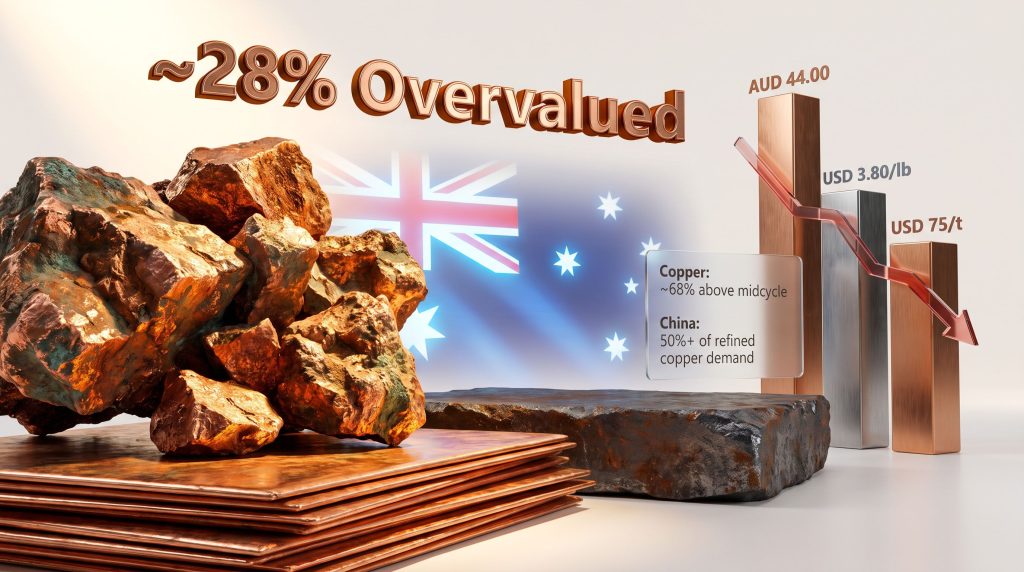
| Morningstar DCF (midcycle pricing) | ~AUD 44.00 | ~28% overvalued | Midcycle copper/iron ore assumptions |
| Broader DCF-based models | Various | 39%–50% overvalued | Independent analyst estimates |
| GF Value (GuruFocus) | Various | 41%–50% overvalued | Quantitative screening |
| Relative P/E comparison | Varies | Appears cheaper | Current-cycle earnings |
| Bank of America (institutional) | N/A | Stretched pricing flagged | Neutral rating |
The weight of evidence across these approaches is striking in its consistency. While no two models produce identical outputs, they converge on the view that BHP's current market price embeds assumptions about commodity price durability that analytical frameworks using long-run equilibrium pricing do not support.
One critical nuance is worth highlighting: relative metrics like price-to-earnings ratios can make BHP appear attractively valued precisely because earnings are inflated by the commodity boom. This is the cyclical illusion that has trapped investors in mining stocks throughout history. A low P/E at a cycle peak is not the same as a low P/E for a stable business.
Is BHP Overvalued Compared to Its Peers?
Goldman Sachs has weighed in on relative value within the sector, backing the Rio over BHP call as their preferred large-cap mining exposure. This institutional preference reinforces the view that BHP's current pricing leaves limited upside relative to comparable peers.
The Midcycle Pricing Framework: Mining Valuation's Most Important Tool
At the core of sound mining valuation lies a concept that most retail investors rarely encounter: the midcycle commodity price assumption. Rather than projecting today's spot prices into the future, this approach anchors long-term earnings models to a price level that reflects sustainable equilibrium between supply and demand across a full cycle.
Morningstar's mining research applies a midcycle copper price of USD 3.80 per pound and a midcycle iron ore price of USD 75 per metric tonne. These figures are not arbitrary. They represent estimates of the price level at which new supply investment is neither strongly incentivised nor actively deterred, and where demand growth neither overheats nor collapses.
Comparing these assumptions to current market conditions reveals the scale of the gap:
- Copper on the London Metal Exchange has risen approximately 50% over the past 12 months
- At roughly USD 6.40 per pound, copper trades approximately 68% above the midcycle assumption used in long-term valuation models
- Iron ore spot prices similarly trade at a material premium to long-run equilibrium estimates
- The gap between spot and midcycle pricing is the primary reason BHP's earnings appear so strong, and the primary reason fair value estimates trail the current share price
How Analysts Build a Through-Cycle Valuation
For investors unfamiliar with the mechanics, here is the step-by-step logic applied by institutional mining analysts:
- Identify the primary earnings drivers for BHP, currently copper and iron ore, with copper now the larger contributor
- Set midcycle price assumptions based on long-run supply and demand equilibrium, explicitly excluding boom-time prices
- Estimate through-cycle EBIT by modelling sustainable earnings across a representative 7 to 10 year commodity cycle
- Apply an appropriate discount rate that reflects capital intensity, geopolitical exposure across BHP's operating jurisdictions, and commodity price volatility
- Derive a per-share fair value and compare it directly to the prevailing market price
- Stress-test the model against bull scenarios, where elevated prices prove more durable, and bear scenarios, where demand contracts faster than consensus assumes
This framework is structurally superior to simply multiplying current earnings by a market multiple because it explicitly accounts for the temporary nature of commodity price cycles.
Copper's Structural Demand Story: Compelling, But Not Without Limits
The argument for structurally higher copper prices rests on a genuinely compelling demand thesis. Copper is physically indispensable to the global energy transition, embedded in electric vehicle drivetrains, grid-scale battery storage, offshore wind infrastructure, and solar panel connections. Its thermal and electrical conductivity properties mean substitution in these applications is technically challenging at scale.
The data centre narrative adds another layer. Copper is used extensively throughout data centre infrastructure, from server hardware and cooling systems to network wiring and grid connection cables. According to estimates from S&P Global, data centres accounted for approximately 3% of total global copper demand in 2025, with projections pointing toward 7% by 2035 as AI workloads and cloud computing continue to expand.
BHP's positioning to capture this demand is significant. However, understanding the broader copper market trends is essential context for assessing whether these tailwinds are already fully priced into the stock. Its copper portfolio is anchored by two world-class operations:
- Escondida, Chile: One of the world's largest copper mines by output, with scale advantages that translate into materially lower unit costs than smaller competitors
- Antamina, Peru: A major polymetallic operation where copper is extracted alongside zinc and silver, providing additional revenue diversification
Copper is now projected to generate more than 50% of BHP's midcycle EBIT through to 2031, making it the company's single most important earnings engine for the foreseeable future. While BHP does not carry an overall economic moat rating, its copper assets demonstrate cost efficiencies and scale characteristics that, at the asset level, resemble moat-like competitive advantages.
Why the Structural Bull Case May Be Partially Overstated
Despite the genuine long-run demand tailwinds, several factors complicate the assumption that copper prices will remain sustainably elevated at current levels:
- Data centre construction timelines: Community opposition, grid connection bottlenecks, and planning delays mean the pace of copper-intensive infrastructure deployment may be slower than headline AI investment figures suggest
- Copper thrifting and engineering substitution: Historically, industries exposed to sustained high copper prices invest in engineering solutions that reduce copper intensity per unit of output. This dynamic has repeatedly surprised commodity bulls who anchored on gross demand forecasts without accounting for efficiency-driven demand destruction
- AI hardware efficiency gains: Advances in chip architecture and energy efficiency may reduce the copper intensity of future data centre generations relative to current designs
- New supply response: Elevated copper prices above USD 5 per pound attract significant greenfield exploration and brownfield expansion capital, which historically leads to supply additions that erode price premiums over 5 to 10 year horizons
Morningstar's mining analysis suggests the market may be pricing in a more immediate and sustained boost from AI and energy transition demand than the fundamental rollout pace can realistically support over the near to medium term.
China: The Variable That Dwarfs All Others
No analysis of BHP's valuation is complete without a rigorous assessment of China's role in global commodity markets. The numbers here are not subtle. Consequently, China iron ore demand trends deserve close attention from any serious BHP investor.
Prior to China joining the World Trade Organisation in 2001, global commodity demand was broadly stable across decades. The subsequent industrialisation wave that followed was historically unprecedented in both scale and speed. Major miners including BHP, Rio Tinto, Vale, and Anglo American dramatically expanded supply in response, reshaping global mining economics.
China now accounts for more than 50% of global refined copper demand and represents the dominant buyer in the seaborne iron ore market. Research tracking copper consumption data from 2009 to 2020 found that virtually all net growth in global copper demand during that period originated from China. That single data point reveals just how structurally dependent current commodity price levels are on the continuation of China's commodity-intensive growth model.
| Commodity | China's Share of Global Demand | Structural Transition Risk | BHP Earnings Sensitivity |
|---|---|---|---|
| Iron Ore | ~70%+ of seaborne trade | High, property sector contraction ongoing | Major contributor, second-largest segment |
| Copper | ~50%+ of refined demand | Moderate, partially offset by electrification | Largest earnings contributor, >50% midcycle EBIT |
The structural risk is straightforward to articulate. China's economy is in the early stages of a deliberate transition away from fixed-asset investment in housing, infrastructure, and heavy manufacturing toward domestic consumption and service-sector growth. Consumption-led economies are fundamentally less commodity-intensive per unit of GDP than investment-led economies.
If this transition proceeds at the pace that structural analysis suggests, the demand impulse that has underpinned elevated commodity prices for two decades will progressively weaken. This does not require a Chinese economic crisis. Even a gradual and orderly transition reduces the rate of commodity demand growth, putting pressure on prices that are currently priced to incorporate continuation of the old growth model.
The next major ASX story will hit our subscribers first
BHP's Premium: Who Is Buying and Why
Understanding whether is BHP overvalued requires examining not just fundamental fair value, but also the technical and structural forces that can sustain a premium above intrinsic value for extended periods.
Forces supporting BHP's valuation premium:
- ASX 200 index exposure means BHP receives disproportionate and largely price-insensitive inflows from superannuation funds and passive index-tracking ETFs, driven by portfolio construction rules rather than fundamental analysis
- Income-focused investors are drawn to BHP's elevated dividend yield, particularly in the current rate environment. A 65% dividend increase attracts significant retail and institutional income demand, even if that dividend reflects peak-cycle earnings that may not be sustained
- The structural copper demand thesis, even if partially overstated, provides a credible narrative that supports premium pricing in growth-oriented portfolios
Forces working against the premium:
- Through-cycle earnings models consistently produce fair value estimates well below the current share price
- Commodity price mean reversion is among the most reliably observed patterns in financial market history
- China's structural economic transition represents a multi-decade headwind that is not fully reflected in current analyst consensus pricing
- A 65% dividend increase built on peak-cycle earnings creates a significant risk of future dividend cuts when commodity prices normalise, which could trigger a sharp reassessment of the stock's income appeal
What BHP's Valuation Means for Australian Investors
BHP's outsized presence in Australian financial markets means this is not purely a question for active stock pickers. Most Australians with default superannuation allocations carry meaningful indirect exposure to BHP through their fund's ASX equity holdings. Index ETF investors are similarly exposed without necessarily understanding the cyclical risk embedded in that exposure.
However, independent analysis from Simply Wall St similarly flags that BHP's valuation warrants careful scrutiny when assessed against through-cycle fundamentals rather than current elevated earnings.
Practical framework for different investor types:
- Long-term value investors: The convergence of independent valuation frameworks around a fair value near AUD 44 per share suggests below-average expected returns from current entry points. Patience and a willingness to wait for a margin of safety is analytically supported
- Income investors: The elevated dividend is attractive but structurally fragile. Mining dividends are among the most volatile in the ASX universe, expanding dramatically at cycle peaks and contracting sharply when prices normalise
- Passive and superannuation investors: Understanding that a disproportionate share of ASX index exposure is concentrated in a single commodity cycle-sensitive stock helps in calibrating overall portfolio risk and considering complementary defensive exposures
Disclaimer: This article is intended for informational and educational purposes only. It does not constitute financial advice. Valuation estimates and commodity price forecasts involve significant uncertainty. Past performance and historical commodity cycles are not reliable indicators of future outcomes. Readers should consult a licensed financial adviser before making investment decisions.
Key Takeaways: Synthesising the Evidence on BHP's Valuation
- BHP's 30% profit surge and 65% dividend increase reflect copper prices trading approximately 68% above long-run midcycle valuation assumptions, not a structural improvement in business quality
- Independent valuation frameworks consistently estimate BHP's fair value in the range of AUD 44 per share, implying a premium of approximately 28% or more at current market prices
- The structural copper demand thesis from AI infrastructure and energy transition is genuine but may be slower to materialise than consensus pricing implies, and is subject to substitution, thrifting, and construction delays
- China accounts for more than 50% of global refined copper demand and the dominant share of seaborne iron ore trade. Its structural transition to a consumption-led economy represents the most significant long-term risk to BHP's through-cycle earnings
- Passive investment flows from superannuation funds and ASX-tracking ETFs create structural demand for BHP stock independent of fundamental value, helping to sustain the premium but not permanently defying gravity
- Long-term investors should anchor their return expectations on through-cycle earnings using midcycle commodity prices of approximately USD 3.80 per pound for copper and USD 75 per metric tonne for iron ore, not on the extraordinary conditions currently prevailing in spot markets
For investors seeking independent equity research and fair value estimates covering BHP and other ASX-listed miners, Morningstar Australia publishes ongoing analysis at morningstar.com.au.
Want to Position Yourself Ahead of the Next Major ASX Mineral Discovery?
While BHP offers exposure to large-cap commodity cycles, Discovery Alert's proprietary Discovery IQ model scans daily ASX announcements in real time, instantly identifying significant mineral discoveries across more than 30 commodities — turning complex data into actionable opportunities for both short-term traders and long-term investors. Explore historic discoveries and the substantial returns they generated, then begin your 14-day free trial to secure a genuine market-leading edge before the broader market catches on.