
August 24, 2026
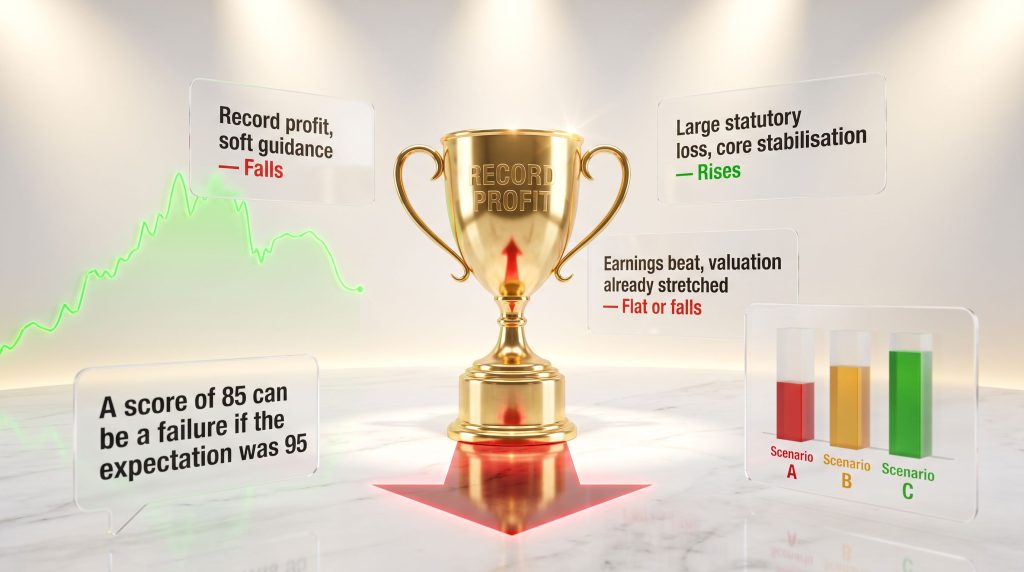
The Gap Between What Happened and What Was Expected
Investor psychology operates on a simple but counterintuitive principle: markets do not reward the past. Every price visible on a trading screen represents the collective judgment of thousands of participants about what a business will earn, generate, and be worth in the future, not what it has already achieved. This gap between backward-looking financial results and forward-looking expectations sits at the heart of one of the most misunderstood phenomena in equity investing, and understanding it completely changes how earnings season should be interpreted.
The question of why a company can report record profits and its share price falls while another announces a devastating statutory loss and its stock rallies is not a puzzle about irrationality. It is a direct consequence of how pricing mechanisms work in efficient capital markets. Once this framework is internalised, seemingly contradictory share price movements become entirely logical.
When big ASX news breaks, our subscribers know first
Share Prices Are Forecasts, Not Scorecards
The Discounting Mechanism Behind Every Stock Price
At any given moment, a stock's price embeds the present value of all future cash flows that investors collectively expect a business to produce. This means historical profits are already absorbed into the price before any earnings report is released. By the time a company sits down to announce its results, the market has often spent weeks or months forming a precise view about what those numbers will look like.
The announcement itself becomes relevant only to the extent it differs from that pre-formed expectation. A result that matches the consensus produces little movement. A result that exceeds expectations tends to push the price higher. A result that falls short, even by a modest margin, typically triggers selling, regardless of how impressive the absolute numbers may appear.
This is why the correct question during earnings season is never simply "was this a good result?" The more analytically rigorous question is: was this result better or worse than what the market had already priced in?
What Shapes the Expectations Bar
The benchmark investors use to assess any given result is constructed from several overlapping inputs:
| Expectations Input | What It Represents |
|---|---|
| Sell-side consensus forecasts | Aggregated earnings estimates from institutional research teams |
| Management guidance | Forward-looking targets issued by the company in prior periods |
| Whisper numbers | Informal, often higher estimates circulating among institutional investors |
| Embedded valuation multiples | The P/E or EV/EBITDA ratio already reflected in the current share price |
| Macro environment signals | Broader economic conditions shaping sector-level expectations |
Importantly, institutional investors frequently operate with proprietary estimates that sit above the publicly available consensus. This means a company can technically beat published analyst forecasts while still falling short of what the largest market participants were privately modelling, creating selling pressure that appears irrational to retail investors comparing results to consensus numbers. Understanding corporate earnings reports and how they are interpreted is therefore essential for any investor navigating reporting season.
Six Structural Reasons Record Profits Can Trigger a Share Price Decline
1. Forward Guidance Undermined the Historical Beat
Investors are inherently future-oriented. Even when a company delivers record profits for a completed financial period, weak forward guidance can rapidly overwhelm the positive headline. A soft trading update, a margin warning, or cautious management commentary signals that the next period may disappoint, and the market immediately reprices to reflect that new information.
A useful real-world illustration comes from the Australian retail sector. During the August 2025 reporting season, JB Hi-Fi delivered record group sales of $11.1 billion and net profit after tax of approximately $490 million, representing a genuinely strong full-year result. Yet the shares fell sharply. The reason was straightforward: investors already knew FY26 was going to be a strong year. The new information they received was a softer trading update covering the early weeks of FY27, and that forward signal outweighed an entire year of record performance.
As one senior portfolio manager observed during that reporting period, the market's focus had entirely shifted from what had already happened to what was likely to happen next, making the soft July trading period far more consequential than the record annual profit figure.
- A soft trading update for the current quarter can outweigh a full year of record historical results
- Management commentary is frequently scrutinised more closely than statutory figures
- Guidance downgrades, even subtle ones, can compress valuation multiples immediately
2. The Pre-Earnings Run-Up Had Already Absorbed the Good News
When a stock rallies strongly in the months preceding an earnings announcement, much of the anticipated positive news has already been incorporated into the price. The formal announcement then becomes a trigger for profit-taking rather than further accumulation, a dynamic commonly described as the buy the rumour, sell the news effect.
This pattern is particularly pronounced in high-growth or momentum stocks where investor enthusiasm can push prices well ahead of fundamentals during the lead-up to results. Institutional investors who accumulated positions in anticipation of a strong result may sell on confirmation, creating downward pressure regardless of how impressive the numbers appear. This is one reason why a great result can still send a share price down, even when everything appears positive on the surface.
3. Valuation Compression When Growth Decelerates
A company trading at an elevated price-to-earnings multiple carries an implicit burden with every earnings report: it must not only deliver strong results but continue to justify a premium valuation. When earnings growth decelerates, even modestly, the market may apply a lower multiple to the new earnings base, creating a double impact where both the earnings estimate and the multiple compress simultaneously.
| Scenario | Earnings Growth | Market Expectation | Multiple Applied | Share Price Outcome |
|---|---|---|---|---|
| A | +20% | +30% | Compressed | Falls |
| B | +15% | +15% | Maintained | Flat |
| C | +10% | +5% | Expanded | Rises |
Key Insight: A business can grow earnings by 20% and still see its share price fall if investors were pricing in 30% growth. The absolute number is far less important than the size and direction of the surprise relative to embedded expectations.
This dynamic is particularly evident in technology-adjacent businesses and high-quality compounders. When companies execute with exceptional consistency, investors naturally pay increasingly large premiums for that reliability. The challenge is that as share prices rise, the expectations embedded in those prices rise with them, leaving progressively less room for anything short of perfection.
4. Underlying Quality Metrics Revealed Weakness Beneath the Headline
Record net profit figures can sometimes mask deterioration in the metrics investors use to assess genuine business quality. Analysts typically look beyond headline numbers to identify whether reported profits are truly sustainable.
Key metrics that can reveal weakness beneath a strong profit headline include:
- Revenue growth deceleration: top-line momentum softening even as margins temporarily hold
- Operating cash flow divergence: statutory profit rising while cash conversion weakens
- Margin compression signals: gross or EBITDA margins narrowing despite higher revenues
- Non-recurring items: one-off gains that inflated the result but will not repeat
- Balance sheet deterioration: leverage increasing or working capital quality declining alongside profits
5. Macro Headwinds Overrode Company-Specific Strength
Even a genuinely strong earnings result cannot fully insulate a stock from broader market forces. Geopolitical events, energy price spikes, or shifting interest rate expectations can redirect capital flows regardless of individual company performance. Furthermore, the commodity price impact on company results is often more far-reaching than investors initially anticipate.
Higher oil prices, for example, do not simply affect energy companies. They flow through freight costs, retail margins, and household budgets, affecting consumer spending patterns across multiple sectors. When consumers are already being selective about discretionary spending, a sustained increase in fuel costs can meaningfully alter the revenue trajectory for businesses ranging from outdoor retailers to food service operators.
This dynamic was evident during the August 2025 reporting period, when elevated oil prices driven by geopolitical tensions in the Middle East created cost headwinds that company results needed to be assessed against. Businesses like Super Retail Group faced a compounded challenge: management pointed to poor weather, higher fuel prices, and cost-of-living pressures simultaneously affecting sales in outdoor and recreational categories. The logical connection is direct: if filling a car with fuel costs significantly more, discretionary activities such as camping, boating, or weekend driving become measurably more expensive, reducing demand for the products that support those activities.
6. Institutional Whisper Numbers Sat Above Published Consensus
The published analyst consensus represents the floor of institutional expectations, not the ceiling. Sophisticated market participants frequently model outcomes that exceed consensus, and a company that technically beats published estimates while falling short of these higher private expectations can still experience significant selling pressure.
This creates a particularly confusing environment for retail investors who compare reported figures directly against consensus forecasts, only to observe price declines despite what appears to be a clear beat.
The Reverse Paradox: How a Massive Loss Can Trigger a Rally
When the Result Is Bad, But Better Than Feared
The same expectations framework that explains why a company can report record profits and its share price falls also illuminates why catastrophic statutory losses can trigger sharp rallies. If the market has already priced in a worst-case scenario through prior downgrades, analyst warnings, or sector-wide pessimism, then a result that is genuinely bad but less bad than feared constitutes a positive surprise.
CSL provided a compelling illustration of this dynamic during the same August 2025 reporting period. The company reported an extremely large statutory loss, inflated by substantial impairment and restructuring charges. Yet the shares rallied meaningfully. The explanation lies in the expectations framework: investors already knew FY26 would be a deeply difficult year. The new information they received was that the core Behring biotherapeutics business showed signs of stabilisation, immunoglobulin momentum had improved through the second half, channel inventories had normalised, and management was guiding to modest underlying earnings growth in FY27.
The statutory loss was already anticipated. The stabilisation evidence was the genuinely new information, and the market responded accordingly.
Core Principle: The share price reaction to any earnings result is not determined by whether the result is good or bad in absolute terms. It is determined entirely by the direction and magnitude of the surprise relative to what was already embedded in expectations.
It is worth noting that CSL's situation was not without ongoing complexity. The Vifor acquisition continued to face challenges, gross margin recovery was described as a gradual process, and the capital allocation outcome of that acquisition remained a difficult assessment for long-term holders. However, after a significant derating, investors were primarily searching for evidence that the core CSL franchise remained intact, and the result provided enough of that to shift sentiment.
What Investors Look for in a Stabilisation Result
When a company is navigating a difficult period, investor focus shifts away from current-period profits toward signals that conditions are improving:
- Evidence that core operating metrics are stabilising or trending upward
- Management guidance pointing toward a return to growth in the forward period
- Confirmation that large charges or impairments are genuinely non-recurring
- Improving second-half trends relative to the first half within the reporting period
- Healthier inventory levels, order books, or pipeline metrics suggesting future recovery
How Changing Earnings Mix Reshapes Long-Term Investment Theses
When a Company's Core Identity Shifts
One of the more structurally significant developments in Australian equity markets during the 2025 reporting season was a milestone within BHP's earnings profile. For the first time in the company's history, copper surpassed iron ore as its largest single earnings contributor. The BHP strategic pivot represents a fundamental repositioning that demands a reassessment of valuation frameworks, growth assumptions, and risk profiles for generations of Australian investors who viewed BHP primarily as an iron ore business.
The strategic logic behind this transition is tied to the physical demands of the global energy transition and the buildout of artificial intelligence infrastructure. Electricity grids, renewable energy systems, electric vehicles, data centres, and transmission networks all require substantial quantities of copper. BHP's management has articulated a view that global copper demand will grow significantly over coming decades, and the company's portfolio is being repositioned to capture that growth.
Iron ore remains a strong cash-generating business, and those cash flows are increasingly being deployed to finance BHP's growth into copper. The dynamic is essentially a transfer of value from a mature, cash-generative division toward a higher-growth future earnings stream, a pattern that requires investors to assess the company through a different analytical lens than was appropriate a decade ago.
There is a meaningful connection here to the AI infrastructure theme visible across other sectors. While AI computation occurs in the cloud, the physical infrastructure that makes the cloud function requires transformers, wiring, power generation equipment, and transmission networks, all of which are copper-intensive. The risk, as one senior portfolio manager noted during this reporting period, is that copper prices are already strong and considerable optimism about this thematic is already reflected in valuations, creating a high expectations bar for future results. This is also where mining equities reaction to commodity price shifts becomes especially relevant.
A Professional Framework for Interpreting Earnings Season
The Three Questions That Replace "Was It a Good Result?"
Rather than reacting to headline profit figures, a more analytically disciplined approach involves three sequential questions. This kind of structured thinking forms an important part of any sound investment strategy framework for navigating volatile reporting periods.
1. Was the result better or worse than what the market was expecting?
- Compare reported figures against consensus analyst forecasts
- Read management commentary carefully for forward guidance signals, both explicit and implied
- Assess whether the result changes the earnings trajectory for the next 12 to 24 months
2. Is the surprise temporary or structural in nature?
- A one-off weather event affecting quarterly sales is temporary; a structural shift in consumer behaviour is not
- Operational disruptions that management can resolve differ fundamentally from competitive or market-share losses
- The durability of any positive or negative surprise matters more than the surprise itself
3. How does the result change the valuation case?
- Does the result justify the current multiple, or does it create a re-rating opportunity in either direction?
- Has the forward growth runway shortened or extended based on new information?
- Are there now better or worse risk-reward characteristics in the stock at the prevailing price?
The third question is particularly important for businesses in sectors undergoing structural change, whether that is the transition of a diversified miner toward copper, a contractor benefiting from AI infrastructure spending, or a healthcare company working through an acquisition-related reset.
The next major ASX story will hit our subscribers first
Execution Risk vs. Demand Risk: A Critical Distinction
Why Thematic Strength Does Not Guarantee Strong Returns
One of the more nuanced lessons from the August 2025 reporting season was the distinction between demand risk and execution risk. A company can operate in a structurally growing market with powerful thematic tailwinds and still deliver a disappointing result if it cannot efficiently convert that demand into earnings. Understanding this distinction is as important when considering bull vs bear markets as it is when assessing individual company results.
The data centre infrastructure contractor SKS Technologies provided one illustration of thematic strength translating into exceptional results, with revenue growth exceeding 30% and profit nearly doubling. However, analysts noted an increasingly important constraint that investors sometimes overlook: skilled labour scarcity. Data centres require electricians, technicians, engineers, and project managers in large numbers, and those capabilities cannot be rapidly scaled. Experienced contractors with established workforces and project management capabilities hold a structural advantage in this environment that is separate from, and arguably more durable than, simple demand growth.
Brambles presented the inverse scenario. The underlying demand for its pallet pooling business remained genuinely solid, but a specific operational challenge in its US repair network created earnings pressure. More automated warehouses require pallets to meet tighter quality standards, increasing repair frequency and cost simultaneously. Combined with subcontractor turnover and labour shortages, this created a situation where demand was not the problem but execution was. Any further deterioration in underlying quality or competitive positioning would meaningfully alter the investment thesis.
Investor Takeaway: Strong industry tailwinds create opportunity, but execution quality determines whether individual companies capture that opportunity. Distinguishing between demand risk and execution risk is one of the more valuable analytical skills an investor can develop during reporting season.
Key Takeaways: The Expectations Framework at a Glance
| Scenario | Reported Result | Market Expectation | Share Price Reaction |
|---|---|---|---|
| Record profit, soft guidance | Strong | Even stronger | Falls |
| Large statutory loss, core stabilisation | Weak | Catastrophic | Rises |
| Earnings beat, valuation already stretched | Above consensus | Priced in | Flat or falls |
| Earnings miss, beaten-down stock | Below consensus | Already discounted | Rises |
| In-line result, no new information | Meets consensus | Met exactly | Minimal movement |
The consistent thread across all five scenarios is that the share price reaction follows the surprise, not the absolute result. Consequently, understanding why a company can report record profits and its share price falls ultimately comes down to one principle: earnings season is not an assessment of historical performance. It is a continuous process of updating the market's collective view of the future, and investors who internalise this distinction are far better positioned to make sense of price movements that would otherwise appear entirely irrational.
This article is general in nature and does not constitute financial advice. It does not consider individual circumstances and should not be taken as a recommendation to buy, hold, or sell any security. Past performance is not an indicator of future performance. Readers should seek independent financial advice before making any investment decisions.
Want to Stay Ahead of the Market's Next Major Discovery?
Discovery Alert's proprietary Discovery IQ model delivers real-time alerts the moment significant ASX mineral discoveries are announced, giving subscribers an immediate edge before the broader market has time to react — explore historic discoveries and their exceptional returns to see what's possible, then begin your 14-day free trial at Discovery Alert to start receiving actionable insights today.