
August 24, 2026
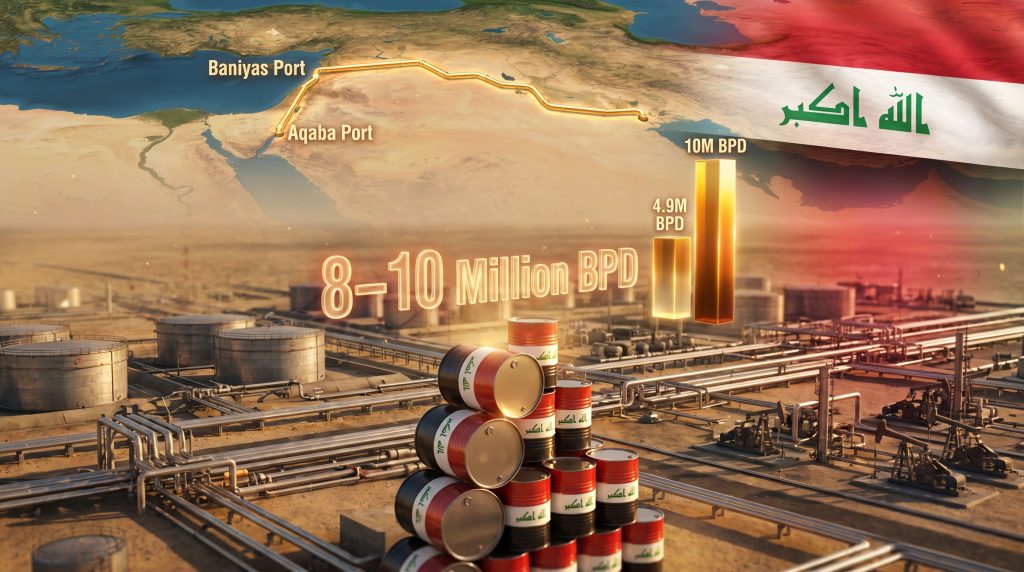
The Geology Beneath the Ambition: Why Iraq's Reservoir Reality Complicates Its 10 Million BPD Dream
When analysts assess sovereign oil production targets, the tendency is to focus on politics, capital, and diplomacy. These factors matter enormously, but beneath every barrel lies a geological reality that no amount of ministerial delegation can renegotiate. Iraq sits atop some of the most prolific carbonate reservoirs on the planet, yet the very characteristics that make its fields so productive also introduce technical constraints that quietly cap the ceiling on how fast output can realistically scale. Understanding these subsurface dynamics is essential context for evaluating whether Iraq oil output to 10 million bpd is operationally grounded or primarily strategic signalling.
When big ASX news breaks, our subscribers know first
Defining the Scale of the Challenge: Iraq's Production Gap in Numbers
Iraq's current production capacity is estimated at approximately 4.9 million barrels per day, according to IEA assessments covering the 2024 to 2025 baseline period. The announced target range of 8 million to 10 million bpd within six years represents a production increase of between 63% and 104% over that existing baseline. To contextualise the ambition, only Saudi Arabia and Russia have sustained output at or above 10 million bpd at scale, and both nations benefit from decades of infrastructure maturity that Iraq does not yet possess.
| Milestone | Target Output | Timeline |
|---|---|---|
| Previous near-term target | ~7 million bpd | Mid-2020s |
| New announced ambition | 8 to 10 million bpd | Within 6 years |
| Current IEA capacity estimate | ~4.9 million bpd | 2024 to 2025 baseline |
| Saudi Arabia (sustained capacity) | ~12 million bpd | Established infrastructure |
This is not an incremental production upgrade. It is a prospective doubling of national output, a category of ambition not publicly declared by a major OPEC member in recent memory. Furthermore, the challenge extends well beyond permitting and investment mobilisation, as the current crude oil market overview reveals when examining the broader supply dynamics at play.
Why Baghdad Chose This Moment to Make Its Announcement
Iraqi Prime Minister Ali al-Zaidi unveiled the 8 to 10 million bpd target at the Baghdad Dialogue conference, a deliberate choice of platform that maximised diplomatic and investor visibility simultaneously. The timing is analytically significant. OPEC+ is navigating one of its most complex internal negotiation periods in years, with quota compliance disputes and market share tensions running beneath the surface of every ministerial communique.
A ministerial committee was dispatched to Saudi Arabia specifically to negotiate an expanded OPEC production quota for Iraq, a prerequisite that underscores a fundamental structural constraint. Without formal quota expansion from within the cartel, any meaningful increase in Iraqi output risks diplomatic friction with fellow member states, regardless of how much capital flows into southern oilfields. The OPEC influence on oil markets has rarely been more consequential than in this current negotiation environment.
Iraq also confirmed it is actively pursuing alternative export corridors, specifically through Syria's Baniyas port on the Mediterranean and Jordan's Aqaba port on the Red Sea. Both routes are designed to reduce Iraq's overwhelming dependence on the Basra Oil Terminal and the Strait of Hormuz chokepoint that currently handles the vast majority of the country's crude exports.
The Three Scenarios for Iraq's Production Trajectory to 2031
Rather than treating the 10 million bpd figure as a binary outcome, a scenario-based framework more accurately captures the probability distribution of realistic outcomes.
Scenario 1: Full Investment Mobilisation and OPEC Cooperation
The optimistic case assumes rapid foreign direct investment inflows, successful OPEC quota expansion negotiated through Riyadh, and accelerated development across Iraq's southern super-giant fields: Rumaila, West Qurna 1 and 2, Majnoon, and Halfaya. Each of these fields holds multi-decade production potential, but each also requires substantial capital injections to expand water injection capacity, upgrade surface facilities, and extend pipeline throughput.
Achieving the upper end of the target would require a capital commitment measured in the hundreds of billions of dollars across six years, a figure that has historically exceeded what Iraq's investment climate has been able to attract and deploy efficiently. According to reporting on Iraq's production ambitions, Baghdad aims to reach this output within six years, underlining the scale of the undertaking.
Probability assessment: Low to moderate under current geopolitical and fiscal conditions.
Scenario 2: Partial Progress Reaching 7 to 8 Million BPD
The moderate scenario represents the most analytically credible outcome. It builds on existing IOC contracts, gradual infrastructure improvements, and a negotiated but partial quota adjustment from OPEC. This trajectory aligns with Iraq's historical pattern of announcing aggressive targets and delivering meaningful but partial progress against them.
Probability assessment: Moderate and represents the most defensible base case.
Scenario 3: Stagnation Near 5 to 6 Million BPD
The constrained scenario reflects the persistent structural headwinds that have historically capped Iraqi oil sector growth despite the country's vast proven reserves. Political fragmentation, chronic budget disputes between Baghdad and the Kurdistan Regional Government (KRG), infrastructure underinvestment, and water injection shortfalls in ageing reservoirs all contribute to this risk pathway.
Probability assessment: Moderate to high if systemic governance challenges remain unresolved.
The Subsurface Reality: Geological Factors That Set the True Ceiling
One of the least-discussed constraints on Iraqi production expansion is the geological behaviour of its carbonate reservoirs. Iraq's giant fields are predominantly hosted in Cretaceous carbonate formations, which are highly porous but also highly heterogeneous. This heterogeneity means that reservoir pressure and fluid distribution are uneven across field extents, complicating water injection programmes designed to maintain reservoir pressure and sustain production rates.
The water injection challenge is not merely a financial problem; it is a reservoir engineering challenge. Injecting water into a heterogeneous carbonate system without adequate geological modelling can accelerate unwanted water breakthrough into production wells, permanently reducing field recovery factors. Several of Iraq's largest fields are already showing early signs of pressure depletion that, if mismanaged, could result in production decline rates that offset any new capacity additions from drilling programmes.
Technical note: Recovery factors in Iraq's carbonate fields are estimated to average between 20% and 30%, significantly below the theoretical maximum achievable with optimal pressure maintenance. Closing this gap represents a major upside opportunity but also a major technical challenge requiring sustained IOC expertise and capital.
Additionally, associated gas management presents a secondary bottleneck that is rarely foregrounded in production discussions. Iraq flares a significant proportion of its associated gas rather than capturing it for power generation or export. This is not simply an environmental issue: flaring represents a loss of energy that could otherwise power oilfield operations, reducing Iraq's dependency on imported fuel and lowering operating costs for expanded production programmes.
Infrastructure Deficits: The Bottleneck That Capital Alone Cannot Instantly Solve
Even with unlimited investment, physical infrastructure constraints impose their own timeline on production ramp-up. The key bottlenecks include:
- Export terminal capacity: The Basra Oil Terminal complex is already operating near its throughput ceiling. Expanding capacity requires marine infrastructure investment with multi-year lead times.
- Water injection systems: Chronically underfunded relative to the scale of fields they are meant to sustain, these systems require not just capital but specialised engineering expertise to deploy effectively in carbonate reservoirs.
- Power supply reliability: Oilfield operations across southern Iraq face inconsistent electricity supply, forcing costly workarounds that constrain drilling and completion programme efficiency.
- Pipeline redundancy: Iraq's internal pipeline network lacks the redundancy needed to absorb a doubling of throughput without significant new corridor construction.
None of these infrastructure gaps can be closed within a single budget cycle. Each represents a multi-year engineering programme with its own procurement, contracting, and commissioning timeline.
The next major ASX story will hit our subscribers first
OPEC Dynamics: The Quota Credibility Problem
Iraq's history within the OPEC+ framework adds a diplomatic complexity to its quota expansion request. Baghdad has been among the most persistent quota overproducers within the alliance, regularly exceeding agreed output ceilings and subsequently submitting compensatory cut schedules that have not always been fully honoured. This track record creates a credibility deficit that Saudi Arabia and other OPEC+ members will weigh carefully, and the broader oil prices and OPEC tensions further complicate the negotiating environment.
The implicit tension is straightforward: rewarding a consistent overproducer with a formal quota increase risks signalling to other member states that compliance carries no real consequence. Saudi Arabia, as the de facto anchor of OPEC+ production discipline, has strong structural incentives to manage this precedent carefully.
If Iraq were to approach even 80% of its Iraq oil output to 10 million bpd ambition, the production gap between Baghdad and Riyadh would narrow substantially, fundamentally redistributing internal OPEC+ bargaining power. This dynamic creates a dual incentive for Saudi Arabia: genuine economic interest in an ally's prosperity on one hand, and a strategic preference for maintaining its own role as the dominant swing producer on the other.
The Alternative Export Corridor Strategy: Analysing Baniyas and Aqaba
| Export Route | Geography | Strategic Benefit | Key Risk |
|---|---|---|---|
| Baniyas Port, Syria | Mediterranean | European market access, reduced Hormuz exposure | Syrian political instability, infrastructure rehabilitation costs |
| Aqaba Port, Jordan | Red Sea | Asian and European diversification | New pipeline construction, Jordanian transit agreements |
| Basra Oil Terminal | Arabian Gulf | Established high-volume throughput | Capacity constraints, Hormuz chokepoint exposure |
The Baniyas route carries a significance that extends beyond logistics. Operationalising it would represent the first time Iraqi crude has flowed to Mediterranean markets via Syrian territory in decades, a geopolitical realignment with implications for regional energy architecture. The Syrian infrastructure would require substantial rehabilitation investment before it could handle meaningful crude volumes.
The Aqaba corridor similarly demands new pipeline construction through Jordanian territory, a multi-year capital project that would need to be negotiated, financed, built, and commissioned before it could contribute to Iraq's export diversification objectives. The broader geopolitical market landscape provides further context for understanding how such regional shifts reverberate across commodity markets globally.
Global Market Implications: What 10 Million BPD Iraq Means for Crude Prices
If Iraq were to approach its upper production target, the incremental supply impact on global markets would be significant. An additional 5 million bpd above current Iraqi output, measured against global consumption of approximately 103 million bpd, represents a supply increase of roughly 5%. Historical analysis of oil market supply shocks suggests that a sustained 5% supply increase, without a corresponding demand increase, can exert meaningful downward pressure on Brent and WTI benchmark prices.
The pace of ramp-up matters as much as the endpoint. A gradual six-year expansion allows market absorption mechanisms to operate. A more rapid increase, were it somehow achievable, would more acutely compress prices. For investors monitoring oil-linked equities and commodity derivatives, the credible trajectory of Iraqi capacity expansion is therefore a material variable in long-term price modelling.
The 2031 production horizon also sits uncomfortably against IEA net-zero pathway projections, which anticipate significant reductions in fossil fuel demand by the early 2030s under accelerated transition scenarios. Iraq's production ambitions represent an implicit wager that global oil demand remains robust through the 2030s, a scenario that remains genuinely contested, particularly given the energy transition pressures increasingly shaping long-term demand forecasts. Independent analysis, including assessments of why Iraq hasn't yet reached 10 million bpd, highlights the structural and operational barriers that continue to constrain progress.
Frequently Asked Questions: Iraq's 10 Million BPD Production Target
What is Iraq's current oil production capacity?
Iraq's oil production capacity is estimated at approximately 4.9 million barrels per day according to IEA data, reflecting output from major southern fields including Rumaila, West Qurna, and Majnoon.
How long would it take Iraq to reach 10 million bpd?
The Iraqi government has outlined a six-year timeline, though independent analysis broadly considers this timeline highly optimistic given the infrastructure, governance, and investment constraints currently in place.
Does Iraq need OPEC's approval to increase production?
Yes. As an OPEC member bound by the OPEC+ quota framework, Iraq requires formal quota expansion to legitimately raise output beyond current ceilings. A ministerial committee has been dispatched to Saudi Arabia to negotiate this directly.
Which fields would drive Iraq's production increase?
The primary candidates are Rumaila, West Qurna 1 and 2, Majnoon, and Halfaya, all located in the southern Basra region and operated under contracts with major international oil companies.
What are the principal risks to achieving the target?
Key risks include water injection infrastructure shortfalls in carbonate reservoirs, the Baghdad to Erbil revenue-sharing dispute, OPEC quota limitations, associated gas flaring inefficiencies, political fragmentation, and long-term demand uncertainty driven by the global energy transition.
What Investors and Energy Analysts Should Watch
For those tracking Iraq oil output to 10 million bpd as an investment or market intelligence signal, the following indicators offer the most reliable leading data:
- OPEC quota negotiation outcomes between Baghdad and Riyadh, specifically whether Iraq secures a formally elevated production ceiling or continues operating in a grey zone of managed overproduction.
- IOC capital commitment announcements from operators at Rumaila, West Qurna, Majnoon, and Halfaya as proxies for near-term production intent.
- Water injection programme milestones as a technical indicator of reservoir management quality and sustainable production growth potential.
- IEA and OPEC monthly production data for Iraq as a real-time capacity tracker against stated targets.
- Baghdad to Erbil political developments as a leading indicator of upstream investment confidence in Kurdish region fields.
- Progress on Baniyas and Aqaba export corridor infrastructure as evidence that alternative route ambitions are moving from announcement to engineering reality.
This article contains forward-looking analysis and scenario modelling based on publicly available data, IEA assessments, and established industry frameworks. It does not constitute financial or investment advice. Readers should conduct independent due diligence before making any investment decisions related to energy sector assets or oil-linked instruments.
For ongoing coverage of Iraq's energy sector and OPEC+ production dynamics, Zawya's Energy section at zawya.com/en/business/energy provides continuous reporting on Middle East oil market developments and policy shifts.
Want to Stay Ahead of the Next Major Resource Discovery Before the Market Moves?
While Iraq's production ambitions play out across a six-year horizon, ASX-listed resource opportunities can shift within hours of a significant announcement — Discovery Alert's proprietary Discovery IQ model scans daily ASX announcements in real time, delivering actionable insights across more than 30 commodities to both short-term traders and long-term investors. Explore how historic mineral discoveries have generated substantial returns on Discovery Alert's discoveries page, and begin your 14-day free trial today to position yourself ahead of the broader market.