August 23, 2026
The Psychological Trap That Keeps Costing British Savers Thousands
Every generation of investors faces a version of the same crisis: the realisation, arriving always too late, that the assets they dismissed as unnecessary would have transformed their financial position. This is not a story about market timing. It is a story about the structural forces that keep ordinary savers locked inside familiar but underperforming financial products, even when the evidence for change accumulates in plain sight.
The Royal Mint's recent survey data brings this dynamic into sharp focus for UK adults, but the behavioural pattern it exposes is far older and far more universal than any single poll. Understanding why so many Brits regret not buying gold is only half the challenge. The more consequential question is why, armed with that regret, the majority appear poised to repeat the same inaction all over again.
When big ASX news breaks, our subscribers know first
What the Royal Mint Research Actually Reveals About UK Savings Behaviour
The survey findings carry more weight than a simple headline about missed returns. They reveal a structural disconnect between what people know, what they feel, and what they actually do with their money.
Key Statistics From the Survey at a Glance
| Metric | Figure |
|---|---|
| UK adults who regret not buying gold (last 5 years) | 1 in 3 (33%) |
| UK adults who regret not buying silver | 30% |
| Gold's 5-year price appreciation | ~128-150% |
| Silver's 5-year price appreciation | ~126-200% |
| Adults who actually held gold savings | 8% |
| Adults who actually held silver savings | 3% |
| Adults relying on high-street current accounts | ~63% |
| Adults who regret missing Bitcoin gains | 20% |
| Adults likely to invest in precious metals next 5 years | Only 25% |
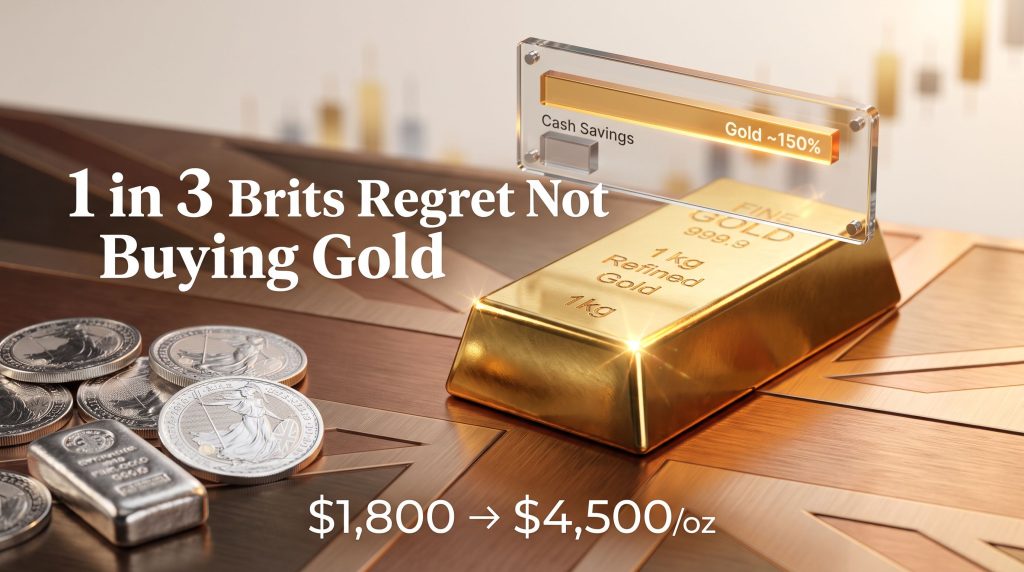
Key Insight: More Brits wish they had purchased gold than wish they had bought cryptocurrency. Gold's regret score outranked Bitcoin's by a significant margin, yet the majority of respondents still indicated they would make no meaningful change to their savings behaviour going forward. According to Royal Mint research, one in three UK adults openly admit to regretting missing out on gold's remarkable five-year price surge.
Why Gold Regret Outranks Crypto Regret Among UK Adults
The fact that gold generates more regret than Bitcoin among British savers is instructive. Cryptocurrency carries a cultural association with speculation and complexity, which may explain why its non-ownership feels less like a mistake and more like a conscious decision. Gold, by contrast, is widely understood as a store of value. People recognise it, trust it in the abstract, and yet still avoided it in practice. That gap between familiarity and action is precisely what makes the regret so acute.
Furthermore, the broader appeal of gold as a safe haven continues to resonate with UK investors, particularly as global uncertainty persists across multiple economic fronts.
The 63% Problem: Why High-Street Current Accounts Remain the Default
Approximately 63% of UK adults continue to hold their savings primarily in high-street current accounts. These accounts offer near-zero real returns in most interest rate environments and provide no structural protection against purchasing power erosion. The persistence of this behaviour, despite five years of demonstrable gold and silver outperformance, points to something deeper than a lack of information. It reflects the grip of institutional familiarity and the psychological comfort that comes from doing what feels normal.
How Does Gold's 5-Year Performance Compare to Traditional UK Savings Options?
Gold vs. Cash Savings Accounts: A Purchasing Power Comparison
Over the past five years, gold has appreciated by approximately 128-150% in price terms. Silver delivered an even more striking performance, with gains in the region of 126-200% depending on the measurement window. Set against these figures, the returns available from standard UK savings accounts tell a very different story.
- Gold appreciation (5-year): approximately 128-150%
- Average UK savings account return (5-year): Materially below inflation for most of the period
- Bank of England 2% annual inflation target: Compounds to roughly 10% purchasing power loss per five-year cycle
Gold vs. Silver vs. Bitcoin: Which Asset Class Delivered for UK Investors?
| Asset | 5-Year Return (Approx.) | Volatility Profile | Accessibility for UK Retail Investors |
|---|---|---|---|
| Gold | ~128-150% | Low-to-moderate | High (Royal Mint, ETFs, coins) |
| Silver | ~126-200% | Moderate-to-high | High |
| Bitcoin | High but variable | Very high | Moderate |
| High-street savings account | Low (often below inflation) | Minimal | Very high |
For investors weighing their options, understanding physical gold vs ETFs is an essential starting point before committing to any particular approach.
The Real Cost of Sitting in Cash: Inflation's Compounding Erosion
Featured Insight: At the Bank of England's stated 2% annual inflation target, a saver who holds £100,000 in a non-interest-bearing current account will see the real purchasing power of that sum fall to approximately £90,000 in five years, and closer to £82,000 within a decade. This is not a market accident. It is a mathematically predictable outcome of central bank policy.
The compounding nature of inflation is one of the least-discussed features of modern monetary policy in mainstream financial media. Each year's 2% erosion applies not to the original sum, but to the already-diminished balance. Over long periods, this creates a silent but significant wealth transfer away from cash savers and toward holders of real assets. Gold's role as a gold and inflation hedge is, consequently, not simply a theoretical concept but a mathematically demonstrable financial reality.
Is the UK's Monetary Policy Environment the Real Driver of Gold's Rise?
Understanding the 2% Inflation Target as a Structural Wealth Erosion Mechanism
Both the Bank of England and the US Federal Reserve operate under a 2% annual inflation mandate. This is not an accident or a failure of policy. It is the stated objective. Central banks believe a modest, predictable rate of inflation encourages spending and investment by discouraging the hoarding of cash. For policymakers, this is a feature. For savers holding cash, it functions as a slow-moving structural cost.
The critical insight here, and one that gets consistently overlooked in public debate, is that monetary debasement is not caused by geopolitical instability. Wars, sanctions, and supply chain disruptions can accelerate or amplify inflationary episodes, but the underlying mechanism driving long-term purchasing power erosion is deliberate domestic policy. The Bank of England does not target 0% inflation. It targets 2% because that level of currency dilution is considered economically optimal for growth.
Central Bank Policy and Its Long-Term Impact on Fiat Currency Purchasing Power
Gold's long-term price trajectory closely mirrors the cumulative debasement of major fiat currencies. Between 1971, when the US severed the dollar's link to gold entirely, and the present day, the purchasing power of the US dollar has declined by more than 95% in real terms. Gold, denominated in that same dollar, has risen from roughly $35 per ounce to figures well above $4,000 per ounce over the same period.
This is not coincidence. Gold does not generate income. It does not pay dividends. Its price appreciation is, in large part, a reflection of currency units becoming worth less over time. Understanding this mechanism changes the framing of the investment case entirely. Moreover, central bank gold demand from emerging market nations seeking to reduce US dollar dependency has added a further structural layer of support to gold's long-term price floor.
What 73% of UK Adults Are Actually Worried About, and What They're Missing
Callout: Survey data shows 73% of UK adults are concerned about how global conflicts and economic instability could affect the value of their money. This concern is legitimate, but the primary driver of purchasing power loss for British savers is not geopolitical risk. It is the Bank of England's own 2% inflation target, applied every single year without exception.
Geopolitical events create volatility. Inflation policy creates certainty. The former is unpredictable and episodic. The latter is guaranteed and cumulative. A savings strategy built around the assumption that only the former matters is structurally incomplete.
Why Did So Few UK Adults Actually Buy Gold? Examining the Participation Gap
The 8% Problem: Why Precious Metals Ownership Remains Marginal in the UK
Despite gold's sustained multi-year rally, only 8% of UK adults held any gold savings over the past five years, and a mere 3% held silver. These participation rates are strikingly low given the widespread awareness of gold's traditional role as a store of value. Several behavioural factors explain this gap, and they are consistent across generations and income levels.
Psychological Barriers to Gold Investment Among British Retail Savers
-
Familiarity bias: High-street bank accounts carry an institutional credibility that feels impossible to replicate. Savers default to what they know.
-
Complexity perception: Many UK adults mistakenly assume that buying gold requires specialist knowledge, large sums of capital, or access to opaque financial markets. In reality, the Royal Mint, ETFs, and digital gold platforms have made access straightforward.
-
Recency anchoring: Investors who watched gold rise from $1,800 per ounce to $4,500 per ounce often conclude that the opportunity has expired. The price looks high relative to recent memory, even if the structural case for further appreciation remains intact.
-
Institutional inertia: Most UK pension products and employer savings schemes do not offer direct commodity exposure. Savers accumulate wealth through the vehicles available to them, and gold rarely appears on that default menu.
-
Loss aversion asymmetry: Behavioural finance research consistently shows that the psychological pain of a perceived loss outweighs the pleasure of an equivalent gain. For savers who have never held gold, the prospect of buying at a perceived peak and then seeing prices fall feels more threatening than the certain, ongoing loss embedded in cash savings.
How the Intention-Action Gap Plays Out in UK Investing
Survey research consistently demonstrates that stated future intentions do not reliably predict actual behaviour. When asked whether they would invest in precious metals over the coming five years, only 25% of respondents said it was likely. Given that less than 10% actually did so over the previous five years despite clear outperformance, the real participation rate going forward may be even lower than expressed intent suggests.
Will Gold Continue to Rise? The Forward-Looking Case for Precious Metals
The Structural Conditions That Could Push Gold Higher Over the Next Five Years
- Persistent central bank inflation targeting in both the UK and the United States
- Continued expansion of sovereign debt in major economies, increasing the incentive to inflate away obligations
- Active central bank gold accumulation by emerging market nations seeking to reduce US dollar dependency in their reserve holdings
- Geopolitical fragmentation increasing institutional and retail safe-haven demand
- Growing awareness among retail investors in major markets of the long-term costs of holding cash
At What Price Will Future Investors Wish They Had Bought Today?
Scenario Projection: Gold traded near $1,800 per ounce five years ago. It has since climbed to approximately $4,500 per ounce. The structural monetary conditions that drove that appreciation, specifically persistent inflation targeting, sovereign debt expansion, and currency debasement, have not been resolved or reversed. An investor who waits for certainty before acting risks finding themselves in an identical position five years from now, lamenting inaction at today's prices.
Is $4,500 Gold the New $1,800? How Entry Point Psychology Distorts Decision-Making
One of the most consistent errors in long-term investing is the belief that the right time to buy was always in the past. This is sometimes called the recency anchor problem. When gold was at $900 per ounce, investors hesitated because it felt expensive relative to its $300 price point a decade earlier. When it reached $1,800, the $900 price looked like the obvious entry point in hindsight. The same psychological mechanism is now operating at $4,500, with $1,800 serving as the reference point for regret.
This pattern does not repeat because investors are irrational. It repeats because the structural forces driving gold higher are continuous, not episodic. Each cycle of regret is simply the previous opportunity viewed through the lens of elapsed time. In addition, consulting a gold-silver ratio guide can help investors make more informed decisions about relative value between the two metals at any given price point.
The next major ASX story will hit our subscribers first
How Can UK Savers Actually Invest in Gold and Silver Today?
Practical Entry Points for British Retail Investors
- Royal Mint physical gold and silver: The Royal Mint offers direct purchase of coins and bars, with optional secure storage through its vault service
- Gold ETFs and ETCs: Exchange-traded products listed on the London Stock Exchange provide price exposure to gold and silver without the need for physical storage or specialist knowledge
- Gold ISAs: Certain precious metals investments can be held within tax-efficient ISA wrappers, reducing the capital gains tax liability on appreciation
- Allocated vs. unallocated accounts: Allocated accounts hold specific, identifiable physical metal on behalf of the investor and carry lower counterparty risk. Unallocated accounts represent a claim against a pool of metal held by the provider and carry greater credit exposure if the institution fails.
- SIPP-linked gold exposure: Self-Invested Personal Pensions can, in certain structures, incorporate gold ETFs or mining equities, allowing commodity exposure within a pension framework
How Much of a Portfolio Should Be Allocated to Precious Metals?
| Investor Profile | Suggested Precious Metals Allocation Range | Rationale |
|---|---|---|
| Conservative (capital preservation) | 10-15% | Hedge against inflation and currency risk |
| Balanced (moderate growth) | 5-10% | Diversification without over-concentration |
| Growth-oriented | 3-7% | Tactical hedge within a broader equity-heavy portfolio |
| Inflation-focused | 15-20%+ | Deliberate purchasing power protection strategy |
Important Note: The allocation ranges above are illustrative only and do not constitute financial advice. Individual circumstances, risk tolerance, time horizons, and existing asset exposure vary significantly. Readers should consult a qualified independent financial adviser before making any investment decisions.
The Behavioural Lesson: How to Stop Repeating the Same Investment Regret Cycle
Step-by-Step Framework for Breaking the Inaction Loop
-
Acknowledge the structural risk. Understand that 2% annual inflation is not a warning or a forecast. It is the Bank of England's confirmed policy target, guaranteed to erode purchasing power every single year.
-
Audit current savings exposure. Calculate what proportion of your total savings is sitting in accounts earning returns below the rate of inflation. This is the portion actively losing real value.
-
Establish a precious metals allocation target. Even a modest 5-10% reallocation from cash to gold or silver materially changes the long-term inflation risk profile of a savings portfolio.
-
Choose an appropriate access method. Physical metal suits investors prioritising counterparty-free ownership. ETFs suit those prioritising liquidity. ISA-wrapped products suit those seeking tax efficiency. The right choice depends on individual circumstances.
-
Commit to an annual review. Monetary policy, inflation data, and gold's relative valuation all shift over time. A once-set-and-forgotten allocation is not a strategy. Build a cadence for reassessment into your financial planning.
Why Regret Is Only Useful If It Changes Future Behaviour
Callout: The same psychological forces that kept 92% of UK adults out of gold over the past five years, specifically familiarity bias, complexity aversion, and institutional inertia, remain fully intact unless deliberately confronted. Awareness of a missed opportunity does not automatically produce corrective action. Only a deliberate structural intervention in savings behaviour does.
The Royal Mint's research is valuable precisely because it quantifies a pattern that most investors sense but rarely examine rigorously. Regret without behavioural change is simply a record of repeated error. The investors who will look back five years from now with satisfaction are not those who predicted the gold price most accurately. They are those who understood the structural case for precious metals, acted on it, and stayed the course regardless of short-term volatility.
The window to avoid the next cycle of regret is open. History, monetary policy, and behavioural data all suggest it will not stay open indefinitely.
This article is for informational and educational purposes only. Nothing contained herein constitutes financial, investment, legal, or tax advice. Precious metals investments carry risk, including the possible loss of principal. Past performance is not indicative of future results. Readers should seek independent financial advice tailored to their personal circumstances before making any investment decisions.
Want to Spot the Next Major Mineral Discovery Before the Broader Market Does?
While precious metals like gold and silver offer powerful protection against inflation and currency erosion, investors seeking exposure to transformative discovery-driven returns can use Discovery Alert's proprietary Discovery IQ model to receive real-time ASX mineral discovery alerts — turning complex geological data into actionable insights — with a 14-day free trial available to get started, or explore historic discovery returns to understand just how significant early-mover positioning can be.