
August 23, 2026
The Hidden Architecture of Energy Security: Why Pipeline Infrastructure Defines Market Power
Most discussions about Saudi Arabia's global oil dominance focus on production capacity, reserve volumes, or OPEC+ quota politics. Fewer examine the less visible but equally critical question of how those barrels actually reach their buyers. In an era of accelerating geopolitical fragmentation, the physical infrastructure connecting oil fields to export terminals is quietly becoming one of the most consequential variables in global energy markets. The Saudi Arabia Petroline expansion debate, which intensified significantly through 2026, sits at precisely this intersection of logistics, strategy, and long-term competitive positioning.
Understanding why this matters requires stepping back from the headlines and examining the structural architecture of Saudi Arabia's export system, what it was designed to achieve, and why its limits are now being stress-tested in real time.
When big ASX news breaks, our subscribers know first
The Strait of Hormuz: A Chokepoint That Shapes Global Oil Pricing
Roughly 20 to 21 million barrels of crude oil pass through the Strait of Hormuz every single day, representing approximately 20% of all global petroleum liquids trade. That single statistic encapsulates one of the most consequential vulnerabilities in the modern energy system. The strait's narrow geography, bordered to the north by Iran, means that political friction, naval posturing, or even credible military threats can send immediate ripples through global oil prices, regardless of whether physical shipping is actually interrupted.
For Gulf exporters, this is not an abstract risk. Saudi Arabia's primary oil processing hub at Abqaiq, along with its major Gulf terminals, feeds directly into shipping lanes that transit the strait. Under normal conditions, this arrangement is efficient. Under adversarial conditions, it represents a dangerous concentration of export exposure at a single geographic point. Furthermore, the relationship between oil prices and geopolitics has rarely been more relevant to understanding why infrastructure decisions carry such weight.
The fundamental problem with single-route dependency in energy infrastructure is that its true cost is invisible during periods of stability and catastrophic during periods of disruption. The Strait of Hormuz embodies this dynamic precisely.
Why Historical Crises Built the Infrastructure That Matters Today
The Petroline was not conceived as a commercial optimisation project. It was an emergency response. During the 1980s Tanker War, a destructive phase of the Iran-Iraq conflict in which oil tankers operating in the Gulf became deliberate military targets, Saudi Arabia faced the existential possibility of having its crude export capabilities physically severed.
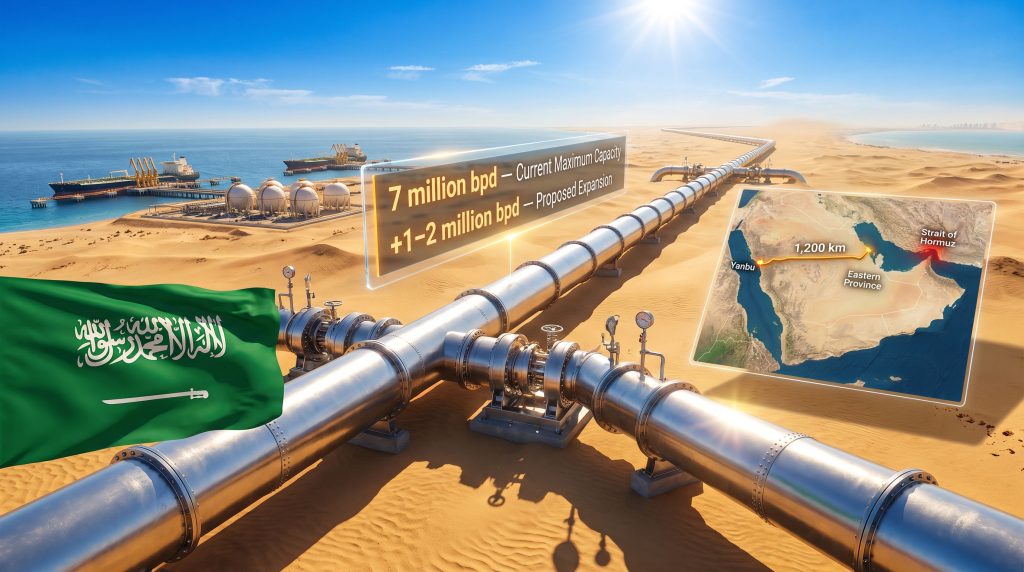
The response was to engineer a bypass: a pipeline stretching approximately 1,200 kilometres from the Eastern Province oil fields through the Saudi interior to the Red Sea port of Yanbu, entirely circumventing the Strait of Hormuz. This historical origin matters because it reveals the pipeline's fundamental design logic. It was built to function under conditions of crisis, not convenience. That same strategic calculus, largely dormant during the relatively stable post-Cold War decades, is now driving the Saudi Arabia Petroline expansion conversation in 2026.
Technical Profile: What the Petroline Is and How It Reached Its Limits
| Specification | Detail |
|---|---|
| Formal Name | East-West Crude Oil Pipeline (Petroline) |
| Operator | Saudi Aramco |
| Route | Abqaiq, Eastern Province to Yanbu, Red Sea |
| Approximate Length | 1,200 km |
| Current Maximum Capacity | 7 million barrels per day (bpd) |
| Proposed Expansion Volume | Up to 1 to 2 million additional bpd |
| Expansion Status | Under feasibility study, no final investment decision confirmed as of August 2026 |
| Strategic Function | Hormuz-bypass crude export corridor |
The pipeline's 2026 capacity story is instructive. Aramco's first-quarter results, published in May 2026, confirmed that the Petroline had been ramped up to its full operational ceiling of 7 million bpd in response to disruptions affecting Gulf shipping routes. This was not a planned operational milestone but a reactive deployment of contingency infrastructure, demonstrating that the pipeline functions as an active crisis management mechanism rather than a passive backup asset.
Aramco's President and CEO Amin H. Nasser publicly attributed the company's ability to sustain export continuity during the disruption period to its multi-decade investment in diverse infrastructure, specifically citing the East-West Pipeline alongside storage capacity and export terminals as the assets that enabled continued production and delivery despite challenging regional conditions.
The fact that the Petroline hit its maximum capacity ceiling during a period of regional stress is what transformed the expansion debate from a theoretical planning exercise into an operationally urgent strategic question. Consequently, long-term energy infrastructure investment decisions are now being scrutinised with far greater urgency across the sector.
What the Proposed Expansion Would Actually Involve
One of the most important distinctions in the Saudi Arabia Petroline expansion discussion is understanding what is actually being studied versus what has been decided. As of August 2026, Reuters reported that Saudi Arabia is evaluating an expansion of up to 2 million additional barrels per day, which would push the pipeline's total theoretical throughput toward 8 to 9 million bpd. However, no final investment decision has been publicly confirmed, and the project remains in a feasibility and evaluation phase.
Two broad infrastructure pathways are under consideration:
-
Upgrades to existing pipeline infrastructure, including enhanced pumping stations, booster capacity, and flow rate optimisation along the current corridor. This approach carries lower capital intensity but offers limited incremental throughput gains.
-
Construction of a new parallel pipeline line, potentially configured to carry refined products rather than crude alone. This pathway is more capital-intensive and requires a longer construction timeline, but would offer greater operational flexibility and allow Saudi Arabia to export a wider range of petroleum products through its western coast.
Critical Distinction for Investors and Analysts: No additional bypass capacity currently exists beyond the existing 7 million bpd ceiling. Any meaningful increase in throughput would require substantial new construction, formal capital allocation, and regulatory authorisation. This should be treated as a strategic option under active study, not a confirmed infrastructure programme.
The expansion is consistently characterised across credible industry sources as a multi-year, multi-billion dollar undertaking if it proceeds. The scale and complexity of the project means that even a positive final investment decision would translate into years of engineering, procurement, and construction activity before any additional export capacity becomes operational.
Three Geopolitical Scenarios That Make Expansion Strategically Urgent
The timing of the Petroline expansion conversation is not coincidental. Three converging scenarios are shaping the strategic calculus, and each reflects the broader pattern of geopolitical trade tensions that are reshaping energy markets globally.
Scenario One: Sustained Hormuz Tension
If geopolitical friction around the Strait of Hormuz persists or intensifies beyond its current levels, Saudi Arabia's capacity to guarantee contracted export volumes to Asian and European buyers becomes structurally dependent on alternative routing. A 2 million bpd expansion would allow the Kingdom to redirect a meaningfully larger proportion of its crude flows westward through Yanbu without requiring production adjustments, directly addressing buyer concerns about delivery reliability.
Scenario Two: Competitive Pressure in Global Oil Markets
As global energy markets become more crowded, with US shale production, Canadian oil sands, and emerging producers all competing for market share, Saudi Arabia's enduring competitive advantage increasingly rests not just on its extraordinarily low production costs but on its delivery reliability. Carole Nakhle, CEO of Crystol Energy and Secretary General of the Arab Energy Club, has framed this succinctly: spare production capacity carries limited strategic value if the produced barrels cannot physically reach the customer. Expanded pipeline infrastructure directly addresses this vulnerability by providing contractual certainty to long-term buyers, particularly in Asia and Africa where demand growth is projected to remain robust through the 2030s.
Scenario Three: Vision 2030 Infrastructure Convergence
The Petroline does not exist in isolation. It connects directly to the Red Sea port of Yanbu, which sits within a broader network of industrial cities, logistics zones, and maritime infrastructure investments that collectively underpin Saudi Arabia's ambition to become a globally significant logistics hub. The broader Saudi energy strategy makes clear that expanding pipeline throughput amplifies the strategic value of this entire western corridor, creating compound returns across energy, trade, and economic development objectives simultaneously.
Strategic Flexibility vs. Volume: Reframing What Expansion Achieves
A common analytical error in coverage of the Saudi Arabia Petroline expansion is to frame it primarily as a volume story. The more sophisticated reading, supported by expert analysis, is that its primary value is strategic flexibility rather than export maximisation.
Nakhle, speaking to Arab News, articulated this clearly: the proposed expansion represents an investment in strategic flexibility first and additional export capacity second. Her argument centres on the observation that additional export routing capacity reassures international buyers that a larger share of Saudi contracted volumes can be fulfilled even when traditional shipping routes experience disruption. This reassurance function carries direct market implications, specifically the moderation of risk premiums and market anxiety during periods of geopolitical tension.
At the same time, Nakhle is careful to manage expectations. She notes that an expansion would not eliminate Hormuz-related supply risk, nor would it replace the majority of exports that normally transit the strait. The pipeline serves as a risk mitigation layer, not a wholesale replacement of existing maritime infrastructure. Diversification of export routes reduces exposure; it does not eliminate it.
Her longer-term framing is equally important: expanded pipeline capacity alone does not guarantee higher export volumes. Global demand trajectories, OPEC+ production policy, and competition from other major producers will continue to be the primary determinants of Saudi export volumes. OPEC's market influence therefore remains a central factor in how any additional throughput capacity would ultimately be utilised. The expansion's market impact is consequently best understood as confidence signalling and risk hedging rather than a structural uplift in Saudi market share.
The next major ASX story will hit our subscribers first
Hydrocarbons Investment and Vision 2030: A False Dichotomy
Perhaps the most intellectually significant dimension of the Petroline debate is what it reveals about the relationship between continued hydrocarbon infrastructure investment and Saudi Arabia's long-term economic diversification agenda.
Yaseen Ghulam, Associate Professor of Economics and Director of Research at Al-Yamamah University in Riyadh, has directly challenged the narrative that investing in oil infrastructure is somehow in tension with Vision 2030's transformation goals. His analysis holds that the two strategies are structurally complementary rather than competing.
The logic is straightforward:
-
Oil revenues remain the primary financing mechanism for Vision 2030's transformation investments across technology, tourism, manufacturing, education, and renewable energy
-
Securing and expanding export infrastructure protects and stabilises those revenue flows
-
Greater revenue certainty directly translates into greater fiscal capacity for public investment programmes
-
Robust energy infrastructure creates an enabling environment for private sector investment across non-oil sectors
Ghulam's position, articulated to Arab News, is that a Petroline expansion would safeguard revenues by enhancing export security and operational flexibility, providing the greater certainty that long-term public investment programmes require. He further observes that Saudi Arabia's sovereign credit profile and international rating depend, among other factors, on the reliability of its oil export revenues, making pipeline infrastructure a fiscal policy instrument as much as an energy asset.
Infrastructure that protects the revenue base of a transformation economy is not a legacy investment. It is the financial architecture that makes transformation possible in the first place.
Could the Petroline Become a Shared Gulf Export Corridor?
One of the less widely discussed dimensions of the Saudi Arabia Petroline expansion is the possibility that it could evolve into a multi-country infrastructure asset serving the broader Gulf Cooperation Council. Reports suggest that Saudi Arabia is evaluating whether an expanded pipeline network could accommodate crude from neighbouring Gulf producers, effectively creating a regional Hormuz-bypass corridor rather than a purely bilateral Saudi infrastructure asset.
Ghulam has highlighted both the opportunity and the complexity embedded in this scenario. A shared export infrastructure network connecting GCC member states to Red Sea terminals would collectively reduce the bloc's geopolitical vulnerability while strengthening its collective positioning as a reliable supplier to global energy markets, a significant competitive advantage in an era of heightened energy security consciousness among major importing nations.
The governance and commercial challenges for such a regional framework are substantial:
| Challenge Category | Specific Issues |
|---|---|
| Governance Architecture | Establishing a transparent multilateral oversight framework with clear decision-making authority |
| Investment Allocation | Defining capital contribution responsibilities across participating states |
| Transit Terms | Agreeing on throughput rights, access conditions, and operational protocols |
| Revenue Sharing | Creating equitable and durable mechanisms for distributing commercial returns |
| Regulatory Harmonisation | Aligning technical standards and operational regulations across national jurisdictions |
Ghulam's assessment is measured but cautiously optimistic: given the decades of economic and diplomatic cooperation that already characterise GCC relationships, these challenges are more likely to be resolved through a transparent regional framework than to become permanent obstacles. If resolved effectively, a regional pipeline corridor could serve as both an economic milestone and a landmark demonstration of Gulf integration in practice.
Tracking the Expansion: From Study Phase to Potential Delivery
| Phase | Status (August 2026) | Key Indicators to Monitor |
|---|---|---|
| Feasibility Study | Ongoing | Aramco capital expenditure disclosures, Reuters reporting |
| Final Investment Decision | Not yet confirmed | Official Aramco or Saudi government announcements |
| Engineering and Design | Pre-FID | Contractor engagement, environmental assessments |
| Construction | Multi-year if approved | Procurement activity, construction contract awards |
| Commissioning | Timeline to be determined | Capacity test results, export volume data from Yanbu terminal |
Frequently Asked Questions: Saudi Arabia Petroline Expansion
What is the Petroline and where does it run?
The Petroline, formally designated the East-West Crude Oil Pipeline, is a roughly 1,200 km pipeline operated by Saudi Aramco. It connects the Abqaiq crude processing complex in Saudi Arabia's Eastern Province to the Red Sea port of Yanbu, providing an export route that entirely bypasses the Strait of Hormuz.
What capacity expansion is being studied?
Reports indicate Saudi Arabia is evaluating an increase of between 1 million and 2 million barrels per day beyond the pipeline's current maximum capacity of 7 million bpd, which would bring total potential throughput to between 8 and 9 million bpd.
Has the expansion been officially approved?
As of August 2026, no final investment decision has been publicly confirmed. The expansion remains in a feasibility and evaluation phase, and should be treated as a strategic option under study rather than a committed infrastructure programme.
Why does the Strait of Hormuz represent a risk for Saudi exports?
Approximately 20% of global petroleum liquids trade transits the strait daily. Its narrow geography and proximity to Iran create persistent geopolitical vulnerability for Gulf exporters, meaning any sustained disruption would immediately affect Saudi Arabia's ability to reach its primary customers through conventional maritime routes.
How does Petroline expansion relate to Vision 2030?
The pipeline connects to Yanbu within Saudi Arabia's western industrial and logistics corridor. Expanding throughput capacity amplifies the value of this corridor, supports the Kingdom's logistics hub ambitions, and protects the oil export revenues that finance Vision 2030's broader economic transformation agenda.
The Long-Term Verdict: Delivery Reliability as a Durable Competitive Moat
In a global energy landscape defined by intensifying competition, geopolitical fragmentation, and the long-term structural shift of the energy transition, Saudi Arabia's durable competitive advantage rests on three interconnected pillars: low production costs, substantial spare production capacity, and multi-route export reliability.
The Saudi Arabia Petroline expansion, if it advances from study to execution, would materially strengthen the third pillar. In doing so, it would reinforce the first two by ensuring that low-cost production and spare capacity can actually be translated into delivered barrels at the buyer's terminal, regardless of conditions in the Gulf.
Nakhle's concluding argument captures the long-term strategic logic: over the coming decade, competitive advantage in global oil markets will depend not only on the capacity to produce crude at low cost but on the demonstrated ability to deliver it reliably and efficiently across a range of geopolitical and market conditions. This is why the Petroline, a pipeline built for survival during an era of tanker warfare four decades ago, remains one of the most strategically consequential pieces of infrastructure in the modern global energy system.
Readers seeking broader analysis of Saudi Arabia's energy infrastructure strategy and Vision 2030 transformation agenda can explore ongoing coverage at Arab News, which provides detailed reporting on Saudi Arabia's energy sector developments and strategic infrastructure initiatives. This article contains forward-looking analysis and references to projects under study. Readers should note that no final investment decisions have been confirmed for the Petroline expansion as of the date of publication, and all projections regarding capacity, cost, and timeline should be treated as indicative estimates subject to change.
Want to Stay Ahead of Major Resource and Energy Discoveries Before the Broader Market Reacts?
Just as Saudi Arabia's pipeline infrastructure determines who controls delivery and who captures value, timing is everything in resource investing — and Discovery Alert's proprietary Discovery IQ model instantly identifies significant ASX mineral discoveries the moment they are announced, turning complex data across 30-plus commodities into clear, actionable insights for both short-term traders and long-term investors. Explore historic discoveries and their extraordinary returns on Discovery Alert's dedicated discoveries page, and begin your 14-day free trial today to position yourself ahead of the market.