
August 23, 2026
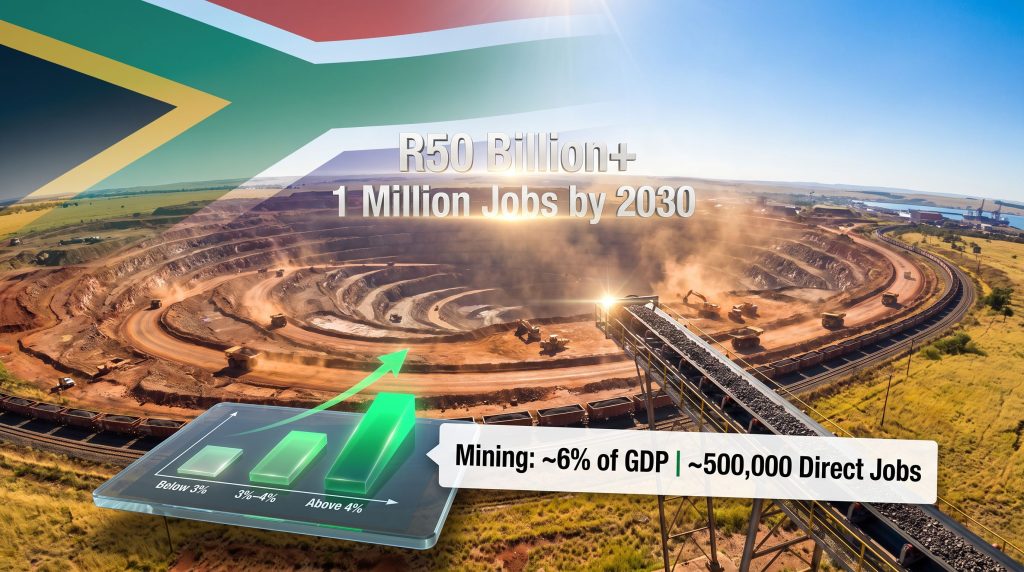
When Growth Becomes a Structural Imperative: South Africa's Mining Crossroads
There is a threshold in economic growth theory that separates stagnation from genuine transformation. For developing economies with large, young, and rapidly expanding labour forces, that threshold is not merely a statistical target. It is the dividing line between a society that absorbs its workforce and one that structurally excludes it. South Africa has been navigating that boundary for years, and the South Africa Government-Business Partnership phase three mining growth jobs initiative represents the most ambitious attempt yet to cross it decisively, with mining positioned as the primary engine of the effort.
When big ASX news breaks, our subscribers know first
The 3% Growth Threshold and Why It Changes Everything
Understanding why South Africa's phase three partnership places such emphasis on a specific growth figure requires stepping back from the politics and examining the raw mathematics of labour market absorption. South Africa currently has approximately 8.5 million people without work. Each year, roughly 300,000 net new work-seekers enter the labour force, a figure that reflects population growth, education system outputs, and shifting demographic patterns.
At growth rates below 3%, the economy simply cannot generate enough new economic activity to absorb this annual influx. Job creation falls short of demand, and the unemployment pool deepens incrementally, year on year. The compounding effect of this dynamic over a decade produces a structural employment crisis that becomes increasingly difficult to reverse. Above 3%, the mathematics flip. Employment creation begins to outpace new entrants, and growth compounds rather than erodes labour market participation.
The phase three partnership is built around a clear set of quantifiable ambitions:
| Indicator | Current Figure or Target |
|---|---|
| Unemployed South Africans | ~8.5 million |
| Net new work-seekers annually | ~300,000 |
| Mining sector GDP contribution | ~6% |
| Direct mining employment | ~500,000 |
| Capital unlock target | R50 billion+ |
| Capital unlock deadline | February 2028 |
| Job creation target by 2030 | 1 million |
| GDP growth target by 2030 | 3%+ |
"The arithmetic of South Africa's labour market makes 3% GDP growth not aspirational but structural. Below that line, economic activity creates the appearance of progress while unemployment quietly expands. Above it, job creation begins to compound in ways that reshape social and fiscal outcomes simultaneously."
What Phases One and Two Built: The Foundation That Made Phase Three Possible
Phase three does not arrive in a vacuum. Its credibility rests substantially on the measurable reforms that the two preceding phases delivered across South Africa's most critical economic bottlenecks. Understanding what was actually achieved helps contextualise the ambition of the current phase.
The energy stabilisation story is particularly striking. In 2023, South Africa endured 335 days of load-shedding, a figure that represented one of the most sustained power supply crises experienced by any major economy in recent decades. By the time phase three launched, load-shedding had ended entirely, and Eskom had returned to profitability for the first time in eight years. This was not a marginal improvement. It was a structural shift that removed one of the most frequently cited investment deterrents in the country.
Logistics recovery followed a similar trajectory. The Port of Durban, previously regarded as a drag on South Africa's export competitiveness, was recognised as the world's most improved port, a designation that carries significant weight for mining operations that depend on reliable bulk commodity export infrastructure. Rail and port inefficiency had been estimated by various industry bodies to cost the mining sector billions of rands annually in lost export revenue and delayed project economics.
Additional phase one and two achievements include:
- South Africa's first primary budget surplus in 15 years, restoring a degree of fiscal credibility that directly influences sovereign credit assessments and the cost of capital for investment
- Exit from the Financial Action Task Force grey list, a milestone that reduces compliance costs for international capital flows and signals improved anti-money laundering governance
- Accelerated implementation of structural reforms through Operation Vulindlela, which targets regulatory and administrative constraints across multiple sectors
The central risk that phase three is explicitly designed to address is reversibility. Reforms achieved under political or crisis conditions can unravel when pressure eases or leadership changes. However, phase three is built around the principle of embedding these gains so deeply into institutional frameworks that backsliding becomes structurally difficult rather than merely politically undesirable.
Is Phase Three Built to Last?
The Minerals Council South Africa's government-business partnership framework signals that this phase is specifically engineered for durability. Furthermore, the South Africa mining decline context makes the case for structural embeddedness even more compelling, given the sector's recent operational challenges.
Mining as a Growth Driver: Why the Evidence Points Here
The selection of mining as one of four designated growth drivers in phase three was described by partnership leadership as emerging from a disciplined, evidence-led assessment rather than sector lobbying. The criteria applied were specific: materiality and scale relative to GDP, the capacity to absorb large numbers of workers including lower-skilled and youth labour, the ability to generate impact across both rural and urban geographies, and the potential for targeted interventions to unlock investment relatively quickly.
Mining scores exceptionally across all of these dimensions. With a direct GDP contribution of approximately 6% and direct employment of roughly 500,000 people, the sector is already one of the largest organised employers in the country. However, the more compelling case is the multiplier effect, a concept that describes how each direct mining job typically generates multiple indirect jobs across supply chains, transport, retail, and community services in mining-adjacent regions.
The four growth drivers selected for phase three reflect complementary economic profiles:
| Growth Sector | Primary Advantage | Employment Profile | Investment Type |
|---|---|---|---|
| Mining | Critical mineral endowment, export revenue | Large-scale, lower-skilled, rural | Domestic + Foreign Direct Investment |
| Tourism | Geographic diversity, wildlife assets | Service-sector, youth-accessible | Domestic + International |
| Infrastructure | Public investment multiplier | Construction, skilled trades | Public-private partnerships |
| Agriculture and Agro-Processing | Arable land, export potential | Rural, smallholder scalable | Domestic + Development Finance |
Mining's inclusion is not simply about its current contribution. It is about what the sector could contribute over the next two to three decades, particularly given shifting metals and mining geopolitics and the structural change in global mineral demand driven by the clean energy transition.
The R50-Billion Capital Unlock: Understanding Where the Money Is Trapped
One of the most analytically important dimensions of the phase three mining agenda is the framing around the R50-billion capital unlock target. This figure is frequently misunderstood. It does not refer to new foreign investment being attracted from overseas. It refers specifically to capital that is already committed, already planned, and already onshore, but currently stalled due to administrative friction and regulatory complexity.
This distinction matters enormously for investment analysis. The implication is that a significant portion of the near-term mining investment opportunity in South Africa does not require a fundamental shift in investor sentiment or new capital formation. It requires the removal of process barriers that are preventing committed projects from reaching construction and production phases. These barriers include:
- Delays in mining rights processing and renewals
- Complex and slow environmental authorisation pathways
- Overlapping regulatory jurisdictions creating administrative bottlenecks
- Inadequate institutional capacity within licensing and approval bodies
The phase three partnership applies what its architects describe as a dual-track capital strategy:
Track 1 targets the release of the existing R50 billion in domestically committed capital by February 2028, through workstream-level interventions to remove specific administrative and regulatory barriers on a project-by-project or systemic basis.
Track 2 targets international capital attraction by repositioning South Africa as a globally competitive mining destination, improving the conditions for foreign direct investment into new exploration and greenfield development.
Both tracks are necessary. Track 1 generates near-term momentum. Track 2 determines the long-run trajectory of the sector's contribution to the South Africa Government-Business Partnership phase three mining growth jobs agenda.
The Critical Minerals Dimension: A 20-to-30-Year Demand Horizon
South Africa's endowment of critical minerals positions the country at an intersection of geology and global macro trends that is exceptionally rare. The country holds some of the world's largest known reserves of platinum group metals, manganese, chrome, vanadium, and titanium, alongside significant deposits of other minerals that are increasingly central to clean energy infrastructure, battery technology, and advanced manufacturing.
The critical minerals demand trajectory is shaped by forces that extend well beyond typical commodity cycles. The global transition away from fossil fuel-dependent energy systems, the rapid expansion of electric vehicle manufacturing, the growth of grid-scale battery storage, and the accelerating buildout of digital infrastructure all create sustained long-run demand for minerals that South Africa possesses in abundance.
Furthermore, the energy transition minerals dynamic adds another dimension to South Africa's strategic positioning. Phase three participants have articulated a view that this demand window extends across 20 to 30 years, a time horizon that fundamentally changes the investment calculus for both domestic and international capital.
This is not a speculative framing. The International Energy Agency and multiple sovereign wealth funds and institutional investors have published long-range mineral demand analyses that validate this structural shift. What makes South Africa's position particularly significant is the concentration of endowment relative to global supply. For several critical minerals, South Africa is not merely a producer. It is a dominant supplier with limited near-term substitution alternatives available to consuming nations.
How Does South Africa Compare Globally?
In addition to its mineral reserves, South Africa's resource export challenges can be examined comparatively through the lens of Australia's own export evolution. Both nations face infrastructure and regulatory headwinds that, if resolved, could substantially amplify their respective contributions to global mineral supply chains.
The next major ASX story will hit our subscribers first
Governance, Accountability, and the Delivery Architecture
The governance design of phase three reflects lessons absorbed from the previous two phases. Each workstream operates under a structure that pairs a Focal Area Lead responsible for operational implementation with a CEO Sponsor who brings private sector leadership, networks, and investment influence to the workstream's objectives.
According to Engineering News, the Minerals Council South Africa occupies both roles in the mining workstream, providing continuity between the sector's organised voice and its implementation responsibility.
Delivery plans and measurable metrics for each focal area are scheduled for public announcement in the fourth quarter of 2026. These plans will then form a standing agenda item at quarterly meetings with presidential oversight, and progress will be reported publicly, including transparent disclosure of where implementation is lagging.
This approach to accountability is deliberate and serves a function beyond internal governance. Public reporting mechanisms create reputational consequences for non-delivery that pure regulatory frameworks do not. When commitments are visible, the cost of failing to meet them extends beyond administrative consequences to investor confidence and the broader growth narrative that phase three is also designed to construct.
Scenario Analysis: What Growth Trajectories Mean for Mining Investment
The growth scenarios embedded in the phase three framework carry differentiated implications for mining sector investment outcomes:
| Growth Scenario | Projected Employment Impact | Investment Outlook |
|---|---|---|
| Below 3% (status quo) | Net job losses relative to labour force growth | Capital remains cautious; FDI inflows subdued |
| 3% to 4% (target range) | Net job creation begins; youth employment improves | Domestic capex unlocks; FDI cautiously returns |
| Above 4% (upside case) | Compounding employment growth; multiplier effects activate | International mining capital accelerates inflows |
The upside scenario is not simply a policy aspiration. It describes the conditions under which South Africa's mineral endowment becomes fully legible to international capital markets. When governance is stable, infrastructure is functional, regulatory processes are predictable, and growth momentum is visible, the risk-adjusted return profile of South African mining assets improves materially relative to competing jurisdictions.
The next 18 months represent what the partnership's own framing identifies as a critical validation window. Detailed delivery plans announced in Q4 2026 will be the first substantive test of whether the South Africa Government-Business Partnership phase three mining growth jobs agenda translates into measurable project approvals, capital deployment, and early employment outcomes.
Frequently Asked Questions: South Africa Phase Three Mining Partnership
What is the South Africa Government-Business Partnership Phase Three?
It is the third iteration of a structured collaboration between South Africa's government and organised business, designed to accelerate inclusive economic growth, unlock investment, create jobs, and strengthen investor confidence. Mining is one of four designated growth driver sectors in this phase.
How Does Mining Contribute to South Africa's GDP and Employment?
Mining currently contributes approximately 6% of GDP directly and employs around 500,000 people. Its indirect employment and economic multiplier effects extend this contribution significantly across linked industries and communities.
What is the R50-Billion Mining Capital Unlock Target?
It refers to capital already committed to planned South African mining projects but currently stalled by administrative and regulatory barriers. The target is to release this capital into active deployment by February 2028.
Which Sectors Are Included in Phase Three's Growth Driver Workstreams?
Mining, tourism, infrastructure, and agriculture and agro-processing have been identified as the four growth driver sectors, selected on the basis of scale, employment capacity, and potential for targeted intervention impact.
How Does Phase Three Differ From the Previous Two Phases?
Earlier phases focused primarily on stabilising critical infrastructure, particularly energy and logistics. Consequently, phase three shifts the emphasis toward sustained growth architecture, embedding reforms to ensure irreversibility and targeting sector-specific capital mobilisation.
What is the Timeline for Phase Three Delivery Milestones?
Detailed delivery plans and measurable metrics for each focal area are due to be announced in Q4 2026. These will be tracked at quarterly partnership meetings with presidential oversight and reported publicly.
How Does South Africa's Critical Minerals Position Support the Phase Three Investment Case?
South Africa holds globally significant reserves of platinum group metals, manganese, chrome, vanadium, titanium, and other minerals central to clean energy and technology supply chains. The demand horizon for these materials is estimated to extend 20 to 30 years, providing a durable structural investment case.
What Governance Mechanisms Ensure Phase Three Commitments Are Honoured?
Each workstream has named Focal Area Leads and CEO Sponsors with clearly defined objectives, measurable targets, and firm timelines. Progress is subject to quarterly presidential review and transparent public reporting, including disclosure of areas where delivery is falling short.
Disclaimer: This article contains forward-looking statements, scenario analyses, and references to policy frameworks that involve assumptions and uncertainties. Nothing in this article constitutes financial or investment advice. Readers should conduct independent research and seek professional advice before making any investment decisions. All figures cited are sourced from publicly available data and verified reporting. Further coverage of South Africa's mining sector reform agenda and the Government-Business Partnership framework is available through Mining Weekly at miningweekly.com.
Want to Capitalise on Significant Mineral Discoveries Before the Broader Market Does?
Discovery Alert's proprietary Discovery IQ model delivers real-time alerts on significant ASX mineral discoveries, instantly turning complex mineral data into actionable investment insights — explore the historic returns major discoveries have generated and begin your 14-day free trial to position yourself ahead of the market.