August 24, 2026
Why Figuring Out How Much to Invest in BHP Shares for Passive Income Starts With Understanding the Commodity Cycle
Passive income investing is rarely as straightforward as dividing a target income figure by a dividend yield. When the income source is a global mining giant with earnings tied to volatile commodity prices, the calculation becomes even more nuanced. Before asking how much to invest in BHP shares for passive income to generate a specific income target, investors must first understand the machinery driving those payouts, because the engine behind BHP's dividends is fundamentally different from the relatively predictable cash flows generated by banks, utilities, or consumer staples businesses.
Mining companies operate with significant operating leverage, meaning a relatively modest percentage change in commodity prices can produce a disproportionately large swing in underlying profit. This dynamic works in both directions. When iron ore, copper, or coal prices rise, margins expand rapidly and dividend capacity grows. When prices retreat, the same leverage compresses earnings sharply, and payout ratios follow. Understanding this asymmetry is the foundation of any realistic passive income plan built around BHP shares.
When big ASX news breaks, our subscribers know first
BHP's Dividend Architecture: A Policy Built on Earnings, Not Fixed Promises
Unlike infrastructure trusts or real estate investment trusts that distribute relatively stable income streams, BHP operates under a minimum 50% underlying earnings payout ratio framework. This policy creates a dividend floor anchored to earnings rather than a fixed cents-per-share commitment, which means the dividend automatically scales with commodity cycle outcomes.
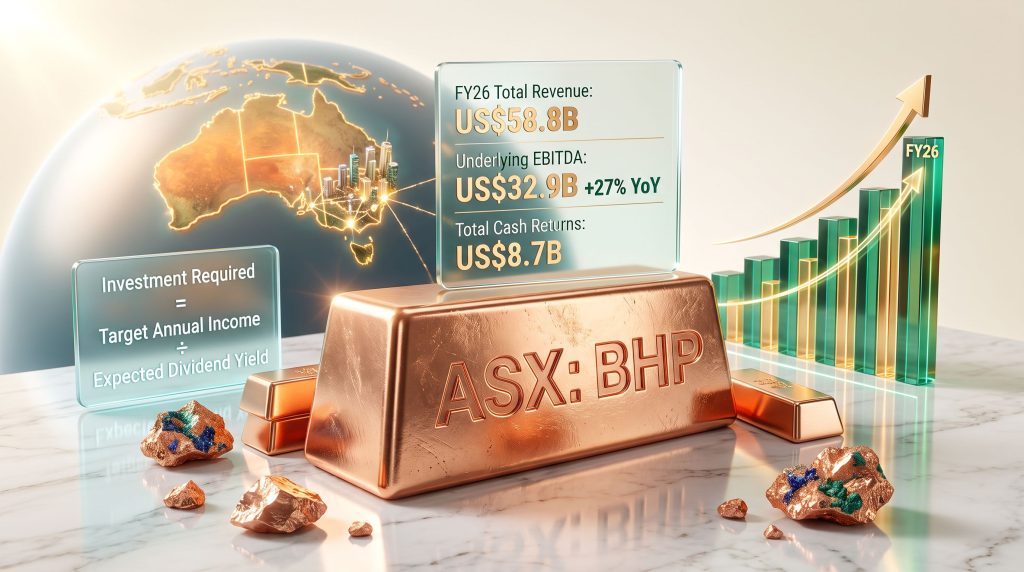
For income-focused investors, this structure has two practical implications. First, the floor ensures meaningful capital returns even in moderate earnings environments. Second, the ceiling is determined by BHP's capital allocation decisions, including reinvestment priorities, balance sheet management, and any special distributions when surplus cash accumulates. The FY26 financial year demonstrated the upside of this model clearly, with BHP returning US$8.7 billion to shareholders across dividends and buybacks.
The Franking Credit Advantage: Why Australian Investors Receive a Hidden Yield Boost
One of the most underappreciated features of BHP's dividend for Australian resident investors is the franking credit mechanism. Because BHP pays Australian corporate tax on its profits, it attaches imputation credits to its dividends that shareholders can use to offset their personal income tax obligations. For investors in lower marginal tax brackets, or those operating through a self-managed superannuation fund (SMSF) in accumulation phase, these credits can generate meaningful tax savings or even cash refunds.
The grossed-up yield calculation adjusts for this benefit:
Grossed-Up Yield = Cash Dividend Yield ÷ (1 minus Corporate Tax Rate)
At Australia's corporate tax rate of 30%, a cash yield of approximately 3.15% translates to a grossed-up yield closer to 4.5%. For a superannuation fund taxed at 15%, the effective after-tax yield on fully franked dividends is even more attractive, making BHP a particularly compelling holding within retirement-focused investment structures.
Comparing BHP's Payout Structure Against ASX Mining Peers
| Company | Typical Payout Policy | Franking Status | Yield Profile |
|---|---|---|---|
| BHP Group (ASX: BHP) | Min. 50% of underlying earnings | Fully franked | 3.5%–5.0% grossed-up |
| Rio Tinto (ASX: RIO) | Min. 50% of underlying earnings | Partially franked | 4.0%–6.0% |
| South32 (ASX: S32) | Min. 40% of underlying earnings | Fully/Partially franked | 3.0%–5.5% |
| Mineral Resources (ASX: MIN) | Discretionary | Partially franked | Variable |
BHP's combination of scale, commodity diversification, and fully franked dividends positions it as one of the more income-reliable options within the ASX resources sector, even if reliability is relative in a cyclical industry. Furthermore, BHP's strategic pivot toward higher-growth commodities adds another dimension to its long-term income story worth examining closely.
BHP's FY26 Financial Results: Reading the Numbers That Drive the Dividend
The most recent full-year result provides the clearest foundation for understanding BHP's current dividend capacity and projecting forward income potential.
| Financial Metric | FY26 Result | Year-on-Year Change |
|---|---|---|
| Total Revenue | US$58.8 billion | +15% |
| Underlying EBITDA | US$32.9 billion | +27% |
| Underlying Attributable Profit | US$13.2 billion | +30% |
| Total Cash Returns to Shareholders | US$8.7 billion | Significant increase |
| FY26 Final Dividend | US$0.99 per share | Strong payout |
A key observation from this data is that EBITDA growth of 27% meaningfully outpaced revenue growth of 15%. This margin expansion signals improving operational efficiency across BHP's asset portfolio, not merely higher commodity prices flowing through the top line. When a mining company's cost base grows more slowly than its revenue, the result is a disproportionate increase in distributable cash, which is exactly the dynamic that delivered the FY26 final dividend of US$0.99 per share.
It is also worth noting that BHP declares its dividends in US dollars, which are then converted to Australian dollars for payment to ASX-listed shareholders. Currency fluctuations between the USD and AUD therefore introduce an additional variable into the effective income received, a factor that income planners should factor into their yield assumptions. Monitoring iron ore price trends is consequently essential for any investor modelling BHP's forward income potential.
How Much Do You Need to Invest in BHP Shares for Passive Income?
This is the question most income investors are ultimately trying to answer when considering how much to invest in BHP shares for passive income. The core formula is straightforward:
Capital Required = Target Annual Income ÷ Expected Dividend Yield
However, the yield assumption applied to this formula dramatically alters the capital requirement. Using a range of yield scenarios reflects the uncertainty inherent in commodity-linked dividends.
Passive Income Scenarios at Different Yield Assumptions
| Annual Income Target | At 3.5% Yield | At 4.0% Yield | At 4.5% Grossed-Up | At 5.0% Yield |
|---|---|---|---|---|
| $500 | ~$14,300 | ~$12,500 | ~$11,100 | ~$10,000 |
| $1,000 | ~$28,600 | ~$25,000 | ~$22,200 | ~$20,000 |
| $2,500 | ~$71,400 | ~$62,500 | ~$55,600 | ~$50,000 |
| $5,000 | ~$142,900 | ~$125,000 | ~$111,100 | ~$100,000 |
| $10,000 | ~$285,700 | ~$250,000 | ~$222,200 | ~$200,000 |
| $20,000 | ~$571,400 | ~$500,000 | ~$444,400 | ~$400,000 |
Important Disclaimer: The yield figures above are illustrative ranges based on available market data and analyst consensus projections. Actual dividends will vary based on commodity prices, BHP's earnings outcomes, and capital allocation decisions made by management. This table is general information only and does not constitute personalised financial advice.
The FY27 Dividend Projection and What It Means Practically
Current consensus forecasts, including projections reflected through platforms such as CommSec, point to a FY27 BHP dividend of approximately A$2.07 per share. At prevailing share prices following BHP's significant 12-month price appreciation of over 50%, this translates to a grossed-up dividend yield of approximately 4.5% when franking credits are included.
Working through the income targets practically:
- To generate approximately $1,000 in annual passive income without factoring in franking credits, an investor would need to hold roughly 484 BHP shares
- With franking credits applied (for eligible investors), the equivalent share count required drops to approximately 339 shares
- The difference between these two figures represents the tangible value that Australia's dividend imputation system delivers to eligible investors
The share price appreciation that has driven BHP's strong total return over the past year has simultaneously compressed its forward yield. This is a critical dynamic that many income-focused investors overlook. When a stock's price rises faster than its dividend, the prospective yield falls, meaning investors entering today are locking in a lower starting income rate than those who purchased 12 to 18 months earlier.
What Drives BHP's Long-Term Dividend Growth Potential?
The Copper Demand Thesis: Structural, Not Cyclical
The emerging copper supply crunch carries significant implications for long-term earnings and dividend capacity. Global copper demand currently sits at approximately 34 million tonnes per annum (Mtpa) and is forecast to exceed 50 Mtpa by 2050, according to BHP's own analysis presented in its FY26 results.
The demand growth drivers are multi-layered and reinforcing:
- Energy transition: Renewable energy infrastructure (solar panels, wind turbines, grid upgrades) and electric vehicles require substantially more copper per unit than their fossil fuel equivalents
- Digital infrastructure: Artificial intelligence data centres, cloud computing facilities, and advanced telecommunications networks are copper-intensive at scale
- Traditional economic growth: Urbanisation in emerging economies, construction activity, and appliance manufacturing continue to underpin baseline demand
- Data centre growth alone: Copper demand from global data centre investment could grow approximately sixfold between 2024 and 2050, potentially reaching up to 3 Mtpa from this single end-use category
What makes this demand story particularly compelling for BHP shareholders is that it is not primarily cyclical. While construction demand fluctuates with economic conditions, the electrification and digitisation megatrends driving copper demand operate over decades, not quarters.
Supply-Side Constraints: The Hidden Tailwind for BHP Earnings
On the supply side, the copper industry faces structural challenges that are rarely well understood outside specialised mining circles. Ore grade decline at existing mines is a persistent and largely irreversible trend. As mining operations dig deeper and process lower-grade material, production costs per tonne of copper increase, while yields per tonne of ore processed decrease.
This grade deterioration effectively raises the industry cost curve over time without any change in commodity prices. Additionally, the lead time for new copper projects from discovery to first production typically spans 10 to 15 years, incorporating exploration, feasibility studies, permitting, financing, and construction phases. This means the supply response to any near-term price signal is severely delayed.
Combined with increasing operational complexity at existing major mines, these factors create conditions that may sustain higher copper prices over the medium to long term, a scenario that would translate directly into stronger BHP earnings and larger dividend payouts.
Speculative Note: Some industry observers argue that the copper market could face a structural deficit by the early 2030s, driven by the convergence of accelerating demand and constrained supply growth. If this scenario materialises, the earnings upside for major copper producers like BHP could be substantial. However, this remains a forward-looking projection and commodity markets are inherently difficult to forecast with precision.
The Cyclical Risk Investors Must Not Ignore
Risk Callout: BHP's dividends are not guaranteed income streams. As a commodity-exposed business, earnings and dividends can decline sharply when resource prices fall. Iron ore remains BHP's largest single earnings contributor, and a significant price correction in that market could offset copper-related gains and compress the dividend meaningfully.
Historical cycles have demonstrated the speed with which mining dividends can be reduced. Operating leverage, which amplifies gains during commodity upswings, works equally powerfully in reverse. A 10% decline in iron ore prices, for instance, can produce a significantly larger percentage decline in underlying profit, depending on BHP's cost structure and production volumes in a given period.
Is BHP the Right Passive Income Vehicle for Your Portfolio?
Comparing Income Strategies Available to ASX Investors
| Income Strategy | Typical Grossed-Up Yield | Dividend Stability | Commodity Exposure |
|---|---|---|---|
| BHP Group (ASX: BHP) | 3.5%–5.0% | Moderate (cyclical) | High |
| ASX Bank Shares | 5.0%–7.0% | Relatively stable | Low |
| ASX Diversified Mining | 3.0%–6.0% | Moderate (cyclical) | High |
| ASX Dividend ETFs | 3.5%–5.5% | Moderate | Diversified |
| Listed Investment Companies | 4.0%–6.0% | Relatively stable | Diversified |
The comparison above illustrates an important point: BHP's grossed-up yield is competitive but not the highest available on the ASX. Bank shares typically offer higher and more stable yields, while dividend ETF alternatives or listed investment companies provide smoother income through portfolio diversification. BHP's strongest argument as an income holding lies in its long-term earnings growth potential via copper, its scale advantages, and the full franking credit benefit it delivers to Australian resident investors.
Furthermore, analysts covering the sector have weighed in on relative value. Rio versus BHP comparisons from major investment banks highlight that stock selection within the mining sector can meaningfully affect income outcomes, making peer analysis an important step in portfolio construction.
Entry Price Discipline and the Yield Compression Problem
One of the most underappreciated risks in income investing is yield compression through price appreciation. When BHP's share price rises significantly, as it did over the 12 months prior to the time of this writing, investors who purchase at elevated prices are accepting a lower prospective income return relative to their invested capital. The historical yield achieved by earlier investors becomes irrelevant to the forward income calculation for new entrants.
For investors considering a BHP position today, several metrics are worth monitoring:
- Free cash flow yield relative to the prevailing share price
- EV/EBITDA multiples compared to long-run historical averages for BHP and its peers
- Consensus earnings forecasts and the implied dividend at the minimum 50% payout ratio
- Iron ore and copper price trends as leading indicators of future earnings
Dollar-cost averaging, whereby an investor systematically purchases BHP shares at regular intervals rather than deploying a lump sum at a single price point, can reduce the risk of entering at a cyclical peak and improve the average yield over the holding period.
The next major ASX story will hit our subscribers first
Step-by-Step Guide to Building Your BHP Passive Income Plan
How to Calculate Your Personal BHP Investment Target
- Define your annual income goal with precision (for example, $3,000 per year or $250 per month)
- Assess your tax position to determine whether you can access the full benefit of BHP's franking credits
- Apply a conservative grossed-up yield estimate in the range of 3.5% to 4.5% to avoid overestimating future income
- Calculate the capital required by dividing your income target by your chosen yield assumption
- Compare that capital requirement to your available funds and determine whether a lump-sum or staged investment approach is more practical
- Build in a variability buffer of 10% to 20% to account for the commodity cycle's potential impact on dividends
- Set an annual review point to reassess BHP's earnings outlook, yield, and your own income requirements as circumstances change
Hypothetical Scenario: A $50,000 BHP Investment
Consider an investor who allocates $50,000 to BHP shares at a prevailing cash yield of approximately 4.0%:
- Year 1 cash dividend income: approximately $2,000
- Grossed-up value for an eligible investor at a 30% tax rate: approximately $2,857, representing a meaningful enhancement to the face value of the payout
- Dividend Reinvestment Plan (DRP) scenario: If the investor participates in BHP's DRP rather than taking cash, dividends are used to purchase additional shares, compounding the share count and building the income base over time without requiring additional capital contributions
- Capital growth overlay: At BHP's recent rate of share price appreciation, capital gains can form a significant component of total return alongside income, though this is not guaranteed to persist and should not be relied upon in income planning
Frequently Asked Questions: BHP Shares and Passive Income
How much do I need to invest in BHP shares to earn $1,000 per year in passive income?
At a grossed-up yield of approximately 4.5%, a capital investment of roughly $22,000 to $25,000 in BHP shares is required. Without applying franking credit benefits, the cash-only equivalent rises to approximately $28,000 to $33,000, depending on the prevailing yield at the time of investment.
Does BHP pay dividends twice a year?
Yes. BHP typically declares an interim dividend alongside its half-year financial results and a final dividend with its full-year results, giving shareholders two income events per year.
Are BHP dividends fully franked?
BHP's Australian-listed shares have historically carried full franking credits, providing a significant tax advantage for Australian resident investors and superannuation funds eligible to utilise those credits.
Can BHP's dividend be reduced?
Yes. The minimum 50% payout ratio policy means that if BHP's underlying earnings decline significantly due to lower commodity prices or higher costs, the dividend will fall in proportion. Dividend reductions have occurred during prior commodity downturns and remain a real possibility in future cycles.
What is the difference between BHP's cash yield and its grossed-up yield?
The cash yield reflects only the dividend payment itself as a percentage of the share price. The grossed-up yield adds the value of attached franking credits, representing the pre-tax income equivalent. For eligible investors, the grossed-up yield is the more meaningful measure of total income return.
Is BHP suitable as a sole passive income source?
BHP's cyclical earnings profile makes it unsuitable as a standalone income solution for investors who require consistent, predictable cash flows. It is most effective as one component within a diversified income portfolio that also includes more stable yield-generating assets such as bank shares, infrastructure stocks, or diversified dividend ETFs.
Key Takeaways for Income Investors Considering BHP
- BHP's FY26 results demonstrated strong earnings momentum, with underlying profit rising 30% to US$13.2 billion and total shareholder returns reaching US$8.7 billion
- FY27 consensus dividend forecasts of approximately A$2.07 per share imply a grossed-up yield of around 4.5% at prevailing share prices
- Generating $1,000 in annual passive income from BHP requires approximately 484 shares on a cash-only basis, or approximately 339 shares when franking credits are applied for eligible investors
- Copper's long-term demand growth trajectory, from approximately 34 Mtpa today to over 50 Mtpa by 2050, provides a credible structural earnings growth story for BHP's dividend capacity over the coming decade
- Share price appreciation over the past 12 months has compressed BHP's forward yield, meaning entry point discipline remains critical for income-focused investors
- BHP dividends are cyclical, not guaranteed, and should be treated as a variable income contributor within a diversified portfolio strategy
For investors seeking additional perspectives on how much to invest in BHP shares for passive income, the ASX's investor education resources provide useful guidance on dividend investing, yield calculations, and portfolio construction principles relevant to Australian shareholders. In addition, Motley Fool Australia at fool.com.au publishes regular analysis of ASX mining shares on BHP and the broader resources sector that may provide useful complementary insights.
This article contains general financial information only and does not constitute personalised financial advice. Investment values can rise and fall. Past dividend payments are not a guarantee of future payouts. Commodity-linked investments carry additional earnings volatility relative to other asset classes. Readers should consider seeking advice from a licensed financial adviser before making investment decisions.
Want to Stay Ahead of the Next Major ASX Mineral Discovery?
While BHP offers a compelling passive income story through its diversified commodity exposure, investors seeking earlier-stage opportunities can gain a significant edge with Discovery Alert, whose proprietary Discovery IQ model delivers real-time alerts on significant ASX mineral discoveries — instantly translating complex data into actionable insights. Explore Discovery Alert's dedicated discoveries page to understand how historic mineral discoveries have generated substantial returns, and begin your 14-day free trial today to position yourself ahead of the broader market.