August 24, 2026
India's Mineral Revenue Architecture Under Pressure
Few fault lines in Indian federalism run as deep as the question of who controls the wealth beneath the ground. The country sits atop vast reserves of coal, iron ore, bauxite, and a range of critical minerals, yet the fiscal architecture governing how those resources are taxed has never been fully settled. Rather than resolving this tension, successive amendments to India's foundational mining legislation have periodically reignited it, each iteration shifting the balance of revenue authority between the Union and mineral-producing states.
The Mines and Minerals (Development and Regulation) Amendment Act, 2026, is the latest and arguably most consequential intervention in this ongoing contest. Arriving just two years after a landmark Supreme Court ruling that explicitly reinforced state-level taxation powers, the amendment has drawn fierce criticism from opposition politicians and several state governments. They argue it represents a deliberate legislative effort around Bhupesh Baghel new mining law state revenue powers to reclaim ground the judiciary had already assigned to the states.
When big ASX news breaks, our subscribers know first
The Constitutional Architecture That Makes This Dispute Possible
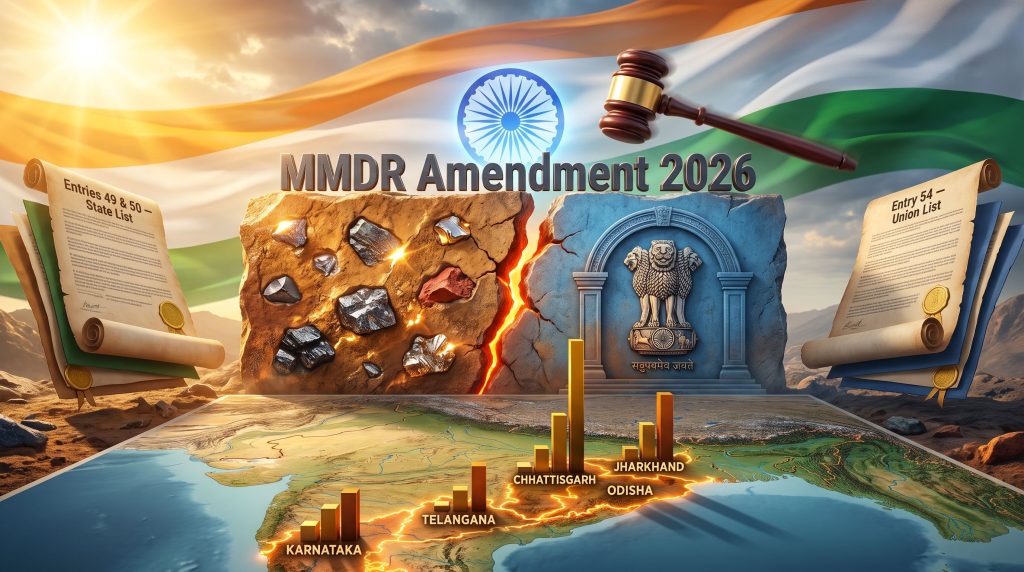
India's Seventh Schedule divides legislative authority between the Union and State Lists across a wide range of domains, and minerals sit uncomfortably across both. Entry 54 of the Union List grants Parliament authority to regulate mines and mineral development in the national interest. Entries 49 and 50 of the State List, however, confer on states the power to tax lands and buildings, and to impose taxes on mineral rights, subject only to limitations that Parliament may impose in relation to mineral development.
This dual structure has historically created productive ambiguity. States with significant mineral endowments have used this space to impose supplementary levies, known as cesses, on mineral extraction within their territories. These charges, layered on top of centrally prescribed royalties, have become a meaningful source of non-tax revenue for states whose subsoil wealth is simultaneously their economic asset and their environmental burden.
The critical mechanism here is that royalties and cesses function differently in legal and fiscal terms. Royalties are charges for the commercial extraction of a public resource, prescribed under the MMDR Act. Mineral cesses, by contrast, are taxes imposed under state legislative competence, historically justified by Entries 49 and 50 of the State List. The distinction matters enormously because it determines which level of government can collect the charge, and whether Parliament can legislate it away. Furthermore, understanding mining permitting basics helps contextualise why these jurisdictional boundaries carry such financial weight.
What the 2024 Nine-Judge Bench Actually Established
In 2024, a nine-judge constitutional bench of the Supreme Court of India delivered one of the most consequential rulings on resource federalism in the country's post-independence history. The bench determined, by majority, that states possess independent legislative competence under Entries 49 and 50 to impose taxes on mineral-bearing lands and mineral rights. Critically, it held that the MMDR Act, 1957, as it then stood, did not operate to extinguish or pre-empt those state powers.
This ruling was significant beyond its immediate legal effect. It resolved decades of interpretive uncertainty about whether central legislation on mining could implicitly override state taxation authority. The answer, from nine of the country's most senior constitutional judges, was that it could not, at least not without explicit and constitutionally grounded language doing so.
Constitutional Precedent: The 2024 nine-judge bench ruling was not merely a procedural clarification. It represented a substantive affirmation that resource-rich states retain fiscal autonomy over mineral extraction that runs deeper than what Parliament had previously acknowledged.
The table below summarises the legal landscape before and after the 2026 amendment:
| Legal Dimension | Position After 2024 Ruling | Critics' Reading of 2026 Amendment |
|---|---|---|
| State authority to levy mineral cess | Constitutionally affirmed | Effectively restricted by new provisions |
| Centre's role in prescribing payments | Limited to royalties under MMDR | Expanded to include additional prescribed charges |
| Federal revenue balance | States retained supplementary levy powers | Revenue authority argues it is being centralised |
| Constitutional basis | Entries 49 and 50, State List | Subject to fresh judicial challenge |
The MMDR Amendment 2026 and Its Most Contested Provisions
The 2026 amendment modifies the MMDR Act's framework governing how mineral extraction is financially regulated. Its most contested provisions, from a federal perspective, relate to restrictions on states imposing independent cesses on minerals extracted within their territory. Critics contend the amendment repositions the Centre as the primary authority for prescribing all additional financial obligations on mining operators, effectively reducing states to passive beneficiaries of whatever the Centre decides to distribute.
Former Chhattisgarh Chief Minister Bhupesh Baghel, addressing a press interaction in Raipur on 24 August 2026, articulated this concern with particular force. Baghel characterised the legislation as having been advanced through Parliament without sufficient deliberation, and argued it was designed to neutralise the practical effect of the 2024 Supreme Court verdict. He framed the Centre's move as a direct transfer of fiscal authority, in which the Union would now collect tax revenues that states had previously been able to levy independently, leaving state powers materially diminished.
Baghel further noted that Kerala, Jharkhand, Telangana, and Karnataka had all formally raised objections to the amendment, and publicly questioned why the current Chhattisgarh government had remained conspicuously silent given the state's acute mineral dependency. That silence, he argued, represented a failure of governance accountability to Chhattisgarh's mining-affected constituencies.
Chhattisgarh's Mineral Economy: Why the Stakes Are Unusually High
Chhattisgarh is not a peripheral player in India's mineral economy. The state's subsoil endowment includes some of the country's most commercially significant deposits across multiple commodity categories:
-
Coal — one of India's largest coal-producing states, with reserves supporting both domestic power generation and industrial supply chains
-
Iron ore — significant deposits that feed into the domestic steel manufacturing sector
-
Bauxite — a critical feedstock for aluminium production with growing strategic importance, and one that intersects directly with critical minerals and energy security considerations at a global level
-
Tin and zinc — commercially extracted non-ferrous minerals with industrial and electronics sector demand
Mining-linked revenues encompass royalties, contributions to the District Mineral Foundation, and state-level levies. Collectively, these form a material share of Chhattisgarh's non-tax revenue base. The District Mineral Foundation, established under an earlier MMDR amendment, channels a portion of mining revenues into community development programs in extraction-affected areas, covering infrastructure, health, education, and environmental remediation. Any restriction on state-level cess powers does not merely affect state government finances; it directly compresses the funding available for communities that bear the physical costs of mineral extraction.
The District Mineral Foundation: A Hidden Casualty of Centralisation
One aspect of the MMDR Amendment 2026 debate that receives insufficient attention is its potential downstream effect on the District Mineral Foundation mechanism. The DMF was conceived as a compensatory instrument, a recognition that mining communities absorb environmental degradation, displacement risk, and infrastructure strain that royalty revenues alone cannot adequately address.
DMF contributions are calculated as a percentage of royalty payments, which means their quantum is directly linked to the scale of mining-linked financial flows within a state. If central legislation reduces the total financial obligations on mining operators within state territories, or limits states' ability to layer additional charges on extraction, the effective funding available to DMFs is compressed proportionally. Consequently, the resource export challenges faced by mineral-dependent economies elsewhere in the world offer a cautionary parallel for how fiscal centralisation can unravel community-level funding arrangements.
Underappreciated Risk: The communities most dependent on DMF funding are precisely those least capable of compensating for revenue shortfalls through other fiscal mechanisms. Rural and tribal communities in mineral belts across Chhattisgarh, Jharkhand, and Odisha have limited alternative revenue sources, making DMF sustainability a direct social welfare issue, not merely a fiscal accounting matter.
The next major ASX story will hit our subscribers first
Which States Are Most Exposed to the Amendment's Revenue Impact
The financial exposure from the MMDR Amendment 2026 is concentrated among a subset of states whose economies are most deeply integrated with mineral extraction. The states that have raised formal or public objections include:
-
Kerala — formally raised concerns regarding the amendment's impact on state fiscal autonomy
-
Jharkhand — a coal and mineral-rich state with significant DMF revenue exposure across its tribal districts
-
Telangana — raised objections linked to its mineral extraction profile and state revenue composition
-
Karnataka — expressed opposition through political and administrative channels
States that have not yet formally objected but face comparable financial exposure include Odisha and Rajasthan, both of which carry substantial mineral production volumes across iron ore, coal, and non-ferrous commodity categories. In addition, the rising critical minerals demand globally means the revenue stakes attached to these state-level deposits are only likely to increase over the coming decade.
| State | Key Minerals | Formal Objection Raised |
|---|---|---|
| Chhattisgarh | Coal, iron ore, bauxite, tin, zinc | Not formally raised (as of August 2026) |
| Jharkhand | Coal, iron ore, copper | Yes |
| Odisha | Iron ore, coal, bauxite | Pending |
| Karnataka | Iron ore, gold, limestone | Yes |
| Kerala | Rare earths, granite, mineral sands | Yes |
| Telangana | Coal, limestone, fluorite | Yes |
Arguments on Both Sides: Uniformity Versus Autonomy
The debate over the MMDR Amendment 2026 is not simply a partisan dispute. Substantive arguments exist on both sides of the centralisation question, and understanding them is essential for evaluating the amendment's long-term policy implications.
The case for a centralised mineral revenue framework rests on several foundations:
-
Uniform mineral taxation reduces regulatory arbitrage, where mining operators structure activity to exploit differences in state levy regimes
-
Predictable, centrally prescribed financial obligations improve the investment climate for large-scale mining projects that span multiple regulatory jurisdictions
-
Centralised revenue collection can improve compliance and reduce leakage in royalty systems that have historically suffered from under-reporting
-
A coherent national framework for critical mineral development cannot function if each of 28 state jurisdictions independently calibrates the financial cost of extraction
The case for preserving state fiscal autonomy is grounded in both constitutional precedent and practical equity:
-
The 2024 Supreme Court ruling explicitly affirmed state competence under Entries 49 and 50, making legislative override constitutionally contestable
-
Resource-producing states bear disproportionate environmental, social, and infrastructure costs that require commensurate fiscal compensation independent of central allocation decisions
-
Federal revenue imbalance is structurally worsened when resource revenues are centralised without guaranteed equivalent devolution to affected states
-
Legislative process transparency matters: economically consequential amendments require adequate parliamentary deliberation and formal consultation with affected states
Fiscal Federalism's Structural Fault: Revenue Sharing Without Revenue Guarantees
India's fiscal federalism operates through Finance Commission devolution, grants-in-aid, and a range of sector-specific transfer mechanisms. Natural resource revenues from mining, however, have historically operated partially outside this framework. States retaining direct royalty and cess income treat these as supplements to their Finance Commission allocations, providing a degree of fiscal autonomy that the general devolution formula cannot replicate.
The MMDR Amendment 2026 introduces a structural shift by potentially reclassifying what types of mining-linked financial obligations states can independently impose. If interpreted broadly, this could reduce the portion of mineral revenue flowing directly to state consolidated funds without passing through central allocation mechanisms. Unlike Finance Commission transfers, which are formula-driven and relatively predictable, centralised mineral revenues carry no comparable constitutional guarantee of return to producing states.
This asymmetry is what makes the amendment's critics frame it not merely as a revenue dispute but as a structural erosion of India's federal compact. The concern over the Bhupesh Baghel new mining law state revenue powers is not simply that states might receive less money, but that the revenue they do receive would depend on central discretion rather than constitutionally guaranteed fiscal autonomy.
Three Scenarios: What Happens Next
The MMDR Amendment 2026's trajectory will likely resolve through one of three pathways, each with distinct implications for India's resource governance architecture.
Scenario 1: Judicial Nullification
Mineral-producing states mount a coordinated constitutional challenge before the Supreme Court. The Court, drawing on its own 2024 nine-judge bench precedent, strikes down or substantially narrows the cess-restriction provisions, restoring state fiscal autonomy over mineral levies. This outcome would establish a clearer constitutional boundary on Parliament's ability to use MMDR amendments to override state taxation competence.
Scenario 2: Negotiated Compensation
Political pressure from mineral-rich states, including some governed by the ruling party at the centre, compels a compensatory arrangement. This might take the form of enhanced Finance Commission allocations, sector-specific grants to mining-affected states, or a modified DMF formula that provides states with an equivalent revenue stream through a different legal mechanism.
Scenario 3: Sustained Centralisation
The amendment withstands legal challenge, and the Centre progressively consolidates mineral revenue authority. Mineral-producing states adapt by maximising revenues within the remaining permissible framework, including optimising DMF contributions, land-use charges, and environmental compensation levies, while absorbing the residual fiscal gap through general devolution adjustments. Furthermore, the broader trend of mining industry consolidation observed globally suggests that large operators may gain additional leverage in a more centralised regulatory environment.
Policy Recommendations for Mineral-Producing States
States with significant mineral revenue exposure should not wait for judicial resolution before responding to the amendment's fiscal implications. A proactive approach would include:
-
Initiating formal inter-state coordination among mineral-producing governments to present a unified legal and political position on the amendment's constitutionality
-
Commissioning independent fiscal impact assessments that quantify revenue exposure under different interpretations of the cess-restriction provisions
-
Engaging Finance Commission mechanisms to seek compensatory adjustments in devolution formulas if cess powers are permanently curtailed
-
Preparing constitutional challenge documentation grounded in the 2024 Supreme Court ruling as primary precedent, in collaboration with constitutional law specialists
-
Strengthening DMF governance frameworks to maximise the developmental value of existing mining-linked revenues while the legal landscape remains uncertain
Key Takeaways: India's Resource Federalism at a Crossroads
The MMDR Amendment 2026 represents one of the most significant reconfigurations of India's mineral revenue architecture in decades. Its emergence immediately after a Supreme Court ruling that explicitly affirmed state taxation powers transforms a straightforward legislative act into a constitutionally charged confrontation between central authority and state fiscal autonomy.
| Dimension | Core Issue | Stakeholders Most Affected |
|---|---|---|
| Constitutional | Does the amendment override the 2024 Supreme Court ruling? | All mineral-producing states |
| Fiscal | How much revenue do states lose if cess powers are curtailed? | Chhattisgarh, Jharkhand, Odisha, Karnataka |
| Political | Is this amendment a deliberate revenue centralisation exercise? | Opposition-governed mineral states |
| Legal | Can states successfully challenge the amendment's validity? | State governments, mining industry |
| Developmental | How does DMF funding sustainability get protected? | Mining-affected communities in tribal belts |
The debate surrounding Bhupesh Baghel new mining law state revenue powers captures a governance accountability dimension that extends beyond partisan politics. For a state whose economic foundation rests on coal, iron ore, bauxite, tin, and zinc extraction, the stakes of passive acceptance are measurable in billions of rupees of foregone revenue and in the community development programmes that revenue supports.
Whether the amendment ultimately survives constitutional scrutiny, is modified through political negotiation, or is struck down by the Supreme Court will define the operating parameters of Indian resource federalism for the decade ahead. The outcome carries implications not only for state government balance sheets but for the communities, ecosystems, and supply chains that India's mineral wealth underpins.
This article reflects publicly available information and analysis as of the date of publication. It does not constitute legal or financial advice. Readers should consult qualified legal counsel for advice regarding the constitutional and regulatory implications of the MMDR Amendment 2026.
Want to Track the Next Major Mineral Discovery Before the Market Does?
Discovery Alert's proprietary Discovery IQ model delivers real-time alerts on significant ASX mineral discoveries, transforming complex geological data into actionable investment insights for both short-term traders and long-term investors — explore historic discovery returns on Discovery Alert's discoveries page to understand just how transformative major finds can be, and begin your 14-day free trial today to position yourself ahead of the broader market.