July 23, 2026
The Copper Tipping Point: Why BHP's Earnings Transformation Changes the Investment Calculus
Commodity supercycles rarely announce themselves cleanly. They tend to emerge gradually, shaped by converging forces across energy policy, industrial development, and technological adoption, before eventually becoming impossible to ignore. Copper is currently at the centre of one such convergence, and the mining company most structurally positioned to benefit from it trades right on the ASX. For investors evaluating whether to buy BHP shares today, understanding why this moment is different from previous copper rallies is the starting point for any serious analysis.
When big ASX news breaks, our subscribers know first
How Does BHP's Current Valuation Reflect Its Earnings Trajectory?
Decoding the Forward P/E Picture
BHP Group Ltd (ASX: BHP) shares have been trading in the A$59.76 to A$60.50 range, placing them in the upper-middle portion of a 52-week trading band stretching from approximately A$39.18 to A$65.98. That recovery from the lower end of the range reflects renewed commodity optimism, but it also raises a legitimate question: has the easy money already been made?
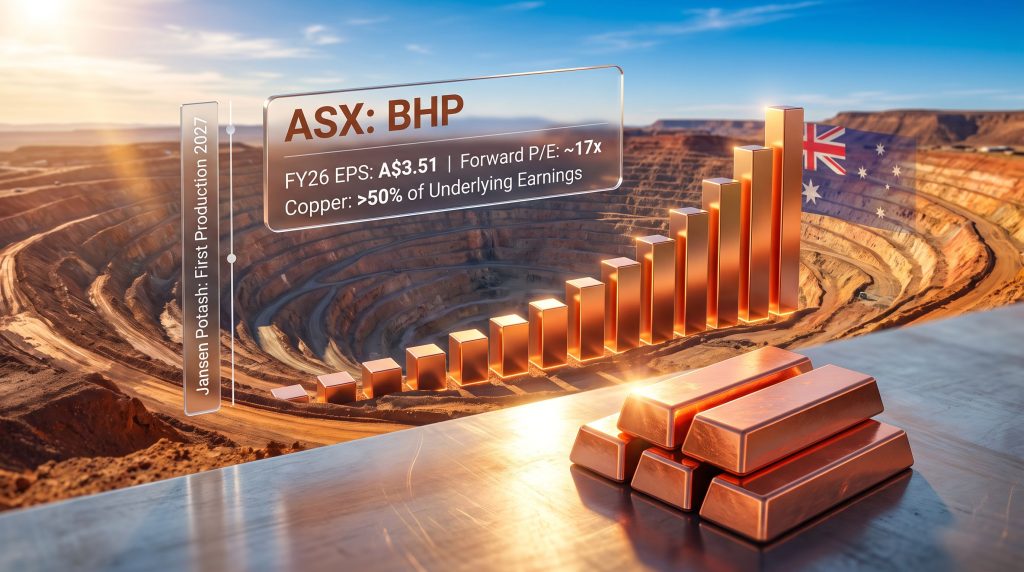
Consensus earnings forecasts compiled through CommSec suggest the company is expected to generate earnings per share (EPS) of approximately A$3.51 in FY2026 and A$3.63 in FY2027. Applying current prices to these projections produces forward price-to-earnings multiples of roughly 17x FY26 earnings and approximately 16.5x FY27 earnings.
The compression in that forward P/E ratio across consecutive years is meaningful. It implies the market expects earnings to grow modestly but steadily, which at current prices means investors are not paying a premium for speculative upside. They are paying a fair price for a business with demonstrably high-quality assets.
A declining forward P/E across two consecutive forecast years typically signals gradual earnings expansion expectations. For long-term investors, this represents a more constructive entry dynamic than a flat or rising multiple against stagnant earnings.
The Dividend Yield Contribution: Variable but Valuable
Income-focused investors should approach BHP's dividend with clear-eyed realism. Distributions from major diversified miners are directly linked to underlying commodity prices and free cash flow generation, which means they fluctuate with the cycle rather than growing at a steady annual rate like a utility or infrastructure company.
That said, the forecast numbers are still competitive within the ASX blue-chip universe.
| Metric | FY2026 Forecast | FY2027 Forecast |
|---|---|---|
| Earnings Per Share | A$3.51 | A$3.63 |
| Dividends Per Share | A$2.18 | A$1.95 |
| Forward Dividend Yield | ~3.6% | ~3.3% |
| Forward P/E Ratio | ~17x | ~16.5x |
| Implied Payout Ratio | ~62% | ~54% |
The implied payout ratios in this table reveal something investors often overlook. At roughly 54 to 62%, BHP retains a meaningful share of its earnings for reinvestment in capital projects, balance sheet management, and growth initiatives. This is not a company distributing every dollar of cash flow and leaving nothing for the future. The dividend is funded by genuine earnings power, not financial engineering.
Why Copper Has Become the Engine Driving BHP's Earnings Mix
The Structural Demand Case Is Broader Than Most Investors Appreciate
Copper is commonly discussed in the context of electric vehicles, but that framing significantly undersells the breadth of the demand story. The metal is a foundational input across electricity transmission infrastructure, utility-scale renewable energy generation, data centre construction, advanced manufacturing, and urban development in emerging economies. This multi-sector demand profile is unusual among commodities and provides a degree of resilience that single-use materials simply cannot match.
Furthermore, what makes copper's supply picture particularly compelling is the structural lag between discovery and production. New copper mines typically require 10 to 20 years from initial discovery to first commercial output, encompassing exploration drilling, resource estimation, definitive feasibility studies, permitting, financing, construction, and commissioning. This multi-decade development pipeline means the global industry cannot quickly respond to demand spikes, creating periods of acute supply deficit where established producers with operating assets command significant pricing power.
The global copper supply crunch is widely expected to produce a meaningful supply gap in the late 2020s and into the 2030s, driven by the depletion of existing high-grade deposits, falling average ore grades at mature mines, and insufficient new project development to replace lost production capacity. Producers with large-scale, low-cost, permitted operations are structurally advantaged in this environment.
BHP's Copper Production Scale and Asset Geography
BHP achieved approximately 2 million tonnes of copper production for the second consecutive year in FY2026, a milestone that cements its position among the world's largest copper producers by volume. This consistency matters. Many miners report strong production years followed by operational disruptions; BHP's back-to-back delivery at this scale signals operational maturity, not one-off performance.
The key copper assets in BHP's portfolio include:
- Escondida, Chile: The largest copper mine on Earth by annual production volume, majority-owned and operated by BHP. Its scale provides cost advantages that smaller operations structurally cannot replicate.
- Spence, Chile: A sulphide expansion project that has steadily increased its contribution to group copper output as the processing infrastructure matures.
- South Australian copper province: Encompasses Olympic Dam, one of the world's largest known deposits of copper, uranium, gold, and silver, alongside the Oak Dam development corridor. This region represents a generational growth option.
One geological factor worth noting for investors is the distinction between oxide and sulphide copper deposits. Oxide ores, found near the surface, are processed more easily and cheaply but are typically shallower and shorter-lived. Sulphide ores, which dominate BHP's South Australian assets and underpin Spence's expansion, require more sophisticated processing but tend to represent larger, longer-life deposits. The shift toward sulphide processing at several BHP assets reflects the industry's broader transition toward deeper, longer-life ore bodies as shallow oxide deposits are exhausted globally.
Copper's Share of BHP's Total Earnings
Copper contributed more than 50% of BHP's underlying earnings in the first half of FY2026, marking a structural shift in the company's earnings composition. For most of its modern history, BHP's financial performance was dominated by iron ore, with copper playing a meaningful but secondary role. That relationship has now effectively inverted, at least at the earnings level.
This rebalancing has important implications for how investors should model commodity price sensitivity. A significant correction in iron ore prices, while still impactful, no longer carries the same earnings destruction potential it once did. Conversely, sustained copper strength now amplifies earnings upside in ways that were not visible in BHP's financial profile five years ago. Investors exploring broader copper investment strategies will find BHP's transformation particularly relevant to that thesis.
Iron Ore and Potash: The Cash Engine and the Long-Dated Option
Western Australian Iron Ore Remains the Foundation
BHP's Western Australian Iron Ore operations represent one of the world's most cost-efficient, high-volume production systems. The Pilbara deposits benefit from high ore grades, established export infrastructure through Port Hedland, and decades of operational refinement that have driven down unit costs to levels that remain profitable across a wide range of iron ore price scenarios.
Iron ore demand is intrinsically linked to Chinese steel production, which in turn depends on the trajectory of China's property sector and infrastructure investment. These are genuinely uncertain variables. However, understanding the China steel and iron ore outlook makes clear that even in bearish iron ore price scenarios — modelling cases where prices fall below US$80 per tonne, for example — BHP's cost position ensures operations continue generating positive free cash flow that funds capital allocation priorities including copper expansion and shareholder returns.
Jansen Potash: A Third Earnings Pillar in Development
The Jansen Stage 1 project in Saskatchewan, Canada is targeting first potash production in 2027, representing BHP's most significant new commodity entry in decades. The investment thesis for potash rests on global population growth, increasing pressure on agricultural yields in key food-producing regions, and the long-term structural need for crop nutrition inputs that support food security.
Key monitoring variables for investors following Jansen's progress include:
- Capital expenditure performance relative to the approved project budget
- Timeline adherence as the project approaches the commissioning phase
- Global potash pricing dynamics, which are influenced by major producing nations including Canada, Russia, and Belarus
- Long-term offtake arrangements that may de-risk revenue assumptions post first production
If Jansen achieves nameplate production capacity on schedule and within budget, it could evolve into a genuine third earnings pillar for BHP by the early 2030s, meaningfully diversifying revenue beyond the copper-iron ore axis.
BHP as a Portfolio Construction Tool for ASX Investors
Why Resources Exposure Offers Genuine Diversification
The case for holding BHP within a broader ASX equity portfolio extends beyond the company's individual investment merits. Resources equities respond to a fundamentally different set of macroeconomic drivers than the sectors that dominate most Australian retail portfolios, including financials, consumer staples, and healthcare.
Commodity prices, global industrial output, infrastructure investment cycles, and currency movements — particularly the AUD/USD exchange rate — drive resources returns. These variables have low earnings correlation with the domestic economic factors that shape bank profitability, supermarket margins, or pharmaceutical reimbursement rates. Adding measured resources exposure can therefore reduce concentration risk in portfolios heavily weighted toward ASX financials and defensives.
How BHP Compares to Smaller ASX Mining Alternatives
| Attribute | BHP Group (ASX: BHP) | Smaller Single-Commodity Producers |
|---|---|---|
| Commodity Diversification | Copper, Iron Ore, Potash | Typically one commodity |
| Production Scale | ~2Mt copper + major iron ore | Substantially smaller volumes |
| Balance Sheet Strength | Investment-grade, low leverage | Higher relative financial risk |
| Dividend Consistency | Cycle-adjusted but sustained | Often suspended in downturns |
| Asset Quality | Tier-1, long-life operations | Variable, often single deposit |
| Growth Pipeline | Multi-project, multi-geography | Often single project dependent |
For investors seeking resources sector exposure without accepting concentrated single-project risk, BHP's diversification across commodities, geographies, and development stages provides a risk profile that smaller producers structurally cannot replicate. BHP's strategic pivot toward copper and future-facing commodities has reinforced this advantage considerably.
Key Risks That Must Be Honestly Assessed Before Buying
Commodity Price Leverage Cuts Both Ways
Mining company earnings are highly operationally leveraged to commodity prices. A 10 to 15% decline in copper or iron ore pricing can translate into a disproportionately larger contraction in net profit, given the relatively fixed nature of many mining cost structures. Investors should stress-test their return assumptions by modelling scenarios where iron ore falls toward US$80 per tonne or copper retreats meaningfully from current elevated levels.
Commodity cycles can be prolonged and severe. BHP's share price history reflects this reality, with significant drawdowns during periods of commodity pessimism. The 52-week low of approximately A$39.18 provides a concrete illustration of how quickly investor sentiment can shift.
The Analyst Consensus Divide
Current analyst coverage on BHP presents a divided picture that investors should understand rather than dismiss. Technical analysis based on moving average indicators has produced signals interpreted as constructive by some market commentators. However, fundamental analyst consensus has generally been positioned closer to a neutral or hold recommendation, reflecting the view that current valuations already incorporate a significant portion of the near-term upside.
This divergence between technical momentum and fundamental valuation caution is a common feature of large-cap mining stocks near cycle highs. It consequently underscores the importance of matching investment horizon to the analytical framework being applied.
China Demand Risk and Geopolitical Variables
Iron ore revenues remain substantially dependent on Chinese steel demand, which is structurally linked to property sector construction activity and government-directed infrastructure investment. The trajectory of China's property sector recovery remains genuinely uncertain, and any escalation in trade tensions affecting commodity flows adds an additional layer of earnings uncertainty that is difficult to model with precision.
The next major ASX story will hit our subscribers first
ASX Listing vs. U.S. ADR: Which Vehicle Suits Which Investor?
BHP maintains equity listings across multiple international exchanges. Australian investors access the company through the ASX-listed shares denominated in AUD, which represent the primary market and typically offer the most cost-efficient and tax-straightforward vehicle for domestic investors. The company's U.S. ADR, priced at approximately US$82 to US$83, may suit investors managing USD-denominated portfolios or those based outside Australia, but introduces AUD/USD currency translation risk as an additional variable.
Australian investors using domestic brokerage platforms will generally find the ASX-listed BHP shares the most practical option, avoiding unnecessary currency conversion costs and reducing complexity around dividend withholding tax treatment.
Building a Decision Framework: When Does Buying BHP Make Sense?
Conditions That Support Entering a Position
- Investment horizon of five or more years, providing sufficient time to absorb commodity cycle volatility and benefit from BHP's long-term earnings growth trajectory.
- Desire for genuine portfolio diversification away from the ASX's financials-heavy composition.
- Conviction in the structural copper demand thesis underpinning global electrification and the energy transition.
- Comfort with variable dividend income that moves with commodity prices rather than growing at a predictable annual rate.
Conditions That May Warrant Waiting or Sizing Down
- Preference for a lower entry price following a commodity-driven correction, given the shares are no longer at the deep discounts available during periods of market pessimism.
- Already significant existing exposure to the materials or resources sector, reducing the diversification benefit of adding BHP.
- A requirement for stable, predictable income that mining dividends structurally cannot provide.
- Near-term concerns about Chinese economic momentum that could weigh on iron ore prices and suppress the cash flow funding BHP's growth agenda.
The most sound approach for most long-term ASX investors is a measured allocation to BHP as part of a diversified portfolio, rather than a concentrated position. This allows meaningful participation in the commodity cycle upside while limiting the risk of outsized drawdowns during inevitable periods of commodity weakness.
Frequently Asked Questions About Buying BHP Shares
What is BHP's current share price on the ASX?
BHP shares have recently traded in the A$59.76 to A$60.50 range, within a 52-week span of approximately A$39.18 to A$65.98. Investors can track live BHP share price data for the most current market information.
What dividend yield does BHP offer on a forward basis?
Consensus forecasts point to a forward dividend yield of approximately 3.6% for FY2026 and 3.3% for FY2027, with distributions remaining tied to commodity price outcomes and therefore variable rather than guaranteed.
What is BHP's most important growth driver over the next decade?
Copper has become the central pillar of BHP's earnings and growth strategy, underpinned by structural demand from global electrification, energy transition infrastructure, data centre construction, and the ongoing decarbonisation of transport and industry.
How does BHP's current valuation compare historically?
At approximately 17x forward FY2026 earnings, BHP is no longer trading at the significant discounts available during prior periods of commodity pessimism. The current multiple reflects fair value for a high-quality diversified miner with a compelling growth pipeline, rather than deep-value pricing. For investors who want to buy BHP shares today, this context is essential to forming realistic return expectations.
What are the most material risks in owning BHP shares?
The primary risks include iron ore price weakness driven by Chinese demand uncertainty, a correction in copper prices from elevated levels, execution challenges at the Jansen potash project, and the broader volatility inherent in commodity cycle investing. All of these factors can compress earnings and reduce dividends simultaneously during downturns.
This article contains general information only and does not constitute personalised financial advice. Investors should consider their own circumstances, risk tolerance, and investment objectives before making any investment decisions. Past performance is not indicative of future returns. Commodity prices, company earnings, and dividend forecasts are subject to change. Readers seeking further analysis of ASX-listed resources companies may find ongoing coverage at Motley Fool Australia useful as a supplementary reference.
Want to Capitalise on the Next Major Copper Discovery Before the Broader Market Notices?
Discovery Alert's proprietary Discovery IQ model delivers real-time alerts on significant ASX mineral discoveries — instantly transforming complex geological data into actionable investment insights for both short-term traders and long-term investors. Explore historic examples of exceptional discovery returns and begin your 14-day free trial today to position yourself ahead of the market in the copper and resources sector.