May 13, 2026
The Slow Unravelling of Dollar Dominance: What Reserve Data Is Really Telling Investors
Monetary systems do not collapse overnight. They erode across decades, shaped by geopolitical realignments, compounding fiscal pressures, and the quiet accumulation of strategic decisions made by central banks far from Wall Street. The current moment in global reserve management represents precisely this kind of slow-moving but structurally significant transition. De-dollarization and central bank gold buying are no longer fringe theories debated on the margins of financial commentary. They are measurable, documented phenomena supported by data that institutional analysts are increasingly unwilling to dismiss.
Understanding what is actually happening, and why it matters for gold prices and the broader monetary order, requires moving beyond headlines and into the underlying mechanics of how reserve systems are constructed, and how they eventually transform.
When big ASX news breaks, our subscribers know first
Why Reserve Systems Are Geopolitical Constructs First, Financial Decisions Second
A common misconception about central bank reserve management is that it operates primarily as a financial optimisation exercise. In reality, the composition of a nation's foreign exchange reserves reflects the prevailing geopolitical order as much as it reflects yield expectations or liquidity needs. Reserve allocation decisions are, at their core, geopolitical acts.
The dollar's rise to dominance illustrates this principle clearly. The formal end of the Bretton Woods system in 1971 is frequently cited as the defining moment in the dollar's ascent, but research from Deutsche Bank's Research Institute challenges this framing. Analysts Mallika Sachdeva and Michael Hsueh argue that the monetary system transition had actually occurred two decades before the dollar's true dominance was established. What ultimately drove gold's declining reserve share in the 1990s was not a change in monetary architecture. It was a shift in the geopolitical environment.
With the Soviet Union dissolved, the United States stood as an uncontested global hegemon. Japan, which had been the closest economic competitor to the U.S. at the time, was firmly embedded within American security and financial architecture. China had not yet joined the WTO and remained outside the core of U.S.-led globalisation. In this environment, holding dollars was simultaneously a financial choice and a statement of geopolitical alignment. The result was a surge in emerging market central bank dollar reserves that went parabolic around 2000, whilst gold's share of global reserves contracted sharply.
By the late 1990s, the U.S. dollar held more than four times the reserve share of gold. That ratio is now, slowly but unmistakably, going into reverse.
What the Reserve Data Actually Reveals About De-Dollarization
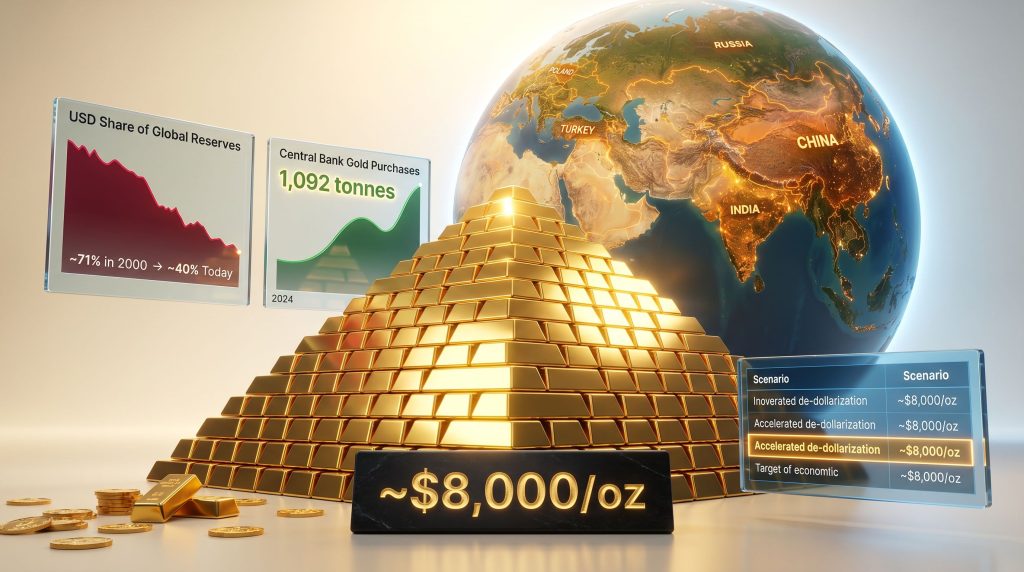
The empirical picture on de-dollarization and central bank gold buying is clearer than many commentators acknowledge. The dollar's share of global central bank foreign exchange reserves has contracted from approximately 60% to around 40% over recent decades, with the sharpest portion of that decline traceable from a peak of roughly 71% in 2000 to today's figure. That is a structural shift of roughly 30 percentage points from peak, representing one of the most significant reconfigurations of reserve composition since the post-war era.
Furthermore, trust in the US dollar has demonstrably weakened, and simultaneously, gold's share of global reserves has roughly doubled over approximately four years, reaching around 30% of total global reserve holdings. Before the 1990s, gold had consistently commanded a larger share of central bank reserves than the fiat dollar. That historical relationship appears to be reasserting itself.
Separating Price Effects from Volume Drivers
A recurring objection from de-dollarisation sceptics holds that gold's rising reserve share is purely mechanical. As gold prices appreciate, the argument goes, its percentage of a fixed reserve base increases automatically without any deliberate accumulation. Sachdeva and Hsueh address this directly, presenting evidence of a genuine volume driver operating beneath the surface.
Their research identifies a statistically close relationship between official sector gold purchase volumes and changes in the real gold price. Critically, they characterise the relationship as endogenous, meaning that volume and price are jointly determined rather than independently operating. Central bank gold demand pushes prices higher, rising prices increase reserve share percentages even for non-purchasing banks, and higher target allocations then require additional purchases to maintain. Volume and prices are mutually reinforcing, and both are contributing to gold's expanding reserve share.
The quantitative evidence supports this reading:
| Metric | Data Point | Significance |
|---|---|---|
| Central bank gold purchases (2024) | ~1,092 tonnes | Near-record annual volume |
| Central bank gold purchases (2025) | ~863 tonnes | Down ~20% but still elevated vs. historical norms |
| Cumulative EM central bank purchases since 2008 | ~225 million ounces | Long-duration structural accumulation |
| Price sensitivity to official purchases | +1% per 1 million ounces | Quantified price-volume relationship |
| Gold's current share of global reserves | ~30% | Doubled over approximately four years |
| Dollar's current share of global FX reserves | ~40% | Down from ~71% in 2000 |
| Advanced economy share of global gold reserves | ~57% | Despite decades of net selling |
| EM central bank gold holdings vs. advanced economy | ~50% | Significant untapped accumulation capacity |
The scale of emerging market central bank accumulation since 2008, totalling approximately 225 million ounces over roughly 16 years, is incompatible with a purely tactical or price-driven explanation. This is multi-decade structural reallocation, not short-term portfolio trading.
Four Structural Forces Converging on the Dollar
The acceleration in de-dollarization and central bank gold buying reflects four distinct but interconnected pressures, each of which independently would be manageable, but which together represent a fundamental challenge to dollar reserve primacy.
Force 1: The Weaponisation of Dollar-Denominated Infrastructure
The freezing of Russian sovereign foreign exchange reserves following the 2022 Ukraine invasion was a watershed event in global reserve management. For the first time in the modern era, a G20-scale economy had its dollar-denominated assets rendered inaccessible through sanctions. The message to every central bank managing dollar reserves was unambiguous: dollar assets carry counterparty and political risk that physical gold does not.
Gold held in physical form within a country's own vaults cannot be frozen, seized, or sanctioned. This zero-counterparty-risk property, previously discussed in theoretical terms, became a live operational reality. The episode did not create the diversification trend. It transformed its urgency.
Force 2: The Reversal of the U.S.-Emerging Market Compact
The prior arrangement that underpinned dollar reserve accumulation involved a structural exchange: the U.S. outsourced manufacturing to emerging markets, which in turn outsourced their security provision and savings management to the U.S. dollar system. Both sides of that arrangement are fracturing simultaneously.
The United States is actively reshoring critical manufacturing and retreating from multilateral trade frameworks. Meanwhile, emerging market regions, particularly across Asia and the Gulf, are reassessing their strategic dependence on U.S. security guarantees and dollar-denominated savings mechanisms. This is not a financial diversification story in isolation. It is a fundamental renegotiation of the post-Cold War geopolitical compact that originally created the dollar's reserve dominance.
Force 3: U.S. Fiscal Trajectory and Inflation Credibility
The dollar's reserve status has historically been anchored in part by confidence in U.S. institutional credibility: sound monetary policy, rule of law, and fiscal discipline. The 2008 Global Financial Crisis served as an early warning signal of structural fragility. Persistent large fiscal deficits, expanding federal debt loads, and episodes of elevated inflation have collectively eroded the long-term store-of-value case for dollar-denominated assets.
The U.S. government's capacity to continue running large deficits at manageable borrowing costs depends structurally on continued global demand for dollar assets. That demand is no longer guaranteed. According to Sachdeva and Hsueh, the period of sound and improving U.S. economic fundamentals that characterised the 1990s and justified the parabolic accumulation of dollar reserves no longer exists in the same form.
Force 4: The Fracturing of Alliance Architecture
Nations that previously held dollar reserves partly as a signal of geopolitical alignment with the U.S.-led order are reassessing that calculus. As the United States steps back from free trade commitments and strains traditional security alliances, the strategic incentive to anchor reserve systems to the dollar diminishes correspondingly. Reserve allocation reflects the geopolitical order of its era, and the era that created dollar dominance is visibly changing. Indeed, this global monetary shift is increasingly driven by China's strategic accumulation and regional influence.
Scenario Modelling: What De-Dollarization Implies for Gold Prices
The Deutsche Bank research team ran four scenarios mapping varying degrees of de-dollarisation against potential gold price outcomes over a five-year horizon. The results illustrate the price sensitivity of gold to reserve reallocation decisions.
| Scenario | EM FX Reserve Level | EM Gold Target Share | Implied Gold Price (5-Year Horizon) |
|---|---|---|---|
| Mild diversification | Stable or growing | 20-25% | Moderate upside |
| Moderate de-dollarization | Declining to $6-7 trillion | 30% | Significant upside |
| Accelerated de-dollarization | Declining to $5 trillion | 40% | ~$8,000/oz |
| Structural monetary reset | Below $5 trillion | 50%+ | Transformational repricing |
The key finding is that even under a relatively conservative scenario, with emerging market foreign exchange reserves declining to $5 trillion and a 40% gold allocation target, gold prices could reach approximately $8,000 per ounce within five years. The price sensitivity relationship of +1% per 1 million ounces of central bank purchases provides a quantitative anchor for these projections.
Disclaimer: These figures are scenario outputs derived from reserve allocation modelling, not price forecasts. Actual outcomes depend on the pace of geopolitical realignment, U.S. fiscal trajectory, the availability of credible dollar alternatives, and numerous market factors that cannot be predicted with certainty. This is not financial advice.
The Self-Reinforcing Demand Loop
One of the most analytically important features of the current dynamic is its self-reinforcing character. The mechanism operates as follows:
- Central banks increase gold purchase volumes in response to geopolitical risk concerns.
- Increased official sector demand pushes gold prices higher.
- Rising prices increase the reserve share percentage even for banks that are not actively buying.
- Higher target allocation ratios then require additional purchases to maintain those targets.
- Additional purchases create further upward price pressure, restarting the cycle.
This creates a structural demand floor for gold that operates largely independently of retail investor sentiment or short-term macroeconomic cycles. It is one of the more underappreciated features of the current gold market environment.
The Macroeconomic Consequences for the United States
The U.S. government's ability to borrow at scale and run persistent large fiscal deficits rests structurally on global demand for dollar-denominated assets. The dollar's reserve currency status creates a built-in global absorption mechanism for U.S. Treasury issuance and Federal Reserve monetary expansion. Without that structural demand, borrowing costs would be materially higher and fiscal flexibility correspondingly reduced.
A sustained reduction in global dollar demand would exert downward pressure on the dollar's exchange value, increasing import costs and domestic inflation. Higher inflation would require tighter monetary policy, raising borrowing costs across the broader economy. The feedback loop between reserve diversification, dollar depreciation, and domestic inflation represents a meaningful transmission channel from geopolitical developments to everyday consumer prices.
The more probable trajectory, in the view of most economists, is not an acute dollar collapse but a gradual erosion of purchasing power and fiscal flexibility. A slow-moving constraint rather than a sudden crisis. However, the direction of travel matters as much as the speed, particularly for long-term asset allocation decisions.
The next major ASX story will hit our subscribers first
Addressing the Sceptic's Case: Is Dollar Resilience Being Underestimated?
The de-dollarisation thesis is not without credible counterarguments, and intellectual honesty requires engaging with them directly.
The Bull Case for Dollar Resilience:
- The U.S. dollar remains the dominant invoicing currency for global commodity trade.
- No alternative reserve currency, including the euro, Chinese renminbi, or any BRICS-proposed mechanism, currently offers the depth, liquidity, and institutional infrastructure of the dollar system.
- Advanced economies collectively still hold approximately 57% of global gold reserves and maintain heavily dollar-oriented reserve frameworks.
- The IMF's Special Drawing Rights basket continues to assign its largest weighting to the U.S. dollar.
The Structural Counterargument:
Reserve currency transitions historically occur across decades rather than years. The directional shift is what matters for long-term asset allocation, not the pace. The dollar's reserve share has already declined from approximately 71% in 2000 to roughly 40% today, a structural change of significant magnitude that has occurred largely without a dramatic catalyst.
Central bank gold reserves are not speculative trading positions. They represent long-duration, institutionally committed capital reallocation that signals multi-decade strategic intent. Even a modest continuation of current trends has compounding effects on gold demand and dollar purchasing power over a 10 to 20 year horizon. De-dollarisation is neither imminent nor overhyped. It is a slow-moving structural transition with asymmetric long-term implications.
What the Shift Means for Gold as a Strategic Asset
For much of the post-Bretton Woods era, mainstream financial institutions characterised gold as a non-yielding relic with limited portfolio utility. The structural shift in central bank reserve behaviour represents an institutional rehabilitation of gold's monetary role. Gold's defining properties, namely finite supply, zero counterparty risk, universal recognisability, and independence from any single nation's monetary policy, are precisely the attributes that central banks are now actively prioritising.
Could Gold Re-Anchor a Future Monetary Order?
Sachdeva and Hsueh raise a longer-range possibility that warrants consideration. The role of gold in the monetary system has historically proven cyclical, and whilst EM central banks currently hold only half the physical gold of their advanced economy counterparts, there exists a plausible long-run scenario in which gold returns to a central role in a reformed international monetary system. This would involve a multipolar reserve framework with gold serving as an independent, politically neutral anchor.
This is not a near-term probability. It is a long-run possibility whose likelihood increases with each year that the current structural trends continue uninterrupted. According to Invesco's central banking whitepaper, gold's perceived qualities as a safe haven and long-term store of value are now primary drivers of institutional allocation decisions. BRICS monetary coordination initiatives and bilateral trade settlement mechanisms operating outside the dollar system are the leading indicators worth monitoring.
A Forward-Looking Monitoring Framework
| Indicator | What It Signals |
|---|---|
| Quarterly IMF COFER data (dollar share) | Pace of structural reserve diversification |
| World Gold Council central bank survey results | Stated reserve management intentions |
| EMDE net gold purchase volumes (quarterly) | Demand floor sustainability |
| U.S. fiscal deficit trajectory | Dollar credibility pressure |
| BRICS trade settlement currency developments | Alternative system construction progress |
| Gold price relative to purchase volumes | Endogenous price-volume loop intensity |
Frequently Asked Questions: De-Dollarization and Central Bank Gold Buying
What is de-dollarization and why does it matter for gold?
De-dollarisation refers to the gradual reduction in the U.S. dollar's role as the dominant currency in global trade invoicing, financial transactions, and central bank foreign exchange reserves. It matters for gold because central banks diversifying away from dollar holdings are increasingly allocating to gold as a neutral, counterparty-risk-free reserve asset. Greater central bank demand for gold supports prices and signals a structural shift in the international monetary system.
How much gold are central banks buying each year?
Central bank net gold purchases reached approximately 1,092 tonnes in 2024, one of the highest annual totals on record. In 2025, purchases moderated to approximately 863 tonnes, down around 20% from the prior year but still well above historical averages. Emerging market central banks account for virtually all net buying, with notable activity from China, India, Turkey, Poland, and others. GoldSilver's analysis of why central banks are buying gold further contextualises these sustained purchasing trends.
Is the dollar actually losing its reserve currency status?
The dollar's share of global central bank foreign exchange reserves has declined from approximately 71% in 2000 to around 40% today. Whilst the dollar remains the world's dominant reserve currency by a significant margin, the directional trend is clear. No single alternative currency has emerged to replace it, but a gradual shift toward a more diversified, multipolar reserve system, with gold playing a larger role, is underway.
Why do central banks prefer gold over other reserve assets?
Gold offers several properties that are uniquely valuable in an era of heightened geopolitical risk: it cannot be frozen or sanctioned, it carries no counterparty risk, it is universally recognised as a store of value, and its supply cannot be expanded by any government or central bank. These characteristics make it particularly attractive to central banks concerned about the weaponisation of dollar-denominated financial infrastructure, a concern that became viscerally real following the freezing of Russian foreign exchange reserves in 2022.
What could gold prices reach if de-dollarization accelerates?
Scenario modelling from Deutsche Bank Research suggests that if emerging market foreign exchange reserves decline to $5 trillion and EM central banks collectively target a 40% gold allocation, gold prices could reach approximately $8,000 per ounce within a five-year horizon. The price is sensitive to purchase volumes, with research indicating that each 1 million ounces of central bank purchases is associated with approximately a 1% increase in the gold price. These are scenario outputs, not predictions, and actual outcomes will depend on numerous variables.
What is the relationship between de-dollarization and central bank gold buying?
De-dollarization and central bank gold buying are closely intertwined but not identical trends. Not all gold buying is exclusively motivated by de-dollarisation. Many central banks add gold as a hedge against inflation and geopolitical uncertainty without necessarily reducing their dollar holdings in parallel. However, for nations that have faced or fear dollar weaponisation, such as Russia and China, gold accumulation is more directly linked to deliberate strategies of reducing dollar reserve dependency. The two trends are related but not identical.
The Structural Trend Is Clear, Even If the Destination Remains Uncertain
The convergence of declining dollar reserve share, surging central bank gold purchases, and the unravelling of the post-Cold War geopolitical compact represents a coherent and mutually reinforcing structural shift. Deutsche Bank's research framing captures it precisely: the end of history, as proclaimed in the triumphant post-Cold War moment, has itself come to an end. The world is back in a context of competing power centres, and reserve management is adjusting accordingly.
This is not a revolution in the international monetary system. It is a slow-moving but consequential realignment that has been building for over two decades. The pace of change is likely to accelerate as geopolitical fragmentation deepens and the conditions that originally created dollar dominance continue to erode.
For investors, the structural demand floor created by central bank gold accumulation is a feature of the gold market that operates largely independently of retail sentiment or short-term price cycles. The self-reinforcing nature of the price-volume relationship means that sustained institutional demand has compounding implications over multi-year horizons. Understanding de-dollarization and central bank gold buying is not merely an exercise in macroeconomic theory. It is essential context for anyone seeking to assess the long-term trajectory of gold prices and the evolving architecture of the global monetary system.
This article is intended for informational purposes only and does not constitute financial or investment advice. All projections, scenario outputs, and price estimates referenced are drawn from third-party research and are subject to significant uncertainty. Past trends in reserve allocation are not indicative of future outcomes. Readers should conduct their own independent research and consult qualified financial advisers before making any investment decisions.
Want To Track The Next Major Mineral Discovery Before The Broader Market Does?
Discovery Alert's proprietary Discovery IQ model delivers real-time alerts on significant ASX mineral discoveries, transforming complex mineral data into actionable investment insights for both short-term traders and long-term investors — explore the historic returns major discoveries have generated and begin your 14-day free trial at Discovery Alert to position yourself ahead of the market.