May 13, 2026
When Policy Reverses Overnight: Understanding India's Precious Metals Tariff Shock
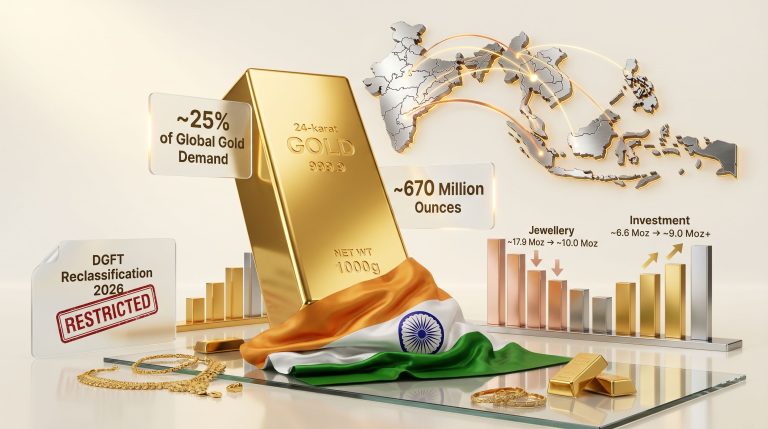
Commodity markets rarely receive clear signals about when major policy shifts are imminent. More often, the transition from speculation to regulation happens abruptly, catching supply chains mid-cycle and forcing traders, manufacturers, and policymakers to recalibrate simultaneously. The global precious metals market experienced exactly this dynamic on 12 May 2026, when India formally raised India gold and silver import tariffs to 15% through government orders, reversing a two-year period of reduced duties designed to formalise trade flows and suppress smuggling.
Understanding why this decision was made, what mechanics underpin the new tariff structure, and what it means for demand across formal and informal channels requires more than a surface reading of the policy announcement. It demands an examination of India's forex vulnerabilities, the structural evolution of domestic precious metals demand, and the historical record of what high tariffs actually produce in a market where smuggling networks remain sophisticated and price differentials are large enough to justify operational risk. Furthermore, the broader precious metals tariff impacts seen globally in recent years provide essential context for interpreting India's policy reversal.
When big ASX news breaks, our subscribers know first
The Architecture of India's New 15% Tariff Structure
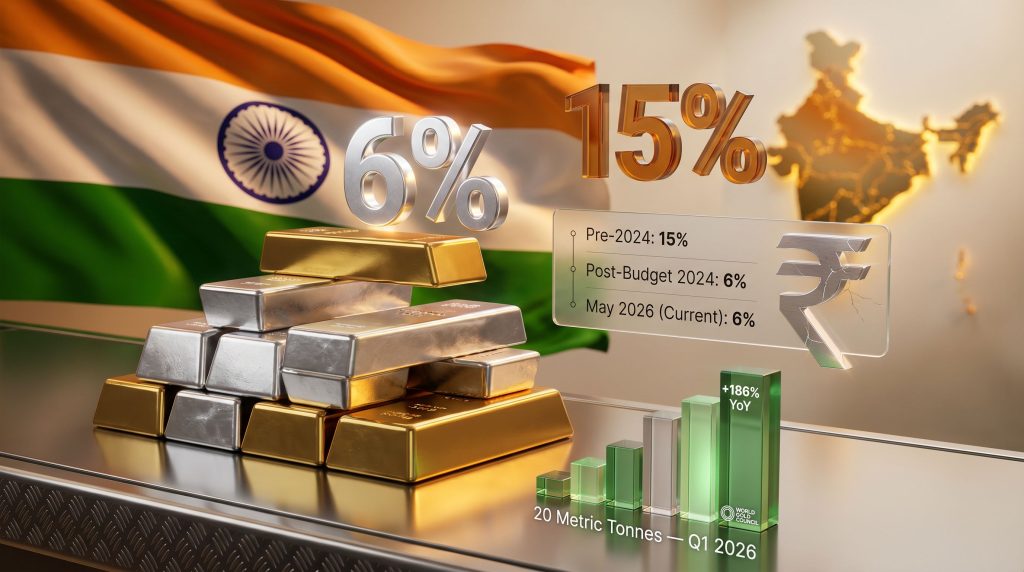
The effective 15% import duty on gold and silver is not delivered through a single flat rate mechanism. Instead, it combines two distinct fiscal instruments that together produce the composite levy. A 10% basic customs duty provides the foundational import charge, while a 5% Agriculture Infrastructure and Development Cess (AIDC) supplements it, bringing the combined effective rate to 15%, up from the 6% rate operative since the Union Budget 2024 slashed duties in a deliberate policy reversal.
The AIDC component is particularly notable because it was specifically dismantled during the 2024 tariff reduction cycle. Its reintroduction signals that policymakers were not seeking a moderate recalibration of duties but rather a full restoration of the pre-2024 tariff architecture. This structural choice implies significant alarm about the pace of foreign exchange deterioration and the cumulative impact of gold imports on the current account.
The tariff, however, does not operate in isolation from other fiscal levies on precious metals transactions:
- A 3% Goods and Services Tax (GST) applies at the consumer purchase level, adding to the post-import cost burden.
- A 3% Integrated Goods and Services Tax (IGST) on gold and silver imports caused significant disruption earlier in 2026, prompting Indian banks to suspend import operations for over a month before compliance mechanisms were clarified.
- The combined effect of import duty, IGST, and GST means that consumers bear a substantially higher total tax burden than the headline 15% figure alone implies.
The effective tariff on gold operates through multiple layers of taxation, meaning that the 15% import duty headline understates the total fiscal drag on precious metals consumption in India during 2026.
India's Forex Crisis and the Policy Calculus Behind Import Restriction
Why the Rupee's Weakness Drove the Decision
To appreciate the urgency behind the tariff increase, one must understand the structural pressure bearing down on India's foreign exchange reserves. Gold consistently ranks among India's most significant import expenditures, second only to crude oil in foreign currency outflow terms. Because India sources nearly all of its gold consumption through imports rather than domestic production, tariff policy functions as a direct lever on the current account balance.
The rupee's performance in 2026 provided the immediate political justification for intervention. Described by Reuters as one of Asia's worst-performing currencies, the rupee's sustained weakness amplifies the domestic cost of commodity imports denominated in US dollars. At gold futures prices proximate to $4,713 per troy ounce as of mid-May 2026, even modest reductions in import volume translate into meaningful foreign exchange savings.
A 15% tariff increase on this import category would, in theory, generate simultaneous benefits: reduced import volumes, lower current account deficit, and upward pressure on the rupee through reduced USD demand. The policy calculus, however, contains important caveats that industry participants were quick to identify.
India's Evolving Gold Demand: Investment Surge Complicates the Tariff Logic
How ETF Inflows Are Reshaping the Market
One of the most structurally significant developments in Indian precious metals demand during 2026 has been the dramatic shift toward investment-driven consumption. According to the World Gold Council, gold ETF inflows into India surged 186% year-on-year in the first quarter of 2026, reaching a record 20 metric tonnes. This occurred against a backdrop of negative equity market returns over the preceding twelve months, which redirected both retail and institutional capital into precious metals as an alternative store of value.
In addition, understanding the choice between physical gold vs ETFs has become increasingly important for Indian investors navigating the new tariff environment. This investment demand shift has important implications for tariff policy effectiveness:
- ETF-based demand does not require physical importation in equivalent volumes to direct bullion or jewellery purchases. Investors acquiring gold exposure through exchange-traded funds access price movement without necessarily triggering a new physical import event.
- Investment demand is more price-insensitive than jewellery demand at the individual purchase level. An investor allocating capital for portfolio protection may accept a higher entry price more readily than a cost-conscious jewellery buyer.
- The tariff increase cannot easily suppress ETF inflows, since these operate through financial markets rather than import channels, meaning one of the fastest-growing demand categories is partially insulated from the policy intervention.
| Demand Category | Tariff Sensitivity | Import Dependency | 2026 Trend |
|---|---|---|---|
| Jewellery fabrication | High | Direct | Moderate |
| Physical bullion investment | Moderate-High | Direct | Rising |
| Gold ETF inflows | Low | Indirect | Surging (+186% YoY) |
| Bridal/religious purchases | Low (culturally inelastic) | Direct | Stable |
| Industrial/silverware | Moderate | Direct | Mixed |
The Smuggling Paradox: How High Tariffs Create Black Markets
India's own policy history provides the clearest case study for what happens when gold and silver import duties reach levels that create profitable arbitrage opportunities for informal trade. The 2024 duty reduction to 6% was explicitly designed to close the price gap between formal and informal channels, reducing the economic incentive to circumvent customs processes. However, the reimposition of a 15% duty recreates precisely the conditions that previously sustained grey market activity.
According to Reuters, a Mumbai-based bullion dealer operating within the formal banking sector warned that informal markets are likely to reactivate under the newly reimposed tariff structure. The dealer's assessment centred on the intersection of elevated current gold prices and the 15% duty differential between legal importation and grey market supply. At these price levels, the absolute per-kilogram profit margin available to smuggling networks would be substantially larger than during previous high-tariff periods.
This creates what might be called the smuggling paradox in tariff policy design: the fiscal instrument intended to reduce import volumes and conserve foreign exchange may instead redirect demand from formal channels to informal ones. Consequently, several structural factors amplify the smuggling risk in 2026 specifically:
- Record gold prices increase the absolute dollar value of profit per kilogram transported through informal channels, making smuggling operations more lucrative than at any previous point in the high-tariff era.
- Established informal networks from the pre-2024 period may retain operational infrastructure that can be reactivated rapidly when economic incentives justify it.
- Regional geopolitical tensions, including those affecting West Asia, a key geographic corridor for precious metals transit toward India, may complicate interdiction efforts.
- The April 2026 import disruption created a supply vacuum in formal channels for over a month, potentially accelerating the reactivation of informal sourcing relationships.
When tariff differentials between formal and informal channels exceed the operational cost and risk premium of smuggling, illegal importation becomes economically rational. India's pre-2024 experience confirmed this dynamic, and the reinstated 15% rate recreates the same incentive structure at higher absolute price levels.
How the April 2026 Import Collapse Previewed the Policy Challenge
Before the formal tariff increase took effect, India experienced a preview of the demand suppression potential of tariff-adjacent regulatory friction. The introduction of the 3% IGST on gold and silver imports prompted Indian banks to suspend import operations for over one month while compliance procedures were clarified. The consequence was stark: April 2026 gold imports fell to near 30-year lows, demonstrating how rapidly formal supply chains respond to regulatory uncertainty.
Following the resolution of IGST compliance mechanisms, the government formally designated 15 authorised banks for precious metals imports, resolving a backlog that reportedly included approximately 8 tonnes of silver held in transit awaiting clearance. Banks resumed import operations and volumes began to normalise before the May 12 tariff increase created a fresh suppression catalyst.
This episode carries important analytical implications. If a temporary administrative disruption produced near-historic-low import volumes, then the permanent reimposition of a 15% tariff at record gold price levels should be expected to produce sustained and significant volume reductions in formal import statistics.
The next major ASX story will hit our subscribers first
Global Market Implications: India's Weight in the Precious Metals Ecosystem
Tracking Price Movements Across the Complex
India's position as the world's second-largest gold consumer means that domestic policy decisions carry ripple effects across global supply and demand balances. Furthermore, the broader context of gold and silver price impacts from shifting trade policy in 2025 and 2026 provides a useful framework for anticipating how markets might respond to India's tariff reversal.
The precious metals pricing environment in 2026 adds considerable complexity to the demand impact analysis:
- Gold futures were trading at approximately $4,713 per ounce as of mid-May 2026, reflecting a 3.84% gain in a single session.
- Silver futures reached $75.495 per ounce, representing a 7.47% single-session increase, with micro silver futures at $75.48 per ounce posting 7.54% gains.
- Platinum was priced at $1,973.85 per ounce, up 4.22%, while palladium reached $1,496.50, gaining 5.39%.
These simultaneous gains across the precious metals complex suggest that the tariff announcement occurred during a period of strong global investment demand for hard assets. Moreover, gold's safe-haven appeal during periods of macroeconomic uncertainty may prove sufficiently strong to partially offset the demand suppression the Indian government is hoping to achieve.
The Trade Deficit Arithmetic and Currency Dynamics
The theoretical mechanism through which the tariff increase supports the rupee operates through a specific causal chain:
- Higher import duties raise the effective cost of gold and silver purchases in rupee terms.
- Price-sensitive demand contracts, reducing the volume of gold and silver imported.
- Reduced import volumes lower USD demand from Indian importers and banks.
- Lower USD demand from the gold sector reduces upward pressure on the dollar-rupee exchange rate.
- The current account deficit narrows as the gold import bill shrinks, improving India's external balance.
This chain logic is internally consistent but depends critically on the assumption that formal demand contraction is not offset by informal smuggling. Additionally, rupee weakness independently compounds the domestic price impact of gold imports, creating a self-reinforcing dynamic: currency erosion makes gold more expensive yet simultaneously more attractive as a store of value for inflation-wary investors.
Surendra Mehta of the India Bullion and Jewellers Association captured this tension in his assessment that elevated gold and silver prices already posed demand challenges before the tariff increase, meaning the policy layered additional fiscal friction atop pre-existing affordability constraints.
What Investors and Market Participants Should Watch
For investors and analysts monitoring the impact of India's tariff decision, employing robust gold-silver ratio strategies may prove particularly valuable during this period of policy-driven market disruption. Several indicators also deserve close attention in the coming months:
- Monthly official import data from India's Ministry of Commerce will reveal whether formal import volumes contract as predicted.
- Gold ETF inflow data from the World Gold Council will indicate whether investment demand migrates further toward financial instruments as physical importation becomes more expensive.
- Rupee exchange rate movements against the US dollar will test whether the tariff achieves its stated currency support objective over the medium term.
- Informal market intelligence from bullion trade associations and bank treasury desks will provide early signals of whether grey market activity is accelerating.
- Global gold price trajectory will determine whether the 15% tariff creates sufficient domestic price elevation to meaningfully suppress demand.
The reimposition of India gold and silver import tariffs to 15% marks a significant inflection point in India's precious metals policy framework, carrying implications extending well beyond domestic jewellery counters and bank trading desks. How the market responds will test competing theories about tariff effectiveness, smuggling dynamics, and the resilience of investment demand in an era of elevated global precious metals prices. The two-year experiment with lower duties provided useful data on how formalised trade responds to reduced fiscal friction; the next phase will reveal whether reversing that policy produces symmetrically different outcomes, or whether established market structures respond in ways that defy straightforward policy predictions.
This article contains forward-looking assessments regarding market behaviour, demand responses, and policy outcomes. These assessments are based on publicly available information and industry commentary. Readers should not rely on this content as financial or investment advice. Precious metals markets involve substantial risk, and past policy outcomes may not accurately predict future market responses.
Want to Stay Ahead of Significant ASX Mineral Discoveries Before the Broader Market Reacts?
As policy shifts reshape global precious metals markets, timing and intelligence are everything — Discovery Alert delivers real-time ASX mineral discovery notifications powered by its proprietary Discovery IQ model, translating complex commodity data into clear, actionable insights for both short-term traders and long-term investors. Explore how historic mineral discoveries have generated substantial returns on Discovery Alert's dedicated discoveries page, and begin your 14-day free trial today to secure a market-leading edge.