June 15, 2026
The Hidden Economics of Gold in a Fractured World
Few commodities reveal the tensions between economic policy and cultural identity as sharply as gold does in India. While Western investors tend to treat gold as a safe-haven investment, hundreds of millions of Indian households treat it as something closer to a savings account, a dowry asset, and a generational store of wealth simultaneously. This deep-rooted relationship between Indian society and gold is precisely what makes India gold import restrictions so consequential, not just for domestic consumers and jewellers, but for global precious metals markets as a whole.
Understanding what has unfolded in India requires grasping three distinct but overlapping forces: a macroeconomic shock driven by elevated energy costs, a long-standing structural trade loophole that was quietly distorting imports, and a demand base that is gradually reshaping itself from ornamental to investment-grade gold consumption.
When big ASX news breaks, our subscribers know first
Forex Pressure and the Energy Import Spiral
When External Shocks Hit a Commodity-Dependent Economy
India's current account has always carried a structural vulnerability. As one of the world's largest energy importers, the country is acutely exposed to global oil and gas price movements. When energy costs surge, the ripple effects are immediate: import bills expand, foreign exchange reserves face drawdown pressure, the rupee weakens, and inflationary pass-through into the domestic economy accelerates.
According to market commentary from CPM Group dated May 12, 2026, India's foreign exchange reserve position had grown severely strained as a direct consequence of elevated oil and gas import costs, compounding existing economic disruption from broader geopolitical conflict. Economic activity within India had also been suppressed by disruptions to international trade flows, creating a dual squeeze on both the trade balance and domestic growth.
Gold imports, which have historically accounted for roughly 3% of India's GDP, represent one of the most visible and, critically, most discretionary drains on foreign exchange. Unlike energy imports, which are non-negotiable for an industrial economy, gold purchases carry an element of choice, at least from a policymaker's perspective. That distinction made gold a logical target for intervention.
The Reserve Bank's Compounding Dilemma
The Reserve Bank of India and the Finance Ministry faced a convergence of pressures in May 2026: a weakening rupee, rising imported inflation, constrained fiscal headroom, and a trade deficit swollen by energy costs. In this environment, Prime Minister Modi publicly called on Indian citizens over the weekend of May 10–11, 2026, to voluntarily reduce gold jewellery purchases for a period of one year, framing this as a form of national economic participation rather than a mandatory restriction.
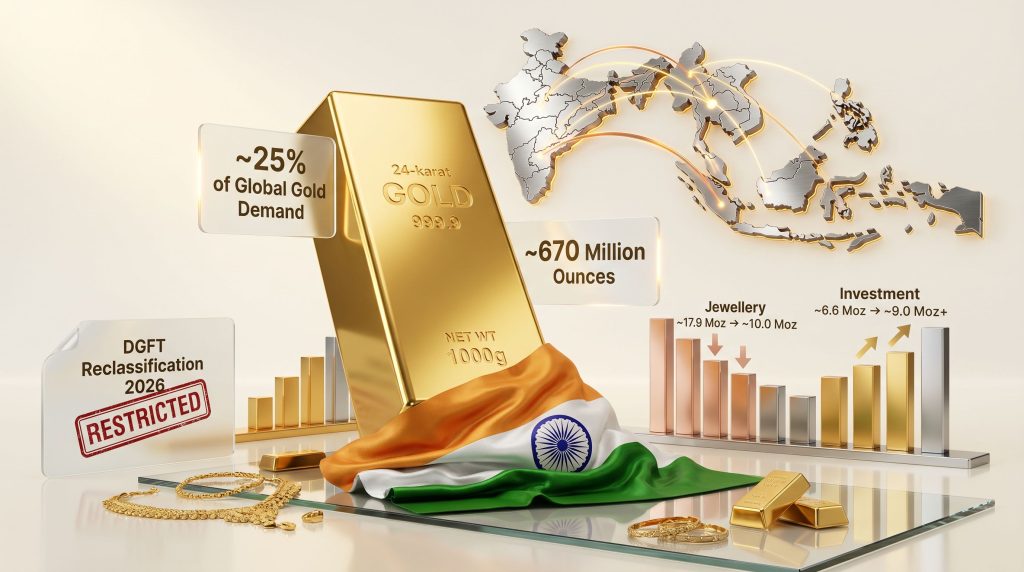
That voluntary appeal was quickly followed by a more structural intervention from the Directorate General of Foreign Trade (DGFT), which reclassified gold, silver, and platinum jewellery imports from the "Free" category to the "Restricted" category, requiring importers to obtain prior government approval or a valid import licence.
The combination of a public call for voluntary restraint and an immediate regulatory reclassification signals that the Indian government is treating gold import control as a genuine macroeconomic stabilisation tool, not merely a political gesture.
What the DGFT Reclassification Actually Means
From Free to Restricted: The Mechanics of the Change
Under India's Foreign Trade Policy framework, imports are classified across several categories, with "Free" representing goods that can be imported without additional approvals and "Restricted" representing goods requiring explicit licensing or government permission. The shift from Free to Restricted is not a ban, but it effectively inserts a bureaucratic gateway into every import transaction.
Critically, the reclassification took immediate effect with no transitional relief provided for:
- In-transit shipments already en route to Indian ports
- Existing import contracts signed under prior "Free" category terms
- Outstanding payment obligations to overseas suppliers
- Commercial banking arrangements tied to bullion import credit facilities
This absence of transitional provisions created immediate supply chain disruption for domestic jewellers, particularly those reliant on imported finished jewellery from ASEAN manufacturers.
Which Products Are Affected
| Product Category | Previous Status | New Status | Customs Tariff Heading |
|---|---|---|---|
| Gold jewellery (studded) | Free | Restricted | 7113 |
| Silver jewellery | Free | Restricted | 7113 |
| Platinum jewellery | Previously restricted | Remains restricted | 7113 |
| Raw gold bullion (bank imports) | Free | Stalled (GST clarification) | – |
| Gold doré (refinery imports) | Conditional | Requires DGFT permission | – |
What Remains Outside the Restrictions
The DGFT reclassification was designed with deliberate carve-outs to protect India's export-oriented manufacturing base. Furthermore, these exemptions reflect a clear policy architecture: restrict consumption-driven imports while shielding the approximately $40 billion gems and jewellery export industry from supply disruption.
- Special Economic Zones (SEZs) and 100% Export Oriented Units (EOUs) are explicitly excluded from the restrictions
- Government-approved export schemes for the gems and jewellery sector remain fully operational
- Personal baggage allowances for returning travellers are unchanged under existing Central Board of Indirect Taxes and Customs (CBIC) rules
The FTA Arbitrage Route That Triggered the Crackdown
How a Trade Agreement Became an Import Loophole
At the heart of the DGFT's intervention lies a specific and long-running trade arbitrage that had been quietly eroding Indian customs revenue and disadvantaging domestic refiners. The mechanism worked as follows:
- Raw gold or silver was exported from India to ASEAN member nations, particularly Thailand
- Those raw materials were converted into finished jewellery within ASEAN, adding minimal transformation but establishing FTA eligibility
- The finished jewellery was then re-imported into India under preferential tariff rates available under the India-ASEAN Trade in Goods Agreement
- The effective duty on re-imported jewellery was materially lower than the standard rate applied to direct bullion imports (~5% basic customs duty plus 1% Agriculture Infrastructure and Development Cess)
- Importers captured the duty differential as margin, while domestic refiners and jewellers faced unfair price competition from artificially cheapened imported product
This form of trade diversion, sometimes called "tariff engineering" or "rules of origin arbitrage," is not unique to India. It is a well-documented challenge in bilateral and multilateral free trade agreements where transformation thresholds are insufficiently strict to prevent minimal-processing circumvention. The precious metals market impact of such loopholes extends well beyond India's borders, affecting global supply chains and pricing structures.
Why Domestic Industry Suffered
For Indian goldsmiths, refiners, and jewellers operating within India's formal duty-paying structure, the FTA loophole represented an uneven playing field. Competitors importing via the ASEAN route could offer finished jewellery at lower prices, not because of superior craftsmanship or efficiency, but because of a regulatory gap that allowed the effective tariff burden to be reduced through geographic routing.
The DGFT reclassification effectively targets the mechanism of trade routing rather than consumer demand directly. This approach may prove more durable than a straightforward duty increase, because it closes the structural incentive rather than simply raising the price of using it.
A Policy Precedent Worth Noting
India's use of import controls to manage gold flows is not a modern invention. The Gold (Control) Act of 1968, now repealed, imposed sweeping restrictions during a prior era of balance-of-payments scarcity. The critical lesson from that period is well-documented: demand suppression through price mechanisms alone tends to generate informal trade and smuggling rather than genuine demand reduction.
The 2013 episode reinforced this historical pattern. When India raised basic customs duty on gold to 10% to address a current account deficit, legal imports fell sharply but smuggling volumes reportedly increased substantially, as price differentials between official and informal market gold widened to levels that justified the risk premium for illicit trade.
| Era | Policy Mechanism | Primary Driver | Observed Outcome |
|---|---|---|---|
| 1960s to 1990 | Gold Control Act 1968 | Forex scarcity, BOP crisis | Widespread informal trade, black market premiums |
| 1991 to 2012 | Gradual liberalisation | Economic reform, WTO compliance | Surge in legal imports, sector formalisation |
| 2013 | 80:20 scheme, duty hikes to 10% | CAD crisis | Temporary suppression, smuggling resurgence |
| 2022 to 2024 | Duty reduction to ~6% | Revenue optimisation, anti-smuggling | Import normalisation |
| 2026 | DGFT reclassification to Restricted | Forex pressure, FTA loophole closure | Supply disruption, price uncertainty |
India's Enormous Hidden Gold Reserve
The Scale of Private Gold Holdings
One of the least appreciated dimensions of India's gold market is the sheer volume of privately held above-ground gold stock. According to CPM Group's 2026 Gold Yearbook, a comprehensive review of supply, demand, and inventory data estimated that India held approximately 521 million ounces of gold in 2013, spanning bullion, coins, jewellery, and decorative and religious objects.
Since 2013, an estimated additional 155 million ounces may have been added to domestic above-ground inventories, bringing the total to approximately 676 million ounces by 2026. To contextualise this figure: at current prices near $4,683 per troy ounce, India's private gold holdings represent stored value in the tens of trillions of dollars.
This is not a new phenomenon. Research conducted in the 1960s by analysts studying global gold supply and demand estimated that Indian private citizens already held more gold than any other nation on earth, at roughly 100 million ounces at that time. The accumulation has been continuous, generational, and deeply embedded in household wealth management practices.
This means that any government effort to restrict new gold imports is operating against a backdrop of enormous domestic liquidity. If Indian consumers decide to transact in existing gold rather than buy new imports, the domestic secondary market is more than capable of absorbing significant demand without requiring a single new ounce to enter the country.
Quasi-Monetary Function and Cultural Entrenchment
Gold in India performs a function that has no precise equivalent in developed Western markets. It serves simultaneously as:
- A household savings instrument, particularly in rural communities with limited access to formal banking
- A liquid asset that can be pledged against loans or sold outright during financial stress
- A vehicle for transferring wealth across generations through inheritance and marriage
- A form of insurance against currency devaluation or inflation
The cycle of selling during hardship and repurchasing during prosperity creates what CPM Group's analysis describes as a deeply embedded savings behaviour that makes government calls to reduce gold consumption culturally and practically difficult to sustain. This is why every major Indian gold policy tightening has historically been only partially effective: the demand does not disappear, it either shifts to the secondary market or migrates to informal channels.
How Indian Demand Is Structurally Shifting
An important and underappreciated trend is the ongoing reallocation of Indian gold demand away from jewellery and decorative objects toward investment-grade formats such as bars, coins, and medallions. This shift reflects both the price sensitivity of jewellery demand at elevated gold prices and the growing sophistication of Indian investors who increasingly prefer standardised, easily valued investment instruments. In addition, the inflation hedge appeal of gold continues to drive investment-format purchases among urban Indian consumers seeking protection against rupee depreciation.
According to CPM Group's 2026 Gold Yearbook data, the trajectory looks as follows:
| Demand Category | 2022 (Moz) | 2024 (Moz) | 2025 (Moz) | 2026 Estimate (Moz) |
|---|---|---|---|---|
| Jewellery and Giftware | ~17.9 | ~16.0 | ~11.6 | ~10.0 |
| Investment (bars, coins, medallions) | ~6.6 | ~7.8 | ~9.0 | ~9.0+ |
| Total Estimated Demand | ~24.5 | ~23.8 | ~20.6 | ~19.0 |
Data sourced from CPM Group Gold Yearbook 2026. Projections made prior to Modi government's May 2026 restriction announcement.
Total demand has declined from approximately 24.5 million ounces in 2022 to an estimated 19 million ounces in 2026, driven primarily by jewellery demand compression at high price levels. Investment demand has moved in the opposite direction, rising from 6.6 million to approximately 9 million ounces over the same period.
This structural dynamic complicates the government's restriction strategy. Higher gold prices suppress jewellery purchases naturally, but simultaneously attract more investment interest, meaning total demand may prove stickier than policymakers anticipate.
A Parallel Disruption: The GST Technical Blockage
How a Portal Error Created a Secondary Supply Shock
Beyond the DGFT reclassification, a separate and technically distinct disruption has emerged in commercial gold imports facilitated through Indian banks. The ICEGATE customs clearance portal, which processes commercial import declarations, has reportedly been displaying an erroneous 3% GST charge on commercial gold imports, despite existing statutory exemptions that should waive this charge.
The effect of this technical error has been to stall bank-facilitated bullion imports pending official clarification from the Finance Ministry and DGFT. Simultaneously, gold doré imports by domestic refineries have accumulated in a permissions backlog as authorities work through the licence approval process introduced by the reclassification.
Together, these disruptions have created a compound supply-side shock: the deliberate policy restriction on jewellery imports and an inadvertent technical blockage on commercial bullion, the combination of which puts upward pressure on domestic gold prices in the near term.
The next major ASX story will hit our subscribers first
Traveller and NRI Gold Import Rules in 2026
Personal Allowances for Indian-Origin Passengers
Despite the sweeping reclassification of commercial gold jewellery imports, personal baggage allowances for travellers of Indian origin returning from abroad remain unchanged under CBIC rules. The applicable limits are:
- Men: Up to 20 grams of gold duty-free (maximum value ₹50,000) after a minimum six-month absence abroad
- Women: Up to 40 grams of gold duty-free (maximum value ₹1,00,000) after a minimum six-month absence abroad
Dutiable Gold via Personal Baggage
Gold imports through personal baggage beyond the duty-free threshold remain permitted up to a total of 1 kilogram, subject to applicable duties. A concessional rate of approximately 6% applies to eligible returning passengers, while standard rates of up to 36% apply to non-eligible travellers. All duties on baggage gold must be paid in foreign currency.
Updated NRI and OCI Cardholder Rules
Non-Resident Indians (NRIs) and Overseas Citizen of India (OCI) cardholders returning after 12 or more months abroad benefit from simplified weight-based allowances that remove value caps applicable to shorter-term returnees. Personal jewellery previously taken abroad with an export certificate may be re-imported duty-free under matching documentation.
Key prohibitions applying to all baggage channel gold imports:
- Gold jewellery studded with pearls or precious stones is prohibited under baggage rules regardless of passenger category
- Foreign nationals are not permitted to import gold through the personal baggage channel under any circumstances
Global Market Implications and Precious Metals Pricing Context
India's Weight in the Global Gold Equation
India accounts for approximately 25% of global gold demand, making it the second largest gold consumer market globally. Any sustained policy-driven reduction in Indian import volumes represents a meaningful demand-side variable in global price formation. This is particularly significant at a time when other demand drivers, including central bank gold demand, geopolitical risk premiums, and North American investor re-engagement, are providing upward price support.
According to CPM Group's May 2026 market commentary, gold prices were trading near $4,683 per ounce, having reached an intraday high of approximately $4,745 on May 12, 2026. The CPM Group outlook at that time projected potential further upside toward $5,200 over the following three months, with a downside scenario in the range of $3,800 to $4,000 representing the plausible trading band over the same period.
These projections were framed before the full implications of India's gold import restrictions had been assessed, suggesting some downside risk to the demand component of those price models.
Silver, Platinum, and Palladium: The Broader Precious Metals Context
India's restrictions are unfolding against a backdrop of broad precious metals strength. Understanding the dynamics across gold and silver markets is essential for contextualising India's role in global pricing. CPM Group's May 12, 2026 commentary noted:
- Silver reached approximately $88 per ounce on May 12, 2026, briefly exceeding CPM Group's projected ceiling for the period. Near-term potential for prices to test $90 was identified as plausible before a pullback. Mixed investor positioning was observed, with some profit-taking alongside continued new interest from investors expecting further upside.
- Platinum was trading near $2,117 per ounce, with CPM Group noting that upcoming platinum marketing activity scheduled around Platinum Week in London was expected to generate bullish industry reports. CPM Group specifically cautioned that claims of a "massive deficit" in platinum supply were not supported by the underlying data, representing an important counterpoint to marketing-driven price narratives.
- Palladium was trading near $1,491 per ounce, with a session high near $1,540. The longer-term price trajectory was characterised as upward, but with near-term sideways movement expected over approximately three months.
CPM Group's commentary on platinum marketing activity is a notable piece of market intelligence. The suggestion that bullish deficit narratives around platinum are manufactured rather than data-driven serves as a reminder that precious metals markets are susceptible to marketing-driven price moves, particularly in thinner, less liquid metals.
Impact on ASEAN Gold Trade Flows
The DGFT reclassification will directly affect Thailand and other ASEAN jewellery manufacturers who benefited from the FTA routing arbitrage. Export volumes to India from ASEAN jewellery fabricators will face immediate constraint pending licence approvals, and the structural incentive for the trade route has been eliminated for the foreseeable future.
Refiners and fabricators in non-ASEAN jurisdictions are unlikely to benefit immediately, given that the restriction applies across all jewellery import origins rather than targeting ASEAN specifically. However, the longer-term implication of this policy could include pressure on India to renegotiate specific provisions of the India-ASEAN Trade in Goods Agreement to formally address rules-of-origin gaps.
The US Inflation Overlay: A Macro Complication
Rising US Inflation and Federal Reserve Policy Uncertainty
India's gold policy decisions are unfolding within a global macroeconomic context shaped partly by US inflation dynamics. CPM Group's May 12, 2026 commentary noted that US Consumer Price Index data released that morning showed headline inflation at approximately 3.8% year-on-year in April, up from 3.3% in March, with month-on-month changes showing sharp acceleration. Core CPI, stripping out volatile food and energy components, was running near 2.8%.
While these figures remain materially below the 9% peak seen in 2021 to 2022 or the 14% peak seen in the 1970s, the trend direction is concerning given elevated energy prices linked to geopolitical disruption. CPM Group noted that the Federal Reserve's posture had shifted from expectations of rate cuts in 2026 and 2027 to a more hawkish stance by March 2026, with rate increases no longer ruled out.
This policy uncertainty is supportive of gold from a safe-haven and inflation-hedge perspective, providing an offsetting demand driver even as India gold import restrictions introduce downward demand pressure. The net effect on prices will depend on which force dominates over the next several quarters.
Frequently Asked Questions: India Gold Import Restrictions 2026
What is the current import duty on gold entering India?
The standard basic customs duty on gold imports into India is approximately 5%, with an additional 1% Agriculture Infrastructure and Development Cess (AIDC), bringing the effective rate to approximately 6% for eligible commercial importers. Higher composite rates apply in certain categories depending on the nature of the import and the importing entity.
Can I bring gold jewellery from abroad into India?
Yes, within defined personal baggage limits. Indian-origin passengers returning after six months or more of continuous absence abroad may bring gold duty-free up to 20 grams (men) or 40 grams (women). Additional gold up to 1 kilogram is permitted subject to applicable duties payable in foreign currency. Gold jewellery studded with precious stones is prohibited, and foreign nationals may not use the baggage channel for gold imports.
Why has India restricted gold jewellery imports in 2026?
The DGFT reclassified gold, silver, and platinum jewellery imports to "Restricted" status for two primary reasons: to address severe forex reserve pressure driven by elevated energy import costs, and to close a structural arbitrage loophole in the India-ASEAN Free Trade Agreement where raw metals were being processed into jewellery in ASEAN countries and re-imported at preferential duty rates.
Are Indian gold exports affected by the 2026 restrictions?
No. Export-oriented units, Special Economic Zones, and government-approved export schemes for the gems and jewellery sector are explicitly excluded from the import restrictions, preserving the competitiveness of India's approximately $40 billion gems and jewellery export industry.
What is the GST issue affecting commercial gold imports through banks?
A technical error on India's ICEGATE customs clearance portal has been incorrectly displaying a 3% GST charge on commercial gold imports despite existing statutory exemptions. This has effectively stalled bank-facilitated bullion imports pending formal clarification from the Finance Ministry and DGFT.
How does India's position affect global gold prices?
India represents approximately 25% of global gold demand. Sustained reduction in Indian import volumes introduces a meaningful demand-side headwind for global prices. However, offsetting factors including geopolitical risk premiums, strong Chinese demand, and renewed Western investor interest in gold were, as of May 2026, providing substantial upside support to prices in the $4,683 to $4,745 range.
Key Takeaways for Investors and Market Participants
Understanding India gold import restrictions requires holding several tensions simultaneously. Consequently, investors and market participants should weigh the following considerations carefully:
- The DGFT reclassification is targeted and structural, aimed at both a macroeconomic stabilisation goal and a specific trade loophole, rather than being a blanket prohibition on gold
- India's domestic above-ground gold stock of approximately 676 million ounces means the secondary market can partially absorb demand that cannot access imports, softening the demand shock
- The structural shift from jewellery to investment-grade gold within Indian demand means that investment demand may prove resilient even as jewellery purchases fall
- Historical precedent strongly suggests that demand suppression through import restrictions produces informal trade as a side effect, making enforcement consistency critical to the policy's effectiveness
- Global precious metals markets are watching India's demand trajectory against a backdrop of elevated geopolitical risk premiums, US inflation uncertainty, and marketing-driven narratives in platinum that may not reflect underlying supply-demand fundamentals
- The technical GST blockage on bank gold imports represents a separate, inadvertent supply disruption that could amplify near-term domestic price pressure beyond what was intended by the DGFT reclassification alone
Disclaimer: This article contains forward-looking market commentary, price projections, and analytical perspectives sourced in part from CPM Group's May 12, 2026 market update. All price forecasts, demand projections, and policy outcome assessments involve inherent uncertainty and should not be construed as financial advice. Investors should conduct their own due diligence and consult qualified financial advisers before making investment decisions based on the information contained herein.
Want to Stay Ahead of the Next Major Precious Metals Discovery?
While India's gold import restrictions reshape global demand dynamics, Discovery Alert's proprietary Discovery IQ model scans ASX announcements in real time, instantly identifying significant mineral discoveries across gold, silver, and 30+ other commodities before the broader market reacts. Start your 14-day free trial at Discovery Alert today, or explore how historic discoveries have generated extraordinary returns to understand the full scale of opportunity available to informed investors.