
May 13, 2026
When Engineering Governance Becomes the Product: Heap Leach Risk in a Post-Eagle Mine World
There is a version of mining development where technical excellence alone is sufficient to move a project forward. That version no longer exists in Canada's northern territories. What has replaced it is a far more complex operating environment, one where engineering accountability, third-party oversight, and demonstrated community relationships have become prerequisites for investor confidence, regulatory engagement, and long-term project viability. For junior gold developers proposing heap leach operations in particular, the bar for governance credibility has never been higher.
The Fuerte Metals Coffee Gold Project heap leach overhaul, announced in May 2026, is a direct response to this new reality. However, understanding why these changes matter, and what they signal about the broader trajectory of heap leach development in Canada, requires stepping back from the company-specific announcement and examining the structural forces that made this kind of governance reform both inevitable and strategically essential.
When big ASX news breaks, our subscribers know first
The Incident That Changed Everything: Heap Leach Accountability After Eagle Mine
Heap leach processing is one of the most cost-effective methods available for extracting gold from low-grade oxide ore. The process involves stacking crushed ore on an engineered liner pad, then applying a dilute cyanide solution that percolates through the material and captures dissolved gold. The pregnant solution is then processed to recover the metal. When it works, it works efficiently. When it fails, the consequences can be severe and irreversible.
The collapse of a heap leach pad at the Eagle Mine stands as one of the most consequential incidents in recent North American mining history. The failure released cyanide-contaminated material into the surrounding environment, triggering an independent review process that exposed critical shortcomings in both the structural design of the pad and the oversight systems meant to prevent such an outcome. Post-incident analysis concluded that neither the engineering design nor the accountability frameworks governing that design were adequate for the risks involved. (Canadian Mining Journal, May 12, 2026)
The Eagle Mine failure did not merely damage one company's reputation. It fundamentally altered how regulators, institutional investors, and community stakeholders evaluate any proposed heap leach facility in Canada, regardless of the operator.
For developers like Fuerte Metals, this means that proposing a heap leach facility in 2026 carries an implicit burden of proof that simply did not exist five years ago. The question is no longer whether the engineering is sound in isolation. It is whether the governance surrounding that engineering is robust enough to catch failures before they occur. Furthermore, the mining permitting realities of operating in northern Canada add yet another layer of complexity to this already demanding environment.
What the Coffee Gold Project Actually Represents
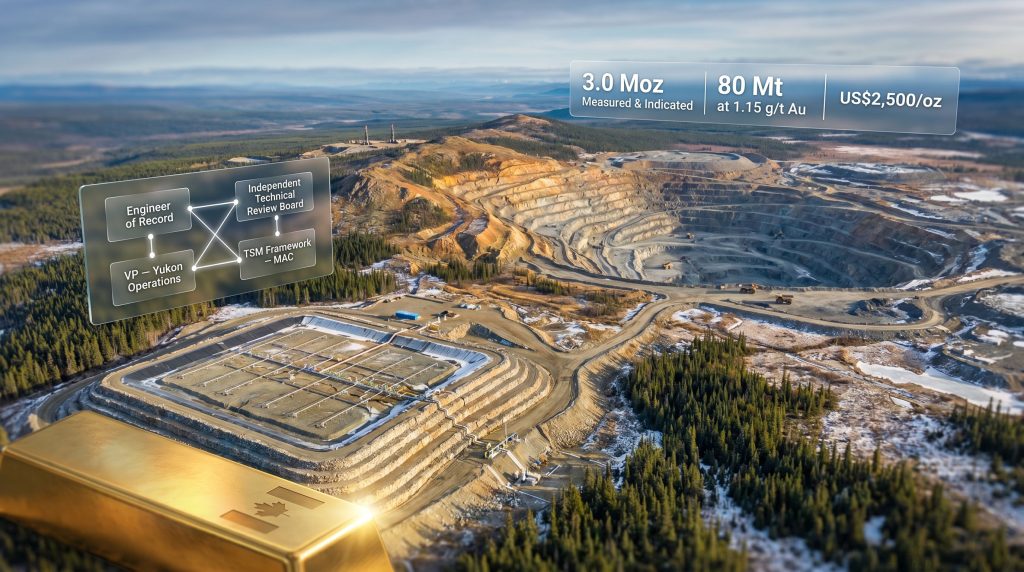
Situated in the Yukon Territory, the Coffee Gold Project is among the more significant undeveloped gold assets in Canada by resource scale. The project hosts a Measured and Indicated resource of 3.0 million ounces of gold across approximately 80 million tonnes at a weighted average grade of 1.15 g/t Au, with an additional Inferred resource of 0.8 Moz. Economic modelling underpinning the Preliminary Economic Assessment uses a gold price assumption of US$2,500/oz and a CAD:USD exchange rate of 1.35.
| Resource Category | Tonnes (Mt) | Grade (g/t Au) | Gold (Moz) |
|---|---|---|---|
| Measured and Indicated | 80 | 1.15 | 3.0 |
| Inferred | N/A | N/A | 0.8 |
| M&I at 0.40 g/t cut-off | 60 | 1.44 | 2.8 |
| M&I at 1.0 g/t cut-off | 30 | 2.19 | 2.16 |
The resource is reported in compliance with NI 43-101 standards, the Canadian regulatory framework governing the disclosure of scientific and technical information in the mining industry. What the cut-off grade sensitivity analysis reveals is particularly instructive: even at a conservative 1.0 g/t threshold, the project retains 2.16 Moz of gold across 30 million tonnes at an average grade of 2.19 g/t Au. This demonstrates meaningful grade resilience, a characteristic that matters considerably when commodity prices shift or operating cost assumptions are revised.
Why Heap Leach Was Selected as the Core Processing Method
The decision to pursue open-pit, heap leach processing rather than a conventional milling circuit reflects both the metallurgical character of the ore and the economics of northern development. Heap leach operations carry substantially lower capital intensity than mill-based alternatives, which makes them attractive for projects where upfront capital constraints are a limiting factor.
However, metallurgical domain performance is not uniform across the Coffee deposit, and this is a detail that deserves careful attention:
| Metallurgical Domain | Recovery Rate |
|---|---|
| Oxide | 86.3% |
| Lower Transition | 31.4% |
The 86.3% recovery rate in the oxide domain is strong by heap leach standards and supports the economic case for this processing approach in the higher-grade oxide portions of the resource. The 31.4% recovery rate in the lower transition zone, however, illustrates a technical constraint that is common in deposits where oxide mineralisation gives way to sulphide or mixed-sulphide material.
Transition zone ore frequently requires alternative processing approaches such as flotation concentration or pressure oxidation to unlock meaningful recovery rates, both of which carry significantly higher capital and operating cost implications. This domain-specific recovery contrast is not a flaw unique to Coffee Gold; it is a characteristic of nearly all oxide heap leach deposits. In addition, it does define the practical limits of where the heap leach model creates value within the resource envelope.
The Supremo Extension: Where Near-Term Upside Lives
Within the broader Coffee resource, the Supremo Extension zone has emerged as the focal point for near-term growth potential:
- Indicated Resource: 2,437 kt at 1.18 g/t Au for 92,000 ounces
- Inferred Resource: 6,059 kt at 1.72 g/t Au for 335,000 ounces
- An active 40,000-metre drill campaign initiated in 2026 is specifically targeting category upgrades in this zone
The Inferred resource grade of 1.72 g/t Au at Supremo is notably higher than the project-wide average of 1.15 g/t. Consequently, successful conversion of Inferred ounces to Indicated status could meaningfully improve the project's overall grade profile and economic metrics in subsequent technical reporting. For more on interpreting drill results in the context of resource category upgrades, the methodology underpinning these assessments is worth understanding in detail.
The Four-Pillar Governance Restructure: What Has Changed and Why It Matters
The governance overhaul announced by Fuerte Metals in May 2026 operates across four distinct but interconnected dimensions. Each addresses a specific vulnerability that post-incident reviews of heap leach failures have historically identified. (Canadian Mining Journal, May 12, 2026)
Pillar One: A New Engineer of Record
NewFields Canada has been appointed as the Engineer of Record for the Coffee Gold heap leach facility, replacing the project's original design firm, Forte Dynamics. Forte Dynamics will continue in a transitional advisory capacity to preserve institutional knowledge of design decisions made to date.
The Engineer of Record designation carries significant weight in mining engineering. This role holds direct accountability for geotechnical design standards, construction specifications, and the technical documentation required for regulatory submissions. The separation of design authority from a fresh, independent engineering perspective is a structural safeguard against what investigators have described in past failures as the normalisation of risk, where original designers become progressively desensitised to the vulnerabilities embedded in their own work.
Pillar Two: An Independent Technical Review Board
Two inaugural members, each with decades of operational mining experience, have been appointed to an Independent Technical Review Board. This body functions as a standing external check on all engineering decisions related to the heap leach facility.
The core principle behind an Independent Technical Review Board is the elimination of single-point-of-failure risk in engineering governance. When one firm holds both design authority and self-review responsibility, the conditions for catastrophic oversight failure are structurally embedded in the project from the start.
By creating a formally constituted external review mechanism with members who have no prior design investment in the Coffee project, Fuerte Metals is deliberately introducing a friction layer into its technical decision-making process. In engineering governance, friction of this kind is not inefficiency; it is a designed-in safety mechanism. According to recent company announcements, this multi-layered oversight structure represents a deliberate departure from the single-firm accountability models that have proven inadequate in previous heap leach incidents.
Pillar Three: Regional Leadership with Territorial Depth
Sébastian Tolgyesi has been appointed as Vice-President of the Coffee Project, bringing Yukon-based operational experience directly into the senior leadership structure. This appointment reflects a considered understanding of the distinct challenges associated with northern Canadian resource development.
Operating in the Yukon is fundamentally different from operating in more accessible Canadian mining jurisdictions. Logistical complexity, extreme seasonal conditions, permafrost considerations in geotechnical design, and the density of First Nations traditional territory claims create a risk landscape that is not navigable without embedded northern expertise. The appointment of a Yukon-based VP signals that Fuerte Metals intends to manage these variables from within the territory rather than from a distant head office. (Canadian Mining Journal, May 12, 2026)
Pillar Four: TSM Framework Adoption Through MAC Membership
Fuerte Metals has applied for membership in the Mining Association of Canada and has committed to implementing the Towards Sustainable Mining (TSM) framework across the Coffee Gold Project.
| Governance Element | Pre-Restructure | Post-Restructure |
|---|---|---|
| Engineer of Record | Forte Dynamics (original designer) | NewFields Canada (independent) |
| External Technical Review | Not established | Independent Technical Review Board |
| Regional Leadership | Not specified | VP appointment, Yukon-based |
| Industry Framework | Not adopted | TSM via MAC membership |
| Accountability Structure | Single-firm responsibility | Multi-layered, distributed |
The TSM framework requires member companies to publicly measure, manage, and report performance across a defined set of environmental, social, and governance indicators. Coverage areas include tailings and heap leach management, biodiversity conservation, crisis management preparedness, and, critically, Indigenous and community relationships. Adoption of TSM introduces third-party performance verification, meaning that commitments to responsible operation are not self-reported claims but externally validated outcomes.
For a project in a jurisdiction as scrutinised as the Yukon, this external accountability layer carries considerable signalling value to regulators and First Nations communities alike.
First Nations Engagement: The Dimension That Cannot Be Engineered Around
Four First Nations communities hold traditional territories that intersect with the Coffee Gold Project area:
- Tr'ondëk Hwëch'in First Nation
- White River First Nation
- Selkirk First Nation
- First Nation of Na-Cho Nyäk Dun
Fuerte Metals has formally described these relationships as the project's highest priority. (Canadian Mining Journal, May 12, 2026) This positioning reflects a hard-learned lesson from decades of Canadian resource development: in the Yukon and Northwest Territories, First Nations engagement is not a regulatory checkbox to be completed during permitting. It is an ongoing relationship that determines whether a project retains its social licence to operate across the full arc of development, construction, and production.
The adoption of the TSM framework reinforces this commitment in a structurally meaningful way. TSM's Indigenous and community relationships protocol requires companies to demonstrate engagement processes that are respectful of Indigenous rights and consistent with the principles of free, prior, and informed consent. Understanding the evolving Indigenous claims framework across Canadian jurisdictions is essential context for appreciating just how meaningfully this commitment elevates the standard of accountability applied to First Nations engagement across the project.
This matters for practical permitting reasons as much as ethical ones. In the Yukon, the Environmental and Socio-economic Assessment Act (YESAA) process requires comprehensive consultation with affected First Nations as a precondition for project approvals. A company that has invested in structured, documented, and externally verified engagement processes is in a materially stronger position to navigate this process than one that has not.
The Economics That Make Governance Worth Protecting
A governance restructure of this scope only makes sense if the underlying asset economics justify the investment. The Coffee Gold PEA parameters suggest they do:
- Mining costs: C$3.27 to C$3.50 per tonne
- Processing costs: C$6.64 per tonne
- Gold price assumption: US$2,500/oz
- Exchange rate assumption: CAD:USD 1.35
- Processing model: Open-pit mining to doré bar output via heap leach
These cost parameters position Coffee Gold at the lower end of the cost curve for Canadian open-pit gold development, which is precisely the value proposition that heap leach operations are designed to deliver. The combination of a multi-million ounce resource base, competitive operating cost assumptions, and a processing model with demonstrated recovery rates in the oxide domain creates an economic foundation that is worth protecting through rigorous governance investment.
Furthermore, as the project advances towards a definitive feasibility study, the governance structures now in place will be instrumental in satisfying the increasingly stringent technical and social criteria that institutional financiers require before committing capital to northern Canadian projects.
Tim Warman, CEO of Fuerte Metals, stated publicly that the company is taking deliberate steps to strengthen how the Coffee Gold Project is designed, constructed, and operated, with a specific focus on implementing multiple layers of independent technical review and establishing clear lines of accountability across the project. (Canadian Mining Journal, May 12, 2026)
The next major ASX story will hit our subscribers first
Why This Governance Model Is Becoming the Industry Baseline
The Fuerte Metals Coffee Gold Project heap leach overhaul reflects a broader structural shift in how junior mining developers must present themselves to attract the capital and regulatory goodwill needed to advance projects through feasibility and into construction. Sweeping announcements of this kind are increasingly being read by the market not as reactive damage control but as proactive strategic positioning.
Historically, smaller developers could rely on a single engineering firm to carry design, review, and compliance responsibilities simultaneously. The post-Eagle Mine environment has made that model commercially and reputationally untenable for heap leach proposals specifically. Institutional investors, streaming companies, and royalty financiers now conduct governance due diligence with the same rigour they apply to resource estimate verification.
A project that cannot demonstrate independent review structures, territorial expertise, and credible Indigenous engagement frameworks faces a higher cost of capital, longer permitting timelines, and greater execution risk at every stage of development. The Fuerte Metals Coffee Gold Project heap leach overhaul addresses all three of these investor concerns simultaneously. It is not merely a risk mitigation exercise. For a junior developer operating in an environment where differentiation at the governance level has become a competitive variable, it is a strategic positioning decision with direct implications for project valuation and financing optionality.
Frequently Asked Questions
What changes has Fuerte Metals made to Coffee Gold Project's heap leach facility oversight?
The company has appointed NewFields Canada as the new Engineer of Record, established an Independent Technical Review Board with two experienced members, appointed a Yukon-based Vice-President for the project, and applied for Mining Association of Canada membership to implement the Towards Sustainable Mining framework.
What is the Coffee Gold Project's total gold resource?
The project hosts a Measured and Indicated resource of 3.0 million ounces of gold (80 Mt at 1.15 g/t Au) and an additional Inferred resource of 0.8 Moz, reported under NI 43-101 standards.
Why was NewFields Canada appointed as Engineer of Record?
NewFields Canada was brought in to provide independent engineering authority over the heap leach facility, replacing the original design firm in response to industry-wide concerns about single-firm design accountability following the Eagle Mine failure.
What is the Towards Sustainable Mining framework?
TSM is the Mining Association of Canada's responsible mining protocol, requiring member companies to publicly measure and externally verify performance across environmental, social, and governance indicators including tailings management and Indigenous community engagement.
Which First Nations communities are engaged in the Coffee Gold Project?
Fuerte Metals maintains active relationships with the Tr'ondëk Hwëch'in First Nation, White River First Nation, Selkirk First Nation, and the First Nation of Na-Cho Nyäk Dun.
What is the status of the 40,000-metre drill program?
Fuerte Metals initiated the 40,000-metre drill campaign in 2026, targeting the Supremo Extension zone with the objective of converting Inferred resources into higher confidence Indicated categories to support future feasibility work.
This article is intended for informational purposes only and does not constitute financial advice. Investors should conduct their own due diligence and consult a qualified financial adviser before making investment decisions. Resource estimates, economic parameters, and project timelines referenced herein are sourced from publicly available company and industry materials and are subject to change.
Want to Know When the Next Major Gold Discovery Hits the ASX?
Discovery Alert's proprietary Discovery IQ model scans ASX announcements in real time, instantly identifying significant mineral discoveries and turning complex data into actionable investment insights — the same kind of transformative opportunities that have historically delivered exceptional returns, as showcased on Discovery Alert's dedicated discoveries page. Start your 14-day free trial at Discovery Alert and position yourself ahead of the broader market.