
July 26, 2026
Capital allocation decisions across heavy industry increasingly reflect a fundamental tension between preserving existing capital infrastructure and deploying resources toward emerging low-carbon technologies. This dynamic has reached particular intensity within steel production, where facility operators must balance multi-decade asset lifecycles against rapidly evolving regulatory frameworks and market demand patterns. The decarbonization of US steel industry represents one of the most significant investment challenges in American manufacturing, with billions in industrial capital allocation over the next five years determining whether traditional production methods receive extended operational periods or whether alternative technological pathways gain market dominance.
Understanding the Decarbonization Investment Landscape
The steel sector represents one of the most carbon-intensive segments of American manufacturing, contributing approximately 7-9% of global carbon dioxide emissions according to International Energy Agency assessments. This emission profile has created urgency around technological transitions, particularly as major production facilities approach critical reinvestment decision points before 2030. Furthermore, these developments intersect with broader energy transition trends that are reshaping global industrial competitiveness.
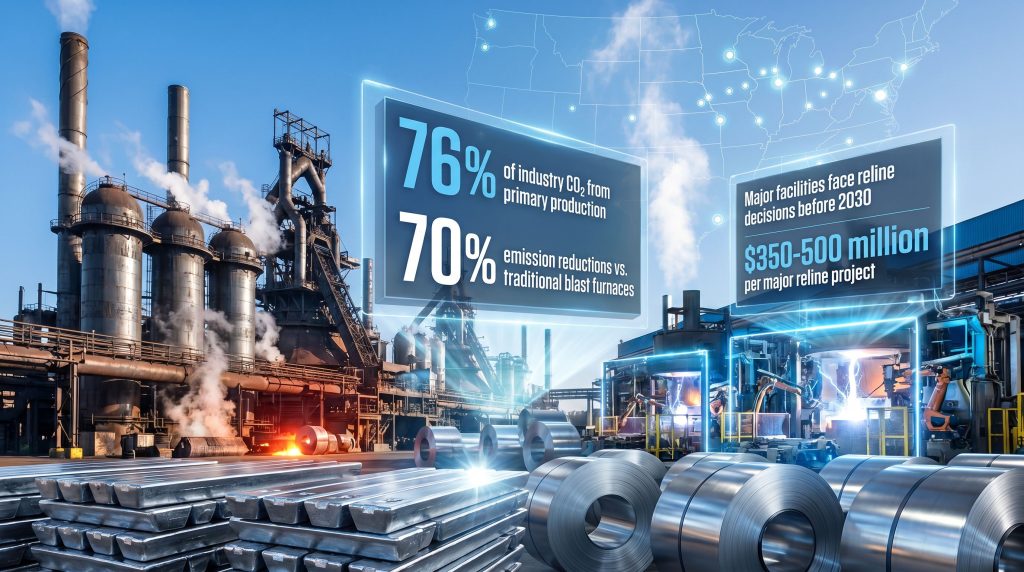
Electric arc furnace systems demonstrate the potential for substantial emission reductions, achieving approximately 70% lower carbon intensity compared to traditional blast furnace operations. However, current market structure shows that electric arc furnaces account for roughly one-third of domestic capacity whilst blast furnace-basic oxygen furnace combinations continue to dominate with nearly 70% of production volume.
Key emission reduction mechanisms include:
• Feedstock substitution – replacing coal-based reduction with natural gas or hydrogen
• Process electrification – utilising renewable electricity for heating and melting operations
• Increased scrap utilisation – expanding secondary steel production through recycled materials
• Carbon capture integration – retrofitting existing facilities with emission mitigation technology
The timing of capital deployment decisions has become particularly critical as major Midwest facilities face blast furnace reline requirements that would extend operational lifecycles by approximately two decades. These investments, ranging from hundreds of millions to over $500 million per facility, represent substantial commitments to existing technological pathways.
When big ASX news breaks, our subscribers know first
Competing Decarbonization Pathways for US Steel
Direct Reduced Iron-Electric Arc Furnace Route
The direct reduced iron approach has emerged as the leading near-term decarbonization pathway for American steelmaking operations. This process fundamentally alters the reduction chemistry by substituting natural gas or hydrogen for coal-based coke in converting iron ore to metallic iron. When powered by renewable electricity, DRI-EAF systems can achieve significant emission reductions compared to traditional blast furnace operations.
Natural gas pathway characteristics:
• Emission reduction potential – substantial decreases in carbon intensity through cleaner reductant
• Infrastructure requirements – new DRI plants requiring natural gas supply and renewable electricity access
• Cost competitiveness – operational advantages over blast furnace-basic oxygen furnace routes
Hydrogen integration represents the ultimate decarbonization potential for DRI systems, producing water vapour instead of carbon dioxide during the reduction process. However, hydrogen deployment faces near-term challenges including infrastructure development requirements and policy uncertainty following the cancellation of over $2 billion in federal funding for West Coast hydrogen hubs in October 2025.
Industry experts note that DRI investment decisions provide strategic flexibility, enabling initial deployment with natural gas whilst maintaining hydrogen-readiness for future transitions as infrastructure develops and costs decline. This approach allows steelmakers to begin emission reductions immediately whilst preserving options for deeper decarbonization as hydrogen markets mature.
Advanced Electric Arc Furnace Expansion
Electric arc furnace technology offers immediate emission reduction opportunities through increased utilisation of scrap steel feedstock. Current domestic capacity shows significant expansion potential, with EAF systems typically achieving emission intensities between 0.6-0.9 tonnes of CO2 per tonne of steel produced, compared to 2.2 tonnes for blast furnace operations.
Mini-mill integration advantages include:
• Flexible production scaling – smaller facility footprints with modular capacity additions
• Reduced capital requirements – lower initial investment compared to integrated steel complexes
• Shorter construction timelines – faster deployment enabling quicker market response
• Location flexibility – proximity to scrap supply and end-use markets
Advanced casting and rolling technologies enhance mini-mill competitiveness by improving product quality and expanding market applications. Endless casting systems and direct rolling capabilities allow EAF-based producers to compete effectively in flat-rolled product segments traditionally dominated by integrated mills.
Carbon Capture and Storage Retrofits
Carbon capture technology represents a pathway for extending existing blast furnace lifecycles whilst achieving meaningful emission reductions. CCS retrofits would allow steelmakers to preserve substantial invested capital in existing facilities whilst meeting evolving environmental requirements.
However, carbon capture deployment in steel applications remains in early development stages, requiring significant research and development investment. The technology faces challenges including high capital expenditure requirements, energy consumption penalties, and uncertain long-term storage solutions. Most CCS proposals focus on capturing emissions from existing blast furnace operations rather than fundamental process changes.
Implementation considerations include:
• Technology maturity – limited commercial deployment in steel sector applications
• Infrastructure requirements – CO2 transport and storage network development
• Economic viability – cost competitiveness versus alternative decarbonization pathways
• Regulatory framework – permitting and liability structures for long-term storage
Critical Investment Decision Points
Blast Furnace Reline Economics
Major steel facilities across the Midwest face imminent blast furnace reline decisions that will determine production pathways for the next two decades. These capital commitments represent some of the largest industrial investment decisions in American manufacturing, with individual projects requiring hundreds of millions in expenditure. Additionally, these decisions intersect with iron ore and coal dynamics that affect global supply chains.
US Steel's Gary Works No. 14 facility exemplifies the scale and timing pressures facing the industry. The Indiana complex undertook a $350 million reline project from May through August 2026, designed to extend furnace operations for 20 years. This investment locks in coal-based production through the mid-2040s whilst foreclosing alternative pathway deployment at that location.
Cleveland-Cliffs has similarly committed to blast furnace relines at its Burns Harbor and Middletown facilities, extending operational lifecycles by approximately 20 years at costs reaching hundreds of millions of dollars per project. These decisions reflect strategic assessments that existing integrated steelmaking infrastructure retains competitive advantages despite emission reduction pressures.
| Investment Category | Capital Range | Timeline | Lock-in Period |
|---|---|---|---|
| Major blast furnace reline | $300-500 million | 3-6 months | 20 years |
| New DRI plant construction | $500-1,500 million | 24-36 months | 25-30 years |
| EAF facility expansion | $100-400 million | 12-24 months | 15-20 years |
New Greenfield DRI Capacity
US Steel's announcement in November 2025 regarding DRI plant construction at its Big River Steel Works campus in Osceola, Arkansas, represents a significant strategic pivot toward low-carbon steelmaking. This facility will provide millions of tonnes of new iron supply to domestic markets by the early 2030s, potentially reshaping competitive dynamics across the industry.
The Arkansas DRI project signals recognition that new iron supply sources will be necessary to meet growing demand for low-carbon steel products. Rather than expanding blast furnace capacity, US Steel chose to develop alternative iron production capabilities that offer emission reduction potential and hydrogen-readiness for future transitions.
Strategic implications include:
• Market disruption potential – alternative iron supply reducing blast furnace dependency
• Supply chain transformation – new logistics patterns for DRI distribution
• Competitive repositioning – early deployment advantages in low-carbon product markets
• Technology demonstration – proving commercial viability for broader industry adoption
Policy Frameworks' Influence on Investment Decisions
Federal Support Mechanisms
The Inflation Reduction Act provides substantial tax credits and production incentives for clean technology deployment, creating economic support for steel sector decarbonization investments. These mechanisms include clean hydrogen production tax credits, investment tax credits for qualified facilities, and manufacturing production credits for domestic content requirements.
The Bipartisan Infrastructure Law simultaneously generates steel demand through infrastructure spending whilst providing funding for domestic manufacturing capability enhancement. This dual effect creates market pull for steel products whilst supporting industry modernisation through federal procurement preferences.
However, hydrogen-specific support has faced significant setbacks under current federal policy directions. The Department of Energy's cancellation of over $2 billion in funding for two West Coast hydrogen hubs in October 2025 represents a substantial policy reversal affecting long-term hydrogen infrastructure development. Moreover, broader trade policy developments, including US-China trade war effects and investment market tariffs, are influencing industrial investment decisions across sectors.
Regulatory Pressure Points
Environmental regulations continue evolving toward stricter emissions standards for industrial facilities, creating compliance pressure that influences investment decisions. Steel facilities must anticipate future regulatory requirements when evaluating multi-decade capital commitments, particularly blast furnace relines that extend operational lifecycles through the 2040s.
Policy insight: Industry experts emphasise that current investment decisions will determine whether American steelmaking infrastructure aligns with or conflicts with likely future environmental regulations, creating potential stranded asset risks for high-emission technologies.
Carbon border adjustment mechanisms under development could provide import protection for domestic low-carbon steel production whilst penalising high-emission imports. These trade policy tools would enhance competitive positioning for early decarbonization adopters whilst creating market incentives for continued technological advancement.
State-level initiatives, particularly in California and other climate-forward jurisdictions, increasingly mandate emission reductions across industrial sectors. These requirements create regional market fragmentation where low-carbon products gain premium pricing and preferential access.
Supply Chain Transformation Scenarios
Accelerated DRI-EAF Transition
Rapid deployment of direct reduced iron capacity could achieve 60% production pathway conversion by 2035, requiring industry-wide investment of $40-60 billion across new facility construction and existing asset modifications. This scenario would deliver 50-70% sector-wide emission intensity improvements whilst positioning American steel production for global competitiveness under carbon border adjustments.
Success factors include:
• Natural gas infrastructure – reliable and cost-competitive feedstock supply
• Renewable electricity access – grid connections for clean power sourcing
• Hydrogen preparation – DRI facilities designed for future hydrogen integration
• Scrap supply coordination – adequate recycled material availability for EAF operations
Risk factors centre on hydrogen infrastructure development delays and natural gas price volatility affecting operational economics. For instance, US natural gas forecasts indicate potential price variations that could impact DRI operation costs. Coordination challenges across multiple facility conversions could create bottlenecks in equipment supply and skilled workforce availability.
Gradual Blast Furnace Modernisation
Extended blast furnace reline cycles with incremental efficiency improvements represent a lower-investment pathway requiring $15-25 billion in existing asset upgrades. This approach would achieve 15-25% emission intensity improvement through operational optimisation whilst preserving invested capital in current infrastructure.
However, this scenario creates substantial stranded asset risk if carbon pricing mechanisms develop more rapidly than anticipated. Facilities that undergo expensive relines in the mid-2020s could face premature obsolescence if regulatory or market conditions shift decisively toward low-carbon requirements.
Modernisation elements include:
• Energy efficiency improvements – waste heat recovery and process optimisation
• Raw material quality enhancement – higher-grade ore utilisation reducing energy requirements
• Auxiliary technology integration – partial carbon capture or hydrogen injection trials
• Digital control systems – AI-powered optimisation reducing emission intensity
Hybrid Technology Portfolio
A balanced approach combining DRI expansion with selective blast furnace retention could require $30-45 billion in mixed technology investments, achieving 35-50% sector emission improvements by 2040. This pathway acknowledges that different market segments may favour different production technologies based on product specifications and economic factors.
Integrated steelmakers might retain blast furnace capacity for specialised product grades whilst developing DRI-EAF capabilities for commodity applications. This portfolio approach spreads technology risk whilst maintaining operational flexibility across diverse customer requirements.
Coordination challenges include:
• Facility specialisation – optimising product mix across different technologies
• Workforce development – training requirements for multiple production systems
• Supply chain complexity – managing different feedstock and energy requirements
• Capital allocation – balancing investment across competing technology options
Market Forces Driving Decarbonization Economics
Demand-Side Transformation
Customer willingness to pay premiums for low-carbon steel products increasingly influences production technology choices. Automotive manufacturers and construction companies face scope 3 emission reduction requirements that drive procurement preferences toward lower-carbon steel supplies.
Supply chain mandates create cascading effects where end-use sectors establish emission requirements for their suppliers, including steelmakers. These requirements often specify lifecycle assessment methodologies and third-party verification systems, creating market differentiation opportunities for early decarbonization adopters.
Market development indicators:
• Green steel certification programmes – standardised verification and labelling systems
• Long-term contract structures – offtake agreements supporting project financing
• Premium pricing acceptance – customer willingness to absorb cost differentials
• Supply chain transparency – emission tracking through production networks
Export competitiveness under potential carbon border adjustments provides additional market incentives for domestic decarbonization. Low-carbon American steel could gain preferential access to international markets whilst high-emission imports face tariff penalties, reshaping global trade patterns.
Cost Structure Evolution
Energy transition dynamics significantly influence steelmaking economics as renewable electricity costs continue declining whilst fossil fuel prices face volatility and potential carbon pricing. DRI-EAF operations powered by renewable electricity benefit from improving cost trajectories, whilst blast furnace operations face increasing input costs.
Carbon pricing scenarios, whether implemented through federal mechanisms or regional programmes, would fundamentally alter competitive positioning between high-emission and low-emission production technologies. Even modest carbon prices substantially impact steelmaking economics given the sector's emission intensity.
Technology learning curves favour emerging pathways:
• DRI plant construction – cost reductions through standardised design and fabrication
• EAF efficiency improvements – advanced control systems and electrode technology
• Renewable electricity integration – grid-scale storage and demand response capabilities
• Hydrogen production scaling – electrolyser cost reductions and efficiency gains
The next major ASX story will hit our subscribers first
Regional Clusters' Role in Transformation Strategies
Midwest Industrial Corridor
The concentration of blast furnace capacity across Indiana, Ohio, and Pennsylvania creates both challenges and opportunities for industry transformation. Existing infrastructure advantages include established rail networks, deepwater port access, and electrical grid connections that support large-scale industrial operations.
However, this geographic clustering also creates workforce transition challenges as traditional steelmaking skills require adaptation for new technologies. Retraining programmes must address both technical competency development and cultural adaptation to different production methods.
Infrastructure advantages include:
• Transportation networks – Great Lakes shipping and interstate rail systems
• Utility infrastructure – high-voltage transmission and industrial gas supply
• Supply chain proximity – established vendor networks and service providers
• Workforce concentration – skilled industrial labour with steelmaking experience
Regional coordination opportunities could enable shared infrastructure development, such as hydrogen pipelines or renewable electricity projects serving multiple facilities. Collaborative approaches might reduce individual facility investment requirements whilst accelerating overall transformation timelines.
Gulf Coast Expansion
Natural gas abundance and proximity to proposed hydrogen hubs position Gulf Coast locations favourably for DRI facility development. The region's petrochemical infrastructure provides both feedstock supply reliability and technical expertise relevant to DRI operations.
Export positioning through deepwater ports enables access to global markets increasingly demanding low-carbon steel products. Gulf Coast facilities could serve both domestic demand and international customers under favourable shipping logistics.
Competitive advantages include:
• Feedstock access – abundant and cost-competitive natural gas supply
• Hydrogen potential – proximity to blue and green hydrogen production projects
• Export infrastructure – deepwater terminals for global market access
• Industrial ecosystem – existing petrochemical and refining expertise
Investment Timing Strategies for Risk-Return Optimisation
First-Mover Advantages
Early adoption of decarbonization technologies provides several strategic benefits including premium pricing for low-carbon products, preferential access to federal incentives before programme saturation, and operational learning advantages before widespread industry adoption.
Market positioning benefits accrue to producers who can demonstrate verified emission reductions and product lifecycle transparency. Customer relationships developed during early deployment phases often translate into long-term supply agreements and collaborative product development opportunities.
Technology learning benefits include:
• Operational optimisation – early experience with new production systems
• Supply chain development – preferred relationships with equipment suppliers
• Workforce expertise – skilled labour development and retention advantages
• Intellectual property – process improvements and efficiency innovations
Policy capture advantages enable access to tax credits, grants, and loan guarantees before programme funding limitations constrain availability. Early project development positions facilities favourably for regulatory approval processes and utility interconnection queues.
Fast-Follower Approaches
Delayed deployment strategies focus on technology maturity and cost optimisation through competitive supply chain development. Fast-followers benefit from reduced technology risk, proven demand validation, and lower capital costs through equipment commoditisation.
Market validation by early adopters demonstrates customer acceptance and pricing structures for low-carbon products. This information reduces market risk for subsequent projects whilst enabling more accurate financial projections and project financing.
Risk mitigation elements include:
• Technology validation – proven performance through early deployments
• Cost optimisation – competitive bidding and standardised equipment
• Market confirmation – established customer demand and pricing
• Regulatory clarity – settled permitting processes and compliance requirements
Future Market Structure Implications
What Will Drive Competitive Landscape Shifts?
The decarbonization of US steel industry through varying capital allocation strategies will fundamentally reshape competitive dynamics between integrated steelmakers and electric arc furnace operators. Traditional cost advantages may erode as environmental considerations increasingly influence customer purchasing decisions and regulatory compliance requirements.
Import substitution opportunities could emerge as domestic low-carbon steel production displaces foreign supply under carbon border adjustment mechanisms. This shift would particularly benefit early decarbonization adopters who can demonstrate verified emission reductions through international standards.
Consolidation pressures may intensify as scale requirements for decarbonization investments favour larger operators capable of financing multi-billion-dollar transformation programmes. Smaller producers might seek strategic partnerships or acquisition opportunities to access necessary capital and technical capabilities.
Innovation Ecosystem Development
Startup technology integration will become increasingly important as established steelmakers seek novel reduction processes and efficiency improvements. Venture capital investment in steel-sector innovations has accelerated, focusing on breakthrough technologies that could leapfrog conventional decarbonization of US steel industry pathways.
Research collaboration between industry and academic institutions will expand as technical challenges require interdisciplinary expertise. Federal laboratory engagement through public-private partnerships could accelerate technology development timelines whilst sharing development costs across multiple stakeholders.
Innovation focus areas include:
• Alternative reduction chemistry – novel reductants and process configurations
• Process electrification – induction heating and plasma technologies
• Circular economy integration – waste material utilisation and byproduct valorisation
• Digital optimisation – artificial intelligence and machine learning applications
Supply chain innovation encompasses equipment manufacturing capabilities and specialised services supporting new technologies. Domestic manufacturing of DRI equipment and advanced EAF systems could reduce project costs whilst creating industrial employment opportunities. Furthermore, ongoing research into steel decarbonization pathways continues to identify technological solutions that could reshape industry economics.
The capital allocation decisions made across America's steel industry over the next five years will determine whether the sector successfully transitions toward low-carbon production methods or remains locked into high-emission technologies through the 2040s. Investment timing, technology selection, and regional coordination strategies will ultimately shape competitive positioning in an increasingly carbon-constrained global marketplace. Consequently, the decarbonization of US steel industry represents both a challenge and an opportunity for American manufacturers to lead global industrial transformation.
Disclaimer: This analysis is based on publicly available information and industry expert perspectives. Investment decisions should consider company-specific circumstances and comprehensive due diligence. Projected emission reductions and economic performance depend on numerous variables including policy developments, technology advancement, and market conditions that may differ from current expectations.
Looking for Opportunities in the Steel Industry Transformation?
Discovery Alert's proprietary Discovery IQ model delivers real-time alerts on significant ASX mineral discoveries, instantly empowering subscribers to identify actionable opportunities in critical materials powering industrial decarbonisation. Understand why major mineral discoveries can lead to exceptional returns by exploring Discovery Alert's dedicated discoveries page, which showcases historic examples of transformative market outcomes. Begin your 14-day free trial today and position yourself ahead of the market in this rapidly evolving sector.