June 5, 2026
Understanding America's Deep Geologic Waste Management Strategy
The evolution of nuclear waste management represents one of the most complex engineering and regulatory challenges in modern industrial history. As nations grapple with the long-term isolation of radioactive materials, the United States has developed a multi-faceted approach that combines deep geologic repositories, surface storage facilities, and specialised treatment technologies. This comprehensive strategy requires sustained technical expertise, regulatory oversight, and operational excellence across decades of implementation.
The Bechtel-led SIMCO WIPP contract extension demonstrates how successful public-private partnerships can address these complex challenges. The management of defence-generated transuranic waste presents unique technical challenges that extend far beyond conventional hazardous material handling. These materials, contaminated with elements heavier than uranium, require isolation from the biosphere for periods exceeding 10,000 years due to their radiological properties and chemical toxicity.
When big ASX news breaks, our subscribers know first
Understanding WIPP's Strategic Role in America's Nuclear Waste Infrastructure
The Geologic Repository Model for Defence Waste Management
The Waste Isolation Pilot Plant operates as the United States' only operational deep geologic repository specifically designed for defence-generated transuranic waste. Located in southeastern New Mexico, the facility utilises naturally occurring salt formations approximately 2,150 feet underground to provide permanent isolation of radioactive materials from the environment.
The repository's host rock consists of the Salado Formation, a 250-million-year-old halite deposit that demonstrates exceptional geological stability over extended timeframes. This ancient salt formation was selected following comprehensive scientific evaluation of its self-sealing properties, which allow the material to naturally close fractures and maintain containment integrity over geological timescales. Furthermore, underground mining engineering techniques have been adapted specifically for this unique application.
Key geological characteristics include:
- Formation age: 250 million years, providing evidence of long-term stability
- Depth: 2,150 feet below surface, well below freshwater aquifers
- Material properties: Halite (rock salt) with plastic deformation characteristics
- Isolation mechanism: Multi-barrier system combining engineered and natural barriers
How SIMCO's Performance Metrics Shape Long-Term Operations
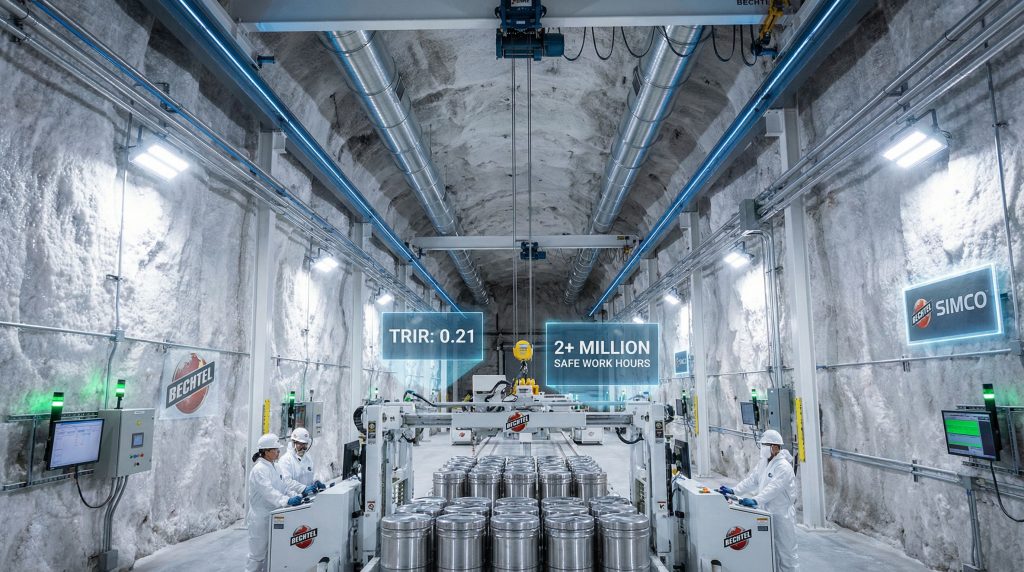
The Bechtel-led SIMCO WIPP contract extension reflects a strategic decision based on quantifiable performance achievements across multiple operational dimensions. The contractor has demonstrated exceptional safety leadership with a 12-month rolling Total Recordable Incident Rate (TRIR) of 0.21, significantly outperforming both Department of Energy targets and construction industry benchmarks.
This performance metric translates to approximately 0.21 recordable injuries per 100 full-time employees annually, representing a 92.5% improvement over typical construction industry rates of 2.8. The achievement becomes more significant when considering that repository operations involve underground confined spaces, radiological hazards, and complex mechanical systems that inherently increase operational risk profiles.
Performance indicators demonstrate:
- Zero lost-time incidents since February 2025, representing over 10 months of incident-free operations
- 2+ million safe work hours completed in 2025 alone
- Consecutive target exceedance for waste shipment volumes across three operational years
- Infrastructure delivery ahead of schedule and under budget on multiple major projects
What Makes the Bechtel-SIMCO Partnership Critical for Nuclear Security?
Joint Venture Structure Between Bechtel National and Los Alamos Technical Associates
SIMCO represents a single-purpose entity combining the complementary capabilities of two specialised organisations. Bechtel National contributes extensive experience in large-scale federal project management, infrastructure delivery, and regulatory interface, while Los Alamos Technical Associates provides site-specific technical expertise in transuranic waste handling and underground repository operations.
The partnership structure was established under a 10-year, $3 billion management and operations contract awarded in November 2022. The current Bechtel-led SIMCO WIPP contract extension utilises three of six available one-year option periods, extending operations from October 1, 2026, through September 30, 2029.
Organisational leadership structure:
- Ben Souther: Bechtel's General Manager of Environmental and Security operations
- Mark Bollinger: DOE Carlsbad Field Office Manager
- Integrated management approach: Combining corporate-level project management with specialised technical expertise
Specialised Expertise Requirements for Underground Repository Operations
Deep geologic repository operations require simultaneous mastery of multiple technical disciplines that rarely converge in conventional industrial applications. The complexity stems from the intersection of underground mining engineering, radiation protection, waste characterisation, and long-term environmental stewardship requirements.
Critical technical specialisations include:
- Underground mining systems: Ventilation design, structural integrity monitoring, and confined space protocols
- Transuranic waste handling: Alpha radiation protection, contamination control, and drum certification processes
- Regulatory compliance: EPA standards, DOE oversight requirements, and safety performance metrics
- Emergency response: Underground rescue capabilities, radiological incident management, and worker evacuation procedures
- Long-term stewardship: Infrastructure maintenance, capacity planning, and institutional knowledge preservation
Safety Performance Benchmarks in High-Risk Nuclear Environments
The nuclear industry operates under fundamentally different safety paradigms compared to conventional industrial sectors. The potential consequences of radiological incidents, combined with the complexity of underground operations, require safety performance that exceeds typical industrial benchmarks by significant margins. Moreover, data-driven operations have become essential for maintaining these exceptional safety standards.
Safety Performance Comparison:
| Metric | SIMCO Achievement | DOE Target | Industry Benchmark | Performance Gap |
|---|---|---|---|---|
| 12-Month Rolling TRIR | 0.21 | 0.30 (CFO) / 1.1 (HQ) | 2.8 (Construction) | 92.5% better than industry |
| Lost-Time Incidents | 0 (since Feb 2025) | <1 annually | Variable by sector | Zero incidents achieved |
| Safe Work Hours (2025) | 2+ million | Not specified | N/A | Sustained high-volume operations |
| Recordable Injuries | None since Feb 2025 | Continuous improvement | Variable | 10+ months incident-free |
The achievement of zero recordable injuries since February 2025 while simultaneously completing over 2 million work hours demonstrates operational maturity that extends beyond basic regulatory compliance. This performance level indicates systematic safety culture implementation rather than statistical variation.
Performance Analysis: Why DOE Extended the Contract Through 2029
Safety Leadership Metrics and Zero Lost-Time Achievement
The Department of Energy's decision to extend the Bechtel-led SIMCO WIPP contract extension stems from demonstrated performance across multiple evaluation criteria. The contractor has sustained exceptional safety performance while simultaneously meeting production targets and completing major infrastructure projects.
Critical performance achievements:
- TRIR calculation methodology: (Number of recordable injuries × 200,000) ÷ Total hours worked
- Benchmark significance: TRIR below 1.0 considered exceptional in nuclear/hazardous operations
- Workforce implications: 2+ million hours suggests 1,000+ full-time equivalent employees
- Operational complexity: Underground work with radiological hazards and confined spaces
The sustained safety performance becomes more remarkable when considering the simultaneous execution of major infrastructure projects, waste processing operations, and routine maintenance activities. This operational compartmentalisation demonstrates mature project management capabilities essential for complex federal facilities.
Operational Excellence: Exceeding Waste Shipment Targets
SIMCO reached its 1,000th waste shipment milestone during 2025, representing consistent throughput since contract initiation. The contractor has exceeded waste shipment targets for three consecutive years (2023, 2024, 2025), indicating optimised logistics coordination and processing capabilities. Additionally, this achievement aligns with broader industry evolution trends towards enhanced operational efficiency.
Shipment performance analysis:
- Cumulative throughput: 1,000 shipments over approximately 3 years
- Average processing rate: 333 shipments annually, or 6.4 shipments per week
- Target exceedance: Sustained performance above contracted requirements
- Operational continuity: Uninterrupted processing despite infrastructure projects
The coordination of transuranic waste shipments requires integration across multiple Department of Defence and DOE sites nationwide. Each shipment involves waste characterisation, packaging certification, transportation logistics, and repository receipt protocols, creating a complex federal supply chain that SIMCO has successfully optimised.
Infrastructure Delivery: Ahead of Schedule and Under Budget
SIMCO delivered the new underground air filtration and ventilation system over a year early and $10 million under budget, demonstrating exceptional project management capabilities in complex underground environments.
According to recent reports from the DOE's official announcement, this achievement demonstrates the contractor's technical competency in specialised underground construction while maintaining operational continuity.
Major infrastructure achievements:
- Underground Air Filtration and Ventilation System: Delivered over one year ahead of schedule and $10 million under budget
- Utility Shaft Construction: Enhanced airflow management and additional personnel/materials transport capability
- Salt Pocket Refurbishment: Site improvements and operational optimisation
- Operational integration: All projects completed without disrupting waste processing activities
The ventilation system project represents critical infrastructure for managing underground air quality, radiological particulate control, and worker exposure management. The early delivery and cost savings demonstrate technical competency in specialised underground construction while maintaining operational continuity. Furthermore, these achievements reflect the growing importance of 3D geological modelling in planning and executing such complex underground projects.
How Does WIPP's Contract Extension Impact National Nuclear Cleanup Strategy?
Continuity Planning for Defence-Generated Transuranic Waste
The Bechtel-led SIMCO WIPP contract extension provides operational continuity for the nation's only permanent disposal pathway for defence-generated transuranic waste. This continuity enables long-term planning across the Department of Energy's environmental management complex, where waste-generating sites can coordinate cleanup activities with assured disposal capacity.
Strategic implications include:
- Waste stream coordination: Integration across multiple DOE and DoD facilities nationwide
- Cleanup acceleration: Predictable disposal capacity enabling site remediation planning
- Cost optimisation: Reduced storage costs at generating sites through timely disposal
- Regulatory compliance: Meeting federal commitments for environmental restoration
Strategic Implications for DOE's Waste Management Portfolio
WIPP's operational success under SIMCO management establishes a performance benchmark for other complex nuclear facilities within the DOE system. The demonstrated integration of safety excellence, production efficiency, and cost control provides a model for similar high-risk operations.
Portfolio-wide impacts:
- Performance standards: Establishing benchmarks for other nuclear waste facilities
- Contractor evaluation: Demonstrating effective public-private partnership models
- Technology transfer: Lessons learned applicable to commercial waste management
- International leadership: Showcasing American capabilities in geologic repository operations
Long-Term Repository Operations and Capacity Planning
The contract extension through 2029, with three additional one-year options remaining, provides flexibility for long-term capacity planning while maintaining operational stability. This approach allows DOE to adjust repository operations based on waste generation rates and budget constraints while ensuring continuity of critical capabilities. Consequently, mine reclamation innovation principles may inform future site closure and long-term stewardship strategies.
Planning considerations:
- Remaining contract options: Three additional one-year extensions available through 2032
- Capacity utilisation: Optimisation based on nationwide waste generation projections
- Infrastructure investment: Long-term facility improvements and modernisation
- Workforce development: Maintaining specialised technical capabilities over extended periods
What Are the Financial and Operational Implications of the 2026-2029 Extension?
Contract Value Analysis Within the $3 Billion Framework
The Bechtel-led SIMCO WIPP contract extension operates within the original 10-year, $3 billion management and operations framework established in November 2022. The three-year extension represents utilisation of available contract options rather than new procurement, providing cost efficiency and administrative continuity.
Financial structure:
- Original contract value: $3 billion over 10 years (2022-2032)
- Contract structure: Initial 4-year base period plus 6 one-year options
- Current utilisation: 3 of 6 available option years exercised
- Remaining flexibility: 3 additional one-year options available
Remaining Option Years and Future Decision Points
The contract structure provides DOE with strategic flexibility to adjust repository operations based on evolving requirements, budget constraints, and performance evaluation. The remaining three one-year options create decision points for assessing continued contractor performance and program needs. Moreover, information from Bechtel's press release confirms the strategic nature of this extension decision.
Decision framework:
- Performance evaluation: Annual assessment of safety, production, and cost metrics
- Budget alignment: Coordination with federal appropriations and program priorities
- Strategic planning: Integration with broader waste management objectives
- Market conditions: Consideration of alternative contractor capabilities and competitive landscape
Cost-Benefit Analysis of Infrastructure Investments
The infrastructure improvements delivered by SIMCO demonstrate positive return on investment through enhanced operational efficiency, reduced maintenance costs, and improved safety performance. The $10 million cost savings on the ventilation system alone indicates effective project management and technical execution.
Investment outcomes:
- Ventilation system: $10 million under budget, delivered over one year early
- Utility shaft: Enhanced operational capacity and redundancy
- Operational efficiency: Reduced downtime and maintenance requirements
- Safety enhancement: Improved worker protection and emergency response capabilities
The next major ASX story will hit our subscribers first
Technical Challenges and Solutions in Deep Geologic Waste Disposal
Underground Ventilation System Engineering
The underground ventilation system represents one of the most critical safety systems for repository operations, managing air quality, radiological particulate control, and emergency response capabilities. The system must operate continuously under challenging conditions including salt corrosion, underground humidity, and potential radiological contamination.
Technical requirements:
- Air flow management: Maintaining negative pressure to prevent contamination release
- Filtration systems: High-efficiency particulate air (HEPA) filters for radiological control
- Redundancy design: Multiple pathways for continued operation during maintenance
- Monitoring integration: Real-time air quality and radiation detection systems
The successful early delivery of this system demonstrates SIMCO's capability in specialised underground engineering while maintaining operational continuity during installation and commissioning phases.
Utility Shaft Construction for Enhanced Operations
The utility shaft project enhances repository operations by providing additional airflow pathways and serving as an alternative personnel and materials transport system. This infrastructure improvement increases operational flexibility and provides enhanced safety redundancy for underground personnel.
Operational benefits:
- Enhanced airflow: Improved ventilation distribution throughout underground areas
- Transport redundancy: Alternative pathway for personnel and materials movement
- Maintenance access: Improved ability to service underground systems and equipment
- Emergency response: Additional evacuation route and emergency services access
Salt Pocket Refurbishment and Site Improvements
Salt pocket refurbishment addresses the dynamic nature of the underground environment, where salt formation movement requires ongoing maintenance and structural adjustment. These improvements ensure long-term operational stability and waste containment integrity.
Technical considerations:
- Salt plasticity: Managing natural salt movement and room closure over time
- Structural monitoring: Continuous assessment of underground room stability
- Waste container positioning: Optimising placement for long-term containment
- Access maintenance: Ensuring continued personnel and equipment access to waste areas
Regulatory Framework and Compliance Requirements for WIPP Operations
DOE Carlsbad Field Office Oversight Structure
The DOE Carlsbad Field Office provides direct regulatory oversight of WIPP operations, establishing performance standards, conducting regular inspections, and ensuring compliance with federal environmental and safety regulations. This oversight structure creates accountability mechanisms for contractor performance evaluation.
Oversight responsibilities:
- Performance monitoring: Regular assessment of safety, production, and compliance metrics
- Regulatory interface: Coordination with EPA, state agencies, and other federal oversight bodies
- Contract administration: Management of contractor performance and option year decisions
- Strategic planning: Integration with national waste management objectives
Environmental and Safety Compliance Standards
WIPP operations must simultaneously comply with multiple regulatory frameworks including EPA environmental standards, DOE safety requirements, and state of New Mexico environmental regulations. This multi-layered regulatory environment requires sophisticated compliance management systems.
Regulatory frameworks:
- EPA standards: Long-term environmental protection and containment performance
- DOE safety requirements: Worker protection, radiological safety, and emergency response
- State regulations: New Mexico environmental and transportation requirements
- Federal oversight: Congressional reporting and budget justification requirements
Performance Monitoring and Review Processes
The contract extension decision followed a comprehensive performance review evaluating safety leadership, operational excellence, and infrastructure delivery achievements. This systematic evaluation process ensures contractor accountability and continuous improvement in repository operations.
Evaluation criteria:
- Safety metrics: TRIR performance, lost-time incidents, and continuous improvement
- Production targets: Waste shipment volumes and processing efficiency
- Cost management: Budget performance and infrastructure delivery metrics
- Regulatory compliance: Environmental monitoring and safety protocol adherence
Industry Implications: What This Extension Signals for Nuclear Waste Management
Contractor Performance Standards in Nuclear Operations
The Bechtel-led SIMCO WIPP contract extension establishes performance benchmarks that may influence contractor evaluation criteria across the nuclear industry. The demonstrated integration of safety excellence, operational efficiency, and cost control provides a model for other high-risk federal facilities.
Industry standards implications:
- Safety performance: TRIR below 0.25 as achievable benchmark for nuclear operations
- Project delivery: Simultaneous infrastructure improvement and operational continuity
- Cost management: Under-budget delivery while exceeding performance targets
- Regulatory relationships: Collaborative approach with oversight agencies
Public-Private Partnership Models for Critical Infrastructure
The SIMCO partnership demonstrates effective integration of private sector project management capabilities with specialised government facility requirements. This model may inform future procurement strategies for complex federal infrastructure projects.
Partnership characteristics:
- Complementary capabilities: Private sector efficiency with specialised technical expertise
- Performance accountability: Quantifiable metrics for contractor evaluation
- Long-term commitment: Multi-year contracts enabling strategic planning and investment
- Flexibility mechanisms: Option years allowing for performance-based contract adjustments
Future Procurement Strategies for Similar Facilities
The success of the SIMCO contract may influence DOE procurement approaches for other complex nuclear facilities, emphasising performance-based contracting, integrated partnerships, and long-term operational stability.
Procurement evolution:
- Performance-based contracting: Emphasis on measurable outcomes rather than prescriptive requirements
- Integrated partnerships: Single-purpose entities combining complementary capabilities
- Option year structures: Flexibility for performance-based contract adjustments
- Infrastructure investment: Contractor incentives for facility improvements and modernisation
Comparative Analysis: WIPP vs. Other Nuclear Waste Management Approaches
Deep Geologic Repository vs. Surface Storage Solutions
WIPP's deep geologic repository model represents a fundamentally different approach to nuclear waste management compared to surface storage facilities that rely primarily on engineered barriers and institutional controls. The geological isolation provides natural containment that operates independently of human institutional continuity.
Comparative advantages:
- Geological stability: Natural barriers operating over geological timescales
- Institutional independence: Reduced reliance on long-term human stewardship
- Environmental isolation: Physical separation from biosphere and groundwater systems
- Proven performance: Over two decades of successful operational experience
Defence Waste vs. Commercial Nuclear Waste Management
Defence-generated transuranic waste differs significantly from commercial reactor spent fuel in terms of radiological characteristics, physical form, and regulatory requirements. WIPP's specialised design addresses these unique characteristics through tailored engineering and operational protocols.
Key differences:
- Waste characteristics: Contact-handled TRU vs. remote-handled high-level waste
- Regulatory framework: EPA standards vs. NRC licensing requirements
- Operational approach: Room-and-pillar disposal vs. engineered barrier systems
- Transportation: TRUPACT containers vs. spent fuel casks
International Best Practices in Repository Operations
WIPP's operational model provides valuable insights for international deep geologic repository programmes, particularly regarding contractor performance management, safety culture development, and regulatory oversight approaches.
International relevance:
- Performance benchmarks: Safety and operational metrics applicable globally
- Partnership models: Public-private collaboration approaches
- Technical solutions: Underground engineering and waste handling innovations
- Regulatory frameworks: Multi-agency oversight and compliance strategies
Future Outlook: Strategic Planning Beyond 2029
Remaining Contract Options and Decision Criteria
The Bechtel-led SIMCO WIPP contract extension through 2029 leaves three additional one-year options available, providing flexibility for continued operations through 2032. Future option exercises will likely depend on sustained performance, budget availability, and evolving waste management requirements.
Decision factors:
- Performance maintenance: Continued achievement of safety, production, and cost targets
- Federal budget: Congressional appropriations and programme priority alignment
- Waste generation: Projections of defence cleanup requirements and disposal needs
- Alternative strategies: Potential development of additional repository capacity or treatment technologies
Long-Term Capacity and Operational Projections
WIPP's continued operations beyond 2029 will depend on ongoing waste generation from defence cleanup activities, repository capacity utilisation, and potential mission expansion. The facility's proven performance provides flexibility for adapting to changing national waste management requirements.
Strategic considerations:
- Capacity optimisation: Maximising disposal efficiency within statutory limits
- Mission evolution: Potential expansion to additional waste streams or categories
- Technology integration: Advanced monitoring, handling, and disposal technologies
- International cooperation: Potential role in global repository development programmes
Technology Evolution in Nuclear Waste Management
The repository operations under SIMCO have demonstrated successful integration of traditional underground mining techniques with modern safety and monitoring technologies. Future developments may incorporate advanced robotics, artificial intelligence, and enhanced monitoring systems.
Technology trends:
- Remote operations: Reduced personnel exposure through robotic systems
- Advanced monitoring: Real-time environmental and structural assessment
- Predictive maintenance: AI-driven system optimisation and failure prevention
- Digital integration: Enhanced data management and decision support systems
Disclaimer: This analysis is based on publicly available information and should not be considered as investment advice or definitive predictions about future contract awards or facility operations. Actual performance and future decisions may vary based on numerous factors including federal budget allocations, regulatory changes, and evolving waste management requirements.
Ready to Capitalise on Critical Infrastructure Investment Opportunities?
Discovery Alert's proprietary Discovery IQ model delivers real-time alerts on significant ASX mineral discoveries, including critical metals essential for nuclear waste management infrastructure and advanced engineering projects. Explore how major discoveries have generated exceptional market returns by visiting Discovery Alert's dedicated discoveries page, then begin your 30-day free trial today to position yourself ahead of the market in this rapidly evolving sector.